


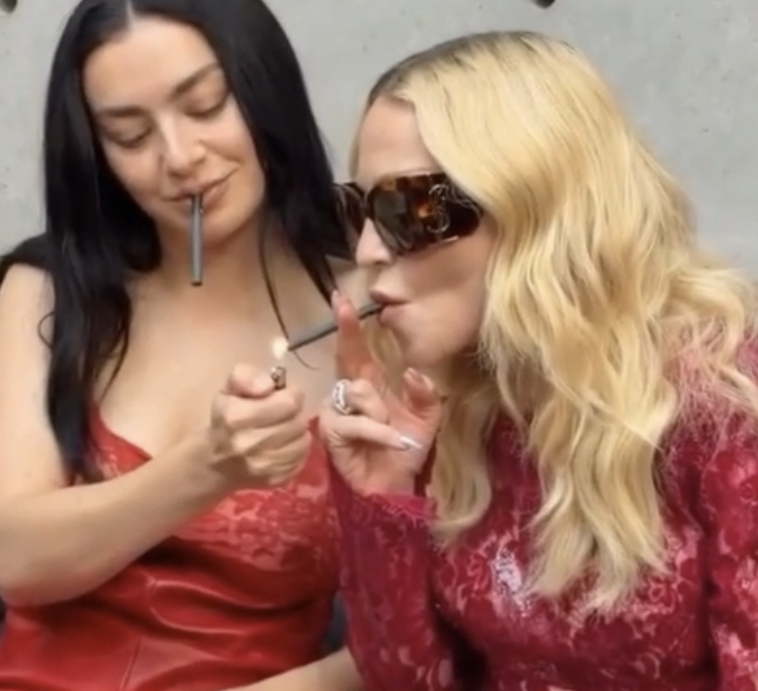
For “many moons” now, Madonna and Charli XCX had been effectively “dancing around” one another (finally coming face to face at the SS27 Yves Saint Laurent menswear show during Paris Fashion Week). Often connected through the collaborators and/or worshippers they’ve shared, whether it’s SOPHIE (when she was still alive), Troye Sivan, Addison Rae, FKA Twigs, Arca or, more recently, Shygirl—who appears in the “Danceteria” portion of Confessions II: The Film alongside Arca and Richard E. Grant. So, in many regards, a collaboration between them has long felt as if it should be a fait accompli. As was the case when Kylie Minogue at last worked with M by way of the Afterhours Mix of “Love Sensation.” Alas, when Charli did the same, “working it out” on the Afterhours Mix of “Danceteria” (one of the more “surprise hits” of Confessions II), the result did not turn out to be as, let’s say, natural-sounding or seamless.
That much is made immediately clear when Charli jumps on the first “add-in” verse of the remix, declaring, “I get off the train, Hackney Wick/I’m sweet fifteen in a weird outfit [side note: Charli would have actually been fourteen when she got her first warehouse gig]/Got invited to perform at this party through MySpace/First time ever at a party in London/I’m kinda nervous, kinda scared/On a makeshift stage playing songs from my iPod/Met a band called Le Couteau Jaune/Yeah, I been doing this shit since 2007” (that year also being a title to one of her songs on Music, Fashion, Film).
While it’s obvious that Madonna is trying to incorporate XCX into her theme of just starting out and discovering “life in the big city,” Charli’s “origin story” has, well, absolutely nothing to do with Danceteria, or even New York in less corporate and expensive times. Which is already where the song loses the plot right out the gate. Like, why are we talking about the London rave scene in the 2000s when this song, as its title indicates, is meant to be about the heyday of Danceteria in 1980s New York?
And while, sure, it’s no secret that such an era is one that Charli XCX covets, she being as fond of “scenes” (particularly club ones) as she is (and also being fond of any era when Lou Reed was skulking around NYC), in this instance, she does nothing to elevate what Madonna already did with her own initial depiction. Portions of which get ousted in favor of allowing XCX some of her own verse time.
Elsewhere, the traces of a different Madonna collab from Confessions II, “Bring Your Love” featuring Sabrina Carpenter, trickle in by way of the lyrics, “You wanna talk about Madonna and Charli/Talk about, talk about, talk about/You got something you wanna talk about?” (Considering Charli is the person who sings, “I wish you’d talk, talk/Wish you’d talk, talk/Wish you’d talk, talk/Wish you’d just talk to me” on Brat’s “Talk talk,” the answer to that is patently yes.)
On the original versions of both “Bring Your Love” and “Danceteria,” it’s the former that bleeds into the latter like a continuous mix (designed to recreate the effect of a DJ’s set), with Madonna’s repetition of, “Talk about, talk about/I got somethin’ I wanna talk about/Talk about, talk about/I got somethin’ I wanna talk about” flowing into “Danceteria” as “Talk about, talk about, talk about/Talk about, talk about, talk about/I got somethin’ I wanna talk about” before the first original verse. And, in the instance of “Danceteria,” what she wanted to talk about—at least on the album version—was how it felt to walk into a space like that when she was in her early twenties and only freshly embarking upon her creative path. Which is why a place like Danceteria was an added jolt to Madonna’s sense of excitement and inspiration in those early days of her New York tenure. It was also the kind of place that made it seem as if her destiny had converged with the exact right time and place in order to turn her into who (and what) she would become.
Thus, to try paralleling this to Charli onstage at a jank rave after getting the gig not through tactile or conventional “networking” means, but through the internet, somewhat cheapens Madonna’s more organic, pre-internet story. Naturally, the attempt to connect Charli’s own “coming up” experience to Madonna’s is what the “Danceteria” Afterhours Mix wants to achieve, but that attempt falls flat quite quickly. Indeed, “Danceteria” perhaps suffers from the problem of two Leos working together, with the final product coming across as if they’re each trying to “out-shout” the other’s tale, having absolutely no “vibing” qualities with one another (not in this format, anyway) and instead allowing the verses to read/sound as if they’re each, let’s say, masturbating in separate rooms entirely rather than in the same one (sort of like the visual representation of Madonna and Britney in separate rooms during the “Me Against the Music” video, except with far less awareness of another icon’s presence on the other side).
As for the additional production credits from Watt (a.k.a. Andrew Watt) and Cirkut on this remix (with Madonna and Stuart Price being the sole producers on the original), the slightly revamped recording further brings out not only a decidedly “late 70s/early 80s sound,” but also amplifies the song’s musical parallel to, well, “Music.” Madonna’s lead single from her 2000 album of the same name, and a track that also just got a new boost into the collective consciousness thanks to Troye Sivan heavily sampling it for “Party.”
And, yes, trying to “start the party” is what XCX keeps endeavoring to do throughout this remix, but instead only slows it down and makes it more stilted (surely not in keeping with the reputation of a “365 party girl”). Case in point, during Charli’s next added verse, she more pronouncedly tries to make her talking voice as “Madonna” as possible as she says, “Switch up to 2015/Linked up with A. G. and SOPHIE/Took a flight to L.A./Where PC Music did Pop City/This new place has a lot of new things/Different DJs/Flavored cocaine [a sub-in for Madonna saying, “He’s a DJ, hide the cocaine”]/Found myself through the songs I wrote/And the songs I wrote are how we start the party.” Here, again, one must ask how we managed to get so far away from 1980s New York and Danceteria. And the answer is, of course, that Charli isn’t the right fit for this remix, with perhaps someone else Madonna name-checks in the song (e.g., Nile Rodgers, David Byrne or B-52s) being better suited to build on it. To be sure, though not mentioned in “Danceteria,” Debbie Harry, herself a frequenter of the club, would have been an amazing get for this. For she’s someone who could have spoken on her own initial arrival to New York in the 60s that would serve as a better parallel to Madonna’s in the late 70s (though yes, she’s talking all about the early 80s within the context of “Danceteria”).
Alas, when it comes to collaborations, Madonna generally always goes for either men of color (with Justin Timberlake being a rare exception to that rule on “4 Minutes”) or ingenues of pop (with Kylie Minogue also being one of her rare exceptions to that rule). Though Lady Gaga was never one of the ingenues she decided to “do it with” (incidentally, even LG would have been a better fit for this remix, with her own Lower East Side origin story being more aligned with Madonna’s Danceteria one). Some claim it’s how she “stays relevant” (as if she really needs others to do that), while others would assert that it’s how Madonna displays her hands-on mentorship to the pop stars that have descended from her. But when it comes to Charli XCX, this is one instance of “staying relevant” and/or “mentoring” that doesn’t quite hit the mark. Though that isn’t to say that one wouldn’t like the to see the two try their hand at another song in the future. Because hey, the first “pancake” is always lumpy.


+ There are no comments
Add yours