


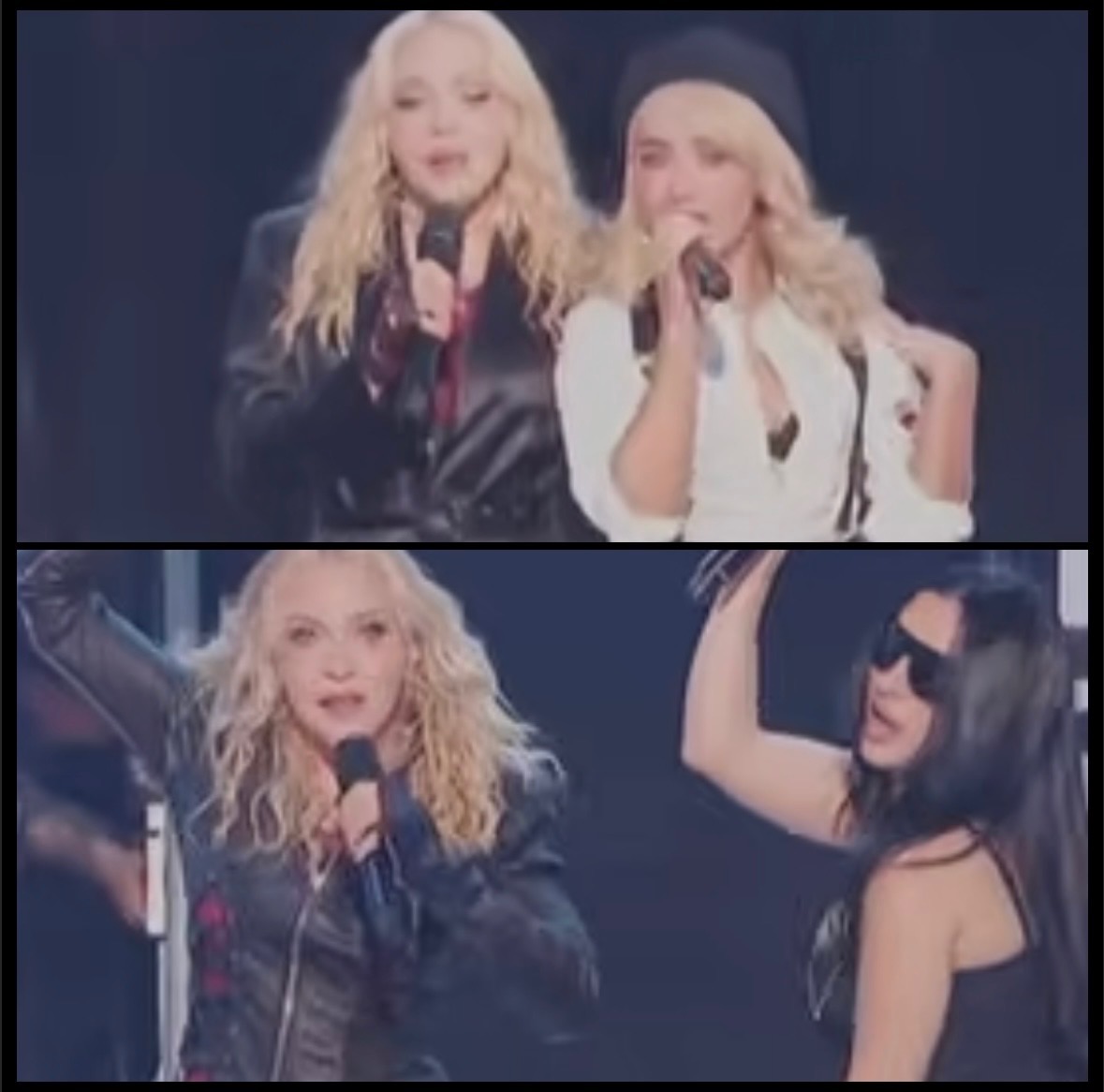
In 2003, Madonna wasn’t necessarily “riding high.” For while she might have just released an album that is only now fully appreciated, American Life wasn’t exactly “resonating” with the public in its day. Which is why part of an attempt to jolt it back into the collective consciousness, on Madonna’s part, was returning to the stage that had always offered so much publicity in the past: that of the VMAs. And, although Madonna had showed up to the famed MTV-helmed awards show in then recent years—including taking the stage with Lenny Kravitz on guitar to perform “Ray of Light” at the 1998 VMAs, appraising some imitative drag queens at the 1999 VMAs and spotlighting her twenty-first century musical direction at the MTV EMAs—her performance of “Like a Virgin/Hollywood” ended up becoming “the one to beat.” Among her most iconic moments on that stage and in general. Indeed, it rivals her debut at the inaugural awards ceremony in 1984, when she walked down a giant wedding cake in bridal attire and proceeded to roll and writhe around indiscriminately.
It was that performance that the 2003 one paid homage to. But, in typical Madonna fashion, she didn’t want to “just” re-create it again. No, this time around, she wanted to be the groom (and a seemingly polygamous one at that). An assertion of her dominance, and, in its way, a classic representation of how Madonna has often been unable to avoid leaning into “masc energy” in order to radiate her power (this being among a few of her baby boomer woman “tells”). In short, that “bride shit” was over her, and it was time to “pass the baton,” as she referred to it, to the next generation of pop stars: Britney Spears and Christina Aguilera.
To lend some ultimate “ceremony” to that notion, she kissed both women onstage, though, as everyone knows, the Britney kiss got far more attention thanks to the cutaway to her then-fresh ex, Justin Timberlake, reacting to it and, thus, taking from Xtina’s kiss screen time. And so, for her first VMA performance since that one was immortalized with a single “lesbian kiss” image, Madonna appeared to have learned a lesson about giving “equal time” to each of the two younger performers she enlisted to help remind still another generation of who the fuck she is (and what album she currently has out). So it was that for her first performance in twenty-three years, she gave one song to Sabrina Carpenter and one song to Charli XCX for her slightly-over-nine-minute opening, which favored “Bring Your Love” and “Danceteria” as the singles to showcase from Confessions II. An album that wasn’t as nominated as the Torso-directed “short film” that Madonna released to promote it, titled simply Confessions II: The Film. In fact, it was this project—not the album itself—that bolstered Madonna getting a whopping thirteen nominations at the 2026 VMAs, including Video of the Year, Best Dance, Best Long Form Video, Best Cinematography, Best Choreography and Best Visual Effects.
In the end, she even managed to knock Taylor Swift’s dick in the dirt by winning seven awards to Swift’s meager three (though the latter was nominated in twelve categories, including Song of the Summer for her shitty contribution to the Toy Story 5 musical canon, “I Knew It, I Knew You”). And this makes perfect sense considering that Madonna has always been MTV’s true “wifey.” Or, as she put it in a taped “speech,” of sorts, that honored MTV’s ten-year anniversary in 1991, “You’ve never had more fun with anyone else.” Nor has anyone else brought such effort, vision and high art-leaning performances to the show. Her return with Sabrina and Charli proved no exception to the rule, kicking it off with her Confessions II “M” logo (legs with a speaker between the crotch) intertwined with the “TV” part of MTV’s logo as a now signature voiceover of this era, “It’s Mutha,” announced her arrival.
In the moments that followed, Madonna highlighted the “Good for the Soul” visuals of Confessions II with dancers offering up green lasers shooting out of their “nether regions” as she paired it with the opening spoken-word portion of “One Step Away,” during which she delivers a “manifesto” that explains, “People think that dance music is superficial. But they’ve got it all wrong. The dance floor is not just a place. It’s a threshold. A ritualistic space where movement replaces language.” The camera then cuts to the main stage where Madonna gives a nod to another key element of Confessions II: The Film: the “robowomen” with “old school” (read: giant) video cameras slung over their shoulders. Descending from the ceiling as they do during the “Bring Your Love” portion of Confessions II: The Film, Madonna sits atop a piano that Carpenter plays as the two dive into singing the intro verses of their collaboration. From there, their performances feel mostly separate, with each pop star “doing her thing” on different parts of the stage amidst the chaotic, “zoomed-out” perspective of so many dancers on the stage.
To be sure, it’s no secret that Madonna has increasingly relied on other dancers to bring the spectacle where she can no longer do so with her own intensive choreo. That much was also highlighted during her halftime show performance for the World Cup, which was a far more “phoning it in” one than this, with Madonna even going so far as to recycle a performance and mashup from her 2006 Confessions Tour. But, for this, Madonna appeared to be adamant that “no recycling” would be allowed. No “feeding into nostalgia” the way that she did in 2003 with that “Like A Virgin” homage. And the way that many probably expected she would.
Granted, some of the things that might be deemed “nostalgic” within the context of this performance is 1) getting two pop stars “of the moment” to join her onstage and 2) reflecting on her early New York days via “Danceteria.” A song she segues into by being forcibly led to a table (à la the “Die Another Day” video) by the robowomen with cameras. She then engages in some of the frenetic, “possessed-like” movements she also does on a table in the “One Step Away” portion of Confessions II: The Film. Except that this particular table happens to move round the stage as a choir (with each member’s face covered by long white veils over their white robes) sings, “I did it all/I did it all for love” in a manner that, of course, can’t help but recall “Like A Prayer.”
And as Madonna keeps “going apeshit” on the table, it’s as if she is reminding the crowd that the only reason she is still around and making music that continues to “infect” the public psyche is because she did, in truth, do it all for love (though, naturally, the money and adoration haven’t been unwanted byproducts). In point of fact, someone like Madonna is a textbook example of why a person is driven to become famous: they want to fill a void where some form of love went missing in their early childhood. For Madonna, as most know at this point, that void was from the death of her mother, Madonna Sr., when she was just five years old. Ever since that moment, it seemed as if Madonna would do whatever it took to get the love she couldn’t from a mother that was no longer around to give it, perhaps thinking that only the love of millions could replace the love of this one extremely important figure in her life.
As her table is led to another set on the stage modeled after the bathroom in her “Danceteria” segment from Confessions II: The Film, Madonna then lets Charli XCX have her “spotlight,” emerging from one of the bathroom stalls to kick off the “Danceteria” Afterhours Mix with, “You wanna talk about Madonna and Charli?” And, although the remix doesn’t exactly jive when it comes to interweaving Charli’s “early days” experience with Madonna’s, the dynamism of the stage—and all of its moving parts—is what brings the collaboration to life (and yes, Madonna and Charli have better “dancing near each other” chemistry than Madonna and Sabrina). Not to mention Madonna dragging out Debi Mazar, Julia Garner (both of whom also appear in Confessions II: The Film), Sombr, Tony Ward (another OG of the “Madonna universe”), Fab 5 Freddy (name-checked in the song) and Seth Rogen (thanks to their The Studio working relationship) to add even more star power into the mix. Star power that’s also incorporated via the video backdrops behind Madonna and Charli, among one of the most noticeable being Lou Reed, who Madonna samples “Walk on the Wild Side” from during a part of the song. Likely a selling point for Charli to appear on the track as she’s made her own love of Reed quite clear over the years, citing him as a major inspiration and influence, along with The Velvet Underground (thus, seizing the opportunity to work with John Cale on “House”).
Strangely, however, the VMAs took place in L.A., which is why delivering this blatant New York love letter might have been met with slightly less of an “embrace” to a West Coast crowd. But, of course, Madonna’s geographical location has never stopped her from getting all “gushy” about NYC. Nor has age ever stopped her from delivering a spectacle-laden performance. And, mind you, Madonna was already being called “old” in 2003, when she was merely in her forties. So for her to continue to have the courage and strong sense of self, in her late sixties, to say “fuck you” to anyone that would try to tell her to pack it in and stop performing is nothing short of an inspiration. Indeed, one could see, throughout the evening, just how much of an inspiration she is to the latest crop of pop stars, with Sabrina and Charli just happening to be the ones that Madonna showed especial favor to for this go-around. Her Britney and Christina of the 2020s (Sabrina is the Britney and Charli the Xtina, if for no other reason than hair color correlations [Xtina was in her dark-haired phase in 2003]). With no kissing required. Not just because it doesn’t have the same “shock value” anymore, but because Madonna wanted to prove, once again, that she doesn’t need to lean into nostalgia to prove her perennial value to pop culture.


+ There are no comments
Add yours