


Madonna’s commitment to the art of the music video has never been in question. Especially since she was at the forefront of establishing the importance of building a visual world to complement the various singles that any musician—pop star or otherwise—released in promotion of an album. Of course, this was, in no small part, thanks to Madonna coming up at the same time as MTV. With Madonna’s own first video, “Everybody,” being filmed in 1982, just one year after MTV’s debut as a cable network channel. But it wasn’t until “Borderline,” directed by Mary Lambert, that Madonna really struck music video gold in terms of creating a certain kind of instantly recognizable (and therefore, memorable) iconography.
As the decades went on, she would continue to outdo herself with each new video, whether escalating the budgets and special effects (with “Bedtime Story” being a primary case in point of that) or noticeably “reinventing” her look…or both. However, as Madonna arrived in the 2010s, she seemed to grow more reliant on “gimmicks” in her videos—namely, in the form of cameos. And it all started with 2012’s “Give Me All Your Luvin’” featuring Nicki Minaj and M.I.A. Both of whom appear in the accompanying video, naturally. For, as the lead single of MDNA (though Madonna’s team would soon after insist it was merely a “promotional” single and that “Girl Gone Wild” was the real lead), Madonna clearly wanted to make a splash with two names that were still highly valued and respected at that time (little did she know, Minaj would go MAGA and M.I.A. would go on her own conservative/religious-leaning path). To follow up the cameos of that video, she then opted for more “fringe” cameos (by U.S. standards) in the form of Kazaky and male models Sean O’Pry, Simon Nessman and Jon Kortajarena.
For the album that followed MDNA, Rebel Heart, Madonna then went for a more “tasteful” cameo (to start, anyway) in the form of Terrence Howard, who appeared as something of the post-apocalyptic Adam to her Eve in the Jonas Åkerlund-directed video for “Ghosttown.” But it wasn’t until the third (and last) music video from Rebel Heart, “Bitch I’m Madonna” (also directed by Jonas Åkerlund) that she really chose to pull out all the cameo stops. Mind you, this ended up coinciding with Swift’s cameo-packed “Bad Blood” video, which was released two months prior to “Bitch I’m Madonna.” And so it was that, in 2015, Madonna was being accused of “competing” with Taylor Swift—whereas now, she’s being accused of competing with Charli XCX (*cough cough* Linda Perry).
Regardless of the pop star she’s being pitted against, the bottom line is that Madonna was no longer being viewed as a trailblazer/trendsetter in video or music form (and hadn’t been considered as such since at least 2008’s Hard Candy). Hence, her apparently increasing inability to rely on herself and her own instincts for what, in the 2010s, started amounting only to likes, views, reposts, etc. So it’s no coincidence that “Bitch I’m Madonna” was the first video of hers to cross the threshold of one hundred million views on Vevo (a.k.a. YouTube). After all, it packed enough star power (including both Minaj and Kanye West, back when they were both still “viable”) to make such an amount all but assured.
In the 2020s, Madonna’s twenty-first century penchant for leaning on “more relevant” acts of the moment (think: her feature on Quavo’s “Champagne Rosé” alongside Cardi B or her feature on The Weeknd’s “Popular” alongside Playboi Carti) has clearly shown no signs of letting up. And Confessions II: The Film, described as “an ambitious visual work,” is no exception to her new rule. Or rather her two new rules: incorporating other famous people into the mix and also referencing her own vast catalogue of music and visual history. Because, now more than ever, it seems everyone has a hard-on for references in pop culture. And since Madonna has long been a staple of postmodernism, she certainly knows how to deliver on that front, starting with the opening of “the film,” which focuses on Madonna in a room with a fireplace. One in which she sits on a chair, “Open Your Heart” video-style, as what can best be described as “fembots” or “robowomen” descend upon the space with “old school” video cameras in hand. The effect of which, for those who are versed in Madonna’s videography, rather recalls the premise of 1998’s “Drowned World/Substitute for Love” (directed by Walter Stern), which involves Madonna being stalked/chased by various camera forms—whether by “ordinary people” or the paparazzi.
And as they surround her, TORSO (a.k.a. David Toro and Solomon Chase), pans way back to deliver the kind of effect that makes the viewer feels as if they’re being transported into a different universe (or maybe just a backroom). One that lands Madonna in a forest with a white light shining out of her vag as she looks down at the camera and opens “Good for the Soul” with the Albert Camus quote, “Everything begins with consciousness.” But the thing is, one isn’t necessarily “fully” conscious just because they’re born and “alive.” Indeed, Madonna would probably argue that she didn’t reach full states of consciousness until 1) moving to New York and 2) studying Kabbalah. And now, perhaps not until walking through a sea of women flashing green lasers through the place “where life begins” at her.
Talking of this green laser aesthetic in a darkened forest environment, Madonna’s own music video oeuvre isn’t all that’s being referred to in Confessions II: The Film, for there’s plenty of Jennifer Lopez’s “Waiting for Tonight” in this instance as well—namely, of course, with the green lasers. That just so happen to be “emanating” from various women’s vaginas (among other orifices). But no, surprisingly, this wasn’t Madonna’s idea…even though it seems right up, er, alley. Yet instead, she claimed, “I never would have imagined lasers coming out of girls’ pussies [really though? Try telling that to Erotica-era Madonna], also adding, “Honestly, I really wanted to try it, but apparently, you get quite hot.” Probably in more ways than one. And yes, there is something about this scene that recalls Madonna’s “nature-y and sexual” NFT (titled “Mother of Creation”).
After the “unwitting” J. Lo nod, Madonna goes back to a bit self-reference for the transition into the next song on Confessions II, “One Step Away,” which begins with a rain-soaked glass window pane and the fembot paparazzi still coming at her, also then shown through the lens of the window pane before TORSO cuts to a driving scene that makes one think of “What It Feels Like for a Girl” (directed by Madonna’s husband at the time, Guy Ritchie). The way it’s shot in these moments can be described as “Being John Malkovich-style” in that the viewer is made to feel as if they’re seeing and doing the same things as Madonna. It’s also a style that Madonna immediately fell in love with when she first saw The Prodigy’s video for “Smack My Bitch Up,” directed by none other than Jonas Åkerlund—which attracted Madonna to him as a collaborator in the first place for many years to come.
The song that plays during these scenes remains “One Step Away,” during which, as the opening spoken verse, Madonna delivers part of the manifesto she and Stuart Price came up with while “world-building” for Confessions II (even if the world in question was already built-in thanks to Confessions on a Dance Floor). That verse being, “People think that dance music is superficial. But they’ve got it all wrong. The dance floor is not just a place, it’s a threshold. A ritualistic space where movement replaces language.” Describing the dance floor in such a way, it’s no wonder Madonna crashes her car (also very “What It Feels Like for a Girl”) in her race to get to the L.A. warehouse where a rave is in progress. This after TORSO gets plenty more opportunity to engage with the type of dynamic, POV-based shots they’ve become known for. Particularly in their work with Charli XCX on the videos for “von dutch” and “SS26.” So here, again, Linda Perry’s insistence that Madonna is trying to be like Charli XCX right now comes up. Even though Madonna seemed less interested in being like her and more in invoking a vague dust-up with her by posting a caption to a carousel of her photos that read, “If your dance floor feels dead maybe you’re playing the wrong music.” This alluding to XCX’s recent lyrical declaration, “I think the dance floor is dead/So now we’re making rock music.”
A genre Madonna has scarcely ever fucked with, save for on American Life and in live versions of certain songs (e.g., “Burning Up” and “Candy Perfume Girl”). Because, for as adventurous as she might be painted, the truth is that Madonna is well-aware her strength/potential for chart success has always lied with dance music. And, of course, less so in anything related to film unless it’s her actual music videos or rare one-offs when she’s been deemed to be “playing herself” (specifically, Desperately Seeking Susan and Truth or Dare). Nonetheless, Madonna stated at the Tribeca Film Festival premiere of her project (held at the Beacon Theatre), “I like the idea of film, because I’m a ‘film-phile,’ a cinephile, and film has inspired a good part of my life. [And] somehow [the word] ‘video’ seems cheap. It was good when it was just MTV and me.” In other words, Madonna only liked the music video medium when she was running the show as the “top dog” at the forefront of innovating what videos were capable of. Not just visually, but also in terms of the feelings they could evoke amongst viewers who still saw the debut of new videos as an “event.”
By positioning Confessions II as a “short film” (instead of using Beyoncé language like “visual album”) worthy of being premiered at a festival, Madonna is doing what she can to remind audiences that she, like, invented the visual medium for music (though, of course, some would prefer to say it was Michael Jackson—who, although he might have come first, didn’t always necessarily keep pushing boundaries with his style). But, in the spirit of film, Madonna knows some “stars” are needed. And when the moment comes for her to enter the warehouse rave, at which time “Bring Your Love” starts to play, she begins to provide those stars in droves. Starting with the flip of her hair in the middle of the crowd suddenly morphing her into Julia Garner wearing a cone bra (because, yes, Madonna won’t let the rumors die down that her Garner-starring biopic is still bound to happen…sooner or later [to use an M song title]). In fact, the technological style of this moment is reminiscent of the face morphings in Michael Jackson’s “Black or White” video. But Madonna remains Madonna in the crowd, with Garner later shown at a separate moment in between Sabrina Carpenter’s time to shine for her featured vocals on the single (one that ultimately sounds a lot like “Love Sensation,” a song that doesn’t get a visual her as Madonna, for whatever reason, only wanted to offer them for the first six tracks of the album—unless there turns out to be a Confessions II: Part II: The Film when record drops).
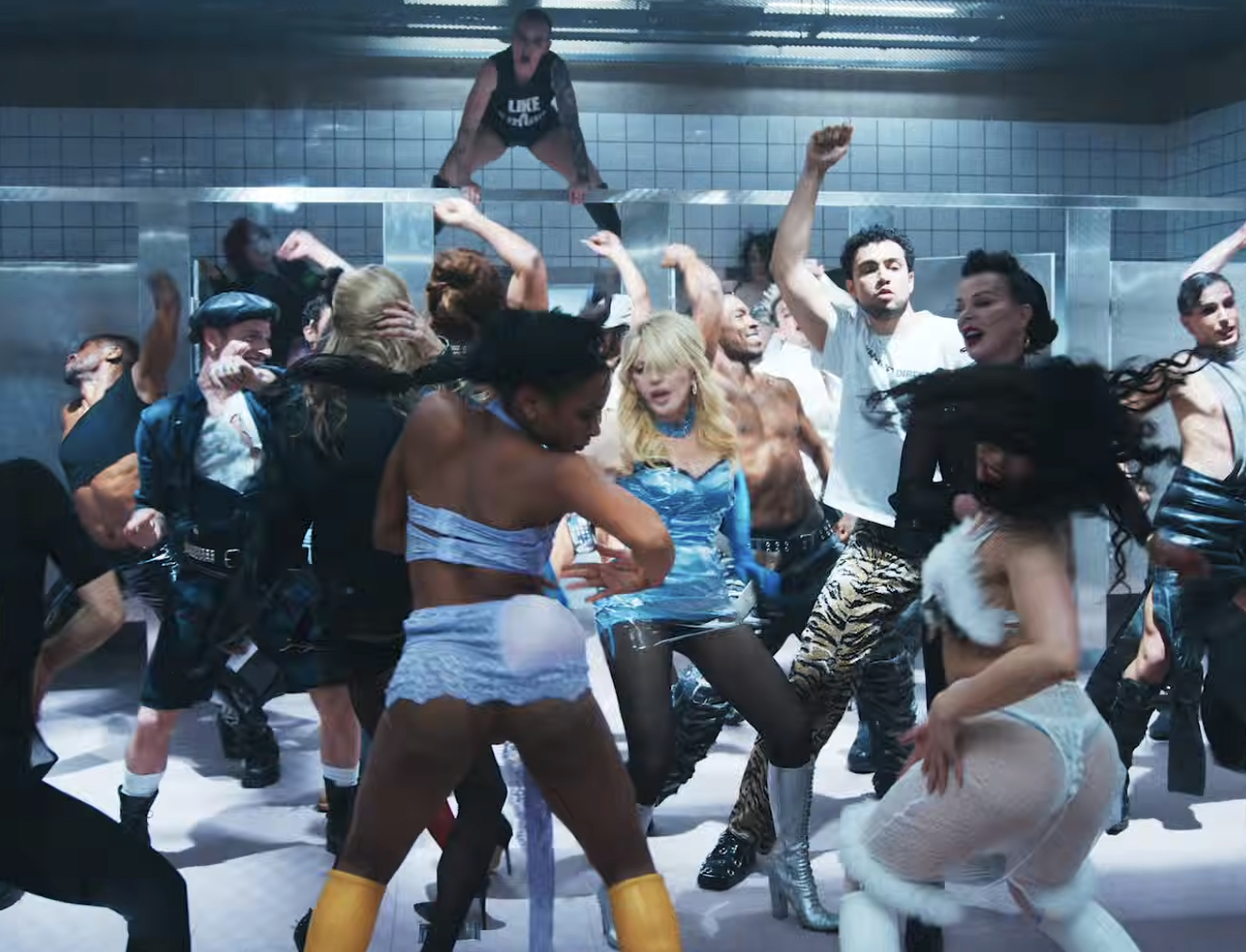
But, naturally, it’s Madonna who gets to shine the most as she flies above the hordes by way of whatever tricks TORSO had up their sleeves to make these instances look effortless (in a manner they certainly couldn’t if Madonna were to perform this feat live). Another flash to someone in the crowd offers a shirt that reads, “Unblemished Record of Heterosexuality”—a bit strange seeing as how Madonna is all about homosexuality. In any case, after a bit of “Me Against the Music”-type play with Carpenter on a catwalk and then flipping and flying over the crowd again, Madonna opts to head to the bathroom where she then immediately delivers another visual reference from her canon: turning on the hand dryer and letting it blow on her face and hair. In Desperately Seeking Susan, a similar scene occurs as M uses the air dryer to not only, er, blow on her face and hair, but also to “spruce up” her armpits. However, there was no Grindr sticker logo conveniently placed above the hand dryer in Desperately Seeking Susan.
Next to Madonna in the mirror, Kate Moss kicks off the first round of major cameos in this toilette, followed by Odessa A’zion, before the intro to “Danceteria” begins (on a related side note: a scene in Desperately Seeking Susan actually was filmed inside Danceteria). For, if anyone has a right to immortalize that beloved 1980s-era NYC nightclub, it’s Madonna. And, in fact, her singing about it is probably long overdue.
Once the music starts up, Madonna’s outfit magically changes into a bodycon dress made of clear vinyl (in fact, its style is reminiscent of both the floor-length gown she wears in photoshoots for the 1995 Versace campaign and the jacket she wears on the back cover of Ray of Light). Wasting no time in getting a “hot piece” into one of the bathroom stalls, an aroused Gwendoline Christie looks over the partition to see what’s what. Also in one of the stalls are Shygirl, Arca and Richard E. Grant (who isn’t as random of a choice to appear as one thinks, considering he also starred in Madonna’s directorial debut, Filth and Wisdom).
As for a completely on-brand-for-a-Madonna-video appearance, Debi Mazar shows up right as the lyrics, “Get on the elevator/I run into Debi Mazar” play in the background. This cementing how truly special Mazar is to Madonna to be lyrically immortalized in this manner. And Mazar, a veteran of appearing in Madonna’s videos at this point (having also shown up in “Papa Don’t Preach,” “True Blue,” “Deeper and Deeper” and “Music”), is an obvious choice for this particular segment, considering that “Danceteria” majorly touches on Madonna’s early 80s lore. Mazar being one of the last people still in contact with Madonna who remembers her from those pre-fame days is, thus, a fitting totem.
For even someone like Mark Kamins isn’t around anymore, though Madonna, for once, is sure to give credit where credit is due by mentioning his contribution to the launch of her career playing her demo tape of “Everybody,” singing, “Then I see Mark Kamins is the DJ/He’s a DJ/Hide the cocaine/He played my tape, ‘Everybody’/This is how we start the party.” As for the cocaine mention, it’s the moment when TORSO pointedly cuts to another shot of Kate Moss before then offering up the likes of Benedict Cumberbatch, who mouths the words, “Everybody get up and dance.” Indeed, “Danceteria” seems designed to serve as M’s 2026 edition of “Everybody.”
Whereas the song that follows, “Read My Lips” featuring Feid, seems more like her 2026 answer to “Medellín” featuring Maluma. And no, not just because it has a Colombian rapper on it (though that is a significant part of these two songs’ connection), but because of the style of the backbeat that goes with it. As for the back and forth between Madonna and Feid, it’s a contentious rapport, with the former telling the latter, “I don’t believe a word that you say,” to which Feid replies, “Eso еs lo que siempre me dices, bebé” (“That’s what you always tell me, baby”).
With this song finding Madonna and Feid in what can best be described as separate liminal spaces, the fembot paparazzi return to her living area at one point, with Madonna again opting to flash a white light out of her vagina as the preview of the song ends and Lourdes steps onto the scene in her own fembot costume to say, “I wish a motherfucker would” (this all part of her “New York tough bitch” shtick that’s been promoted for the past few years, despite perhaps needing to be reminded that she was born in Los Angeles).
Lourdes then walks through the apartment space with her own unwieldy video camera in tow (as the sound of “I Feel So Free” starts to play yet again, as it did in the beginning), giving viewers a glimpse of scenes like another fembot smoking in the bathtub (as “Bitch I’m Madonna” also showed, M loves a bathtub moment—whether she’s the one in it or not) or two of the fembot making out (à la Madonna and Britney at the 2003 VMAs).
In another room, some of the fembots are watching Confessions II: The Film on a TV screen while sitting on the couch and eating bananas—this a blatant callback to a scene in Madonna’s “Deeper and Deeper” video. And as the sample of Lil Louis asking, “So how’s your evening so far?” plays, TORSO shifts to Lourdes commanding, “Cut, bitch.” And no it’s not the first time “Lola” has made a big splash in one of her mother’s videos, having also done so in 2009’s “fan version” of the “Celebration” video, dressed in Madonna’s “Like A Virgin” wedding attire. Though this is the first time she’s been given the honor of concluding a video and having a speaking part in it.
So clearly, Madonna seems to trust Lola’s artistic vision more at present, what with her recently releasing her own body of musical work (including a single called “T Shirt”). However, what Confessions II: The Film reveals is that Madonna still doesn’t seem to trust herself as much as she once did, relying on these “Bitch I’m Madonna”-esque cameo gimmicks yet again for clout. Not to mention reverting to an album she already made twenty-one years ago. And yet, considering the current conditions for being deemed “innovative,” Madonna’s offering here is something unique in the current landscape. Even if it rests heavily on her previous laurels.


[…] Confessions II: The Film—Along With Offering Many Callbacks to Her Previous Music Videos, It’s A… […]
[…] causing a frenzy (particularly with fans wanting to clock all the self-references) with Confessions II: The Film, Madonna wasted little time in offering up a standalone version of one of the videos contained […]
[…] celebrities that included longtime Madonna bestie Debi Mazar, Kate Moss (both of whom appeared in Confessions II: The Film), Arca, Stuart Price, Connor Storrie (who famously took a cigarette break with Charli at the Met […]
[…] of it all. That much is made apparent in the trippy “Good For the Soul.” A song that, in Confessions II: The Film, stands out most especially because it’s the point in the visual when green lasers are shooting […]