


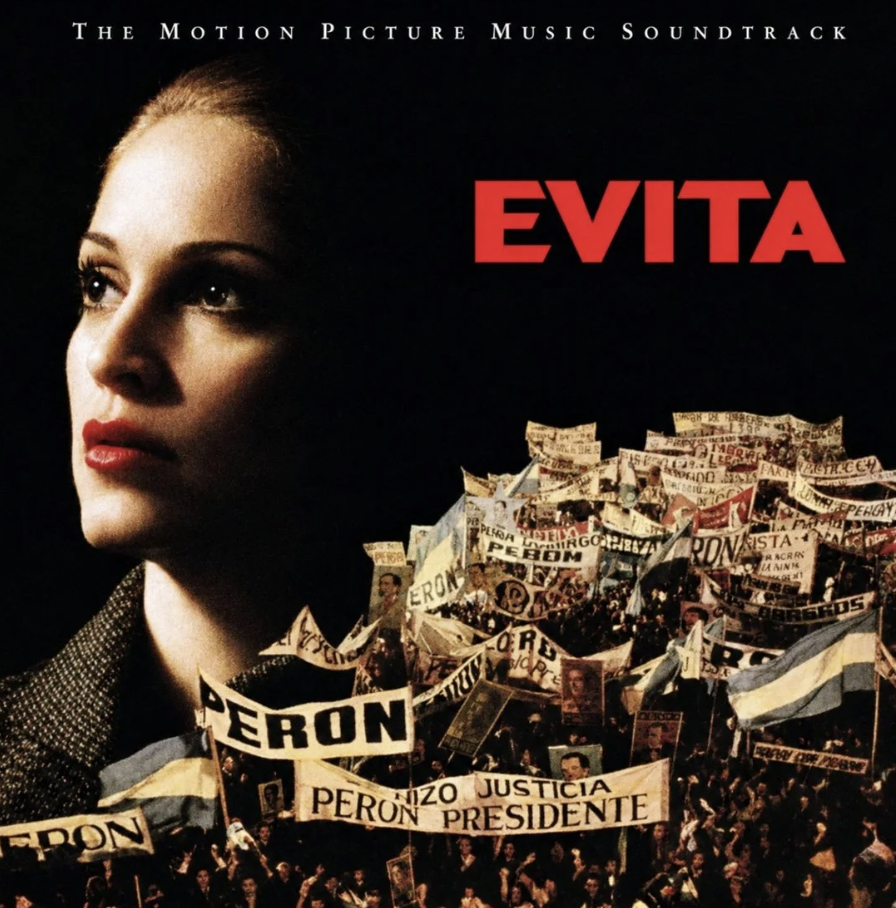
When Madonna set her mind to securing the role of Eva Perón, there was no question she would also do whatever it took to deliver the vocal style required of this kind of musical production (though she already “calculatedly” began to pivot toward it with 1994’s Bedtime Stories). And so, it didn’t take long for her to set about the task of doing director Alan Parker proud (for it was Parker that she wrote a four-page letter to, highlighting her connection to Evita and how she was born to play the role—this not unlike the three-page letter she wrote to the lesser known Stephen Jon Lewicki to appear in the lesser known A Certain Sacrifice long before Madonna became famous). A key part of that being to take voice lessons from renowned vocal coach and therapist Joan Lader. It was Lader who can be attributed with fundamentally changing the sound of Madonna’s voice. Indeed, Madonna’s music career can be divided into two parts: Before Lader and After Lader.
It was Before Lader that Madonna was often written off by critics as having a flimsy or “thin” voice (with one infamously likening it to “Minnie Mouse on helium”—which feels a bit redundant since Minnie Mouse already has an “on helium”-sounding voice without needing to “take” any more of it). But when Lader coached her on how to tap into an upper register she never knew she had, it changed the game for Madonna’s sound. As fans were quick to appreciate when, two years after the soundtrack was released (on November 12, 1996 [the two-disc edition, anyway]), she came out with Ray of Light. Her most “mature” work yet—and in no small part because of how her voice sounded. As Lader phrased it at the time, “[She] had to use her voice in a way she’s never used it before. Evita is real musical theater—it’s operatic, in a sense. Madonna developed an upper register that she didn’t know she had.”
So it was that Madonna’s rapid evolution as a singer (for she is known for taking to everything she does as a kind of avid sponge, eager to absorb and learn whatever she can) was enough to appease Andrew Lloyd Webber, who was far less convinced of her abilities than his Evita co-writer, Tim Rice. Though they weren’t the ones tasked with writing the “official” screenplay. Instead, that was left to Alan Parker and, of all people, Oliver Stone, an auteur not usually associated with this genre (though he is known for his historical biopics). Indeed, it was Stone who was attached to the project before Parker and, by 1994, he had walked away from the film entirely but retained a co-screenwriting credit for all of that initial grunt work he did. In fact, he was involved in the late 80s when Madonna was circling the part the first time around. And she might have gotten it too, were it not for the fact she was coming across as too big for her britches with regard to her “diva demands.” Despite this, Newsweek still noted in 1996 that, when Stone was signed on as the principal writer, “[He] and Madonna spent a jolly evening with Andrew Lloyd Webber in the composer’s lavish Trump Tower apartment in New York.” On a separate note, it’s hard to imagine anyone artistic, least of all Madonna, ever having a “jolly evening” in Trump Tower (perhaps that’s why Webber spent most of his time there trying to sell the property).
It was Newsweek that also pointed out what lost Madonna the role when she was initially being considered for it: “Then, according to Stone, Madonna told Webber that she intended to rewrite some of the Evita score. ‘At the time she hadn’t done many movies, and she was insisting on script approval,’ says Stone. I said, ‘Madonna, you can’t have script approval.’ And she wanted to rewrite Andrew Lloyd Webber! Here she was making these demands, and I said, ‘Look, there’s no point in our meeting anymore; it’s not going to work.’”
But, in the end, Madonna forced it to. Even if it took almost a decade to be considered again (this after Michelle Pfeiffer was “in the bag” as Perón, but dropped out when it became clear to her that the intensity of the shoot would not align with spending enough time with her recent newborn child). Alan Parker eventually getting tapped to direct would also add to the full-circle nature of Madonna being cast, since Parker, too, was considered to helm the project in the early 80s. However, unlike Madonna, he was the one who turned it down as he was already fresh from directing a musical: Fame. Upon at last “conceding” to Evita, it shouldn’t have come as any surprise that, as another “auteur type,” Parker, per that same Newsweek article, “refused to use Stone’s script. ‘I wanted to start from scratch,’ he says. ‘It’s a pride thing, really.’ Parker is livid that the Writers Guild has decreed that he share the screenplay credit with Stone.”
As for Madonna, both writer-directors’ approach would have had her acting out her singing in the same way, with Parker, too, “envision[ing] a sung-through format, ‘a new film genre—not opera, not an old MGM musical with people speaking, then bursting into song.’” Which is why the lyrical delivery is the crux of the film. At the same time, Madonna’s acumen as a pop star was integral to making the material accessible to a modern audience. That skill shines through most notably on songs like “Buenos Aires,” “Another Suitcase in Another Hall” and, obviously, the two ballads the film is most known for: “Don’t Cry for Me Argentina” and “You Must Love Me” (which Webber and Rice penned specifically for the movie). The latter was the first single released from the soundtrack (auspiciously released on Lourdes Leon’s birthday, October 14, 1996). And radio airplay quickly smiled upon it, with an article in Billboard quoting the music director of WBBM Chicago at the time, Erik Bradley, as saying, “It’s a totally nontraditional top 40 record. But if anyone can pull off having a major hit with it, Madonna can. She can truly do no wrong.”
Parker felt the same when it came to Madonna’s work ethic, and her determination to “sing the score as it was written and not cheat in any way.” This also meant doing a lot of things that Madonna was not only unaccustomed to, but also entirely averse to. First and foremost, not being in total creative control. As she herself admitted, “I’m used to writing my own songs and I go into a studio, choose the musicians and say what sounds good or doesn’t… To work on forty-six songs with everyone involved and not have a big say was a big adjustment.” In other words, Madonna was probably losing her mind. This also went for having to record her vocals with the presence of an eighty-four-piece orchestra in lieu of what she was additionally used to doing: singing with a pre-recorded track. So yeah, compared to her previous soundtracks, including I’m Breathless and Who’s That Girl, Evita was epic and demanding on an unprecedented scale—and made the process she endured for contributing to other soundtracks seem like child’s play.
On the plus side, of course, “running this marathon,” so to speak, was of long-term gain. And something she even noticed in the short term, commenting in Billboard, “If you listen to [‘One More Chance’ and ‘You’ll See’], you can hear how I was trying to absorb and utilize what I was learning for the recording of Evita.” And absorb it she did, much to the benefit of Madonna fans and casual listeners alike, with Madonna also declaring, “It was an experience that I think has had a real impact on other aspects of my singing.”
In short, were it not for the making of the Evita Soundtrack and its associated rigors, Madonna likely wouldn’t have become the improved vocalist she is today—at least probably not on the same level. Because recording those songs was absolutely essential to her evolutionary journey. And so, even if one can’t appreciate musicals, perhaps they can at least appreciate that particular boon when it comes to Evita.


+ There are no comments
Add yours