


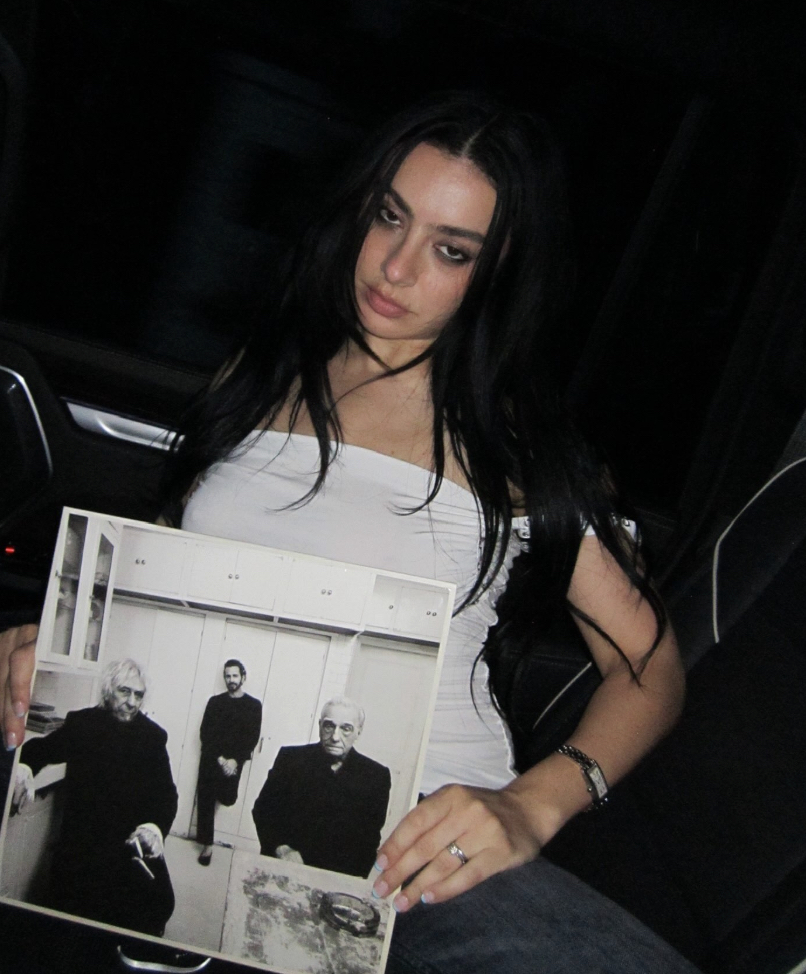
There was a reason that Charli XCX called Brat an “albatross” during her 2024 interview with Zane Lowe. For she knew then that it would become the record that would subsequently be compared to all the ones that came after it. And so, with that in mind, while some “pop stars” might have been afraid to make another album so soon after the success of a juggernaut like Brat, Charli XCX chose to keep going like the Energizer bunny. Not only pivoting to a movie career that had her miraculously participating in eight projects, but also creating an entire soundtrack for the phenomenon that was Wuthering Heights (and yes, even for those who panned the movie, it was still a phenomenon). A soundtrack that established her “sound deviation” from Brat and, therefore, served as a bridge toward her seventh studio album (or her eighth, for those vehement about counting the Wuthering Heights Soundtrack), Music, Fashion, Film. Three words that have been Charli’s lifeline throughout most of her life, and yet, as she points out on “SS26,” “Nothing’s gonna save us, not music, fashion or film.”
Nonetheless, she still seems determined to try “saving” others (and herself) through these mediums as the world appears on the brink of environmental, political and economic collapse. All in the midst of continuing to grow and experiment as an artist this “late” in the game. Of course, considering that Charli XCX began her foray into music at fourteen, she’s not exactly “old” yet—though she does call out her impending age (thirty-four) during “Camera” in reference to trying to become a “movie star” despite no longer being an “ingenue.” Before showing her reverence for “film,” however, XCX tellingly kicks off the album with an homage to “music,” titled, what else, “Rock Music” (because, obviously, Madonna already has dibs on “Music”). A sonically ribald and, yes, rock-driven song that finds XCX declaring from the very beginning of the album that, “I think the dance floor is dead/So now we’re making rock music.”
Of course, that lyric got everyone up in arms as they accused her of abandoning the very genre that, like, “made” her. The line got so saturated into “the culture” that even Madonna, on the precipice of releasing her dance sequel album to Confessions on a Dance Floor, Confessions II, captioned a carousel of photos with, “If your dance floor feels dead maybe you’re playing the wrong music.” But then, as it was well-documented, the two had what XCX called essentially a “mini break” together in Paris during Fashion Week and it was clear there was no bad blood between them. Just as there’s no bad blood between Charli and dance music. The lyric is, instead, per her own account, an acknowledgement of how it was immediately clear that after Brat, she was going to have to make the anti-Brat. Not just because her pattern is “pendulum swing,” but because the musical stylings of Brat were no longer speaking to her and she needed to do something that felt creatively inspiring again.
And as for inspiration, Charli XCX was already speaking on the wealth of it she kept experiencing even after Brat, writing in a Substack post titled, “Running on the Spot in a Dream” in November of ‘25, “Feeling creativity in abundance is such a fucking blessing and relief. It doesn’t even matter if the ideas are good or not, it just feels euphoric to feel the fountain flowing again. After my previous album, Brat, I had this feeling that I wouldn’t be able to make music anymore.” As it turned out, it was quite the opposite. And, as she told Sam Murphy of PopSamCam, “I’m a big believer in the idea that once you get that gift of inspiration, you kinda have to go with it because you never know how long it will last, whether you’ll ever get it again… That’s what happened with this. It totally took me by surprise, I really was, like, thinking I would not be making a record.” Or, as Lana Del Rey told Rolling Stone of her own inspiration “process” in 2023, “Music is like a little bird who is always right on my shoulder. Even when I’m looking for respite someone always comes in and plays a little tune and I’m like, ‘Shit, it’s happening again.’”
In contrast to Del Rey, however, XCX is someone who wants to be focused on making art all the time (whereas Del Rey appears to want to be more focused on engaging in her “all-American” activities…like sitting in the desolate parking lots of malls and hanging out at Waffle House). As she also said in the abovementioned Substack, “Creating art is my one true love that I will never desert [it] and no matter how rough things get, I’ll always be there standing by its side.” This kind of die-hard declaration of having such a love for art is something that’s become increasingly rare in what Addison Rae would call “times like these.” Mostly because, for quite a while now, the collective obsession with making money has taken precedence over “lofty ideals” of “creating.” Especially since making art of the niche variety is rarely known for paying the bills (unless, of course, you’re Charli XCX). But just as being obsessed with making money is selfish (not to mention soul-destroying), so, too, is being consumed by making art, though the latter often flies under the radar on the selfish front.
But it’s something XCX is willing to confront head on within the framework of Music, Fashion, Film, also admitting on PopSamCam, “That kind of is, I would say, you know, the sort of overarching theme of the album, for me at least, is this sort of passion to create and, um, how, you know, I would sort of do that at all costs. Even when sometimes the decisions I might make are selfish and possibly hurt other people in the, sort of like, quest for creativity. It is a bit narcissistic I suppose in that way.”
And narcissism is something that conveniently goes hand in hand with the “mood board” of “SS26.” Among the many tracks to convey a kind of quintessential “Charli-branded” nihilism, it opens with the by-now infamous lines, “Spring, summer ‘26/When the world is gonna end, no hope for any of it/Yeah, we’re walking on a runway that goes straight to hell.” Yet, like so many other people, Charli can’t seem to stop herself from being hypnotized by the trappings of wealth (you know, the very ones that cause climate change), which, needless to say, extend to haute couture. So it is that she somewhat ruefully muses, “Yeah, I think I’ll be alright if I look good in the clothes.”
It’s a motif that leads perfectly into “Card Declined,” a track that’s tantamount, lyrically speaking, to her version of The Clash’s “Lost in the Supermarket” or, to use another analogy, her resigned, nihilistic interpretation of Madonna’s “Material Girl.” As for the jumping-off point in crafting its especially fatalistic sound, co-producers A. G. Cook and Finn Keane wanted to use The Normal’s “Warm Leatherette” as a prototype for what Charli was going for (to be sure, “70s post-punk” was the vibe, complete with a final result not unlike The Velvet Underground’s music). And though it might have started out sounding a bit more like that when it was in its original fast-paced incarnation, by slowing the music way down, the song became drug-addled in a more “opium haze” sort of way. Or maybe “shopping haze” is the better analogy here. And, considering she was working on the song in Rue Boyer studio in Paris during Fashion Week (because it would seem there’s always a Fashion Week happening), it was only natural that the topic of vacuousness and materialism should cross her mind.
So it was that she mentioned while on an episode of Tape Notes, “Those material things, like, those clothes and things like that can sometimes make you transform who you are as a person, they can kind of, I don’t know, like, unlock a new side of your personality, but it can also be very, very fake. It can feel like a performance. And there’s something kind of sad about that, like accessing a part of yourself through an item of clothing…”
Granted, there can also be something “joyful” about it too. Hence, at the one-minute-thirty-five-second mark, the song changes tack, giving Charli a more “pod person” kind of voice, as if to say that all the things she’s bought really have made her into a “new person.” Which speaks to The Clash’s “Lost in the Supermarket” lyrics, “I came in here for a special offer/A guaranteed personality.” By the same token, tapping into parts of oneself that can only come out when “styled” a certain way isn’t the only meaning behind “Card Declined.” For it also ties into what Cake was talking about on their 1993 single, “Rock ‘n’ Roll Lifestyle,” filled with lyrics that skewer the kind of poseurs who think they can buy their way into “inserting” themselves into a subculture (sort of like the people who jumped on the Charli XCX bandwagon when Brat came along). In the 2010s, the word “hipster” quickly became more of a catch-all term for poserdom, with that lot spending oodles of cash on clothes from Urban Outfitters and apartments in the “chicest” (read: most increasingly gentrified) neighborhoods so as to feel “with it.”
It was a period of time that could have easily been soundtracked to the droning of Charli “singing,” “Let’s go shopping/I’ll buy a handbag/I’ll buy some shoes/I’ll buy a smile/I’ll buy some jewelry/A personality/A whole backstory/Card declined.” And when she says “card declined” after all that, she doesn’t seem to mean it in a purely literal sense, but also in the one that says you can’t gain acceptance into a community or culture solely by purchasing the things that are supposed make you “fit in automatically” with it. Of course, if it’s the douchey rich types you want to fit in with, maybe buying a “Mah Jong sofa” or a “Jaeger-LeCoultre” watch will do the trick.
At the two-minute-forty-four-second mark, “Card Declined” switches its tone and style for a third time, veering into the song that fans first came to known as the B-side to “Rock Music,” “I Keep Thinking Bout You Every Single Day and Night.” But when Charli repeats, “I keep thinking ‘bout you every single day/I keep thinking ‘bout you every single night” in this context, it feels as if it could apply more to the notion of having buyer’s remorse—the kind where you regret not buying something, and so you keep thinking about it hanging (or being displayed) in the store where you saw it.
Fortunately, XCX has other things to take her mind off wanting to buy expensive clothes, bags, jewelry, etc. For there are movies to be made. And Charli clearly wants to churn them out as quickly as possible while she’s still in her “fresh-faced” era. “Camera” is a direct homage to her decision to take her longstanding cinephile status and parlay it into actually getting to appear on the screen rather just participating as an observer. In the same aforementioned Substack piece, XCX even went so far as to concede, “As some of you may know I’m currently feeling more inspired by film than I am by music. Film is where my creative brain seems to be gravitating. I’m enjoying acting, I’m enjoying writing, I’m enjoying watching and I’m above all enjoying discovering a new craft.” Even if it isn’t entirely “new” for someone who has been performing, in some way or another, since at least 2007, when she first started fiddling with music on MySpace.
Talking of that year, seeing as how it’s been a while since Charli XCX 1) truly alluded to her millennialness and 2) dropped a nostalgia track à la “1999,” it seems that a song like “2007” has been overdue. And yes, it focuses on another seminal year in the mind of millennial youth: when Britney shaved her head (something even MARINA had to mention on 2021’s “Purge the Poison,” singing, “2007 when size zero was the rage/Britney shaved her head and all we did was call her crazed”). But for Charli, 2007 wasn’t a “dark time,” so much as the beginning of what would become her lifelong commitment to music, to art.
And, in the spirit of the early music she was making, perhaps that’s the reason why “2007” has such a “girl’s voice” sound to it, along with the lack of guile in repeating the same phrase over and over: “I can take you to heaven like it’s 2007/Pop star in my bedroom like it’s 2007.” Though she’s sure to throw in a “deviating” verse that speaks to the transition that fame (and how one goes about pursuing it) was undergoing at that time, how it was becoming more fully democratized. To that point, XCX poetically remarks, “Pictures on the sofa become pictures on the screen/All from your apartment, you can shine bright like a star” (surely, as a known Rihanna stan, this must be an allusion to the latter urging, “Shine bright like a diamond”).
In other words, there was no need to leave the comfort of one’s own room anymore to become famous, for as XCX explained to British Vogue, “[‘2007’ is] about how everybody can have their own moment of fabulousness all through their phone in fifteen seconds. It’s sort of the ultimate screen test.” Yes, a nod to Andy Warhol—both the “fifteen seconds” (in lieu of fifteen minutes) and the screen test. After all, she wouldn’t have John Cale on her album cover if she wasn’t a Warhol/Velvet Underground stan. However, in 2007, her tastes weren’t as “sophisticated,” with British Vogue summing it up as follows:
“Charli was fourteen, obsessed with Paris club crew Ed Banger and making music for the first time. The Hertfordshire teen put her early singles on MySpace and convinced her parents to drive her to perform at Hackney warehouse raves. She signed a five-album deal in 2008, aged sixteen, but still enrolled at the Slade School of Fine Art in 2010. There, her art about Britney Spears and hamburgers was misunderstood, but online, like-minded fans were eating up the goth-tinged tracks that would become her 2013 debut album, True Romance.”
The precedent being established here is that, clearly, it’s taken a while for XCX to be so fully embraced. To be given the artistic luxury to do pretty much whatever the fuck she wants and still have it heralded as visionary, no matter the form or genre it comes in. And yet, to be understood as the erratic artistic spirit she is on a personal level has taken somewhat longer. For a while, XCX seemed to hope the person that would understand her in a romantic relationship was Huck Kwong, who she rode out the pandemic with before running straight from the quarantine club to George Daniel’s arms. The bloke best known as the drummer for The 1975 and a producer in his own right who has frequently worked with Charli (even before they became “official”).
Which brings one to the notion that a lot of XCX’s core relationships are generally only built with people who are artists themselves and can, therefore, talk nonstop about music, fashion, film. Because most other topics, to Charli, are a bit naff. As British Vogue puts it when it comes to these friendships that have become such an intrinsic part of her art-making, “The purity of that [early] era lives on in Charli’s love of making music with friends, something she talks about with such profound gratitude, it seems she’s anxious this could all vanish any second. George [Daniel] theorizes that some part of the record is ‘the idea of really deep and powerful trust’ with her collaborators, he says, calling it ‘a very powerful thing that takes thousands of hours to cultivate.’” And yet, to them, those hours don’t feel long, but rather, fun…and, of course, fruitful.
However, what XCX has found less fruitful among the post-Brat noise that surrounds what she does, is the actual releasing of the music. As she explained it to British Vogue, “Now there’s just so much noise around anything else that I do in a way that I sometimes find a bit pointless. I’m like, ‘Why don’t I just make the album and listen to it with A. G. and Finn?’ But there’s obviously a narcissism that prevents me from doing that.” Ah, that word again. The one so much more synonymous with being an artist than most can comprehend—even artists themselves.
Switching toward a much darker, moodier tone, “I’m Afraid” is Charli’s overt “love song” to George Daniel, who she married in July of 2025 (a year after the chaos of Brat summer). And it’s a song that addresses that aforementioned issue about Charli taking almost as much time to find the right romantic partner as she did to gain mainstream recognition. But, despite Daniel’s “rightness” for her, XCX must still admit that, well, she’s afraid. Afraid of fucking it up, afraid it won’t last, afraid she’ll be “too much,” etc.
So it is that she works through these fears by speaking as honestly as she ever has through verses like, “Happiness came in a box [this once again serving some very “Card Declined” vibes]/Never meant that much before [that is to say, the idea of getting married]/Till I met someone who knew/How to balance who I am/As we know, I’m insecure/He might’ve missed out on my birth/I replicate the things I learnt/I don’t blame him though.” The latter lines seem to be a nod to Charli’s awareness that she’s prone to mimicking some of the toxic behaviors she might have seen in her own parents and their treatment of one another (harkening back to Brat lyrics like, “I think the apple’s rotten right to the core/From all the things passed down from all the apples coming before”).
But, for as determined as she is to self-flagellate, she’s also just as determined to embrace the “mess” that is her prismatic self, getting all Meredith Brooks with the chorus as she sings, “I’m a wife, I’m a kid/I’m destroyed, I’m a bitch/I’m too drunk, I can’t sleep/I can’t feel, I’m afraid/I’m afraid, I’m afraid/I’m nothing without him/What if I ruin it?/Take the ring, take the ring.” And she did. A decision that has been so far, so good (and hell, it’s surely gotta last longer than Taylor Swift’s marriage to Travis Kelce).
Regardless, it hasn’t stopped Charli from feeling a general sense of inner turmoil, this “pile-on” to her fame and art life of becoming someone’s wife and all the pressures that go hand in hand with that as well. So it is that she adds, “All this pain makes me believe/I’m a better artist now/An excuse I tell myself/To act selfishly.” This being the verse that most succinctly goes back to what she said on PopSamCam: “…sometimes the decisions I might make are selfish and possibly hurt other people in the, sort of like, quest for creativity.”
And in that quest for this particular album, even though Music, Fashion, Film is meant to assert itself as some kind of “polar opposite” to Brat, it actually doesn’t get much more Brat than “Yeah” (surprisingly not titled “I Don’t Wanna”). Another “all chorus” song that offers the “pendulum swing” back to “happy” and “upbeat” compared to the candor and rawness of “I’m Afraid.” Not to say that “Yeah” doesn’t get pretty damn candid and raw in its own way. After all, XCX is asserting her right to say, “I don’t wanna/I don’t wanna/I don’t, I don’t, I don’t/I don’t, I don’t, I don’t wanna/No, I don’t wanna/I don’t want to/I don’t want to.” A not-so-subtle way for her to tell fans and casual listeners alike that she can’t get on board with making any kind of music or art that doesn’t feel authentic and true to her. And to what is genuinely inspiring her in the moment.
Of course, Charli wouldn’t be Charli without including the antithetical interjection, “Wait/Now I wanna feel it.” This line appealing to the part of herself that can’t avoid wanting to be successful in a “mainstream approval” kind of way. Hence, telling Zane Lowe in 2024, “I’ve always been caught in this dichotomy of, ‘Am I a left-field underground artist or am I supposed to be a pop star?’” Switching to the second person at the forty-three-second mark, it seems Charli is talking more to herself as a “detached entity” now. And, as a pop star (which she is in spite of her attempts to stay “niche”), that is what one has to do in order to step back and see that it’s all more than slightly ridiculous. And while “Persona” would have made for the ideal follow-up to this notion, the track that follows is instead “Wink Wink.” A flirty little ditty that, compared to the other songs on the record, is definitely the most playful (as such a title would suggest). And it also very blatantly touches on her so-called reputation as a bad girl a.k.a. a party girl (since, per societal black-and-whiteness, one must be “bad” to love a good time).
Not to mention a girl who calls out other people that are ostensibly giving her “nemesis” energy, as was the case with Lorde before “Girl, so confusing” allowed them to clear the air. And, on the subject of that song, once again giving off Brat energy is “Persona”—which amounts to the “Girl, so confusing” of the record. What’s more, like the songs from Slayyyter’s WOR$T GIRL IN AMERICA, this one has plenty of “crunch” to the music. But it’s the lyrics that truly give one pause to wonder if XCX is addressing another person, or perhaps just herself. Because who else would be the victim of such brash, confrontational words as, “Wish you could be honest about your internal dialogue, it wouldn’t faze me” and “Don’t fucking choke on your ego when you see me coming/I know you’re preforming, I know that you’re hurting/So you try to hide it when you see me coming/Don’t wanna confront it, I’m scared I’m annoying.”
At the same time, it could very well just be a song—with all its “split personality”-meets-“toxic internal voices” hints—that’s quite literally inspired by Ingmar Bergman’s Persona, what with XCX being the film buff she is. Otherwise, if it really is directed at another woman like “Girl, so confusing,” the automatic assumption could be that it’s Taylor Swift who inspired it. With the verse, “I gotta say, I do respect the commitment to the bit, now that’s persona/We’re both under the influence of life imitating art, and we both know it” applying plenty to her dynamic with Swift. But then she mentions, “I see your face in a film, and it makes me cry” and it leads one back to the theory that this is Persona-inspired (and no, it wouldn’t be the first time XCX wrote a song named after a movie [hear: “True Romance”]). Even if Elisabet Vogler (Liv Ullmann) is a stage actress, not a screen one. The Persona speculation is all but confirmed when XCX chooses to conclude the track with, “I know you see me when I see you/When you see me/When I see you.”
Switching gears to what has now evidently become her requisite “thank you” song, “Magic Metal Montana” is her tribute to longtime collaborator A. G. Cook. So here, too, one might make the comparison that it’s the “So I” of Music, Fashion, Film…except for the part where Cook isn’t dead like SOPHIE, though Charli is sure to mention, “I’d cry if you died” (one would hope, for who else could come up with backing tracks like this for her?—well, apart from Finn Keane). She also discusses how the two communicate more often than not through the nonverbal language of music, having developed a shorthand over the years that borders on telepathy (sort of like Madonna with Stuart Price during the Confessions sessions). The kind of closeness that makes their resulting work together possess that rare kind of “magic”—just one of the ways that word applies to the title of the song.
Though it really comes from Charli saying to Cook, “You like old things: Magic, metal and Montana.” No word on whether the kind of “metal” she’s referring to is music or, like, copper. It would seem more like the latter since metal as a genre isn’t really that “old,” but anyway… As the song comes to a close, a sort of “Blink-182” guitar sound accentuates Charli’s vocals as she continues to thank A. G. by way of telling him, “Oh, you make it easy for me/Yeah, you make it easy for me/Yeah, you make it easy/Easy for me.”
And perhaps she wanted to include this “thank you” song right before the album’s grand finale, “No One Lasts Forever” featuring David Cronenberg, because, with Cook’s musical prowess (not to say Keane wasn’t of great service as well), it’s something close to her “masterpiece.” At least for Music, Fashion, Film. And it’s a song that builds on the motif of “Twice,” the final track on the standard edition of 2022’s Crash. During said song, Charli has a jauntier existential experience as she announces, “Gotta live life good, appreciate it/Nothing is forever/Lucky to remember/Stay up in the moment/All night, all night, yeah/All the things I love are gonna leave me/One day, you’re never gonna be there/I tell myself to take it easy/Don’t think twice about it, baby.”
However, on “No One Lasts Forever,” she’s most assuredly thinking twice (and thrice and then some) about it. Starting with how “now I’m more confident than ever/Since everyone knows my name/All the parties got better.” And at one of these much better “post-Brat fame” parties, Charli finds herself “sitting on the floor of a Parisian apartment/With a French girl talking ‘bout philosophy” (as one does when they’re talking to a French person). Leading her to realize, yet again, “And I know deep down that it’s here and now/‘Cause nothing’s gonna last forever.” A revelation that artists struggle with perhaps more than anyone else, because it would be a lie to say that a key reason behind why they do what they do isn’t related to securing something like a “legacy.” To somehow “endure” by leaving behind such an impactful form of art that people still interact with it hundreds of years later (e.g., Mozart). Though, to be fair, it’s only an extremely rare kind of artist that can achieve that. As Cronenberg (joining the ranks of other Charli “it” codgers for this record that include John Cale, Marc Jacobs, Martin Scorsese and Vincent Cassel) points out in his own way when he jumps onto the track at around the three-minute-seven-second mark (for Music, Fashion, Film is all about offering a “two tracks in one” kind of feel).
His first comments to Charli, who (in a non-recorded-for-this-song part of their conversation) asked him if he thought about art during an instance of collapsing and feeling like it might be the “end,” are this: “As I was lying there on the sidewalk, I did not think about art at all. I thought about people, I thought about life… But, um no, I wasn’t thinking about art and I wasn’t thinking about art as endurance, as, as, uh, immortality, you know?” And even though Cronenberg allows for the idea that “it can turn out that, yes, some artists have created art that has really survived thousands of years” (with medieval art being slightly over a thousand years ago now), he reminds Charli, “But experientially, for them, they are dead, they are gone, they are not experiencing that… Um, and you hear me assuring you that oblivion is freedom.”
From that point onward, it’s just Cronenberg’s voice reverberating with the ominous (but meant to be a comfort) mantra, “They are dead, they are gone, no one lasts forever.” Not even the most ego-driven, ambitious of artists that assumed their work was far too monumental to ever be forgotten. Alas, as even Madonna notes on her latest record, “Everything fades away.” In the event of such “fading,” Charli would likely self-soothe with the “Twice” lyric, “Die happy thinkin’ ‘bout my best friends.”
Because, for as much as this is an album about art, it’s an album about Charli’s friendships with fellow artists. Or fellow narcissists, if you prefer. And, going back to that classification, there is often an idea of the artist as some kind of soothsayer or even a “benevolent soul,” but the truth is, it does take a lot of selfishness to keep making art—especially past “a certain age.” However, even for as nihilistic and narcissistic as the album might come across at times, XCX is ultimately saying that if she had to take away one true meaning and purpose of life, it is to make art. Because without it, humans really would be nothing more than animals. And not even very useful ones at that.


[…] […]
[…] […]
[…] here. I’m, uh, really grateful that you came and I can’t wait for you to hear my new album, Music, Fashion, Film, particularly in this setting. Um, throughout this album process, I’ve been making things with my […]
[…] […]
[…] 1) creating Brat and 2) being quite keen to step away from it to explore a different sound on Music, Fashion, Film so that Sivan could shoot his shot at his own interpretation of the material. Something that XCX […]