


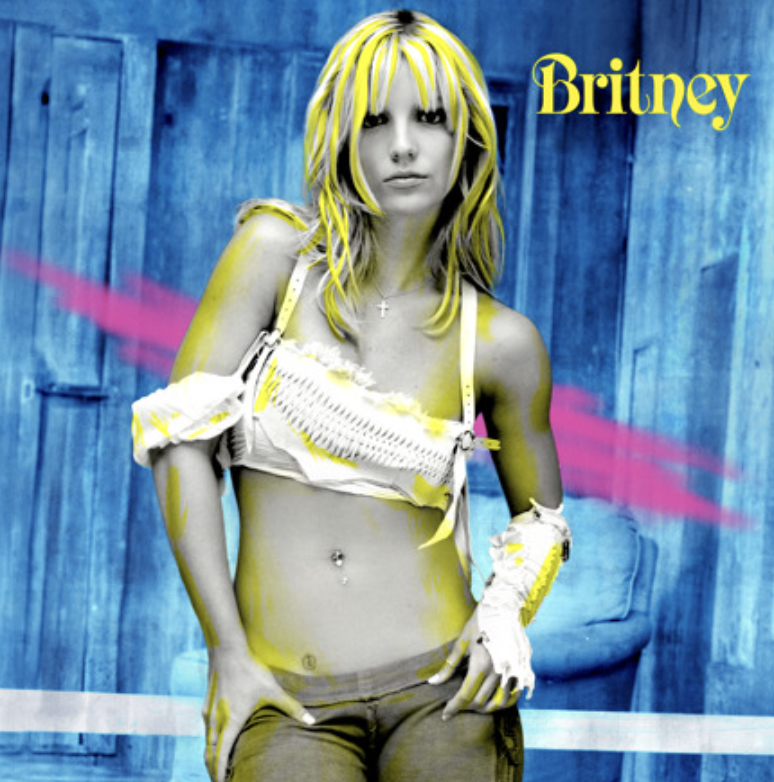
Annoyingly, Britney Spears’ third album, Britney, was released at a time that many would call “the peak of her powers.” And that’s annoying, of course, because it refers to the idea that Spears was only at her “strongest” when she was still what the misogynist suits would call “fuckable.” This being part of why she was, in 2001, the most sought-after, dissected and overexposed pop star on the planet. With the rollout of Britney, all of that amplified even more. And it’s one that began quite early in 2001, starting with co-hosting the American Music Awards with LL Cool J on January 8th and then her performing cameo at the January 28th Super Bowl Halftime Show (still in such a germinal phase that Pepsi hadn’t even yet become the official sponsor—instead E-Trade had the honor that year) alongside Aerosmith and *NSYNC during “Walk This Way.” It then continued with her first Pepsi commercial in March (after Spears signed a deal with the “soda pop” brand in February that left her with roughly seven million dollars in her pocket—even more than Madonna got when she signed her own deal in ‘89 [though everyone knows she didn’t have to do much work afterward once she scandalized them enough into calling off the partnership while Madonna pocketed the cash]).
Aside from her constant visibility during the first part of 2001, the promo and buildup surrounding the record then reached a crescendo with Spears’ indelible performance of “I’m a Slave 4 U” at the 2001 MTV VMAs on September 6th (just shy of being overshadowed by 9/11), where the song itself was heard by the world for the very first time. And, as far as its lyrical content, the lead single went hand in hand with the “salacious” visuals of the performance, which found Spears dressed in a “belly dancer-inspired” costume that consisted of embellished ultra-low-rise “mini” shorts with attached scarves at the side for a “flowing effect,” an earthy green bra top, flesh-tone, knee-high, bejeweled boots and, of course, a Burmese python draped around her neck for a portion of the performance. It was the ultimate kickoff to the true start of her “Britney era.” The final word in how to transition from “bubblegum pop” to “serious pop star.” Of course, there were many (mainly conservatives) who took it all a little too seriously. Case in point, the governor of Maryland’s wife at the time, Kendel Ehrlich, declaring, “Really, if I had an opportunity to shoot Britney Spears, I think I would.”
This being the response to what was deemed her hyper-sexual image while she was “supposed to be” a “role model” for girls as young as the under ten set. But, as Spears points out in that hard-to-watch Primetime interview with Diane Sawyer in 2003, she isn’t “responsible” for people’s children, nor did she ever declare she that she wanted to or should be. “I’m a Slave 4 U” was a definitive announcement of that. And its B-side, “Intimidated,” announces it as well. Appearing as the first “new” track on the twenty-fifth anniversary edition of the record (even though, yes, it was released in 2001 on the “I’m a Slave 4 U” single). Its industrial-sounding opening has echoes of Madonna’s Erotica and Bedtime Stories eras, and a pinch of early 90s Janet Jackson, to boot. The introduction of a video game-y backbeat then brings us straight into the 2000s as Spears begins with, “I see you over there/Don’t be shy, come here,” already recalling the lyric in “I’m a Slave 4 U” that goes, “I feel like talkin’, feel like dancin’/When I see this guy.” To be sure, throughout this album, it’s all about looking and observing from the darkened corners of the dance floor (hear also: “I spotted you dancin’, you made all the girls stare”). And, in a way, Spears set the precedent for Lana Del Rey to sing something like, “I look at you looking at me/I know you know how I feel” on “High by the Beach.”
Spears’ overtones of voyeurism and sensuality on Britney were all part of why it was labeled as her “transition” album, marking an unapologetic proclamation of her sexual nature, whereas the previous two records were all rooted in “hints” and “suggestions” of it (even if ones that hit people over the head as they hit the masses, baby, one more time). Spears played up that element of transition with an “in between” single like “I’m Not a Girl, Not Yet a Woman” (which would also feature prominently on the 2002 soundtrack for Crossroads). Not necessarily a “fan favorite” by any means as it falls into the category of extremely dated ballads by Spears (along with the likes of “E-Mail My Heart” and “Dear Diary”). And one wonders if she could have swapped it out for something a little more timeless. Especially considering that, when Spears appeared on TRL to promote the album’s release, Carson Daly mentioned, “Originally you had some twenty-three tracks, twelve made the cut. Now out of curiosity, what do you do with the other songs?” Spears offered, “Um, the overseas, um, records that’ll probably go overseas, we’ll probably put it on that or just save ‘em for, you know, the next record.” Daly then said, “Yeah ‘cause in hip hop they’ll usually put ‘em in a library and they often get used or—” She interjected to agree, “Eventually, like later on, yeah. Well sometimes we’ll do that, yeah.” She then flashes the camera a mischievous expression. Almost as if she knew there would one day be an expanded edition of Britney. At the same time, it once again seems as if Spears is little involved in this reissue (the same went for the twenty-fifth anniversary edition of Oops!…I Did It Again), and that it’s but another attempt for someone “in charge” to make money off of her. What’s more, Spears’ general disinterest in promoting the re-release is manifest on her various social media accounts. For example, as of the release weekend, the last thing she posted on her official Twitter (never X) account was a screenshot of a video with the title, “How Britney Spears’ Mom Failed Her.” While, on her Instagram, the usual cryptic postings endured.
What’s more, it’s entirely possible that Spears is especially averse to revisiting this album, what with it being so intertwined with the pinnacle of her “dating Justin Timberlake” era. Not only that, but part of the era that would signal not just her musical transition, but her transition into being painted as pop’s proverbial “villain” or “bad girl” in the aftermath of Timberlake going around and telling the world that he was done wrong by Spears’ infidelity (with their mutual choreographer, Wade Robson, who also happens to be one of two of Michael Jackson’s key accusers in Leaving Neverland). Yet before this development, Timberlake was essentially Spears’ “get out of being accused of being a ‘slut’ free” card. This akin to how Madonna stated of being married to Sean Penn for four years in the 80s that it briefly prevented the media from its all-out assault on her and her “hyper-sexual” “antics”/mode of dressing. But once a woman in the public eye is “without a man,” she’s fair game for the media to tar and feather. Particularly if her ex-boyfriend is announcing that she cheated on him (even though Timberlake actually cheated more fully and long before Spears did, as her memoir makes clear).
But, at the very least, before “the fall,” Spears and Timberlake got some collaboration time in together on Britney, as also showcased on “She’ll Never Be Me,” a track that has Spears foreshadowing how Timberlake would spend the rest of his life looking for her in other women. This foretold in Spears’ confident delivery of the lyrics, “And you can’t deny/That everywhere you go/See my face, hear my name/And it eats you up inside/You know I’m one of a kind/Can’t get me out of your mind.” Musically speaking, it has certain similarities to The Stop Remix! of “(You Drive Me) Crazy,” with production from Riprock ‘n’ Alex G underscoring some of Timberlake’s background vocals (and yes, he’s also listed as a co-writer on the track). Though they’re not as prominent as the ones on Britney’s original closing track, “What It’s Like to Be Me.” On the twenty-fifth anniversary edition, the latter is featured as track fourteen, sandwiched between “I Run Away” and “Before the Goodbye,” songs that have already shown up on international editions of Britney, and, therefore, offer more of “nothing new.”
Much like the additions of the superfluous and already well-known remixes of “Overprotected” and “Boys,” which are stuffed in between “Intimidated” and a “new” song in the form of “Right Now (Taste the Victory),” which first appeared in Spears’ 2002 Pepsi commercial in collaboration with FIFA World Cup. Accordingly, it has a kind of RuPaul vibe with “empowering” lyrics like, “Yeah, we can share the dream/Feel it, taste the victory” and “I will be your champion/This is where we belong/Making it happen, now/Nothing will stop us/Won’t pull us under.” Of course, such lyrics presently read as ironic considering just how much Spears was stopped and pulled under.
Following “She’ll Never Be Me,” “Am I a Sinner” has the “sexed up” vocals of a song like “Touch of My Hand” (which appears on 2003’s In the Zone). And clearly, Spears’ Southern Baptist/Christian upbringing was still haunting her during this period of “letting it all hang out.” Hence, conveying a kind of “Catholic guilt” about feeling horny/attracted to a man when she offers the spoken word intro, “The way he feels, it feels so right/Every night, I feel the heat/Close my eyes and it comes to me.” “It” likely being some sort of sexual vision. In any case, the song also offers allusions to Spears acting unfaithful when she sings, “I confess if I’ve done wrong/But in your eyes, I see I’m guilty, I’m guilty/The stress that keeps me strong/I feel as though my heart is empty/‘Cause you’re not with me.” In this regard, it almost sounds as if she could sense the end of her relationship with Timberlake coming.
There’s also a sonic dichotomy to “Am I a Sinner”—for, on the one hand, it’s a ballad and, on the other, it has an almost 90s dance sound to it at times (and an intonation that occasionally mirrors, incidentally, Lene Marlin’s “Unforgivable Sinner”), with instrumentation that even recalls something far more fast-paced like Ace of Base’s “Beautiful Life.” The “split-ness” of the sound is what punctuates Spears feeling the push and pull between being a “good” girl and a “bad” one (a.k.a. a regular nineteen-going-on-twenty-something who enjoys having fun, and has the looks and the money to do so). And by the end, she questions being positioned as a sinner with the outro, “So tell me, am I a sinner?/Tell me, am I wrong?/Something’s wrong with the picture/This is not my fault/So am I a sinner?”
The public and the media certainly answered that question with a resounding yes. Though maybe they would have been less inclined to if Spears had kept “When I Say So” on the album. A song that is something of a “hold on to your virginity” anthem and of an ultimate “2000s style,” with a backing track that reminds one of the synthesized acoustic guitar in TLC’S “No Scrubs” (released in ‘99, but still setting the tone for the next four or so years in music, particularly hip hop). In the spirit of other “hold on to your virginity” (or just a general encouragement to “wait” to have sex) songs like Jermaine Stewart’s “We Don’t Have to Take Our Clothes Off,” Christina Aguilera’s “Genie in a Bottle” and Amanda Lemeche’s “Everybody Doesn’t,” Spears offers such assertions as, “Ain’t no reason to rush in/Nothing starts till I say go/I don’t really wanna tease you/I don’t wanna mislead you/You’ll get some when I say so.”
Thus, Spears isn’t technically saying she won’t put out, she’s just saying it has to be on her terms. Which is part of what makes “When I Say So” among her more empowering tracks of this era (which also includes the defiant/“I will survive”/“I can make it on my own” themes of 2000’s “Stronger,” along with other Oops!…I Did It Again tracks like “Don’t Go Knockin’ on My Door” and “What U See [Is What U Get]”). And also part of what makes this song, too, retroactively bittersweet considering how little in control Spears was of anything for so long. Before that smackdown arrived, however, she was self-confident enough to make such pronouncements as, “You’re feelin’ me, my jeans, my baby tee [this sartorial callout also showing up on In the Zone’s “Brave New Girl” when she sings, “He said, ‘You look real cute with your low-ride jeans/And your pink little baby tee’”]/You want it now, but just chill, slow it down, ah/Think you got game and you know how to play with me/But who told you that this will be easy?”
In other words, Spears is expressing that part of her arousal is “the chase.” The idea of being wooed and pursued. Though, by the same token, she insists she’s “not like all them other chicks” who want “relationships” (how very “pick me” of her). That sentiment shifts quickly when she admits, “I might be down for relationships/Gotta do me right to make me wanna flip” (“do me right” also appearing on “What It’s Like to Be Me” when she urges, “Do me right or I’m through” [and yes, in both cases, there is a double meaning to the phrase]). Naturally, in order for this man-boy to “do” her right, Spears has to give her consent.
In terms of why “When I Say So” was left off the album, it makes sense considering that it’s a little “too much, too soon” on ramping up the “bad” girl image (even though it has illusions of the “good” girl motif in terms of talking about waiting to bone). But, sonically, it’s in keeping with just how Michael Jackson-y the Britney album sounds. And his influence would have tracked when taking into account that he became a bit of a “force” in her life due to Timberlake becoming “friendly” with him in 2001 after writing “Gone” for him (and discussing the possibility of duetting it), though Jackson turned it down and *NSYNC recorded it instead. However, the song prompted Jackson to personally call Timberlake and tell him that he would reconsider recording it if Timberlake sang with him on the track. As Timberlake recalled, “[He] said that he wanted to cut the record, but he wanted it to be a duet between himself and I. And I said, ‘Well… we’ve already cut the song as an *NSYNC record. Could we do, like, ‘NSYNC featuring Michael Jackson,’ or ‘Michael Jackson featuring *NSYNC’? And he was very absolute about the fact that he wanted it to be a duet between himself and I.”
So clearly, blame Jackson for driving Timberlake’s already inflated ego to the point of treating Spears like, well, to make a reference to a song on Britney, Cinderella. As for Spears, the Jackson influence also became clear at the Michael Jackson: 30th Anniversary Celebration in September of 2001 (again, just barely spared, like the VMAs that year, from being overshadowed by 9/11), where she performed a rendition of “The Way You Make Me Feel” with him. At the 2002 VMAs, she would also introduce him before he was meant to join her to co-present the award for Best Pop Video, taking her use of the phrase “Artist of the Millennium” to mean that he was getting a special award for that very one-off category. Jackson then gave secondhand embarrassment to all watching by picking up a music note decoration that he assumed was his statue to commemorate the honor. In any case, his influence on the sound of Britney can’t be denied—and it also allowed her to beat Timberlake to the punch with that influence before he grafted the same sound for his 2002 solo debut, Justified.
As for the “big” finish of the re-issued album, “My Big Secret” (a song that was also leaked long ago), it has a very “The Boy Is Mine” lyrical opening, complete with another instance of Spears giving a spoken word intro. This time, it goes, “Listen, I just wanna let you know that/He wants to be with me, and I wanna be with him/It’s alright, he didn’t mean to hurt you/Things change, you’ll be okay.” So it is that Spears offers another song on the re-issue that pits her against another woman. Indeed, “She’ll Never Be Me” is all over the lyrics, “So, baby, can’t you see/You could never be me?/I do all things that he loves me to.” And yes, that latter statement doesn’t really seem like something to brag about (nor is it in keeping with the sentiments of “When I Say So”). Not to mention how condescending Spears is being by calling another woman “baby.” This also perhaps too “villain-y” to include on the final version of the original album. Along with Spears throwing further salt in the wound by saying, “Open your eyes/Can’t you see, girl?/He is mine.”
Based on these previously unofficially released songs, it’s obvious that, in many ways, Spears was the one pushing to “reinvent” herself as pop’s “bad” girl, likely tired of being associated with the “cookie cutter” image (as Christina Aguilera called this wave of pop stars/boy bands upon shedding her own “good” girl persona with 2002’s Stripped) that had been pinned on her with …Baby One More Time just because she was a teenager with a “sweet” face. But it seemed as if the record label was reining her in before she went “full throttle” with In the Zone, and that’s part of why songs like “She’ll Never Be Me” and “My Big Secret” were cut. In the end, of course, Spears would still be branded as “bad” by the public.
And of these reactions to her and her music, all Spears could rightly say at the time was, “I don’t see the big deal and I don’t see the need for an apology. I’m a nineteen-year-old girl about to be twenty, I’m growing up and there’s nothing wrong with that. Besides no matter what, I can never win. When I did ‘…Baby One More Time’ they were saying I was too controversial, so you can never win.”


+ There are no comments
Add yours