


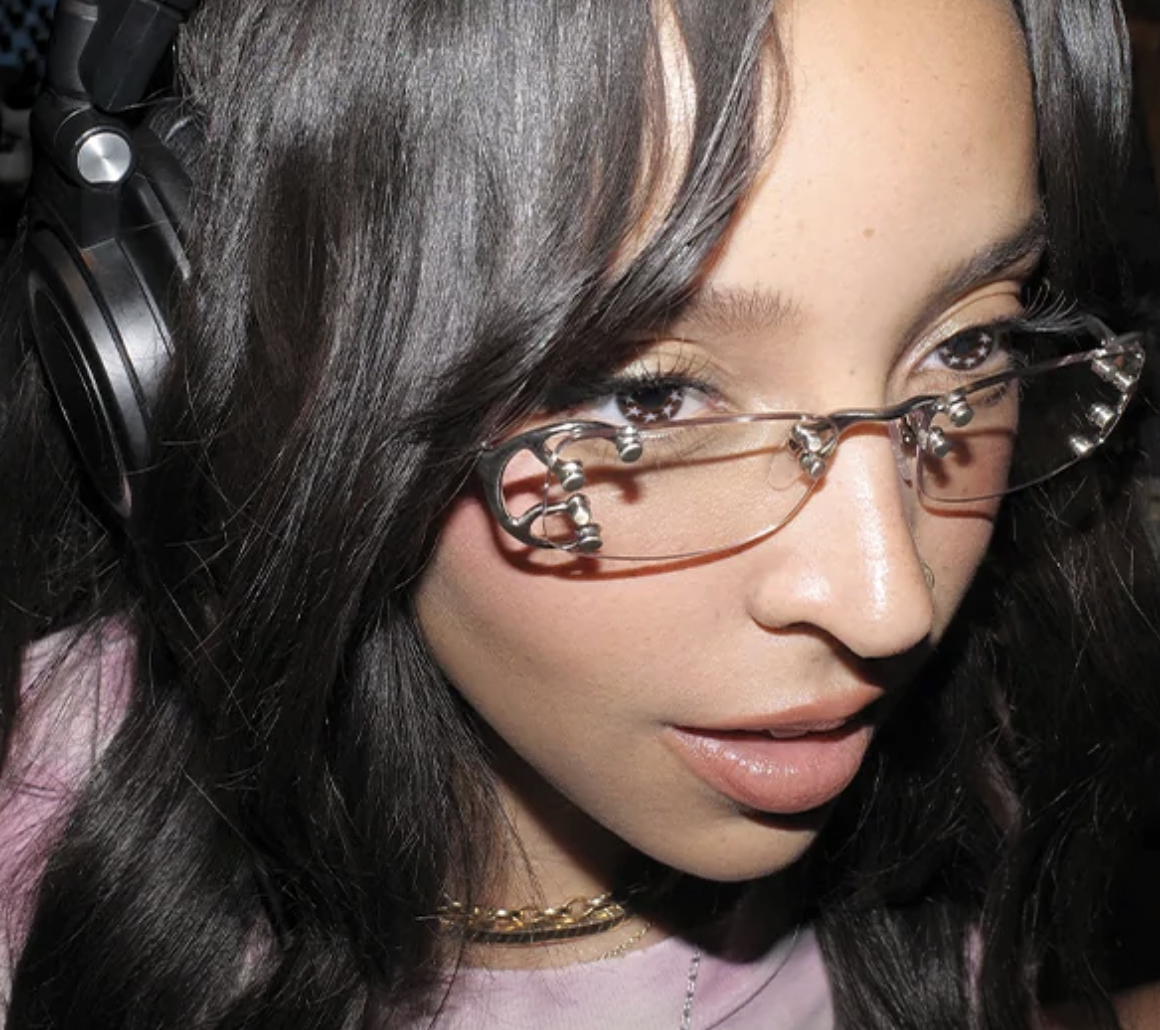
From the moment Tinashe’s eighth album, Popstar, begins with “Sunglasses,” it’s apparent that her aim is to be as in your face with her playful experimentalism as possible. Because, after this many albums, and this much grind, Tinashe is making it clear that she’s no longer here to try pleasing anyone but herself or fitting into any mold but her own. Ultimately, that’s the crux of and drive behind Popstar, an album that seeks to shed light not only on the inherent bias behind who’s “allowed” to have that moniker in neon lights above them and who’s not. Hint: it’s usually only white girls who get the title (or, where Ariana Grande is concerned, occasionally blackfishing white girls).
Tinashe is defying that stance by not only taking the term and labeling herself with it, but also proving how that term has never truly been defined by any one genre. Even some of the latest white girl pop stars, like Billie Eilish, aren’t making music that most would associate with “conventional” pop. Because that term has mutated and evolved so much over the years that it’s impossible to define as any “one thing.” Even though, in the past, being “one thing” is what the tenets of “monoculture” demanded. But now that monoculture has been all but obliterated, it does make it a bit easier for Tinashe to come along and give everyone a reminder that pop music has always been amorphous.
Indeed, in looking at the pop music that’s dominated the charts ever since the charts were invented, it’s always been plain to see that “pop” has never truly been any one thing. It is always influenced by other genres, and most especially the genres that have historically been viewed as “Black.” For example, in looking at the pop music that dominated the 2000s—a decade that Tinashe is clearly taking some inspiration from for this album—hip hop was the “trend” infusing most of the pop hits of the day, including something like Britney Spears’ “I’m a Slave 4 U.”
To be sure, The Neptunes’ (a.k.a. Pharrell Williams and Chad Hugo) hip hop infusion into just about every major pop hit of the “Britney era” (a.k.a. early to mid-00s) was telling of how the genre can not only be whatever anyone wants it to be, but is also largely informed by, frankly, Blackness. And yet, it is so often Black women who are boxed out of the category of being considered a pop star (for even Black men—namely, Prince and Michael Jackson—have been “allowed” to be pop stars; granted, it’s also indicative of an innate prejudice within the music industry [and society at large] that Prince was “light-skinned” Black and Jackson felt obliged to essentially “dye himself white” over the course of his career).
With Popstar, Tinashe is patently declaring to said notion: fuck that. And, as she explained during her interview with Zane Lowe, “I always saw myself as a pop artist, even when I made music that was, debatably, the most R&B type of music that I’ve made, which is, like, the music that I made right out the gate.” Yet, to Tinashe, R&B was still under the umbrella of “pop” (just ask Janet Jackson). Which is why she also added to her statement, “[There’s been] a conflicting understanding about, like, who I was. And if I was meant to be this, like, urban thing or this, like, pop white thing. And that divide, again, did not make sense to me and… I felt like I was meant to pick between and that was a really uncomfortable place that I just obviously didn’t want to have to do. And so I kind of feel like the course of my career has been staying the course of being, like, “I’m gonna create what I want to create, I’m gonna be who I am.’ Regardless of these, you know, the boxes.”
And to prove she will not be hemmed in by any such imaginary “boxes,” “Sunglasses” sets the tone with its dreamy experimentalism. That categorization undeniably arising from some co-production by Arca, who veers into SOPHIE-esque sonic territory during the intro (with sounds that are so alive and vibrant, they seem almost tactile). This before the beat drops and Tinashe announces, “Eyes straight forward, I see tunnel vision/Speakers so loud, music my religion.” A pronouncement that aligns with the assertions on another pop star’s latest album: Miley Cyrus with Bass Persuades. For it’s on the record’s second track, “Different Religion” featuring Model/Actriz that Cyrus sings, “I want to be saved by a different religion.” In Tinashe’s case for sure, that religion is music. Again, not of any one genre.
This further emphasized by telling Lowe, “When I think of the word ‘pop star,’ I don’t think of this as something that’s exclusionary of the other genres. I think it’s all of these things combined. I don’t think it’s, like, not R&B or not pop or not… dance music. It’s all of those things combined, it’s all of them when they come together and, like, are presented in this, like, amazing package.” Part of that package is typically, well, sunglasses. Which is why it’s so appropriate for Tinashe to kick off Popstar with this song. For what is a key aspect of every pop star’s (/celebrity in general’s) “uniform” if not “shades” (just look at Madonna in Star for an ideal reference point)? What’s more, it even seems as if Tinashe could be alluding to Corey Hart’s 1983 hit, “Sunglasses at Night,” when she sings, “Sunglasses after dark/This is my favorite part.”
The dreamy, chill sonic landscape continues when Tinashe casually notes in a higher pitch, “Blacked out sunglasses/Nothing else in the world even matters.” This description, whether she intended or not, speaks to a certain breed of narcissism that exists within the average pop star. For it does take a unique level of self-involvement (and self-assurance) to have the kind of “tunnel vision” to rise to the top of such an industry. And yes, Tinashe has steadily done just that, reaching a mainstream crest with 2024’s “Nasty.” This after years of slogging it out, and even after Britney Spears gave her a “visibility” boost in 2016 by releasing a different version of “Slumber Party” with her as a feature. And, despite all this struggle for recognition, Tinashe really has made it all look “Too Easy.” The song that follows “Sunglasses” (and also serves as the lead single from the album) and does a quick one-eighty in terms of tone and sound.
Amplifying the sense of confidence she wants to exude with this record, the up-tempo pace commences with a “beep-beep” sound effect in the background that one can’t help but associate with, well, the Roadrunner. And, in this regard, it’s easy to make the association that Tinashe views herself as someone that needs to be “caught up with.” In many regards, she’s not wrong. And she’ll continue to drive that point home on “Melatonin” as she goads those who would dare to “sleep on” her. Before that moment arrives, however, Tinashe wants to make the listener aware that she is very much attuned to how the nature of pop history is filled with Black artists. Including Kelis, whose “Milkshake” influence is apparent here by way of Tinashe’s own differently-intonated “la-la-la’s” (Tinashe will say “la” six times in a row as opposed to Kelis’ five).
And when she asks, “I got a question, is you really down to pop or what?” she means it in a sense that also pertains to this: are you ready to understand what pop really means? Which is, of course, everything. An all-encompassing genre that doesn’t need to be limited to the skinny, blonde, white girl trope. Something Tinashe reiterates on “Melatonin,” which further ups the tempo of things thanks to co-production from Ricky Reed, Nightfeelings, Zack Sekoff, Ike Schultz and Tinashe herself. With barely even the slightest pause between “Too Easy” and “Melatonin,” the latter keeps the high energy, “pop star-ing is like breathing to me” energy going as Tinashe begins in a low pitch, “Bet you thought we’d stop, you already know we kept it going.” The chorus then continues, “Getting’ hella coin [because Tinashe, after all, must show her California pride with ‘hella’]/Walkin’ by, I See you hella pointin’/Talkin’, talkin’, talkin’, talkin’, talkin’, bitch, you hella annoying/Sleepin’, sleepin’, sleepin’ on me, bitch, you so melatonin.”
Around the twenty-eight second mark, that sound again veers into SOPHIE-esque production territory, with the beat getting more frenetic as Tinashe continues to repeat her shade-throwing chorus. But all of that coolness and conviction goes out the window on “Empty Stadium,” a vulnerable slow jam that, as the title suggests, speaks on Tinashe’s feelings about being met with nothing but an empty stadium in spite of all the hard work she’s put in to draw in an audience. The ethereal backing music (which, at times, recalls certain sonic landscapes of Brandy’s Never Say Never) is meant to build on the eerie image of what a pop star singing to an empty stadium would look like. This image, for Tinashe, stemming from, as she told Lowe, a recurring dream she has—hence, calling it out as a dream (though it would certainly be deemed a nightmare by most pop stars) from the very first verse: “Last night I saw a dream so vivid that I woke up sick/In an empty stadium lookin’ at the walls, seein’ no exits.”
Tinashe then gets even deeper and more confessional with the lyrics, “When I realize I’m alone, I’ve been singin’ so long and nobody hears it/And I’m standin’ on the stage just waitin’ for applause that’ll never exist.” The brutal honesty of that admission gives way to even dreamier-sounding instrumentation at around the thirty-seven-second mark, after which Tinashe imagines a scenario in which, “Finally almost had it/Everything that I imagined/And everyone would finally love me/But would that ever be enough?/I never lied to be accepted/Now I hope I don’t regret it/I put the work in and waited/Don’t wanna die underrated, oh yeah.” It’s within this verse that Tinashe touches on the notion of how even achieving success at the level one thought would be “enough” only ends up getting one on a proverbial “hamster wheel” (her word choice) where the unfillable void for “more” and “better” can never possibly be quelled, explaining during her Lowe interview,
“I think it’s an anxiety that potentially all of the work you’ve done, like, is kind of…no one’s there to hear it, no one’s there to appreciate it and where does it go? I think as an artist, as someone who creates something that the crucial element of, like, wanting it to connect with people and wanting it to be heard by people is, like, a big part of it. And so I think there’s always this feeling of like always feeling like maybe it’s never quite being understood. Like, you’re never quite getting through to people. People aren’t fully seeing you. People aren’t fully hearing you. And there’s kind of this sense of, like, all of a sudden I realized that, like, I’m here and I’ve been doing all of this for so long and kind of, for what, you know?”
When Lowe poses the question, “Wouldn’t that be okay?” Tinashe can finally say without hesitation, “Yeah.” Because, fundamentally, an artist that’s doing it because they have to isn’t doing it to be “seen,” per se. Of course, when one was born to be a pop star, not being seen and adored can be a kind of torture, as Tinashe makes clear on “Empty Stadium.”
What she makes clear on “Flashbacks” (which has an equally, er, laid-back sound to “Empty Stadium”), instead, is that she’s still looking for someone to match her freak. Or, in this case, match her “freaky flashbacks,” which she depicts with such details as, “Nonstop, putting that cherry on top/Unannounced, runnin’ butt naked ‘round the house.” Of course, she’s not saying she’s the one getting the “freaky flashbacks,” but rather that she’ll be giving them to the person she’s “so bossy” toward in the boudoir (and other parts of the abode, obviously). Thus, her sensual chorus, “Close your eyes, ‘bout to be hypnotized/Flashbacks, freaky flashbacks/Got you having/Flashbacks, freaky flashbacks.” And yes, Tinashe does tap into a specific flashback phenomenon, wherein all a person can think about is the images from a particular “sex session” (something Zara Larsson would probably get on board with [plane pun intended], as per her recent thoughts on sexual fantasies/flashbacks while flying).
And if that’s somehow “Overdramatic,” then so be it. This particular title being the appropriately sultry (it’s the saxophone, at first) forty-five-second interlude that shifts Tinashe back into high-confidence gear as she shruggingly sings, “Don’t be so overdramatic/Oh/Already know I’m the baddest.” Since being the “baddest,” by American standards, of course means being rich, Tinashe concludes, “I-I’m getting money like a bandit/I want something, I’m gonna grab it.” This assertion is a fitting tie-in to the sentiments behind the also sultry “I’d Rather Be Alone,” a track that declares Tinashe knows her worth well enough not to tolerate a mediocre man/relationship any longer.
In order to get that point across, Tinashe delivers her vocals in a decidedly Rihanna-like way (to be sure, this song has plenty of “Kiss It Better” similarities in terms of her tone). And referencing Rihanna is an important choice on Tinashe’s part. For there is arguably no other Black woman (not even Beyoncé) who has truly managed to be considered a part of the pop music pantheon with her hip hop/R&B/dance music sound. With Popstar, Tinashe is picking up where Rihanna left off on that front, with albums like Good Girl Gone Bad and Talk That Talk being prime examples of what Tinashe was saying to Lowe about many genres constituting pop, and that it’s typically a matter of how the “package” of the music is presented in order to be considered as such.
While it might not seem so “on the surface,” “Crash Out” is another exemplar on this record of pure pop perfection. In fact, it even has some very clear thematic connectedness to Britney Spears’ 2007 pop hit, “Piece of Me.” What with Tinashe also expressing being at her wits’ end just as Spears was (and kind of still is) with a verse like, “Don’t talk to me/Used to play nice but I’m off of it/Can’t take the bait they offering/And all of that stress on top of it/I just need to get my energy right/What you want from me, I?/They been pressin’ me, I/This can’t be what this life is like/It’s overrated.” And the kind of life she seems to be mostly alluding to is the one that puts a person in the spotlight. Even so, Tinashe worked too hard to shy away from this level of fame now. Though it’s still not at the level (and never could be) that subjected Spears to so much endless media scrutiny in the 2000s. With Blackout being Spears’ lyrical crystallization of all that scrutiny.
Although the Blackout sound might be all over “Crash Out,” “Pillow Fight” is something of a “Part II” to Tinashe’s feature on “Slumber Party” from Glory. Complete with the same kind of innuendo interwoven into “sleepover lingo.” Mainly, “Give it to ya good, you could spend the night/We could roll around, have a pillow fight/I like to tussle, I wanna wrestle.” Intermixing the “romantic” sound of piano notes with a hip hop-inspired backbeat, Tinashe once again blends genres through sonic moods that add up to one thing only: pop.
And bleeding in seamlessly to that track is “Nobody Wanna Dance Anymore,” which happens to be second song she wrote for the album after “Popstar” itself. And yes, die-hard Lady Gaga fans will recognize the sample from Wale’s 2009 single, “Chillin” (which itself samples from both Audio Two’s “Top Billin” and Steam’s “Na Na Hey Hey Kiss Him Goodbye”). That Tinashe would home in on this as reference in a song of hers also speaks to the ways in which she flexes her pop/multi-genre knowledge throughout Popstar. And one such reference she also seems to be making is to, once again, Britney, with her manner of singing, “I don’t wanna make a scene like this/Actin’ super shy, but I’m lovin’ the attention” done in a way that recalls Spears’ intonation and vocals on 2003’s “Showdown” (from In the Zone), acting faux shy when she says, “I don’t really wanna be a tease/But would you undo my zipper please?”
To be sure, the entire vibe of the song is “Showdown” (with a dash of Glory‘s “Do You Wanna Come Over?”), with Tinashe simultaneously lamenting the state of the dance floor (read: flaccid) and flexing that she’s only too ready to be its lone saving grace. In a certain regard, the lyrics mimic what Miley Cyrus is pronouncing on “Bass Persuades”: “The kids don’t wanna dance, the kids don’t wanna dancе.” In Tinashe’s version of that statement, it’s, “Nobody wanna dance, dance/Nobody wanna dance, dance/Nobody wanna dance no more.” At least not on a dance floor in public, preferring instead somewhere in their house for a TikTok video. Addressing this, Tinashe adds of the current IRL dance floor scene, “Got their hands in their pockets or their phone out/‘Tween a late night and a sweet romance/Can’t lie, I’d rather just dance” (that latter phrase feeling like another nod to Lady Gaga).
Cyrus echoes that summation in “Bass Persuades” with, “Glued your eyes to the telephone screen/But you missed the hit without MTV” and “If we ain’t moving, baby, baby, why are we here?” Such an existential question is what Tinashe is all about on “Twentyfive Eight” (a title meant to one-up the conventional “24/7” saying). A track that finds her examining what the point really is of wanting so badly to reach a certain echelon of success when it only leads to never feeling like it’s enough (something she also explores on “Empty Stadium”). With “Twentyfive Eight,” Tinashe shows that she’s moved beyond that—and the craving for a certain type of success. So it is that with the poetic opening verse (delivered in an oh-so-angelic tone), Tinashe announces, “All I want to/Do is what I was meant to do/Spending the days and nights/Climbing the ladder to nowhere.”
She then talks about the proverbial “race to the top” and how it truly does get you nowhere, breaking it down for the listener as follows: “If you win the rat race and you come in first place/Then you’re still a rat” (those lyrics are for you, Taylor). Or, as she stated to Lowe, “There is a kind of hamster wheel that you go on when you start thinking about success… there’s always this feeling of, ‘But what if there’s more?’ Like, what if there’s more out there? What if I haven’t reached my full potential? And like, what if that’s not enough?” (on “Twentyfive Eight” that translates to, “When you get what you desire/The bar you set just gets even higher”). Moreover, Tinashe discussed how seductive the financial boon of success can be, and how it can also work to create a pressure cooker environment when it comes to wanting to keep supporting one’s family and friends (something Britney, too, knew all about). Not to mention maintaining the “lifestyle” a pop star has grown accustomed to.
So it is that Tinashe, as if trying to remind herself as much as her listeners, serves up the wisdom, “Where do minutes all go when you only got one life, one life?/I know you gotta pay bills but the good parts you cannot by, not buy.” Even so, Tinashe can’t help but admit, “I like the pressure, it makes a diamond.” And also in the sense that she can now buy diamonds because of all the work-related pressure she’s put on herself. But, as “they” say, “If you do what you love, you’ll never work a day in your life” (that is, if you have the luxury of making money off doing what you love). Which is perhaps why Tinashe is sure to distinguish that, “I’m in it for the love/Twenty-five eight I’m grinding.” That is to say, her nonstop work ethic when it comes to music and performing is because she loves it. To her, it isn’t tiring but enjoyable, life force-giving.
Besides, as any “bona fide” pop star knows, “The Show Must Go On,” no matter how one is feeling about it. And as for that classic “show business” phrase being the title of a twenty-second interlude before “Popstar,” well, it serves as something of an incantation-like buildup to Tinashe warning (in a style that, again, very much channels some Rihanna-style vocals), “Don’t fall in love with a popstar/Didn’t know we’d get so far/Tell me is it everything you thought it’d be?/Work late night on a weekday” (there’s a reason Sabrina Carpenter said, “I’m working late ‘cause I’m a singer”). And yes, it’s the kind of verse that makes the song feel like it should have been on the Marry Me Soundtrack instead of anything by J. Lo.
With its “gauzy” sound, Tinashe also touches on being a someone who lived right outside of Hollywood’s reach, growing up in Pasadena as “just a girl with the stars in her brown eyes.” Those “popstars” showing up literally, if one looks closely enough at her Hugo Comte-shot album cover. A cover that, at first glance, might appear as if it’s “just” an image of her in the recording booth wearing some 00s-inspired glasses (whether they’re true sunglasses or not is debatable for some). But look more carefully, and one will see the barrage of stars (in her own unique Popstar logo style) circling her irises. In effect, Tinashe wants to bring a trippier, perhaps more sinister meaning to the term “starry-eyed” than Ellie Goulding ever did. In explaining that detail to Lowe, Tinashe stated,
“There’s also this feeling throughout this album of this starry-eyedness and how there’s this, like, weird, bittersweet feeling, I think, of being in the industry, being in Hollywood, being in music, growing up in L.A., like, having this, like, dreamy, romantic, like, ‘I could have this beautiful Hollywood dream’ happen right here, everything’s possible, and then also like this reality that you’re kind of constantly faced with. And I think that there’s, like, this, to me the concept of, like, feeling starry-eyed and, like, always trying to, like, go back to that feeling that I, like, initially felt as a child, like, which sparked the path that I’ve now kind of gone on. I think that there’s always, like, a willingness and a hope to, like, hold on to that and, like, what does that mean? What does that look like now?”
Chances are, probably a lot like “Brainrot”—since that’s what just about everything looks like now. And it’s a song that also serves as the perfect thematic follow-up to “Popstar,” what with its talk of being numb and “fake love” everywhere she turns. In short, the nature of being inside the “Hollywood machine.” With its up-tempo and frenetic pacing, “Brainrot” also reflects the kind of “overstimulated” feeling that goes hand in hand with being in the spotlight. Yet for all the “perks” that are supposed to come with that spotlight, Tinashe has the revelation, “Guess money can’t save me/Lifestyle of the rich and shameless/Everybody wanna be famous [though not according to recent reports]/My status, outrageous.” The use of that particular word again feeling like a slight homage to Britney, who has a song called “Outrageous” on In the Zone that talks all about her own famous lifestyle. In fact, there’s plenty of that Britey-inspired defiance in lines like, “Damn right [another “Milkshake” by Kelis similarity]/And I hope you caught it on camera/Stayed humble, but they couldn’t handle.”
Nor can they probably handle Tinashe’s beatific expressions on “Cloud 9.” A song during which she not only brings out her Rihanna vocals again, but also contrasts the “Brainrot” lyric of, “I’m nothing but numb” with “I’m finally feeling something.” A lot of something, it would seem, as Tinashe joyously talks about a new love that has her declaring, “Ah-ah, I’m in paradise, yeah/Cloud nine, getting starry-eyed [that word again], yeah” and “Your sex almost sending me to space/And I can’t even lie about it.”
And what Tinashe also can’t lie about on the final track is the “Heavy Weight” she’s had to carry throughout her entire life. A weight that’s only gotten heavier the more successful she’s become. For, it’s like she explained to Lowe: the more successful you get, the higher your standards and those of everyone around you become. In this instance, that would refer to her family, who she’s helped support “and now everyone relies on me to keep it all together,” as she puts it so candidly on “Heavy Weight.” A song that stands out from all the others on the record not just because it’s an acoustic guitar-laden ballad, but also because it has a songwriting credit from Amy Allen, who is known for bringing out these types of candid, confessional lyrics in people.
Among such candid, confessional lyrics she brings out in Tinashe being, “I’m killing myself tryna make it better/So I just work harder/I’m the oldest daughter/And nothing’s ever gonna change.” At the same time, by finding the courage to record this song and admit these feelings, maybe it actually is the first step toward something changing in her dynamic with the family that’s come to rely on her. Even though Tinashe is the one that put herself in the “Big Daddy”/caretaker role, also admitting to “doing shit you didn’t ask of me.” And also admitting that true strength wouldn’t be continuing to carry all this damn weight on her shoulders like Atlas, but to let others know that she can’t do it anymore. This much made evident in the emotional lyrics, “And I’m not strong enough to ever say/I can’t carry it now/It’s weighing me down.”
With Popstar, however, Tinashe comes across as completely weightless and comfortable in her own skin. So much that she didn’t seem to want the writing and recording process for it to ever end. Indeed, as Tinashe noted to Lowe, she spent more time than usual working on this record, taking two years to finish it, and writing around a hundred and fifty songs before editing it down to the tracklist one sees before them today. Sixteen taut, to-the-point offerings that remind listeners, in case anyone forgot or didn’t know in the first place, that pop music is all genres and for all people. Not to be “defined” by the kind of limiting labels that once put Prince in an American Music Awards category called Best Black Album. And that’s why Tinashe also reiterates that the best pop music is also teeming with a political undercurrent.


+ There are no comments
Add yours