


While “weird” people have been increasingly showcased through film in the time since the twenty-first century began (see: Amélie, Ghost World, Submarine, Frances Ha, et al.), perhaps it’s all been ultimately a ruse to lead the true weirdos to believe they’re being seen, heard and “understood.” A trap to make that niche feel a little less alone in a world that has become so much more isolating. Especially ever since tech and its associated devices made that feeling all the more pronounced despite the internet’s early intention to “bring people together.” Instead, the ultimate result has been to rip people apart. Not just through eroding genuine human connection, but also through establishing echo chambers that only confirm and reinforce whatever people want to believe. It’s the latter that has led to such divisiveness in the U.S. in particular. The effects trickling down to children in more ways than parents can possibly understand.
Yet another great divide being the one that separates the kids who don’t spend most of their days on a screen compared to the ones that do. Bonnie Anderson (Scarlett Spears) falls into the former category, and it’s starting to make her feel like more and more of a freak every day. This much is made crystal clear to her within the first ten minutes of Toy Story 5, after Bonnie tries to initiate some kind of social situation with the twins that live across the street from her. When they laugh at her “strange” way of doing so—hiding behind Jessie (Joan Cusack) and making her “speak” for her by saying shyly (and kind of creepily), “Helllooo”—a deflated and ostracized-feeling Bonnie goes inside to ask her parents point-blank, “Why won’t anyone be my friend?” Jessie, observing this heartbreaking exchange from inside the clothes hamper where Bonnie keeps her toys, decides to get to the bottom of why the twins (not to mention any of the other kids in the neighborhood) don’t seem to be “vibing” with “her kid” at all.
Leaving the Andersons’ place on the back of her trusty steed, Bullseye, she rides across the street to peer into the window of the twins’ house to see that, “They’re both just sittin’ there. Doin’ nothing.” That is to say, they’re posted up on the couch staring at their screens. Granted, there is some element of “being interactive” with it by playing a game. But it’s like nothing Jessie has ever seen before. Which brings one to the “anomaly” of Jessie and the other toys that belong to Bonnie lucking out with a kid that still enjoys the “analog” form of playing. An anomaly that’s also tied to the fact that it’s taken this long for the Toy Story franchise to tackle the subject of smartphones and tablets infiltrating children’s lives despite the past decade-plus revealing the detrimental effects of Gen Z being the first generation to be exposed to this kind of technology from the very beginning of their childhood. Something that even Toy Story 4, released in 2019, could have addressed rather than waiting until now. Whereas with, Toy Story 3, released in 2010, the full weight and aftermath of screen takeovers in the lives of children hadn’t been fully felt just yet.
However, as if to address the “behind-ness” of the franchise in dealing with this matter, one of the toys that overhears Jessie commenting on the “bizarre” behavior of the twins chimes in, “You didn’t hear? The age of toys is over, lass” (it’s a sea captain toy, hence the use of the word “lass”). Jessie asks, “What do you mean ‘over’? When did that happen?” Another abandoned toy in the form of a turtle replies, “It’s been happening for years! Where have you been?!” And where Jessie has been, of course, is playing in Bonnie’s room, still experiencing the sense of being a useful and necessary tool to letting a child’s imagination flourish.
Wanting Jessie to fully grasp what she hasn’t yet been exposed to, the discarded toys in the twins’ yard insist that Jessie take a look at the other kids glued to their screens through the blue-lit windows of the neighboring houses. Incredulous, Jessie says to Bullseye, “Look at ‘em all. All on devices. Except for Bonnie.” The proverbial “freakshow” because of this “phenomenon” she seemed to have missed. In no small part because of her parents, who have been cautious about outfitting her with the tablet that every child has: Lilypad (Greta Lee). That is, until Bonnie’s melancholic query to them, which prompts them to cave and buy her, at just eight years old, what all the other kids have. If only they, like Lily Allen, had decided to read Jonathan Haidt’s The Anxious Generation. Then maybe they could have found enough other parents in the neighborhood or at Bonnie’s school to take the “Wait Until 8th” pledge that Haidt advocates for, suggesting that a group of at least ten parents/families form a collective against getting their children smartphones until at least eighth grade so that the children of those families can’t claim to feel left out because “everyone else has one.”
Alas, as is the case with most parents, Bonnie’s are too weak-willed/uninterested in going against the grain to try such an approach. So it is that Bonnie is given her precious Lilypad, quickly as hypnotized by it as all the other kids, much to Jessie and Bullseye’s dismay as they watch her fall down the rabbit hole in real time. Within the span of a day, Lilypad is all that Bonnie wants—and Lilypad is insistent to Jessie that she “just wants what’s best for Bonnie.”
With this development (causing Bonnie’s lack thereof), Jessie is made to feel useless and obsolete again, especially after Bonnie, filled with embarassment, throws her and Bullseye back into the car when the “friends” at the sleepover she’s invited to (after Lilypad adds them as “friends” on the app) make fun of her for bringing them. But Jessie refuses to let Bonnie go it alone, jumping out of the car with Bullseye, then having to play “dead” as a toy on the street right when an elderly woman walks by and decides to return these toys to their owner, clocking the address scrawled on the inside of Jessie’s pant leg, the one her first kid, Emily, wrote in there to ensure she would never lose her.
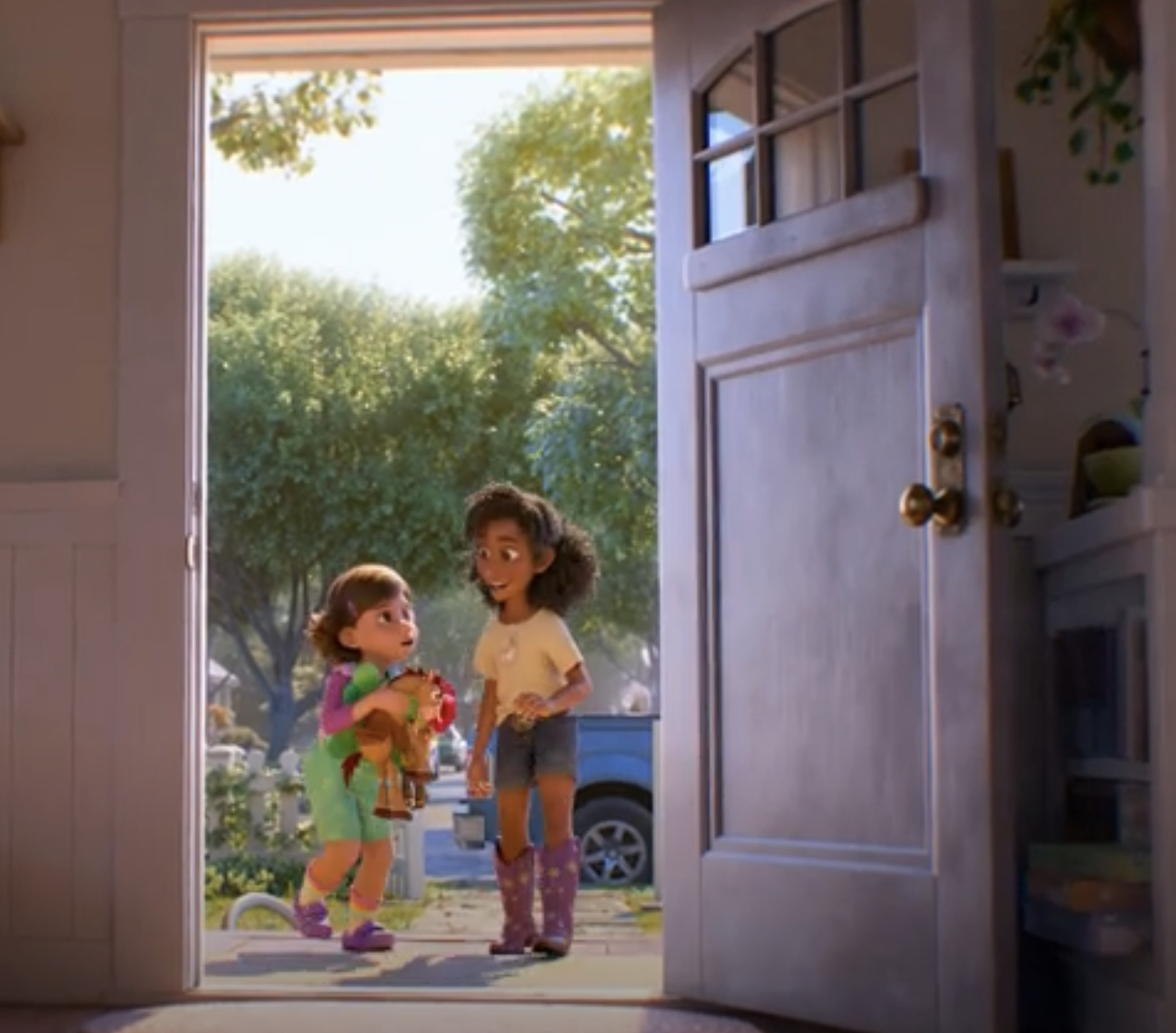
That’s how Jessie ends up back at the last place she would have ever wanted to go, a place that’s now a trauma epicenter because of the pain of being reminded that Emily no longer had any use for her either. Just like Bonnie in the present. But, after befriending some other discarded toys on the premises, even of the “ancient” tech variety, Jessie realizes that maybe this detour isn’t a total wash. Because she sees something in nine-year-old Blaze Manoukian (Mykal-Michelle Harris), the girl that now lives in the room where Emily used to. Indeed, Jessie sees the same “quirkiness” (now a word for a child who doesn’t have much tech in their life) and sense of play in Blaze that Bonnie still has, even if Lilypad is working around the clock to stamp it out and turn her into another drone.
Fortunately, observing Blaze and her “vibe” makes Jessie feel certain that she’s the perfect genuine friend for Bonnie. Not some fair-weather one that will ostracize her just because she still likes to play with real toys. A quality that makes her stand out from everyone else her age because she’s using her imagination and creative sensibilities to problem-solve and expand her mind through the scenarios she’s creating in her head and bringing to life through the toys.
Thus, a core message emerges by the end of the movie, one that essentially reinforces what Haidt advocates for: “freakos” need to find other “freakos” in order to survive in this increasingly normie world. And by “freako,” what is mostly meant is a child that continues to hold on to their childhood for as long as they can before feeling the pressure to grow up too fast (for most girls, that’s usually a makeup/skincare obsession, eating disorder and all) because of what they’re seeing and comparing themselves to on social media. This being what Haidt calls “the great rewiring” of childhood post-2010, shifting children away from “play-based” activities to “phone-/screen-based” ones.
And yet, although Toy Story 5 declares the age of toys to be over, funnily enough, toy sales are still booming. In part because they’ve been equipped to pair with tech and also in part because of the “kidult” market. In short, the very market that would be inclined to see Toy Story 5. Because the kids who grew up on it now have kids of their own. Ones that they’re seeing live in an entirely alternate dimension from what they knew in their (far more tangible) childhood. And the comparison is horrifying.
Toy Story 5 is meant to offer some comfort amid that horror. It’s just unfortunate that it’s come to the point where the best consolation anyone—including a mainstream “kids’” movie—can offer is that you have to find other “freakos” (again, people not completely sucked into the matrix) to align with your “vision” of how existence should be (i.e., tactile and in real life) if you want to persist as a human in this ever more humanoid world.


