


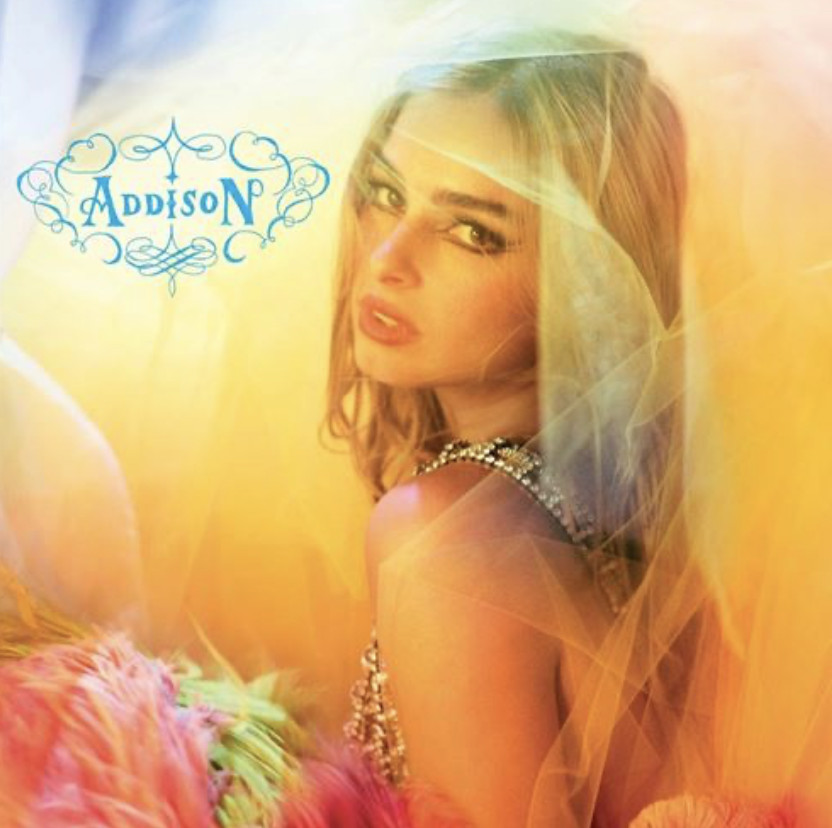
Almost as though to emphasize Madonna’s influence over Addison Rae in general and Addison the album (with Ray of Light specifically cited as a primary sonic touchstone), perhaps kicking off her debut with a song called “New York” isn’t completely non sequitur. Especially considering that Rae continued to jumpstart her career by moving not to New York, but to Los Angeles (signing with the Beverly Hills-based WME talent agency) after gaining a large following on TikTok. This not exactly being in tune with Madonna’s much more analog trajectory of moving to NYC to “become” a dancer. However, perhaps one thing the latter might be able to recognize of herself in Rae is a “willing to do whatever it takes to secure fame” attitude. Not in the same way that other people on social media apps want to be famous, but rather, in a way that will ensure a lasting “pop icon” legacy.
The similarities between Madonna and Rae don’t stop there either. Rae, too, got her start as a dancer (hence, her gravitation toward TikTok), gradually finding her way to music because she loved pop songs and the way that they reach people. Dipping her toe into those waters with her first single in 2021, “Obsessed,” the track was largely derided by critics as the worst kind of frivolous pop. Rae would clap back at the condemnation three years later on Charli XCX’s “Von Dutch” remix, ribbing, “Got a lot to say about my debut/About my constant revenue/I guess it makes sense ‘cause I’m just living that life.” “That life” she details on “New York,” which immediately establishes the gritty, mid- to late 90s sound Rae and her producers, Luka Kloser and Elvira Anderfjärd (a.k.a. ELVIRA), are going for. Hence, Ray of Light as a seminal part of the sonic mood board. This in addition to the 1988 Korg M1 synthesizer, of which Kloser stated (though this part of the interview didn’t make the cut for the Elle feature), “It’s the more Euro sister to the Triton, which was famously used for early 2000s Timbaland, Neptunes [productions]. But the M1 workstation synthesizer was famously used in songs that now feel fundamental to Rae’s electro-pop sound; you can hear its bold features in Madonna’s ‘Vogue,’ Crystal Waters’ ‘Gypsy Woman (She’s Homeless)’ and CeCe Peniston’s soulful ‘Finally.’ They all conjure visions of 90s supermodels marching down catwalks, goddesses who Rae is seeking to channel in the spirit of her music.”
With “New York,” she’s off to a good start (even for those who are induced to vomit by the mere mention of the city’s name). Easing the listener into the inevitable “beat drop,” Rae takes it slow with phrases like, “Out of control/Time’s moving slow/LA is home [this having a double meaning for Los Angeles and Louisiana]/But I’m ready to go.” Ready to go, that is, to the “big city” a.k.a. Big Apple, a cornball nickname she’s sure to mention at the outset with, “Take a bite of the Big Apple.” Followed by the simple utterance of “New York,” said in a way that’s all distorted and swelling, which feels like more than a subtle nod to Imogen Heap’s “Hide and Seek.”
Continuing to describe how she’s living “that life” as one supposedly only can in New York, Rae details, “Black car, pick me up from the airport/Drop my bags at The Bowery Hotel [a known favorite haunt of hers at this point]/Next stop to the club, I’m a dance whore/Kick drum, chew gum.” It’s here, at the forty-seven-second mark, that the beat drops to give listeners the up-tempo rhythm they’ve been expecting, with Rae then getting right to the point again with the repetition (a.k.a. chorus), “Oh God, I love New York, love New York, love New York/Love New York, love New York.” Of course, one shouldn’t have to remind that this is exactly what Madonna was saying on 2005’s “I Love New York,” where she, too, repeats, “I love New York.” And it’s clear she still does considering that, out of all the places Madonna could live, she opts to stay there (even at a time when the U.S.—which, try as the city might to deny it, includes New York—has never been scarier).
Rae, however, remains bound, for the moment, to Los Angeles. A place that, like many before her, she’s betrayed by talking up New York with such effusive expressions as, “Feel so free, feel so free, feel so free/It’s my religion.” Though perhaps what she really means when she says such a thing is that money is her religion. For no American city better embodies capitalism (on steroids) than NYC. Which is why “Money Is Everything” would have been the better song selection to follow “New York,” but instead, Rae opts for “Diet Pepsi,” the first single from the album, and something Rae fought hard for in terms of convincing her label (Columbia) that it was “the one” to kick off this era. Along with a music video that’s shot in black and white, which executives rightly assumed would be an automatic turn-off to her Gen Z audience.
And yet, Rae has proven that perhaps she isn’t like most others in her generation, for she’s willing to challenge and be challenged. Unafraid to “reference or not reference” (as it is said). For even the album cover itself is one big pastiche, looking like it was plucked straight out of the 00s, modeled after the spirit of “teen queens” of the day. For instance, Hilary Duff (see: Metamorphosis), Lindsay Lohan (see: Speak), Mandy Moore (see: So Real, even if it was released in 1999) and Jessica Simpson (see: In This Skin). But, of course, it’s the veil Addison wears on the cover that again evokes the image of Madonna. Specifically, her Like A Virgin era (something Chappell Roan is fond of referencing as well). But the person she seemed to be referencing the most with “Diet Pepsi” is Lana Del Rey, looking to her ideals of Americana for visual and lyrical inspiration (complete with draping an American flag around herself at one point and playing with pearls at another—oh yeah, and mentioning Pepsi). Among those ideals also being the “National Anthem” adage, “Money is the anthem of success” and “Money is the reason we exist/Everybody knows it/It’s a fact, kiss kiss.”
Rae exudes that energy on her update to the sentiment, “Money Is Everything,” even opening in that “Lana talking” sort of way as she paints the picture, “When I was growing up/Mama always told me to save my money/So I never had to rely on a man to take care of me/But money’s not coming with me to heaven/And I have a lot of it/So can’t a girl just have fun?/Can’t a girl have fun? Can’t a girl have fun? Can’t a girl have fun-fun-fun?” That won’t be the last allusion to another pop star’s lyrics (something that’s also a very Del Rey signature)—in this case, Cyndi Lauper’s.
Then there’s Natasha Bedingfield manifested in the line, “Pocketful of sunshine, busting through the seam.” Of course, the ultimate blonde Rae has to mention is Marilyn (just like Lana would) as she sings, “Say it, baby, don’t lie, money’s everything/Diamonds are my best friend like I’m Norma Jeane.” For, even all these decades later, Gentlemen Prefer Blondes still has a chokehold over pop culture. Even if no one realizes it because they assume Madonna in the “Material Girl” video was the original “Diamonds Are a Girl’s Best Friend” reference. And, speaking of Madonna again, Rae is sure to shout her out with the line, “I drink on the nights that I wanna remember/And when I’m up dancing, please DJ, play Madonna.” This itself alluding to “Music,” the Madonna track that opens with the demand, “Hey Mr. DJ, put a record on. I wanna dance with my baby.” And what Addison Rae wants is to “roll one with Lana [another clear indication of Del Rey as a prominent reference point], get high with Gaga.” Though Madonna likely wouldn’t want to be present for Addison’s hang with the latter.
At the end of the song, Addison gleefully concludes, “Money loves me! I’m the richest girl in the world!” (said like Jack in Titanic screaming, “I’m the king of the world!” or Pee-wee Herman shouting, “I’m the luckiest boy in the world!”) That same level of confidence and braggadocio persists on “Aquamarine,” the second single from Addison that signaled her first marked shift into a more experimental sound (and even more so on “Arcamarine”)—at least by Top 40 radio airplay standards. And that was, again, due to the strong vision of Luka Kloser and Elvira, both of whom are students of the Max Martin production school—a.k.a. signed to his publishing company, MxM Music. Because, as a student and enthusiast of pop herself, Rae would naturally want the proverbial Swedes involved in producing her first album, as they were in Britney’s first. That fellow Louisiana girl who Rae looks like the spitting image of at times (particularly when she deliberately dresses like Spears).
“Lost & Found,” a brief interlude that serves as a bridge into “High Fashion,” carries on the trippy motif. Or, as Rae would tell Zane Lowe of the sound she wanted for “High Fashion,” “That was kind of, like, the idea was for it to feel, like, pretty druggy and, you know, lost in itself.” However, Rae is certain to express that, for every time that she loses herself, she also finds herself, declaring, “I lost myself and found myself again” before repeating, “Drugs, drugs” for good measure. Just in case there was any confusion about what the high-gloss world of fame in any industry can provide. And yet, the irony is that, on “High Fashion,” Rae insists, “I don’t need your drugs/I’d rather get, rather get high fashion.” She’d also rather have it “feel like summer forever.” For, unlike Del Rey, she doesn’t get that “summertime sadness” (though, to be fair, neither does Del Rey, really, who technically loves summer based on how often she mentions it favorably in other songs). Hence, the next track being called “Summer Forever,” a slow jam, of sorts, that serves as the lone “full-on” love song of the album.
Whether or not the inspiration is Omer Fedi, Rae depicts a relationship based on two people with very different upbringings in terms of how their respective parents approached love: “‘Loving’s hard,’ my parents said it, yours said, ‘Second time’s the charm’/I never thought I’d find someone easily/Now I’m wrapped up in your arms and it feels just like a dream/Friends say I disappeared, I blame it on the things we do” (cue Addison’s friends playing Selena Gomez’s “Call Me When You Break Up”). As for the hyper-romantic tone, both musically and lyrically, chalk it up to what Addison told Rolling Stone back in January: “The Libra in me is a hopeless romantic.” So it is that she muses in the chorus, “Stayin’ up all night long/Singin’ our favorite songs [instead of “Listen to my favorite song”]/Makin’ out in the car/Doin’ shots at the bar/We’re naked at the beach/Barefoot on the street [which feels like an Amy Winehouse/Blake Fielder-Civil callback]/Background on my phone/Never felt less alone.”
In effect, Addison is living out all her romantic dreams, in addition to her career ones. And while, at times, the saccharine nature of the song might draw, for some, an automatic connection to Spears’ …Baby One More Time and Oops!…I Did It Again eras, it is, once more, Del Rey who is all over a chorus that goes, “All my fеars thrown out the window/Makes it feel like summеr forever/And I truly think you’re special/This love’s one to remember.” It has all the stylings of a lyric like, “Now my life is sweet like cinnamon/Like a fuckin’ dream I’m livin’ in.”
Shifting seasonal mood boards on “In the Rain,” the abovementioned Korg M1 synthesizer suffuses this track with plenty of catwalk flair as Addison sings, “Walk in the room, my high heels on, I strike a pose [again, Madonna]/Young, dumb and cute, nothing to lose/And now the past is someone that I have to answer for/I got a whole new point of view.” One that suggests being sad “feels like a waste of time” (here, Addison couldn’t be more at odds with the Del Rey philosophy). Not just because Addison knows that the masses don’t relate to rich, hot people complaining, but because, in all likelihood, she knows that maintaining a happy, positive aura is part of also maintaining good skin. And keeping her haters from relishing any perceived vulnerability. Thus, she insists, “Misunderstood but I’m not gonna sweat it/Isn’t it all for the show?/Keepin’ a smile on my face for protection/Turning my tears into gold.” This latter line alluding to how most pop stars can alchemize pain into cash with a hit song (or, as Ariana once said, “Gon’ make that shit [i.e., marriage] last/God forbid somethin’ happens/Least this song is a smash”). Even so, Rae would prefer not to be seen during a moment of vulnerability if it’s not one she’s curating, hence her life hack: “So I cry, only in the rain.” A.k.a. no one can tell that she’s crying (or, to quote Milli Vanilli, “Blame it on the rain”).
And it’s hard to believe someone with the level of confidence conveyed on “Fame Is a Gun” could ever cry anyway. Indeed, this is Addison’s take on track one of Ray of Light, “Drowned World/Substitute For Love,” which launched an entire genre of songs about fame. Even though, up until now, most of them have cautioned against its negative attributes (mainly, no privacy). Addison, on the other hand, seems game to take on whatever fame might throw her way, so long as she can keep leading what Sheila E. (and now, Addison) call “the glamorous life.” Thus, she shruggingly tells her detractors, “Fame is a gun and I point it blind/Crash and burn, girl/Baby, swallow it dry/You got a front row seat, and I/I got a taste of the glamorous life.” With an ever-so-slight and occasional hint of the instrumentals David Bowie was giving on “China Girl,” Addison delves into the second verse, which includes the lines, “And when you shame me, it makes me want it more/It makes me want it more, more.” Something that’s also a very Madonna-esque sentiment, especially when she was just starting out in New York.
Things get more Selena Gomez-y (think: the intonation of her singing, “I just wanna look good for ya, good for ya”) on the dreamier, more laid-back “Times Like These,” the sixth single (which means half the album has been rendered “single-worthy”) from Addison, released the same day as the album. Mirroring the sound of Tove Lo’s “Kick in the Head” (which appears on Dirt Femme), itself a mirror 90s house standards, Rae reflects on the pressures of pleasing others while still trying to remain true to what she wants. Something that often feels impossible in an industry that favors youth, conventional beauty and stick-thinness. Rae addresses all these issues in the opening verse, “I know you like when I wear this dress/I feel best when I’m wearin’ less/If I dye my hair bleach blonde/Maybe then I’ll turn you on.” Del Rey materializes again on that line, with the “Gods and Monsters” lyric, “If I get a little prettier/Can I be your baby?” coming to mind. Elsewhere, Rae’s studying under Charli XCX shines through when she asks, “Do I eat what I want tonight/Or will it make me feel less tight?/I’m so caught up in my head/Wanna take back what I said.”
These feelings channel two lyrical moments on Brat. The first being on “Rewind,” when Charli says, “Nowadays, I only eat at the good restaurants/But, honestly, I’m always thinking ‘bout my weight” and the second being on “I might say something stupid,” when she worries, “I might say something stupid/Talk to myself in the mirror/Wear these clothes as disguise/Just to re-enter the party/Door is open/Let in, but still outside.” And yes, mentioning the significance of Charli XCX to the creation of Addison can’t be overstated either. For it was Charli who, as Addison phrased it to Lowe, made her feel confident and “seen” enough as a songwriter and artist to keep going where her instincts were taking her after the two recorded the “Von Dutch” remix together (which, yes, was nominated for a Grammy).
Which is why Addison admitting, “I’m so confused” also feels like a little nod to Charli (i.e., “Girl, so confusing”). In addition to Rae essentially describing what Charli experienced after Brat made her go mainstream: “My life moves faster than me/Can’t feel the ground beneath my feet/No matter what I try to do/In times like these, it’s/It’s how it has to be, yeah/How it has to be.” Or, as Charli phrased it on the remix of “Everything is romantic,” “I’m trying to shut off my brain/I’m thinking ‘bout work all the time/(It’s like you’re living the dream, but you’rе not living your life)/I knew that you would relatе/I feel smothered by logistics/Need my fingerprints on everything/Trying to feed my relationship/Am I in a slump?/Am I playing back time?/Did I lose my perspective?/Everything’s still romantic, right?”
For Addison, a similar barrage of anxiety-ridden questions comes up as she sings, “Don’t wanna get too close, I’m scared/Do you hate me, or do you care?/Think about all the time I spent/Feeling lost, but I’m found again [reminding listeners of “Lost & Found”]/Should I jump in the unknown/Or is it better to know how it unfolds?/Am I too young to be this mad?/Am I too old to blame my dad?” There’s the Del Rey again (even though she’s more likely to blame her mom).
Rae and her producing duo keep the dreaminess going on “Life’s No Fun Through Clear Waters” the second “chanting interlude” of the record, and one that presages a lyric in “Headphones On,” the grand finale of Addison. And what a finale it is. One that speaks, yet again, not just to the ways in which her parents’ relationship and divorce has affected her emotional state in life, but also to how music has long been a balm for any of her woes. As was listening to Björk while filming the video for “Headphones On” in Iceland (because, when in Iceland, listening to Björk seems as integral as visiting the Eiffel Tower when in Paris for the first time).
To that end, it feels significant that Rae should comment to Lowe of one of her key ingredients for musical success and innovation, “I really pride myself on my taste. I think I have pretty refined taste.” Lowe agrees with how important it is to have taste, remarking that some of the greatest of artists of all time “have to figure it out, but if their taste is there at the very beginning, the rest is just a matter of time… Taste will lead the way in all things creative.” That was also true of Madonna arriving to New York and instinctively gravitating toward a specific group of artists and musicians that would help form her early sound and aesthetic. Or of Britney Spears knowing in her gut that she wanted the concept for the “…Baby One More Time” video to be set in a school and that she wanted to wear a schoolgirl uniform. The rest, in both cases, is history.
As for Addison Rae, this record marks the true beginning of her own pop star history. At a taut twelve tracks, two of which don’t really count as “proper” songs (sort of like “Interlude 1” and “Interlude 2” on Miley Cyrus’ Something Beautiful), Rae gives listeners the chance to hear how much she’s put into honing the thing she’s truly wanted to do all along: sing (and dance and act—in short, to entertain). But with just a dash more fervor and attention to detail than most other people starting out would bother with. Other people who would likely defer to the opinions and suggestions of those who “must know better” because they’re more technically trained and seasoned. But, as Miley Cyrus told Lowe in her own recent interview with him, people who pay attention to the culture, who study pop music and know what’s going on, they’re the ones who are going to stick around. And, based on Addison Rae’s debut, it looks as though she could be in the pop game for quite a while. Or at least as long as there’s still an audience left on this Earth.


[…] Addison Rae Shares Her Pop Knowledge on Addison […]
[…] One” (which marked her fifth single from Period, thereby signaling that, like Addison Rae with Addison, Kesha had released almost half of the album in single format before it came […]