


Like the shit-tastic, highly sanitized Michael, Lady Gaga and Doechii’s “Runway” video is bound to be a “crowd pleaser.” Which is to say, of course, that there are lots of “shiny things,” so to speak, to distract from the fact that, like the sound and lyrics themselves, this single is an extremely corporate enterprise hiding behind its “LGBTQIA-friendliness.” But there’s such a thing as “corporate gay,” too. With RuPaul’s Drag Race being one of the most glaring examples of that phenomenon over the now many years of its ascension (ergo, many, many spinoffs of the original show).
In fact, it seems as if the Parris Goebel-directed video is a near-three-minute sendup of that series. Because it certainly does no honor to the OG forms of ballroom and voguing that started as early as the mid-nineteenth century before it began to bubble up more prominently in the late 1980s, with Madonna “exposing” the movement fully with her 1990 hit, “Vogue” (which remains one of her best-known songs).
Indeed, that very track made it onto the soundtrack for The Devil Wears Prada when it came out in 2006, with Andy Sachs (Anne Hathaway) werking the streets of Midtown Manhattan as her own personal runway while Madonna’s signature vocals heightened the display of her various “costume changes.” With The Devil Wears Prada 2, it’s apparent that Lady Gaga’s “Runway” is meant to be the “new” “Vogue” of the operation. Which is perhaps why it sounds so, as Madonna herself would say, “reductive.” Not just in terms of its backbeat (co-produced by Watt, Cirkut, Bruno Mars and D’Mile), but it’s cartoonishly catch phrase-y lyrics.
And, talking of cartoonish, that’s the aesthetic that Goebel and Gaga seem to be going for. Having directed and choreographed the video for “Abracadabra” (as well as choreographing the video for “The Dead Dance”), itself a ballroom competition (with Gaga declaring at the outset, “The category is: dance or die”), Goebel wields “Runway” in a manner that tries to emulate that. Except, in lieu of the single massive warehouse space that Goebel and Gaga employ to showcase the height of ballroom-inspired dance maneuvering (with the number of backup dancers in the “Abracadabra” video being truly something to behold), they opt for garish-but-fundamentally-stripped-down sets, starting with the black-and-white-striped (a.k.a. “Beetlejuice”) background that finds Gaga costumed in a pleated blue gown and color-coordinated veil with an outstretched hand as its “cherry on top.” She’s also sporting the signature yellow hair that most people associate with the “Telephone” video, though “Runway” is a far cry from that. Both visually and sonically. Nonetheless, everyone (especially the gays) loves a “reference” now. Even a self-reference (of which there are many more sartorial-related ones that Gaga provides).
In another scene while Gaga is still in the “Beetlejuice room,” she’s wearing a “teapot top” to match the very teapot she’s pouring tea from, timed so she can mouth the words to the line, “You gon’ burn your tongue on this tea.” A by now overused parlance kifed by straights from the ballroom community over the years since Drag Race made such words and phrases more mainstream. Along with “yas,” “gagging” and “hunty.”
As Doechii begins to insert herself more prominently into the visuals once her verses crop up, Goebel gradually starts to take them out of the “Beetlejuice room,” now showcasing a red backdrop while the pair are dressed in “Marie Antoinette-inspired” looks. This, too, being a Madonna allusion in the sense that she performed “Vogue” in her own Marie Antoinette costume for the 1990 MTV VMAs, with her male backup dancers wearing some more salacious takes on eighteenth-century attire (Jose and Luis’ hot pants anyone?).
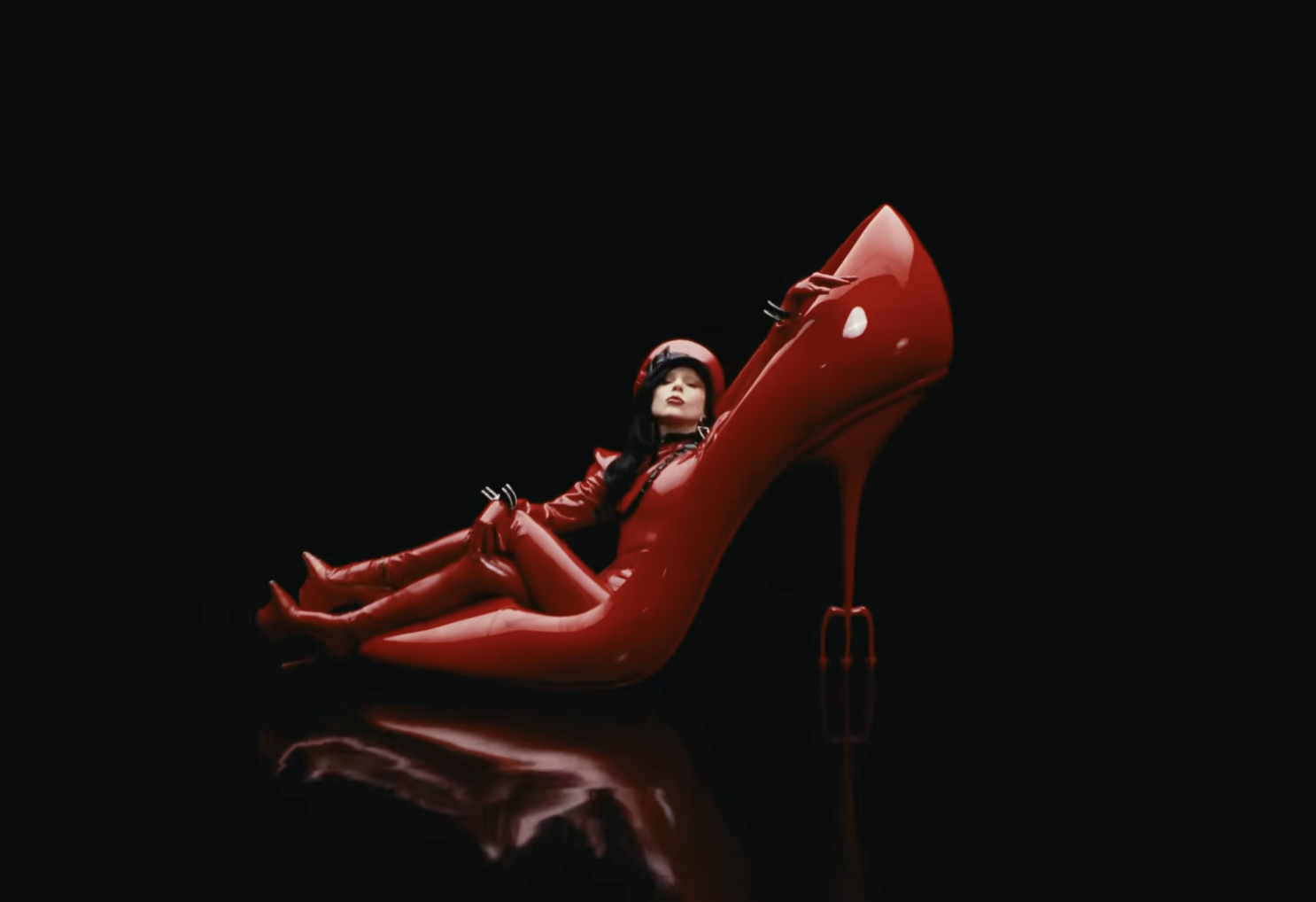
But Goebel isn’t finished with what can not only be called the “Beetlejuice room,” but also one of several “glamorized backrooms” throughout the video. All designed to mitigate the idea that anything about “Runway” is hyper-corporate and hardly in keeping with the, let’s say, “lo-fi” nature of what it once meant to strut through the ballrooms of Harlem (as immortalized in Paris Is Burning). Now, instead, Gaga, Doechii and her dancers are using the “Beetlejuice stripes” as their “runway” markers, flaunting their outfits and moves before Goebel cuts to a previously (though briefly) shown scene of Gaga in a red leather catsuit (yes, it recalls Britney in the “Oops!…I Did It Again” video) while sitting inside of or next to the now “iconic” devil’s pitchfork heel from The Devil Wears Prada poster.
Then, around the one-minute-four-second mark, Goebel varies up the backdrop again (even though it’s still a “glamorized backroom”) by placing Doechii in a “spike room,” as it were, to coordinate with her spiky black gimp outfit (Gaga, too, will get to wear one in silver). One she parades while sitting in a spiky chair as two dancers vogue behind her (this echoing what Jose and Lusi did while wearing cone bras during Madonna’s “Like a Virgin” performance for the Blond Ambition Tour). The spike room then gives way to another industrial-looking space where the presence of “mini catwalks” are the only thing worth noting apart from the lights. In fact, this particular space looks very reminiscent, structure and aesthetic-wise, to the one Megan Thee Stallion used in her “Body” video.
Thus, in total, there are six main “glamorized backrooms”: the “Beetlejuice room,” the “red” room (where they’re both dressed as if wanting to be Madonna emulating Marie Antoinette), the “devil pitchfork heel” room, the “spike room,” the “‘Body’ video-reminiscent room” and the final “runway” room where Gaga and Doechii walk down it together appearing as if they’re conjoined fashion twins because of the “pantsuit,” of sorts, that they’re wearing (or “sharing”).
The final scene of the video, however, is a close-up shot of Gaga and Doechii cheek-to-cheek (maybe a subtle nod to Tony Bennett on Gaga’s part) in the red room. But, in all honesty, it doesn’t matter which room they’re in, because, just as it has become in life, everywhere is a liminal space that people try to forget is one by “decking it out.” Whether with props or the costumes they choose to wear in such places. All done in service of “the photograph” or video that must be taken to capture it. In other words, all done in service of social media. Which is exactly why a music video such as this has become increasingly common (see also: Cardi B’s “Enough [Miami]” video). And, to be quite frank, increasingly soulless and meaningless. Thus, in total opposition to what ballroom and gay culture once stood for.


[…] Not only that, but “we’re walking on a runway that goes straight to Hell.” Something that Charli and Torso highlight when models start walking to the end of the runway only to fall into a black pit that likely leads straight there. And as the last Model Charli is about to make her way to the edge, a blinding white light appears, blotting her out so that the viewer doesn’t get to see if she “takes the plunge.” Was it a nuclear blast? An angel descending from the heavens to “spare” her? Probably the former. In any event, it certainly has more substance to it than Lady Gaga and Doechii’s “Runway” video. […]