


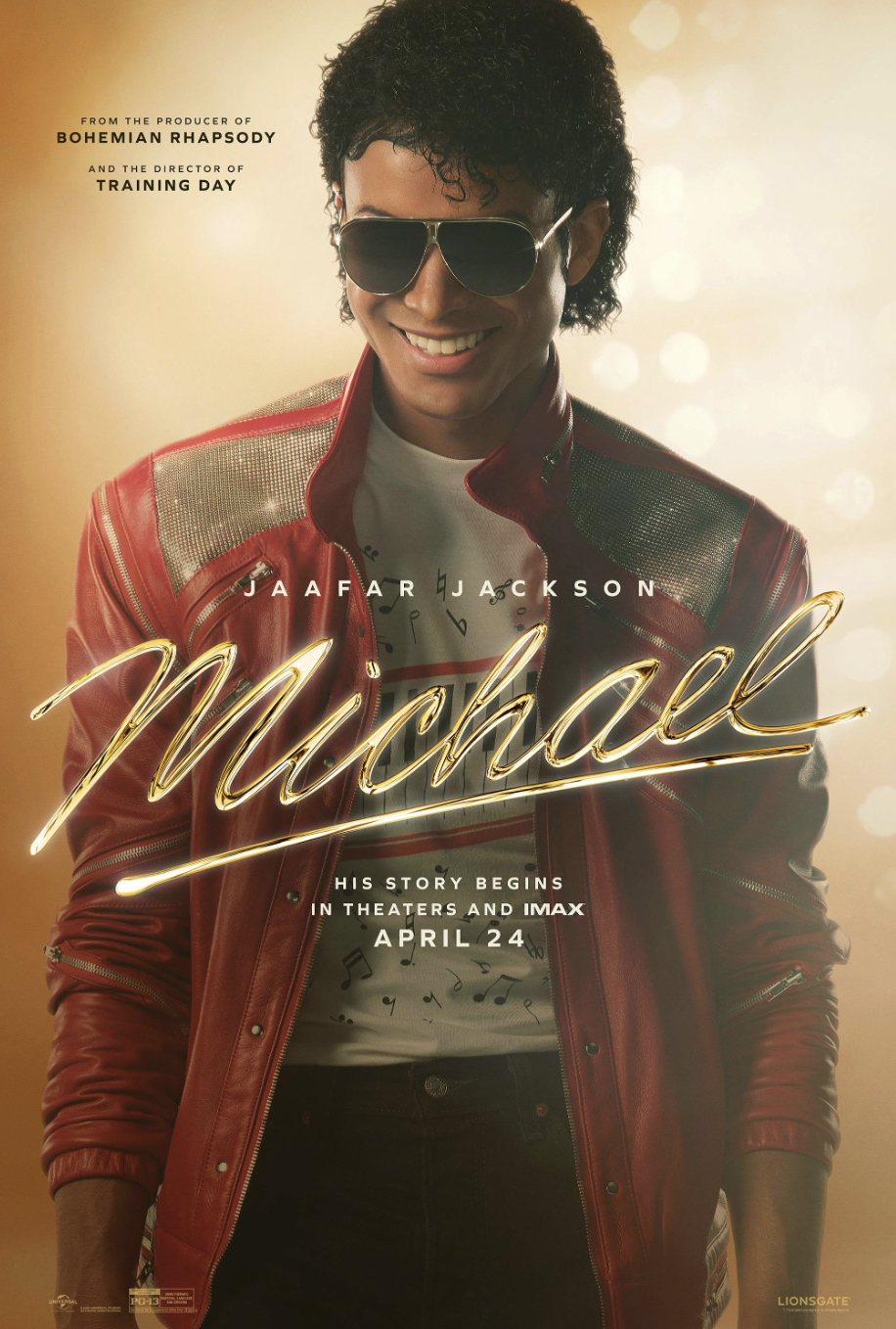
While critics have panned Michael (with one particularly poetic headline from BBC reading, “A bland and barely competent daytime TV movie”), it of course hasn’t stopped the biopic from raking in many millions during its opening weekend. For, as Dan Reed, the director of Leaving Neverland, so bluntly put it, “…people don’t care that he was a child molester. Literally, people just don’t care.” And yes, it appears as if, despite the initial traction that Leaving Neverland gained as a result of arriving just two years after #MeToo, the pendulum has swung back in favor of Michael Jackson as being an “untouchable” (though he sure could touch whoever he wanted) “king.” Not just the “King of Pop,” but a king of the music industry. For, after The Beatles, Jackson remains the best-selling musician of all time.
It is that aspect of Jackson—his musical talent—that is focused on with bread and circuses overkill for the entirety of the Antoine Fuqua-directed biopic. Fuqua, whose best-known films remain Training Day and Southpaw (and Michael is a large fall from artistic grace compared to those two), has also been called out by Reed, who read the director’s recent profile in The New Yorker and saw him cruelly dismiss the stories of victims like Wade Robson and James Safechuck with the assessment, “Sometimes people do some nasty things for some money.” This prompted Reed to retort to The Hollywood Reporter, “For Antoine Fuqua to accuse people of gold digging is kind of ironic. It seems to me all the people involved in [Michael] are just making bank. How can you tell an authentic story about Michael Jackson without ever mentioning the fact that he was seriously accused of being a child molester? I just don’t really see it. If anyone’s making money, it’s Michael Jackson’s estate and the people who worked on this biographical picture.”
Among those people being producer Graham King, who also struck biopic gold in 2018 with Bohemian Rhapsody, a so-called Freddie Mercury biopic (with nothing in it that even came close to mirroring Mercury’s bacchanalian lifestyle). But even that movie is more “digestible” than the schlock that gets peddled in Michael (a movie title that not only immediately suggests its banality and lack of creativity, but is also already spoken for by Nora Ephron’s 1996 movie starring John Travolta). In fact, comparing it to a TV movie, as BBC did, is actually overly kind. Especially when considering how much better (and more thorough) the TV miniseries about the Jacksons—The Jacksons: An American Dream—actually is. And yes, Jermaine Jackson was a co-producer on that one as well. But evidently seeing another goldmine opportunity with this biopic, he went all in through an entirely different means this time around: by getting his own son, Jaafar Jackson, to play his younger brother (adding yet another Jackson into the mix to cash in on Michael). Eunuch-inspired voice and all.
Though that isn’t to say Jaafar’s “acting” (i.e., parroting) is anything to write home about. Nor is the John Logan-penned script, which clearly got edited into oblivion as a result of the many “weigh ins” from various people “concerned” with the Jackson estate. Or rather, ensuring that Michael would be re-deified anew to keep the profits coming without fear of anyone questioning the “ethicality” of listening to Jackson’s music with such abandon.
And yet, even Reed isn’t trying to advocate for the “erasure” of Michael’s work (sort of like the erasure of Janet Jackson’s entire existence from this biopic, as she rightly did not want to participate in any way—with her presence in The Jacksons: An American Dream also making that depiction automatically superior, along with Diana Ross [as played by Holly Robinson Peete] being represented in it too). For he also told The Hollywood Reporter, “I’m not trying to stop anyone from consuming his music. I’ve never advocated canceling Michael Jackson. Book burning is for the Middle Ages and the Taliban. I just think if you’re going to enjoy his music, let’s also consider the fact that he liked to have sex with children and see how that affects your enjoyment, in all honesty.”
But those who turned up to the theater in droves (many dressed in Michael Jackson-style costumes) weren’t there for “honesty,” so much as pure entertainment. Hence, the many re-creations of some of Michael’s major performances and music videos designed to appeal to both long-standing fans and cater to a next generation of them. And as for that next generation who is even less concerned with the facts than the people not presenting them for this movie, it’s highly likely that their takeaway from this will be that 1) Michael was amazing and 2) he had a horrible childhood and that’s why he turned out to be so “odd” (to put it mildly). Results that bring to mind the “Billie Jean” lyrics, “And be careful of what you do/‘Cause the lie becomes the truth.”
And even the cruelty of Joe, as rendered by Colman Domingo, is made to read more like a sitcom dad (with a laugh track just waiting to burst forth) than a truly sinister force to be reckoned with (as he comes across in The Jacksons: An American Dream). Maybe that’s, in part, because any scenes of violence against Michael are “intimated” rather than shown, with one beating shown early on and then the belt only coming off behind a closed door. And this, of course, invokes plenty of sympathy from the viewer, who can, for the rest of the movie, see Michael as an “innocent” being tormented by the requisite antagonist of in his “life story”: Joe. Meanwhile, his mother, Katherine (Nia Long, who has nothing on Angela Bassett’s portrayal) mostly sits back and “kind of” says don’t hurt Michael, but is mostly content to “console” her child by watching movies of the “white classic” canon (e.g., Singin’ in the Rain) when he’s done taking his knocks.
As for Michael’s brothers (at least the ones who are shown to exist, with Randy being noticeably absent like Janet and Rebbie), Jermaine (Jamal R. Henderson), Marlon (Tre Horton), Tito (Rhyan Hill) and Jackie (Joseph David-Jones), their presence is so “non”/background that it even manages to make La Toya (Jessica Sula) stand out despite her incredibly minimal amount of scenes, mostly just chillin’ there basking in the second-hand glow of the other Jacksons’ spotlight (though her own talent is living off the talent of others).
The same way that the real John Branca (played by Miles Teller) ensures he’s presented as a major player in the movie, ergo Michael’s life story. When, in truth, as the co-executor of Jackson’s estate, he had plenty of say in how the biopic would look. Complete with the characters acknowledged and/or given ample screen time. But Branca’s “savior”/“near and dear friend” role is just one of many unpalatable elements of the movie (and one that Paris Jackson took particular issue with, commenting on Branca’s role as producer blatantly affecting not only his prominent presence in the storyline, but also paying for a bigger star to play him).
Branca’s role is only the tip of the iceberg on what makes the whitewashing (if one will pardon the unintended pun) of Michael’s life so glaring. For there is no shortage of cringeworthy-in-their-pandering-nature scenes and moments in the movie, including, but not limited to, Jackson being told he’s not “like other people,” that he has his own “path” and “light to shine” (a reference to the family Jehovah’s Witness background), acting as a savior of the Bloods and the Crips by way of the “Beat It” video and the filmmakers trying to turn all of his creepy “quirks” into something “endearing.” For example, his unhealthy obsession with the story of Peter Pan and his constant attraction to children, not to mention his unhealthy obsession with collecting animals as “friends”—with Bubbles the monkey getting some major play via CGI…though no mention of how Jackson would keep him in a crib like his little baby while the two lived at Neverland Ranch.
Then again, there’s no mention of Neverland at all, considering that the story (and it is just that—a story, scarcely rooted in fact so much as mythology) stops in 1988, the very year that Jackson purchased and installed himself in that sprawling Santa Barbara property. You know, the one where Jackson would frequently invite hundreds—maybe even thousands—of children over the course of his seventeen-year “stint” at Neverland. But after being acquitted of the child molestation charges against him in 2005, Jackson did not return to the property, though he didn’t sell it either.
And maybe part of the reason he didn’t return was because even he felt haunted by what happened there. Though his claim was simply that it no longer felt like a home to him. Perhaps because too many kids—or, more accurately, the parents of kids—were getting wise to “Jacko’s” pedophilic modus operandi when it came to being around children. With his penchant for playing a “lost lamb” himself making it easier to lure and groom others. Like the abovementioned Robson and Safechuck. But there was also Jordie Chandler, Jason Francia and Gavin Arvizo, bringing the total number of documented accusers to five.
The cliché goes that “hurt people hurt people,” and that definitely applies to Jackson, who was used and abused from a single-digit age by his father (inexplicably played by Domingo, who one thought had better taste than in roles and films than this). That abuse continued well into the years of the Jacksons hitting the big time on Michael’s vocal talent, with MJ so conditioned to fear his father’s wrath that he continued to obey every command well after he not only had enough money to say “fuck off,” but also well after the age of eighteen.
However, once Jackson started to gradually get out from under Joe’s thumb, his narcissism was allowed to flourish under the conditions that the success of his debut solo album, Off the Wall, enabled. But, of course, Jackson’s egomaniacal nature is repackaged in Michael as him sounding “Christlike” when he says he wants to change the world with music or having others calling him a genius instead of declaring it himself (and yes, his attraction to little boys who dressed in the same style that he did also fed his increasingly insatiable ego).
At times, there are hints of this ego being more fully explored, as well as what might have been a film more willing to delve into the “complicated nature” (to use a common euphemism) of Jackson’s legacy. Alas, an entire third act of Michael was scrapped (this being a primary cause behind millions of dollars’ worth of reshoots) because Branca failed to take into account Jordie Chandler’s legal settlement with Jackson that stipulated he could never be portrayed onscreen in any fictional portrayals of those early 90s events (a stipulation with quite a bit of foresight), therefore “forcing” the filmmakers to stop at the end of the 80s rather than going into the 90s and glossing over “the scandal” entirely.
Accordingly, Paris Jackson called out Branca’s lack of experience as a producer as being part of “the root of reports that the estate has had to fund tens of millions of dollars in reshoots after the terms of a well-known settlement agreement prevented the production from using substantial amounts of footage already shot.”
While some might try to pin it on Chandler’s settlement requirement as being why Michael couldn’t discuss the child sexual abuse allegations, the reality is that the movie is exactly what those who stood to benefit from the financial success of this biopic wanted. Some franchisable tripe that could sell audiences—once again—on the music, the performer. Not the man.
For as Reed also remarked, “None of the allegations in Leaving Neverland have been seriously challenged, right? But there was enough noise online from those simplistic debunking [videos] that people found it easy to give themselves permission to like Michael Jackson’s music again, if they ever stopped liking it. I think a lot of people just love his music and turn a deaf ear. And short of having actual video evidence of Michael Jackson engaged in sexual intercourse with a seven-year-old child, I don’t know what would be sufficient to change these people’s minds.” Even then, changing “these people’s” minds would probably still be unlikely. Almost as unlikely as a “Part II” of Michael (which is all but confirmed based on the box office receipts of “Part I”) genuinely addressing his pedophilia.


[…] “Sanitized” Doesn’t Even Begin to Convey the Nature of Michael—But Maybe “Vomit-Inducing P… […]