


Continuing to build on her arsenal of visuals from Lux, ROSALÍA tapped Petra Collins to help bring to life “Focu ‘Ranni,” her fourth single and video following “Berghain,” “La Perla” and “Sauvignon Blanc.” Unlike the previous visuals, however, this particular video (released the same day as another Collins masterpiece, “Drop Dead” by Olivia Rodrigo) “pulled a Taylor Swift” maneuver by initially only being available via Apple Music or Spotify (which Swift did with both “Opalite” and “Elizabeth Taylor,” with theories rightfully speculating that doing so improves chart rankings, as YouTube numbers a.k.a. views stopped being counted toward Billboard’s data earlier this year). Mercifully, however, it’s now available to all the non-subscribing hoi polloi. As Saint Rosalia, the Sicilian saint that inspired the song, would want it to be.
What’s more, because Rosalia was Sicilian, this ROSALÍA chose to throw in some Sicilian dialect at the end of the song as an homage to that heritage, belting out, “Tu/U me focu ‘ranni/Mi jittaiu nta lu nenti/Pi nun pèrdiri a libbirtà/E l’amure senza liggi/È l’unicu c’accittassi/Mi jettu nta lu nenti/Prima d’abbruciarimi” (“You/My great fire/I threw myself into nothingness/To not lose my freedom/And love without law/Is the only one who would accept/I throw myself into nothing/Before I burn”). This an ardent declaration of Rosalia’s devotion to God, her commitment to becoming “the bride of Christ,” as it were. In addition to choosing herself as much as she chooses God. In fact, Rosalia was slated to be married to a mere mortal man (with many wealthy noblemen vying for her “hand”) before shirking marriage entirely. Instead becoming a “different kind of bride.”
So it is that Collins opens on a dramatic black-and-white shot of ROSALÍA as a blindfolded bride (wearing a decidedly modest, almost Victorian dress style). Collins then incorporates rapid intercut shots of her standing in a room with two other women behind her holding candles—with ROSALÍA framed in the middle of them. Women who, at certain moments, appear to be her bridesmaids. Though it seems one of them is keen to rip ROSALÍA’s engagement ring right off her finger and guide her faster along her path toward becoming “God’s wife” (or Jesus’—or hey, why not both?). For she belongs to no mortal man, none of whom are ever worth a damn anyway.
In another instant, ROSALÍA kneels down in her wedding dress and looks “heavenward” (this aesthetic and motion combining elements of both “Like A Virgin” and “Like A Prayer,” in terms of Madonna-centric visuals). As if waiting to “receive” some kind of divine light or counsel. A gust of wind then puts out the candles that the two women behind ROSALÍA are holding before a shock of lightning evidently confirms to her that she needs to flee into the woods, with everything turning to color after this “divine presence” makes itself known to her (embodying The Wizard of Oz trope of going from black and white to color when someone experiences, let’s say, an odyssey that makes everything so much clearer to them).
And for ROSALÍA’s first scene in color that isn’t interrupted by more sporadic black-and-white moments, she is placed by Collins against another black backdrop as snow falls onto her lush, satiny white gown (with lace material also in the mix as well). This while she commences with the first verse, “Ya yo me solté la coleta/Quería ir de blanco y fui de violeta/La arena que en tus manos la sujetas/Resbala de tus puños si la aprietas” (“I’ve already let my hair down/I wanted to wear white, but I wore violet/The sand you hold in your hands/Slips from your fists if you clench it”). In effect, the more tightly you try to cling to something (or someone) that “can’t be contained,” the more forcefully they’ll slip from your grasp.
Remaining in that half-lying position as the snow keeps falling, ROSALÍA continues, “Mejor hablar/Ahora que/Callarme para siempre/Y puedo decir/Que estoy en paz/Por mi lao” (“Better to speak/Now than/Be silent forever/And I can say/That I’m at peace/On my side”). Then, in the next scene, still wearing her wedding dress and mantilla-style veil (typically worn for Catholic weddings, therefore most prominent in Mexican, Spanish and Italian culture), Collins opts for something that’s more “Del Rey-core” by having ROSALÍA stand in front of six motorcycles with their headlights on (for it’s still the dead of night, which is perhaps part of why Collins also sticks to a black background whenever not filming outside). Only, in contrast to the typecasting Lana would choose here (i.e., old men), Collins has six women perched on the saddle of these “bikes” as ROSALÍA further explains to her would-be husband, “No seré tu mitad/Nunca de tu propiedad/Seré mía/Y de mi libertad” (“I won’t be your other half/Never your property/I’ll be mine/And my own freedom”).
The six women, now evidently subbing in for the two women with candles in terms of providing “moral support” solely with their physical presence, wait and watch as ROSALÍA unfurls even more of her explanation for eschewing marriage, insisting, “Lo que se construyó con amor/Es más difícil de incendiar/Pero habrá fuegos que/No podrás apagar” (“What was built with love/Is harder to set on fire/But there will be fires that/You will not be able to put out”). In this scenario, the fire that Saint Rosalia can’t put out is the one she feels for God, Jesus, the Virgin Mary and spirituality as a whole. This effusiveness captured by yet another “bursting forth” of that high-pitched vocal that opened the song (and sounds a lot like something that would be in a Passion Pit track).
As this sound plays, ROSALÍA is then shown riding on the back of one of the motorcycles, all devil-may-care (though not to the point that she isn’t wearing a helmet). It’s also at this juncture that Collins implements her rapid intercutting style again, with plenty of scenes of ROSALÍA also running into the woods like a madwoman (or just a free one, when you get right down to it). And the feeling being captured here is exactly the one that Rodrigo embodies in “Drop Dead” as she runs through the Palace of Versailles and along its various exteriors. Indeed, it’s obvious that both singers tapped Collins for the directing job because no one knows how to encapsulate the reckless abandon of a being a girl/woman in love like she does. And yes, ROSALÍA—as Saint Rosalia—is in love. Only not with a man, but with a life devoted to worship. Reverence. Solitude.
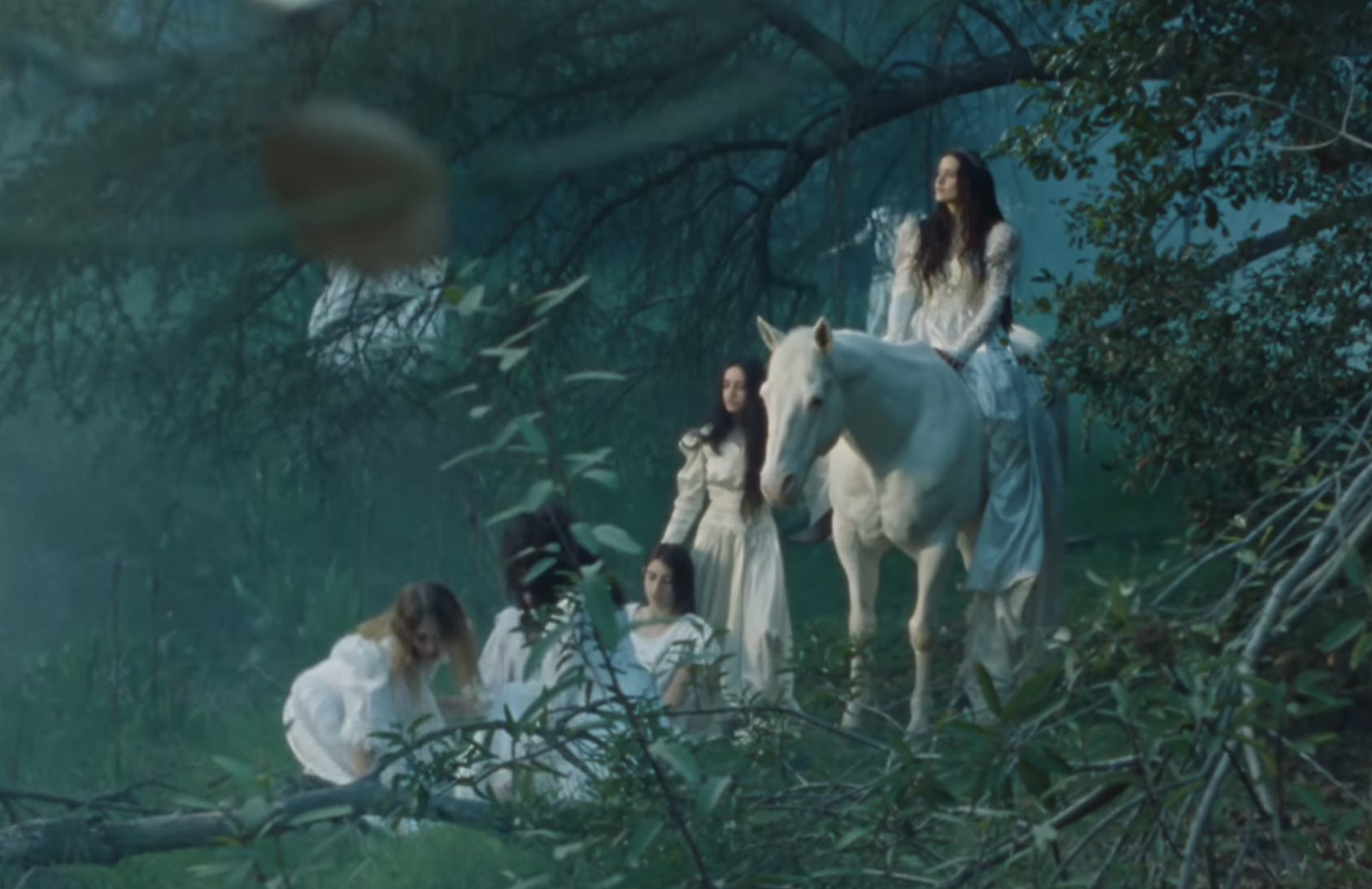
When daybreak arrives around the one-minute-thirty-three-second mark, a euphoric ROSALÍA (still in that wedding dress, of course) is at the center of the women dancing around her in the woods. All of them channeling their freedom and joy together in a manner that would instill fear in any man who saw them (for most straight men’s worst fear is not one, but many women frolicking together in an expression of empowerment).
And as they lie around, skip stones, climb trees and generally bask in the glory of Madre Natura, it’s apparent that ROSALÍA wants to remind women everywhere (regardless of whether they feel “called by God” or not to do it) that they don’t have to succumb to the pressures of marriage. Or an otherwise “conventional” lifestyle. They can instead retreat to the woods and start really living. Or, in Saint Rosalia’s case, retreat to a cave and become a hermit (because hell is other people, especially when it’s a man you agreed to spend the rest of your life with).
Delivering that final verse in Sicilian as she sits tranquilly atop a white horse (still surrounded, at times, by her fellow “witches”), the video then concludes with another burst of running through the woods. The train of her white wedding dress still trailing behind her. And, in another intercut scene, ROSALÍA is shown being dunked into water by one of her “sisters” as she experiences the baptism that will allow her to be reborn as an independent woman. With no need of getting married at all. Except maybe to herself.


