


The gradual birth of Miley Cyrus’ ninth album, Something Beautiful, began almost exactly two months before its official release date. That is to say, when the videos for “Prelude” and “Something Beautiful” were dropped on March 31st. Since then, Cyrus has worked diligently to build up the anticipation for what is inarguably her most ambitious project yet—if for no other reason than she’s done the “Beyoncé thing” by turning it into a “visual album.” In other words, instead of making music videos for certain songs, she’s made one long visual that features all thirteen tracks. Of course, it’s not hard to break each song up so that they can be viewed as individual music videos, like her latest offering, “Easy Lover” (which conjures an immediate association with Ellie Goulding’s 2023 single of the same name). And, incidentally/somewhat ironically, the album feels less like a cohesive body of work designed to be listened to all the way through (à la Plastic Hearts and Endless Summer Vacation) than it does a disjointed and fractured glimpse into Cyrus’ mindset of the moment. Which is this: glamor and grandiosity have been missing for far too long from pop music.
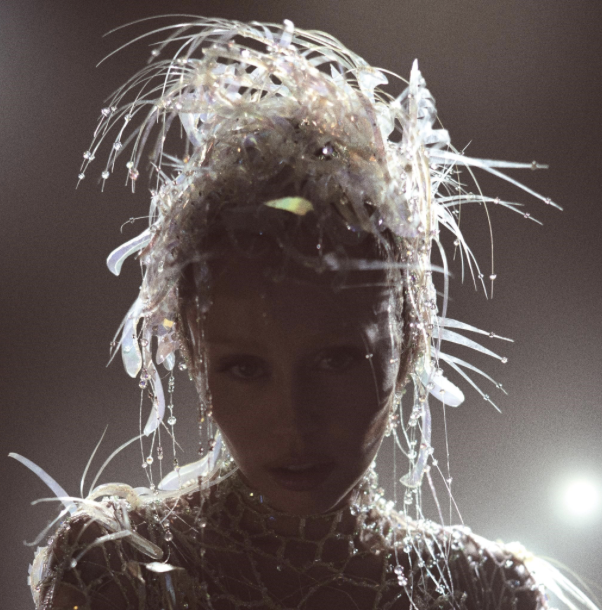
The dramatic, almost Lynchian weirdness of “Prelude” appropriately kicks off a record that will never stay true to any one sound, not even when listening to the same song. That goes for “Prelude” as much as it does for the following track, “Something Beautiful.” And, as Cyrus confessed in the final spoken verse of “Prelude,” “The beauty one finds alone is a prayer that longs to be shared.” That beauty, for Cyrus, isn’t just pop music itself, but fashion. Ergo, merging the two as never before on this record (and, thus, the need for it to be a visual album). As she makes glaringly apparent on the cover itself, which features her now indelible silhouette bedecked in an archival piece of Thierry Mugler couture from 1997. That image being one of the many “something beautifuls” she wanted to bring to the fore for this era. And, as she said in her interview with Lulu Garcia-Navarro for The New York Times, she also wanted to redefine the word “beautiful” for herself. As far as Cyrus is concerned, the word can apply to things that are both joyful and tragic (she lists birth and death as examples—though some are aware that death is the joyful thing and birth the tragic one). In short, there’s, as Frou Frou once said, beauty in the breakdown.
Maybe even the societal breakdown that humans are currently witnessing (e.g., a convicted felon/rapist and sexual abuser getting elected for the second time as U.S. president or learning that a key wealthy white man advising that president was drugged out of his mind while both contributing to his campaign and advising him on various political “maneuvers”). Because at least there is still—so far—music to soundtrack that breakdown. And “Something Beautiful” is filled with the kind of simultaneously blasé and sardonic tone needed for such a soundtrack. Plus, when Cyrus says, “Flash, bang, spark/Lightin’ up the dark/Bomb, bomb” it’s almost like a deliberate precursor to “End of the World,” the album’s “official” lead single.
For those assuming that Cyrus’ intent behind this song was meant to be a political rallying cry about the environment or the perilousness of so many unhinged men having access to nuclear arms, they might be disappointed by the single’s true meaning. For, as Cyrus confirmed in the abovementioned interview with Garcia-Navarro, it is, as speculated, about her mother. Except that said speculation made things much more complicated than what actually inspired Cyrus: her mother going away on a trip to Italy for a week. A huge ordeal for both daughter and mother as, apparently, per Cyrus, “I had never had my mom leave the country without me before.” The interviewer’s rightful reaction to that was, “That’s what the song’s about?” Yes, yes it is. But for those who would still prefer to think of it as being a song with slightly more, well, substance, they’re free to position it as that previously presumed “rallying cry”-meets-“surrender Dorothy” anthem. Much as “More to Lose” is an anthem for love lost.
Up until this point, Cyrus offered a mix of not quite “classifiable” genres, but “More to Lose” is an undeniable torch song. Even while admitting that she knows the relationship couldn’t have lasted—which, of course, makes it all the more bittersweet. And, at the same time, it speaks to the kind of tragedy that Cyrus was referring to with her definition of “something beautiful.” It is while the listener is still in the “sadness hangover” of this song that Cyrus slowly guides them out of it with “Interlude 1,” a trippy/dreamy instrumental that marries the sound of the Twin Peaks soundtrack with the sound of fashion runway music. In other words, a natural lead-in for the country-rock-pop blend that is “Easy Lover.”
Once again taking on the subject she deals best with—a boo that she loves but also kind of hates—Cyrus gets right into it with the opening verse, “You’re my baby, you’re the only one/You drive me crazy, oh, but I still miss you when you’re gone/Every second, every hour/It’s in your nature, to light me up/I love to hate ya, uh, but I can’t stand it when you’re gone/So I call you once every hour.” Highlighting the push and pull of a toxic relationship (as, again, Ellie Goulding also does on her own song of the same name), Cyrus takes us on that emotional roller coaster with her. All while speaking in the second person—almost as if to make the listener feel partially as guilty as her (not so) easy lover ought to.
Even so, there are plenty of moments when she’s full of praise for this person. Case in point, declaring, “You got the love I always needed/Tie me to horses and I still wouldn’t leave ya/But you’re not an easy lover/You’re a wildfire and I’m in your path/I’ve decided I wanna keep on dancin’ in the ashes/And so I call out, ‘Let it burn.’” Oy vey, again with the Ellie Goulding allusions.
As Cyrus guides us out of “Easy Lover” Land and into new sonic territory, she sees fit to do so with another transition called “Interlude 2.” Extremely up-tempo and often techno-y, it’s the ultimate sonic “clue” for what’s coming in the second half of the album: a lot of fucking fierceness. And, in contrast to the first half of the record, not of the more rock-oriented variety. So it is that we’re presented with “Golden Burning Sun,” a song that could have easily fit in with the offerings on Endless Summer Vacation. Not just because it has that “sun-soaked,” summer vibe to it, but also because there is an openness to Cyrus’ tone as she insists, “You’re the only one/Under the golden burning sun,” subsequently asking, “Can I have you/If I never let you down?”—which sort of sounds like Casper asking Kat Harvey (Christina Ricci), “Can I keep you?”
And, speaking of young love that couldn’t last, “Golden Burning Sun” seems to be very much a song about spending summers with some (presumably) opposite sex bestie that Cyrus didn’t realize how much she loved because she was too pre-puberty to understand the full extent of her emotions for him (think: Joey Potter with Dawson Leery). So it is that she sings with more than a tinge of woe, “I had a dream and saw a vision/We built a house that we could live in/I know we’re young, but we’re growing up/We’d go swimming in the water/Then have dinner with your father.”
Cyrus gets even more evocative on the bridge, giving her best impersonation of some Taylor Swift lyrics when she sings, “There were fireflies in the summer air/Bare skin and knotted hair/Burning sun up in the sky/‘Cause I didn’t notice/I’m just so lost in this moment.” But not so lost that she remembers it’s time for a new song as she repeats “surrender” (in a manner not totally unlike Ashlee Simpson on “Surrender”) to close out the track.
The romantic overtones of “Golden Burning Sun” then give way to “Walk of Fame,” which opens with a very “Smalltown Boy” by Bronski Beat sound, courtesy of a feature from Brittany Howard. With a wistful, resigned lilt, Cyrus then paints the picture, “Every day, every night, it’s all the same/Hungry cries are callin’ out my name/You beg me to stay, but/I walk away/Every time I walk, it’s a walk of fame/Walk away, yeah.” Filled with double meanings, Cyrus refers to the literal Hollywood Walk of Fame (hence, shooting the scenes for this part of her visual album there and incurring an infection on her knee, as she told Jimmy Kimmel), the more-than-occasional allure of walking away from fame full-stop and the notion that everywhere she goes (or “walks”), her behavior—however quotidian—is deemed “legendary.” Perhaps her most “The Weeknd-esque” track in terms of its motif, “Walk of Fame” is among the most standout songs of the record. For who can speak to the complexity of this subject matter as well as Cyrus, who’s been exposed to fame, as she says, since she was born.
Upon becoming famous in her own right, it didn’t take Cyrus long to understand that, despite the supposed glamor of celebrity, “Every day, every night, it’s all the same.” In other words, everything is rendered “the same” by the constant bane of being stalked at every turn by fans and paparazzi alike. So it is that Cyrus, much as Britney Spears in the 2000s, finds herself “every night, looking for a place to hide/And you could be that somewhere, is that alright?” Whether she’s referring to a place or person in that regard, the point is that Cyrus needs a “drug” of choice to facilitate some sense of escapism and safety.
During the outro of the song, Howard, almost as though riffing on the bookend moments of The Substance, promises Cyrus (and all other “icons” at her level), “You’ll live forever in our hearts and minds/An ageless picture, a timeless smile/We’ll wear it on our t-shirts, a star buried in the pavement/Everyone will walk around it, around it/You’ll live forever, you’ll live forever, you’ll live forever.” An “assurance” that feels like both a blessing and a curse. But hey, most celebrities have essentially been told, “Pretend You’re God.” The fitting title of the track that follows.
Slowing down the tempo on this one, Cyrus opens it with a Lana Del Rey-esque verse that goes, “In my dreams, I see your face/It hits me like a thousand trains/I don’t wanna wake up if you’re gone” (this recalling the Del Rey lyrics, “Every time I close my eyes/It’s like a dark paradise/No one compares to you/I’m scared that you/Won’t be waiting on the other side”). And maybe the Del Rey correlation—all doom, gloom and regarding a sig other like a deity—stems from Emile Haynie being a co-writer on the track. Not only is he the bloke responsible for co-producing most of Born to Die, but he also helped Del Rey co-write a line like, “I will love you ‘til the end of time.” As for “Pretend You’re God,” it’s co-produced by Cyrus, Shawn Everett, Jonathan Rado, Michael Pollack and Maxx Morando (Cyrus’ boo for the past few years), who choose to keep the instrumentals minimal. And yet, it’s another prime example of Cyrus wanting to channel a “fashion runway” sound. Indeed, there’s a tinge of Björk’s “Army of Me” on it in the repetitive instrumentation underlying it.
Similar to “Golden Burning Sun,” “Pretend You’re God” also finds Cyrus “bargaining” with her lover, insisting that she can give that person what they want, provided that they’ll 1) stay and 2) be everything that she needs. So it is that she promises, “I’ll give you what you want/Pretend that you’re God all night long.” That last urging dripping, in many ways, with a certain sexual innuendo. In terms of the sonic landscape exuded throughout, Cyrus’ deep dive into 90s culture while making the album (case in point, she told Zane Lowe that she’s been watching Academy Awards ceremonies from that time)—complete with the couture she sports on the cover—surely ties into being taken in by the 90s alt-rock influence of singers like PJ Harvey, Sinéad O’Connor and even Nine Inch Nails.
As for the Sinéad comparison, it’s only right that Garcia-Navarro should bring up the open letter O’Connor wrote to Miley in 2013 in the aftermath of both her “Wrecking Ball” video (released September 9th) and her much-discussed, much-panned 2013 VMA performance (which aired on August 25th, the same day “Wrecking Ball” was released as a single). Accused by O’Connor at the time of allowing herself to be “pimped” by the music industry, Cyrus maintains that that was never her experience, and that O’Connor was simply projecting her own feelings onto Cyrus. As for the performance that launched her into bona fide infamy, Cyrus remarked, “Now it seems very soft if you look at culture today… It really wasn’t that wild,” in addition to reminding, “When you look at culture now, young people, they sing about sex all the time—and by the way, they sing about sex way before I did.” Yet that latter statement only plays into what O’Connor was warning her against in that letter: “I’ve been in the business long enough to know that men are making more money than you are from you getting naked. It’s really not at all cool. And it’s sending dangerous signals to other young women.” Those young women who have now one-upped Cyrus on being “provocative” thanks to being “formed” by her in their own preteen years.
But, like Madonna before her, Cyrus won’t apologize for parading her sexual energy. Something that becomes all the more evident on what is perhaps the most epic and sweeping track on the record (which is really saying something), “Every Girl You’ve Ever Loved.” Commencing with an “ultimate 80s” saxophone solo that screams scandaloso, Cyrus again channels some Bronski Beat-ness while also harkening back to the 80s sound of Endless Summer Vacation’s “River” (as well as the lyrics, “I got a new dress just to meet you downtown/Can you walk me through the park just to show it off?/I can pull my hair back in that tight way that you like/If you wrap me in your arms and never stop”).
Bragging about her ability to “match my bag to my new dress/I’m still looking like a ten/While my hair is a mess,” Cyrus highlights her sexuality as a key reason why this object of her desire should give in to her. So it is that she warns, “I’m gonna work it all night/Till I get what I want/Yes, yes, yes/No, I can’t believe that you’re still/Holding out on me like a dog in the street, oh.” In other words, Cyrus can’t understand how there’s any man (or woman) on Earth that could resist her. Not just because of her appearance, but because of the raw sexual energy she exudes. Yet that’s the kind of energy that still gets women branded as nothing more than “sluts” and “whores.” Thus, Cyrus feels obliged to demand, “Aren’t I pretty enough for more than fun in the dark?”
However, that question also stems from the person she’s attracted to being emotionally impervious. Therefore, prompting the next question, “Why’re you still holding onto your heart?/Looking for the one, but one is never enough/I’m every girl you’ve ever loved.” In short, this person sees all the women he’s dated as “the same” in some way or another—all being “a little bit angel, a little bit not.” But what Cyrus also means by the phrase is that she embodies all the best qualities of the women he’s loved (or pretended to) before, and that he should, accordingly, “come get under the one that you’ve been dreaming of.” The one that can truly live up to the fantasy unfulfilled by those others before her.
As though to once more reiterate her 90s love on this album (even if the 80s nod is also present in a lyric like, “Don’t you want me, baby?”), Cyrus also taps Naomi Campbell for a speaking part that comments, among other “isms,” “She never wears a watch, still she’s never late/She’s got that kind of grace/Did Botticelli paint her face?/She has the perfect scent/She speaks the perfect French/She can dance the night away/And still she’ll never break a sweat.” And yes, certain parts of that “monologue” seem to make specific reference to Cyrus’ one-time collaborator on “Prisoner,” Dua Lipa. But whether or not it’s about Lipa, Cyrus and Campbell’s rhetoric is relatable to every girl who’s ever felt the push and pull between feeling overly confident and overly insecure. The pendulum constantly swinging back and forth, particularly when one is a “hot pop star.”
The grandiosity of the backing rhythm also finds Cyrus hitting her Lady Gaga-meets-Madonna stride. Though, when it comes to the latter, that’s more about the repetition of the word “pose” toward the end. For everybody—especially Miley—knows that “vogue language” is forever associated with M. Something Beyoncé knew as well when she incorporated vogue and house stylings into “Break My Soul” (as well as other tracks on Renaissance). Which is why she tapped Madonna for the “Queens Remix” of the single. One brings up Beyoncé in this instance because, with forty-six seconds left in the song, that’s when the ultimate Renaissance-esque musical breakdown comes in for the grand finale of “Every Girl You’ve Ever Loved.” And at the end, when Campbell keeps repeating “pose,” it sounds just like the (musical) end of “Vogue.” Even if what “Every Girl You’ve Ever Loved” samples from is the Soulwax remix of Marie Davidson’s “Work It.”
The trance-y, Renaissance-like sonic motif continues on “Reborn,” a track that, however subconsciously, speaks to Cyrus’ dealings with EMDR therapy (this practice also being a probable reason for all the mentions of trains on the record, since she was instructed to, within her mind, “seat myself on a train… where you watch it pass you by”/watch her life like a movie while on a train and each of the windows passing by would show specific momentous scenes from her life—sort of like a version of what happens to Ariana Grande in the Brighter Days Ahead short film). For it was while engaging with the practice that she tapped into the reason why she had anxiety about performing live. Something, she found, that had less to do with herself and more to do with the inherited trauma of her mother, Tish, being given up for adoption. Which is why the thought that came to her about what she was feeling while onstage was: “I just want them to love me so bad.” As it turned out, that thought, as she learned in her hypnotic state, was coming from her mother. And in that hypnotic state, Cyrus said she felt herself inside her biological grandmother’s womb as Tish, in turn, hearing her biological parents talking about giving her away. The trippy, “we’re all interconnected,” “we’ve all been here before” vibes of “Reborn” definitely address some aspect of that experience.
Kicking off with a “monastic” sound (think: a riff on the musical intro to Madonna’s MDNA Tour performance of “Girl Gone Wild”), Cyrus asks in “confessional mode,” “If I break away any bodies between us/Would you promise that I’m enough/If I give you all of my love?” The beat then drops to lend the effect of being in some sweltering body-to-body club located at the basement level. After un petit instrumental break, Cyrus continues, “We’re so beautiful/Our souls go back and forth/Lightning strikes again/If heaven exists/I’ve been there before/Kill my ego, let’s be reborn.” The idea of ego death seems to be rather appealing to pop stars of late—at least if one is also going by Lorde’s most recent single from Virgin, “Man of the Year.” She, too, relishes the chance to kill her ego, or at least to let it die, as she describes “gliding through/Like new from my recent ego death.”
This “like new” (or “like a virgin”) feeling is something that Cyrus transfers to her listener as she seeks to make them feel transcendent on the dance floor. For that is precisely the venue that this song is designed for (as are “Walk of Fame” and “Every Girl You’ve Ever Loved”). Much as Madonna designed Confessions on a Dance Floor and MDNA for those venues, too. And it is M that Cyrus seems to be channeling yet again when she repeats, “Give me all you love, give me all your love, give me all your love” (in essence, that same chorus as Madonna’s on “Give Me All Your Luvin’”). The idea of being “reborn,” in the popscape, is also something Madonna has been all about since the beginning. Except that, under her “banner,” it’s been called reinvention.
Elsewhere, the common Something Beautiful themes of seeing someone in a dream (“In my dreams, I see you standing there, you’re all alone/We both run away forever, never coming home”) and also the fear of not “being enough” for someone (“Would you promise that I’m enough/If I give you all of my love?”) are accounted for. But perhaps the thing that “Reborn” is really getting at is the true thesis of the record: “Drown me in love, let’s be” (add “and beauty” after “in love,” and that’s the core message). The simplicity of that statement, “Let’s be,” having never been more important than it is now, at a time when governments around the world want nothing more than to not let people just be.
The “I feel love” aura of “Reborn” transitions into “Give Me Love” with a seamless guitar string arrangement. And, for those who might wonder at why it has such a Renaissance-y sound (as in, the actual Renaissance, not Beyoncé’s), it’s because the song was inspired by a Hieronymus Bosch print Cyrus came across. Wanting to build on the theme of the painting that “love is the path to sin”—in terms of what one will do for it—Cyrus also incorporated almost every instrument from the painting into the song. And, as she put it to Lowe, “Hell shows music as evil.” Cyrus can certainly see signs of “good Christians” still believing that (especially if the reaction to the 2013 VMAs was an indication), ostensibly wanting to remind that, in fact, music is the path to love as much as love is the path to “sin.” And, being that “Give Me Love” is Cyrus’ loose re-creation of the Garden of Eden story, it makes sense that she would delineate an idyllic, utopian milieu “where golden apples hang in the trees, and a bare lady sings.” That “bare lady” potentially alluding to Eve, who, along with Adam, was famously naked in the Garden of Eden before she ate the forbidden fruit (an apple) from the Tree of Knowledge that then made her aware of petty human constructs like having a sense of shame. Whereas, before “the fall,” “Lovers lay with boundaries erased once you get past the gray.”
For Cyrus, however, there is no gray, so much as every color of the rainbow (see also: her pansexuality). And there always has been—hence her line, “I give you every single color that there is” on “Every Girl You’ve Ever Loved.” Wanting to spread all these colors of love to her listeners, Cyrus seems to be saying in the outro to “Give Me Love” (“So I’ll send my goodbyes to the earthly delights/While my perfect Eden goes down in flames [perhaps also a subtle nod to her Malibu home]/I’m eaten alive by the mouth of a monster/While fearlessly calling out your name”) that she, like Eve, would also take such a risk—losing paradise—if it meant doing it for love…a.k.a. something beautiful.
Which is, to borrow a phrase from Burt Bacharach and Hal David, “what the world needs now.” This being precisely why Cyrus billed Something Beautiful as her attempt to “medicate a sick culture” (something Lana Del Rey has also accused “the culture” of being). And Cyrus, apparently, wants to instead be sickening in the drag queen sense in order to cure these people. Most of whom are probably incurable. But it remains the job of the musician—the artist—to keep trying. Even as more and more people (especially “youths”) are showing themselves to be too philistine to appreciate art, let alone keep themselves from destroying it. Whether literally or through dilution to the point of oblivion (e.g., everything about TikTok).


[…] Miley Cyrus’ Latest Album Is Something Beautiful, Disparate and Wild […]
[…] Miley Cyrus’ Latest Album Is Something Beautiful, Disparate and Wild […]