


In a series called Mondo Appropriato, Culled Culture examines how “right” something is in the pop cultural and/or political landscape.
Time and time again over the past decade or so, Taylor Swift has continuously emerged, somehow, as the contender for “Biggest Pop Star Since Madonna.” Prior to Swift, Britney Spears filled that role. And in a manner that actually made far more sense, seeing as how she was making pop music from the start and getting people—men and women alike—all hot under the collar/hot and bothered with her overt sexuality. This even before the clothes started coming more fully off, since her intro to the world in the “…Baby One More Time” video was a suggestive Lolita-esque performance (further cemented by her first Rolling Stone cover photoshoot in 1999) that provoked the kind of response that Madonna’s midriff once did in the early 80s. The difference being that Madonna was twenty-four when she got her record deal and Spears was sixteen when she filmed the music video that would make her instantly iconic.
As for Swift, her own debut album, Taylor Swift, in 2006 was released just before she turned seventeen, aligning her with Spears in that regard. And, in many ways, her first music video feels like an attempt to emulate the “Spears formula” of being a virginal but still desirable “hot blonde.” But Swift, rather than trying her hand at the sexed-up image of “…Baby One More Time,” went straight for the “From the Bottom of My Broken Heart” route via her first music video, “Tim McGraw.” In a similar fashion, Swift talks about the pain of losing a first love while reminiscing about a young romance and its end with lyrics like, “September saw a month of tears/And thankin’ God that you weren’t here/To see me like that/But in a box beneath my bed/Is a letter that you never read/From three summers back/It’s hard not to find it all a little bittersweet.”
Spears expressed her yearning/regret/nostalgia with a bit less of an attempt at being “highfalutin,” getting to the point with lyrics like, “From the bottom of my broken heart/There’s just a thing or two I’d like you to know/You were my first love, you were my true love/From the first kisses to the very last rose.” In any case, during these early days of her career, Swift attempted at going a more “country Spears” route than anything resembling Madonna. And that has always been apparent. Which is why, in many regards, it’s been so surprising to see Swift surface as a key competitor in Madonna’s usual domains of the Billboard Hot 100 and even best-selling female artist. To boot, despite Madonna being around longer, Swift still “somehow” (read: with lots of re-releases) usurped her in the category of most number one albums on the Billboard 200. Even Spears, who has been far more compared to Madonna and went so far as to share a kiss with her at the 2003 VMAs (as if to cement the “passing of the baton”) hasn’t sold near the same amount of records as Swift. And will now never have the chance to considering that she’s repeatedly made it known that she has no interest in returning to the music industry after all the shit she endured.
Nonetheless, Spears’ contribution to the reputation (not to make a Swift reference) the VMAs built over the years for creating “iconic” moments is far more remarkable than Swift’s, who will mostly forever be associated with that awkwardness of Kanye West jumping onstage during her acceptance speech for Best Female Video at the 2009 VMAs and saying, “I’ma let you finish but…Beyoncé had one of the best videos of all time.” As for Madonna, she has even more indelible VMA moments than Spears, starting from the very first ceremony in 1984, when Madonna became a household name after descending the “steps” of a giant cake in a white wedding dress accessorized with her infamous Boy Toy belt and rolling around/writhing on the floor while singing “Like A Virgin” to the appalled/shocked-but-delighted expressions of those in the crowd.
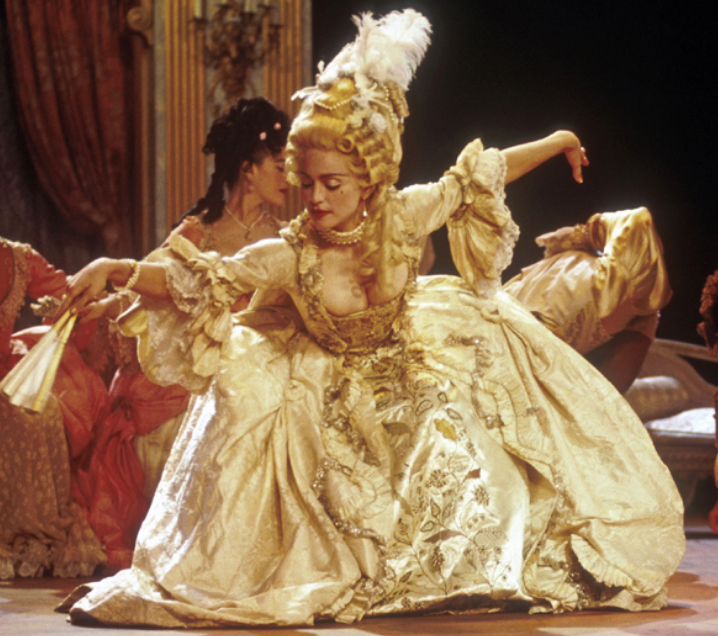
And that was to be the first of many unforgettable performances during this particular awards ceremony, including her 1989 rendition of “Express Yourself,” turning up dressed in full Marie Antoinette regalia to perform “Vogue” with a coterie of gay male dancers in 1990, translating her The Girlie Show performance of “Bye Bye Baby” to the VMA stage in 1993, getting Lenny Kravitz to play guitar for her during “Ray of Light” in 1998 and kissing Britney and Christina in 2003, itself a performance that was a callback to her OG “Like A Virgin” one in 1984. And yes, maybe that’s part of why it was the last time Madonna offered a musical performance for the show (though one can still dare to dream she might return to the stage for some actual singing again), as if the full-circleness of it was an indication that she could do no more for the VMAs at that point, leaving it to the pop princesses of the day to carry the torch.
Spears certainly delivered on that during the years prior to appearing with Madonna onstage for yet another “one for the books” performance, showing up in 1999, 2000 and 2001 to deliver the kind of memorableness that Madonna cultivated from the outset (as for Spears’ stage antics in 2007, well, it was sadly memorable for altogether different reasons). What’s more, Madonna has technically “performed” more times than both Spears and Swift (tied for six performances during the main show), with a total of seven (including her “live via satellite” performance during the Who’s That Girl Tour, with “Papa Don’t Preach” being the song that aired during the 1987 VMAs). And with so much history together, Madonna and MTV being as intertwined as they are, it’s no wonder she’s the second-most nominated artist at the VMAs (after Beyoncé—which is still preferable to being beaten out by Swift).
Though, once again, Swift has her beat when it comes to most actual wins, having thirty “Moon People” (formerly Moonmen) to Madonna’s twenty—one of which is a Video Vanguard Award. And yet, joyfully, Swift doesn’t have as many nominations, still “lagging” behind with eighty to Madonna’s eighty-two, ratcheting up her count with eleven nominations at the 2026 VMAs to Swift’s nine. And while the bulk of those noms for Madonna are related to her short film, Confessions II: The Film, it’s comforting/reassuring to know that MTV still understands that Madonna was, is and will always be the Queen of the VMAs. Still, that doesn’t mean Swift’s shite, “The Fate of Ophelia” and “Opalite”—the videos that got her nominated this year—won’t end up winning out. Not to mention competing with M in the category for Artist of the Year, an award that could also very well go to Swift even though Madonna is the far more deserving recipient (especially after the coup of Confessions II this year). Alas, while you can lead listeners and viewers to water, you can’t make them drink it. In other words, there’s no accounting for taste. Or lack thereof.


