


Maybe the only thing that “come[s] back stronger than a 90s trend” (as it was said on 2020’s “Willow”) is Taylor Swift with a new single just when you think she might have gone quiet for a while. Besides that, she was probably letting the “dust settle” on the disheartening success of a single that bastardizes one of Shakespeare’s greatest works, in addition to waiting for people to move on to the next “scandalous” news item after the leak of her text exchanges with Blake Lively.
Then, of course, there’s the personal satisfaction of being able to say, “See? ‘Opalite’ isn’t some kind of racist dog whistle” after a recent report revealed that, when The Life of a Showgirl first came out, there was a barrage of bots that joined forces to create “a coordinated online attack” designed to “suggest Taylor Swift promoted Nazi ideas.” With “Opalite” being one of the primary examples used to insist that Swift was wielding coded imagery to convey racist thoughts. This exemplified in the chorus of “Opalite” that goes, “You were dancing through the lightning strikes/Sleepless in the onyx night/But now the sky is opalite.”
Apart from Swift using “onyx” (a.k.a. black) to represent “bad” and “opalite” (a.k.a. white) to represent “good” (which took on further racist undertones to people in that Travis Kelce’s ex, Kayla Nicole, is Black), there’s the mention of lightning, which she incorporated into a piece of “Opalite”-themed merch (a necklace) that featured the kind of lightning bolts on it that many were quick to pounce on as looking awfully similar to the Nazis’ “SS” logo, itself stylized to look like lightning bolts. Swift seemingly took the critique to heart, removing the item from her official store (unless, of course, it simply “sold out” to her equally as historically unaware fans) in mid-October after the online commentary about it kept circulating.
All of this controversy would have been well out in the open by the time Swift’s October 28th appearance on The Graham Norton Show occurred (this marking her fifth appearance to date on it, so she must quite enjoy the wine). But, of course, as is the celebrity and talk show host way, “unpleasant” topics like these are never addressed, with asshole-licking being part and parcel of the setup. Besides, the spotlight wasn’t entirely on Swift as she was also joined by Cillian Murphy, Greta Lee, Jodi Turner-Smith, Domhnall Gleeson and, later, Lewis Capaldi. This being how all five of these seemingly unconnected “stars” (apart from Cillian and Domhnall, who are both Irish, so yeah…) ended up in Swift’s latest video for, what else, “Opalite.”
Indeed, it’s almost too uncanny that Norton focused on that particular song from the album, telling Swift, “‘Opalite’ is such an earworm. It’s proper, it really is.” Others might tend to disagree, but since the commentary surrounding the racist “conspiracy theories” about the album have been quelled, one supposes it’s “safe” to say such things again. Besides that, the release timing of “Opalite” as a single further proves another longstanding “conspiracy theory” about Swift: that she “calculatedly” releases new music/music videos right at a moment when other musicians are trying to receive their proverbial flowers.
This week, that would have pertained to Swift feeling left out about not being “included” in the Grammys, in addition to the fact that Charli XCX has released The Moment, yet another endeavor that positions her as something of the “anti-Taylor” in terms of her approach to the music business. And, talking of Charli, she might have been the one to proclaim, “I’m a 90s bitch” on 2012’s “I Love It” (in addition to writing an entire song about wanting to go back to the 90s [specifically, 1999]), but she would probably never make and release a video as cornball as what Swift has done for “Opalite” as a means to show her “90s love.” And while many might speculate as to why/what possible “Easter egg” Swift could be referencing by setting her video in the 90s, the likeliest reason is that it’s a nod to something Cillian Murphy said during The Graham Norton Show.
It happens when Murphy is finally given a bit of a spotlight to plug his latest project (you know, instead of Norton mostly gushing over Swift). At the time, that was Steve, giving him the chance to talk about how the character in the play that the movie is based on (titled Shy) is a “headmaster of a kind of reform school in the 90s.” Norton then notes, “And it’s interesting you decided to keep it in the 90s. Why did you decide to not bring it to now?” Murphy replies that there are a few reasons but that, mainly, “The music was so good then and Max [Porter, the writer of both the play and its film adaptation] is obsessed with drum n’ bass.” What’s more, “We could tell a story where we didn’t have to deal with smartphones and the internet.” Because, yes, smartphones and the internet are what have made youths even more “ungovernable” than they were in the 90s.
And so, aside from wanting to “pay homage” to what Murphy said, Swift also probably concurs that “telling a story” without having to somehow incorporate the use of smartphones or the internet does make it all so much easier. Otherwise, the use of Gleeson’s dancing would have to be for TikTok rather than a talent show/competition. And it’s also Gleeson’s “moves” that Murphy called out on this episode of The Graham Norton Show, telling everyone that The Paper is “just worth watching for Domhnall’s dancing alone.” Swift agrees, “Yes, absolutely.” Gleeson then jokes, “I’m hoping to get in a Taylor Swift music video.” A look of “revelation” then spreads across her face when he says this (a clip she also uses at the end of “Opalite”).
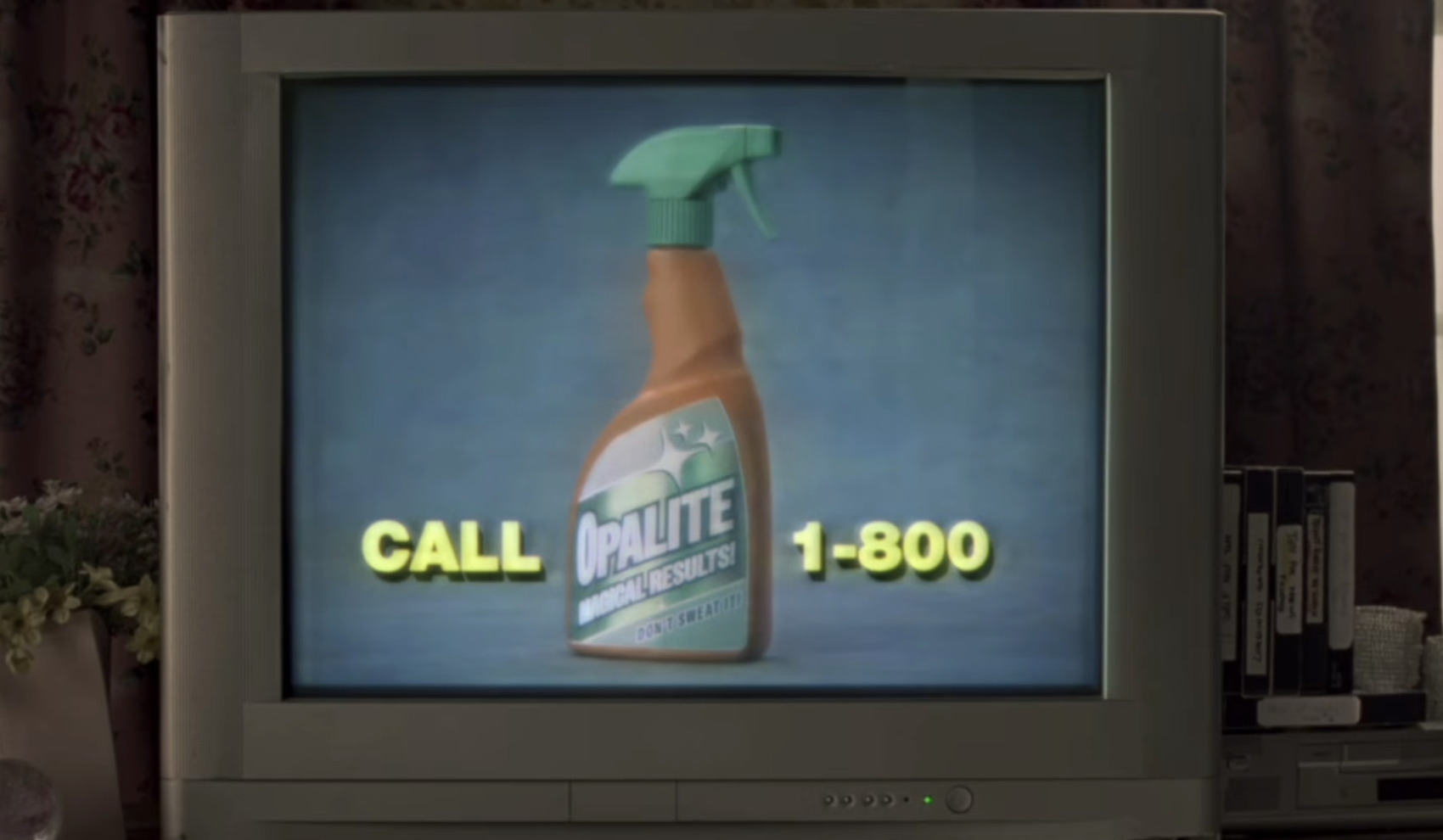
Little did he know, she would want him to play her love interest. But before her co-guests on Graham Norton (including Norton himself) materialize in the video, Swift presents her audience with a riff on 90s informercials shilling products that promised to change (or at least mildly improve) your life (the made-up product here is, of course, called Opalite). And, as a millennial, Swift’s child mind would have undoubtedly been influenced/brainwashed by this kind of “magical improvement” content.
After the infomercial finishes, the video (directed, naturally, by Swift) cuts to “Lonely Woman” (played by, naturally, Swift) sitting on the couch next to a “friendship rock” (which really looks like a Pet Rock) she also most likely purchased from a phone number shown during an infomercial. Swift then shows a montage of herself engaging in various “activities” with the rock—from swinging on a swing with it to trying to play a cootie catcher game with it—that emphasize just how lonely she is and how unsatisfying a relationship with an inanimate object can be (seeing as how “sex robots”—and robots in general—were a long way off in the 90s).
When she even takes the rock to her karaoke performance (while wearing what can be called a “She’s All That dress”), this is where Greta Lee’s cameo comes in, manifesting on a TV screen at the bar in a way that makes her look like a singer doing an “unplugged” set for MTV (the channel she appears on). This, too, being a reference to what was discussed during The Graham Norton Show episode: that Lee was also once a musician—as was Cillian Murphy, who appears via voiceover and in Opalite advertisement form (because obviously, he’s much too credible of an actor to really show up in one of Swift’s videos). Jodi Turner-Smith instead plays a workout guru type (think: Tamilee Webb), instructing Swift on how to use her stepper from yet another TV screen.
Meanwhile, Gleeson doesn’t show up as “Lonely Man” until about halfway through, proving to be the foil to Swift’s “character” with his own kind of inanimate “bestie”: a cactus. Which, as the viewer will see, is far more dangerous to be friends with than a rock. Fortunately, since both of them have ordered Opalite, it ends up magically (that word again) transporting Swift to his house, where he “cleans her up” (because why wouldn’t she look like she was covered in placenta upon arrival?) and the two begin to get to know one another, realizing how much they have in common. Thus, it doesn’t take long for Swift to have no need of saying, “Meet me behind the mall.” Instead, the two show up there front and center together to get their portraits taken by Lewis Capaldi, who is so enchanted by them that he says, “I want to be your friend!” and joins in for the photo session as well.
As the pair continues to travel through the mall, they encounter Norton as an Opalite salesman—and a “Nope-alite” one, this product being the “antidote” to reverse any Opalite effects. Noticing this, Lonely Man is quick to prevent it from being sprayed in their direction, not wanting to lose his flesh-and-blood companion. Needless to say, his maneuvering is successful since, in the next arbitrary scene, Gleeson is permitted to showcase those dance moves that Murphy was speaking so highly of as he and Swift appear in matching glittering blue tracksuits to impress the judges at a dance competition (this allowing Swift’s presumed favorite dancer from The Eras Tour, Kam Saunders, to make a cameo).
What it all amounts to—apart from Swift continuing to assure the masses that there’s no racist messaging to “Opalite”—is that the most “major” artists in the industry really have nothing meaningful to say with their work. Everything is just a repackagement of a reference, whether esoteric or not. Granted, audiences tend to applaud a more esoteric reference because it gives them greater amounts of “sleuthing” to do. This having been a key part of Swift’s success as well: keeping fans digging and discovering so that they can feel both “clever” and “in” on what the fuck she’s talking about. All while making it seem as though every one of her ideas, however shallow, should both 1) automatically come to fruition and 2) prove, somehow, her “writing genius.” This much was made apparent by her stating of the video’s creation,
“My favorite part about writing is that first spark of an idea. It can happen at any time, for any reason. The idea for the ‘Opalite’ music video crash landed into my imagination when I was doing promo for The Life of a Showgirl. I was a guest on one of my favorite shows, @TheGNShow… Anyway. I remember thinking I got ridiculously lucky with the group I was paired with. Cillian Murphy, Domhnall Gleeson, Greta Lee, Jodie Turner-Smith, and @LewisCapaldi . All people whose work I’ve admired from afar. When we were all talking during the broadcast, Domhnall made a light hearted joke about wanting to be in one of my music videos. He’s Irish! He was joking! Except that in that moment during the interview, I was instantly struck with an *idea*. And so a week later he received an email script I’d written for the ‘Opalite’ video, where he was playing the starring role. I had this thought that it would be wild if all of our fellow guests on the Graham Norton show that night, including Graham himself, could be a part of it too. Like a school group project but for adults and it isn’t mandatory.”
Ah, and there Swift goes again, revealing how pretty much everything she does comes from a place of being (and, evidently, wanting to be) “so high school.” Chalk it up to another aspect of her millennial nature, seeking always to revert back to a time, like the 90s, when high school movies felt “romantic.” Like a universe you wanted to be a part of, especially if you were the kind of total dweeb or outsider that Swift so frequently makes herself out to be. Which is why it’s odd that she should try to be so “exclusionary” by only allowing the video’s accessibility to those who subscribe to Apple Music and/or Spotify platforms for the first few days of its release.


