


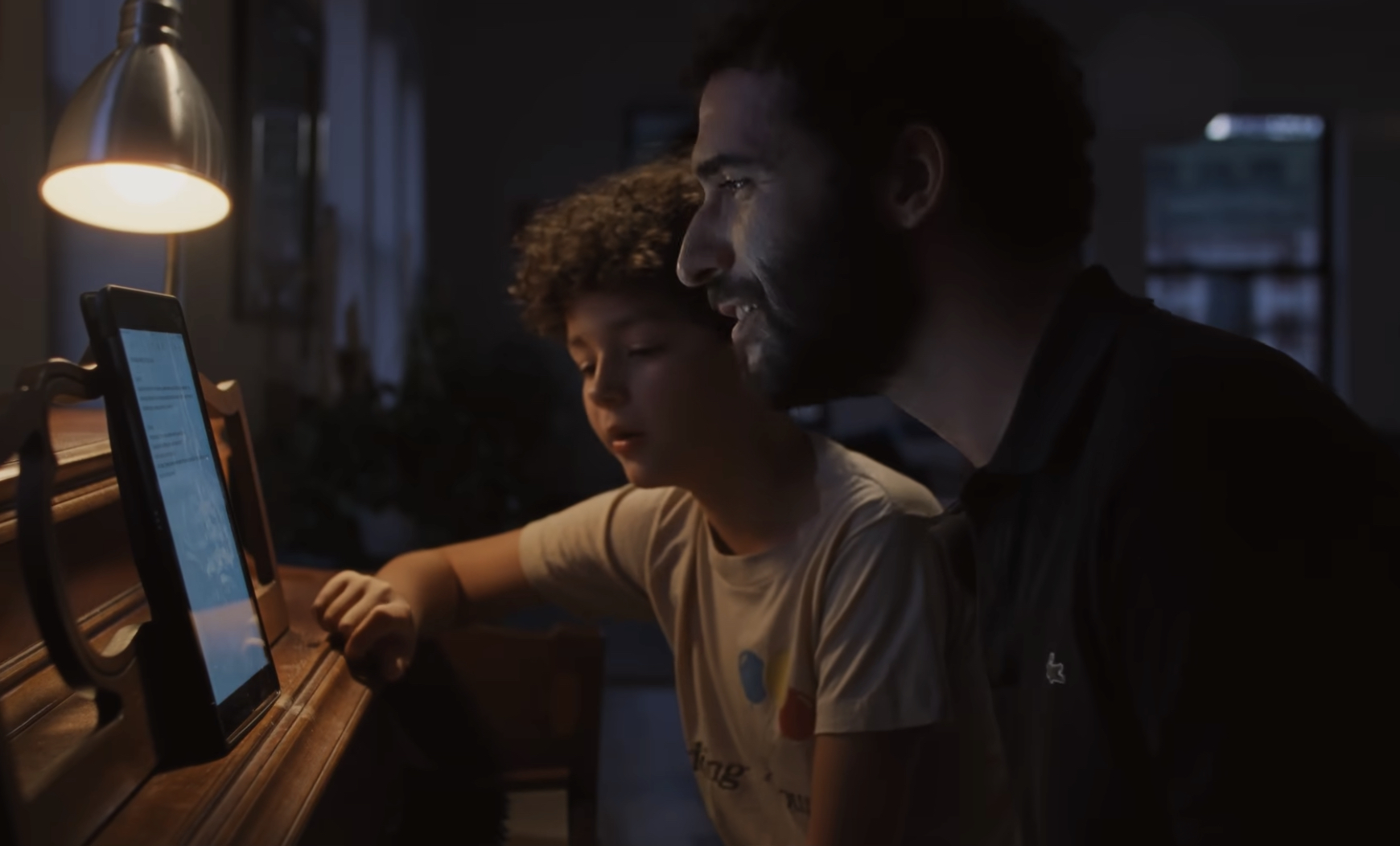
Upon first encountering the trailer for Club Kid, it was difficult (at least for the Adam Sandler “cinephiles” out there) not to liken the premise to 1999’s Big Daddy. As it turns out, the movie itself further cements this comparison. Yes, of course, there are nuanced differences—mainly that Sandler’s character, Sonny Koufax, is merely acting as Julian’s (Cole and Dylan Sprouse) stand-in dad until Kevin Gerrity (Jon Stewart) returns from a business trip to claim him. For Julian, too, has a mother that has recently died and whose wish it apparently was for the one-night stand that co-created him to step in and take over. Much the same as Arlo (Reggie Absolom), the British (another distinct nuance) child at the center of Club Kid, conceived in the midst of an ecstasy-fueled orgy. One during which Arlo’s mother, Leonora a.k.a. Innit Babes? (Paris Petitjean), er, inserts herself after previously making it known that she thinks Peter (Jordan Firstman) is well “fit” when she encounters him at the Club Labor party he’s throwing. This despite Peter making it known that he’s gay. Not bi, gay.
Though that was already pretty clear from the opening scene of the film, when Peter and his coterie of friends (that make up all parts of the LGBTQIA+ rainbow) get into an Uber and start bumping Rihanna’s “Sex With Me.” As the carload starts singing along, Peter declares it (Anti) to be the album of the year, which is intended to let the worthwhile viewer know this is happening in the Year of Our Lord 2016. And if that wasn’t enough of an indication, others in the car then weigh in on additional contenders by shouting about Beyoncé’s Lemonade, Frank Ocean’s Blonde and Kanye West’s The Life of Pablo (as this was before he was 1) Ye and 2) an open neo-Nazi).
And yes, the mention of all these titles does take one back to a simpler time (even before the Orange Creature seemed like a serious threat and actually got “elected” later that year). Specifically, a more “idyllic” time in Brooklyn. Despite their mention, however, Firstman, who wrote and directed the film (his debut, in both of those roles), still feels obliged to provide the caption, “Brooklyn 2016.” Adding, weirdly, to the romanticization of that year, which kicked off at the beginning of 2026. The year that Firstman flashes forward to after revealing to the audience how a gay man might end up with a biological child he previously wasn’t aware he had.
In the present, Peter isn’t having quite so much fun. In fact, one can see he’s experiencing the thing that Joan Didion would describe as “stay[ing] too long at the fair.” In other words, he’s still trying to force himself to feel the way he did about partying at the beginning of his club promoting days, when it was all new and exciting. Now, doing drugs every night feels less like a “joy,” and more like a health hazard/self-imposed burden. Worse still, Club Labor clearly isn’t paying the bills well enough for Peter to avoid drug dealing on the side. And so, in many ways, he’s in a bit of a floundering/“stuck” phase in his mid-thirties, much as Sonny is at thirty-two (the specific age mentioned in Big Daddy). The difference being that Sonny at least has a wad of cash ($200,000) to live off of as a result of a settlement he got after his foot was run over by a cab. Still, that doesn’t do much to comfort his girlfriend, Vanessa (Kristy Swanson), or his father, (Joseph Bologna), who, upon learning that Sonny is acting as a substitute father for Julian, chastises him for agreeing to take on a child, insisting that the Julian will probably end up dead because of him.
Much the same as Sophie (Cara Delevingne), Peter’s best friend and business partner, insists the same of Arlo being cared for by a club kid. That very phrase having the built-in connotation that a person is still acting like a child. Retreating to the club as their version of Neverland. Which is what Peter is inclined to do despite knowing that Neverland becomes increasingly tainted when you know damn well that you’re not a “kid” anymore. And because he’s aware of being stunted, like Sonny, Peter is completely averse to the notion of actually “holding on” to this child on any kind of permanent basis. Unfortunately for his plan to jettison Arlo, he makes these feelings clear to Edison (Kirby Howell-Baptiste), Leonora a.k.a. Innit Babes? best friend who’s brought Arlo all this way from Britain to complete her final “duty” to her. Hearing his concerns and refusals, Edison feigns that she’s just going to tool around the city for a “couple” of hours and she’ll be back to get Arlo later.
Of course, from the moment she starts running out the door, Peter can tell he’s being saddled with this kid whether he likes it or not. Nonetheless, he still tries to find Edison after too much time passes, and he realizes for certain that he’s been had. So it is that he begins his quest—with Arlo in tow, naturally—through the clubs of New York to try and fish her out of her proverbial k-hole (after all, she was with Leonora at the club in 2016, so it’s no surprise that’s the first environment she would unleash herself on the second she got a chance). Along the way, this allows for Peter and Arlo to end up at an intimate party where Shygirl randomly happens to be sitting there, allowing Arlo to further flex his musical knowledge by asking, “Are you Shygirl?” When she confirms her identity, Arlo tells her that they once met before, when he was with his mom. And, in the end, the cameo isn’t so random in the sense that Shygirl wrote a song called “Waves” for the soundtrack and Firstman, despite achieving his breakout role in I Love LA, is of the “New York is so magical, you never know who you might run into” camp.
Indeed, as was the case with Big Daddy (which Club Kid also could have been named were the title not already taken [though, incidentally, Firstman did have a small role in a 2015 movie called Daddy]), New York plays a pivotal role in Club Kid. Granted, Firstman is much more heavy-handed in his romanticization of the city, laying it on real thick when he’s riding in the back of an Uber with Arlo and they cross over a bridge that offers the “classic” skyline view. Peter nudges his half-asleep son so that he’ll get to see it for the first time, leading to his expected wonderment. Then, as if that wasn’t enough, Peter cheesily comments, “It’s like that every time.” As in, Arlo will always “feel butterflies in his stomach” when it comes to “taking New York in” like this.
The romanticization of the city continues when Peter, in the midst of learning that Edison has truly abandoned Arlo by going back to London, takes his son for a day out at places like Balthazar (where he does no favors for the restaurant by calling the food “mid” and saying that people still only really come because it’s an institution) and the record store. It’s at the latter that Peter indulges Arlo in a three-hundred-dollar Elliott Smith vinyl. Because, even if he’s broke, music is one expense a club kid can never resist splurging on.
With the two of them bonding far quicker than Peter could have imagined or predicted (again, à la Sonny and Julian), he starts to think that maybe being a dad isn’t so scary or challenging after all. What’s more, it’s giving him a newfound sense of purpose and self-esteem after Sophie cut him loose from Club Labor, declaring, as Vanessa does to Sonny, that he needs to get his shit together because, as it stands, he can’t be trusted to deal with anything “adult.” Least of all running and expanding a business.
The timely appearance of a son then makes both Peter and Sonny start to grow up and find deeper meaning in their lives just when they needed it. A message that essentially reinforces what society has told women for centuries: your life is worthless if you don’t eventually succumb to being a parent. A message not unlike the one in Picture Perfect, with Kate Mosley (Jennifer Aniston) being discriminated against for her “perennially-in-college” lifestyle. The same judgment being passed on the “deadbeat” likes of Sonny and Peter. First, in life, then, in court (for both movies will involve a thorny custody battle and court scene, as well as a scene of the son in question being ripped away from his father by a “state-mandated” figure).
To be sure, with regard to being a “club kid,” the emphasis remains that, even for the most “progressive,” “unconventional” of people, the “lifestyle” has an expiration date (as many of the original club kids who appeared on Geraldo would go on to prove). That, unless one manages a feat of “transition” like Madonna (who wielded her stint in NYC’s clubland to create a debut single like “Everybody” and then get a record deal from it that allowed her to become among the most famous/successful people in the world), the best one can hope for if they don’t escape the club after “a certain age” is being washed up and the worst is ending up like Michael Alig (who likely would have had plenty of bifteka with this movie’s “preciousness”—and probably bifteka with an actual kid trying to roll with the club kids).
Peter underscores the fate of staying too long in clubland as being inevitably “bleak” by pivoting away from the “lifestyle.” This in the form of partnering up with a social worker named Oscar (Diego Calva) and extricating himself entirely from “the scene” by the end of the movie. With a coda that acknowledges not only Peter’s “personal growth,” but also his acceptance that it’s time for a new crop of “hot messes” to take the reins on partying. And the rhythm of the night plays on, unconcerned with who’s dancing to it, so long as someone is—and preferably not someone too “old.” Which is how the cycle/revolving door of New York itself works.
To the point of youth being the ultimate currency in clubland and especially New York clubland, it bears quoting from Didion’s “Goodbye to All That” essay once more: “It is often said that New York is a city for only the very rich and the very poor. It is less often said that New York is also, at least for those of us who came there from somewhere else, a city only for the very young.” Even so, Peter isn’t likely to leave the city, contented instead to accept that he’s found a new drug to replace the old one (i.e., clubbing). For, as Club Kid and Big Daddy both highlight, having a child does mirror the highs and lows of a drug. Albeit a much, much more expensive kind.


+ There are no comments
Add yours