


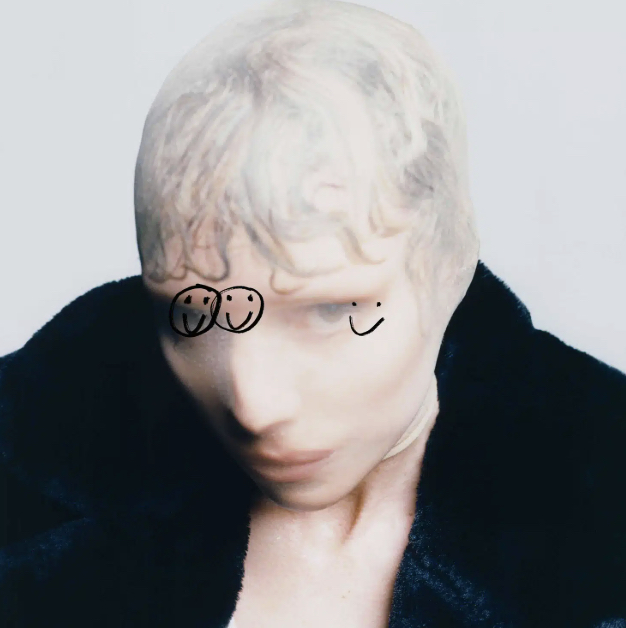
Lykke Li has been teasing The Afterparty for the better part of 2026 and, now, at long last, the full “enterprise” has arrived. Having previously offered listeners the chance to hear “Lucky Again,” “Knife in the Heart,” “Sick of Love” and “Happy Now,” it’s as if all the puzzle pieces have finally come together to reveal one complete picture, starting with the first track, “Not Gon Cry” (not to be confused with the Mary J. Blige song of the same name). Though, if anyone knows Lykke Li’s music by now, of course she’s going to cry—and she’s going to make her listener do the same with her.
So it is that she wastes no time in painting an undercuttingly bleak portrait by intimating that there’s no one out there to save you or the collective “us.” This achieved as she sings, “Eyes to the sky/No angels here tonight/No dancing queens, no/Messiah on these streets.” And, talking of dancing queens, Li described The Afterparty as her bid to try and “be a bit ABBA, if ABBA took a lot of LSD.” Like, a lot, a lot.
And speaking of fellow Swedish icons, one would be remiss not to mention a certain Robyn parallel when it comes to Lykke Li. Not just because, like Sexistential, The Afterparty has nine tracks (four of which were also unveiled before the album came out), but because she, too, has a gift for turning sadness into a danceable ditty. A triumphant sonic landscape. Which is perhaps why she famously sang, “Sadness is a blessing” on 2011’s Wounded Rhymes. And it still seems to be if the majesty of “Not Gon Cry” is any indication. Co-produced by Li, Jacob Olofsson and Björn Yttling, the exultant mid-tempo backbeat is as integral to making the song what it is as lyrics like, “City nights/Some gon’ dance/Some gon’ fight/Some gon’/End up broken like I’m/Tonight, I’m not/I’m not gon’ cry/It’s the rain.”
And yes, her “I’m not crying, you’re crying”-type insistence is precisely the reason why Addison Rae would wield the life hack, “So I cry/But only in the rain” (these lyrics being from Addison’s “In the Rain”). As for Li, she would also like to remind, “I’m all out of lives/I’m no Jesus, I won’t rise.” A lyric that feels particularly poignant considering she keeps making allusions to how this is going to be her last album. At least under this “guise” (which sounds kind of like Abel Tesfaye saying he’s got no more The Weeknd albums left in him either).
Turning forty this year (in addition to recently giving birth to her second child) has likely played a significant part in her making mention of wanting to “hang it up” (though she assures making music will always be in her life, one way or another). Particularly since she sounds keen to show women in her own age bracket a way “to be” artistically. As she told NME,
“There’s so much knowledge about how to be young in all the novels [Youth Novels has a new resonance here], the music, the movies. We have the manual. And then, all of a sudden, you’re forty, and it’s quite uncharted territory. You look at people like Marina Abramovich or Tracey Emin—there are a few people that continue to be completely themselves and fearless. But if you tune in on a frequency level, there’s sheer panic and fear. And that, to me, is quite scary. I want the crone perspective to teach me. I want advice from my female elders, because there has to be something beyond that.”
To be fair, there are a few female elders who have already lit the path. Madonna being someone who’s at the top of that list, continuing to break barriers as she releases what’s likely to be one of her best albums, Confessions II, at the age of sixty-seven. But Li appears interested in a kind of aging that is more “unbridled” than Madonna’s (or Cher’s, for that matter, with both women relying on plastic surgery to stay “pop star-worthy”). A kind of aging that actually chooses to acknowledge it’s happening. Something even Taylor Swift, for as “faux candid” as she is in her “deeply personal” songwriting, has yet to do. In fact, Swift still clings to “girlhood” as much as any pop star has been conditioned to do. As for Li, she’s created what amounts to an entire “concept album” around what it means to age (in a manner reminiscent of Blood Orange’s own elegiacal [despite also only being forty] Essex Honey, released the same year Dev Hynes entered his forties).
In this respect, she stated in an interview with High Snobiety, “At the pregame, you’re young, you could meet the love of your life, you have everything ahead of you. It’s such an exciting time. At the afterparty, you’re drunk as hell, and what’s coming is harsh sunlight and a massive hangover. It’s being able to see the end—that what’s coming is really death.” Talk about someone who likes to get “way too heavy” at a party. And it also speaks to a daybreak/daylight metaphor (the first of many) she wields during “Not Gon Cry”: “Sun show your teeth/This dawn is breaking me.” Followed by her “I’m all out of lives” comment.
Like most of her songs, “Not Gon Cry” has a “jilted lover” perspective, but, in many ways, she’s directing her anger and defiance at her own sense of lost youth. But it’s more difficult to make that kind of abstract leap on “Happy Now,” a track that, once again, appears to be aimed at a disappointing ex. And one who has likely moved on not just from her, but the intensity of feeling they might have once had for her. Though, naturally, it seems no one can match Li’s intensity, particularly when she makes addict analogies like, “I’m still a fiend, it’s killing me/I’ll chase the high anywhere.” She’s chased it, in fact, all the way into 2026. For the same level—if not an even higher one—of ardor she conveyed on Youth Novels is present here. And maybe that’s because, in the eighteen years since Lykke Li’s first album, Youth Novels, came out, she’s released a total of six records. In other words, she’s not the type of artist who feels pressure to “churn things out” the way, say, Taylor Swift does (yes, again, with the Swift comparison, since she’s considered some kind of “benchmark” for women in the music industry).
From the very beginning of her career, Li has worked with Björn Yttling (perhaps still better known for his role in Peter, Bjorn and John). The duo’s partnership on The Afterparty reaches new heights of brilliance, likely because it’s “way existential.” Ergo, “spiritual” (as was Madonna’s Ray of Light, still considered her best album because of that spiritual searching). That theme prompting Li to rightly note to High Snobiety, “I would say that this is my God album—LSD God, all-is-one, the source, energy, all of that.” Ah, the mention of LSD again. Which she surely must have at least micro-dosed to create “Lucky Again,” the lead single from the record. As a song that samples from Vivaldi’s famed The Four Seasons, Li homes in on the death metaphor/motif she sought to evince with “the afterparty” concept. Though, in this case, it’s more about a “circle of life” energy, describing it as a “samsara” song. More specifically, “The wheel of life; winning, losing, living, dying. Having had something and praying you’ll have it again. Whether it’s sex, money, vitality, love.”
On “Famous Last Words,” Li’s tone about maybe “having” or “touching” something again isn’t quite as hopeful. And the aura of moroseness is immediately apparent with the opening piano notes that let the listener know this is going to be a “sad bar song.” To that end, Li begins with, “Do you have a cigarette to spare?/Take me somewhere/I don’t care” (the “take me somewhere” line also teased on her Instagram account at the end of February, with an image of her carrying a synth while walking past a building whose windows have that phrase on it giant letters). It’s all very Morrissey singing, “Take me out tonight/Take me anywhere/I don’t care, I don’t care, I don’t care.” So long as Li can forget about herself and her troubles, if only for a little while.
Otherwise, she’ll just have to “show you what it takes to fill the void” herself. Or, worse still (for those who don’t want to know or see the truth), she’ll tell you the things no one else will. Like, “They say it won’t hurt/Baby, it only gets worse.” A warning that far more youths should be aware of. Then again, it’s impossible to believe that “til it happens to you” (as Lady Gaga would say). “It” being running out of steam/losing enthusiasm for the proverbial party. In short, “getting older.” Thus, Li candidly admits, “I’m a phoenix, baby/The flames no longer burn/Trust me, it won’t hurt/Famous last words.” And if the flames no longer burn, how will she be able to rise from the ashes of them this time?
But, if nothing else, the pain has served as her long-standing inspiration as she explains, “Had to crash and burn to tell the tale/It takes a hammer/To know a nail.” That last line reminding one of the Lorde lyric on the opening track of Virgin, “Hammer,” during which she sings, “When you’re holding a hammer, everything looks like a nail.” And, although it was “Sick of Love” Li was talking about when she posed the question, “What if I just pretend that I’m Brian Eno and I go into a room with modular synths and EBow and just kind of go ham?,” it applies to “Famous Last Words” as well. Complete with referring to herself as a “bad boy” (in truth, many male rock stars inspired her for this album, including The Beatles, The Rolling Stones, The Verve and Radiohead). This perhaps being a “Future Fear” of hers come to life in the present. As for the title of that “song,” which comes in at the “midpoint” of the album, track five, it comes across like more of an interlude.
And that’s not just because of it’s one-minute-twenty-three-second length, but also the “novelty sound” of Li’s high-pitched opening that finds her stating, “I love you, I don’t trust anyone/I’m going to a dark place, do you need anything?” This being among the first lyrics she posted on her socials at the beginning of the year. And the first lyrics she posted in what can best be described as her own version of Drake’s If You’re Reading This It’s Too Late font. The childlike voice admitting to this sense of fear—ultimately synonymous with anxiety—then starts chanting (for an effect that is, indeed, eerie), “Future fear, no regret, couple lefts/I’m scared, I’m scared, I’m scared.”
Eventually, the high-pitched voice insisting, “I love you” (despite not trusting anyone—which is what love requires a person to do) is intermixed with an ultra-slowed down voice saying the same. These converging vocal effects serving to highlight the antithetical statement, “I love you, I don’t trust anyone.” Li then leans into the analogy of an afterparty by saying, “Afterparty, morning after, after life.” A string of interconnected words that lead perfectly into her normal voice singing, “I’m not young, it’s just late/Kiss me, the sun’s going down.” Yet another ominous metaphor about aging that relates to times of day. So naturally, Li would then transition right into “So Happy I Could Die.”
As one of the slowest jams on the record, it also marks the second song to mention the word “happy.” Even though it often doesn’t seem like she is at all throughout this record. Yet contrary to the dichotomy of her music, Li has said she leads a life that isn’t nearly so melancholia-filled as her songs. Songs that declare things like, “Happy Hurts” (track four on her last album, Eyeye)—yet another title with that word in it. But one could also argue that without exploring—plumbing—the depths of sadness, it would be more difficult to appreciate/fathom true happiness when it’s at last found. On “So Happy I Could Die,” she does find it, even if only for an ephemeral night. Yet the song starts sometime in the day, with Li once again mentioning the sun via the opening verse that goes, “The sun is in my eyes/I know I might be blind sometimes/Ooh, what if I fall?/Ooh, it’s nothing at all/You make me happy tonight/Happy, so happy I could die.” It’s a sentiment that feels oddly aligned with Kesha’s “Die Young” when she sings, “So while you’re here in my arms/Let’s make the most of the night like we’re gonna die young.”
The Kesha correlation persists (and, yes, one could envision her covering this song with an interesting interpretation of her own) with party (or afterparty) imagery that adds, “I hope you’re wasted too/I’m drunk enough to say I love you.” Alas, Li starts to question her happiness about halfway through the song when she ruminates, “How long can it last?/We’re just slipping through the hourglass.” She doesn’t just mean humans “at large,” of course, but rather happiness itself. And especially happiness theoretically gleaned from romantic feelings for someone else, always doomed to disappear.
Having anticipated the inevitable comedown from her happiness high, “Sick of Love” is the hangover that follows “So Happy I Could Die.” Because whoever she was with at the party has suddenly found a new love interest that Li characterizes as being “television pretty” (though she doesn’t make the distinction between “network television pretty” and “streaming [the modern-day equivalent of cable] pretty”). Spending most of the song lamenting how her own looks can’t measure up to this new woman who’s gotten her erstwhile boo’s attention, Li warns, “When you’re sick of her/I’ll be sick of love.” In effect, this man will realize too late that “you don’t know what you’ve got till it’s gone” (or so Li hopes that will be his revelation—but it might only be her wishful thinking).
Just one of many examples of how this life is, as the song that follows succinctly phrases it, a “Knife in the Heart.” And no one has explained that better to the masses over the past eighteen years than Li. Which is perhaps why she’s a bit tired of doing so, and ready to hang her hat up on this endeavor she calls “Lykke Li.” Though maybe “hat” isn’t the right word, so much as nylon stocking or trash bag—both of which she’s put over her head for different photoshoots during this album cycle. And in one case with the trash bag, she hilariously captioned it with, “No filter just a trash bag on my head who’s with me!!!!!!!” This is, in essence, the crux of The Afterparty: Li holding up the mess for all to see (and at one point on “Famous Last Words,” she even says, “I’ve been a bad boy/Made such a mess”). Unabashedly and unapologetically. Which also comes across in the few interviews she’s done to promote it. Including one for Nylon during which she asserts, “I wanted to reflect the world we’re actually in: war, poverty, recession… The album is really conceived on the street… I’m just tired of people flaunting money and plastic surgery. Fuck that. That’s not what most people’s lives look like.”
But even for those many people whose lives do not flaunt money or plastic surgery, they can still experience the fleeting moments of happiness that the sparsest song on the album—which is rightly the last one—embodies. Aptly titled “Euphoria” (and probably far more enjoyable to experience than season three of the TV series called the same), it begins with a musical and vocal intonation that kind of echoes Bradley Cooper and Lady Gaga on “Shallow” before eventually finding its own footing. Though it still has that “Shallow” bent when she advises, “On a night like this/Put your best dress on/You, you can dance on, dancer/Baby, I will/Take your sorrow on my shoulder/We can borrow euphoria/Though it won’t last, hallelujah/Least we knew ya, euphoria.”
Reading as much like an elegy for the end of the world as it does for the good, carefree times of youth (and also her career), Li brings a “time of day” metaphor into it again with, “Waste the night away/There’s a black moon sky.” Whether the sun will ever rise again for the person navigating this particular “afterparty” doesn’t seem like a given. And, as Li herself summed up the concept behind the record, “It’s kind of this night creature who’s like, ‘Come with me. We’re going nowhere. You wander through a dystopian concrete jungle trying to make it to dawn. In a way, this album is from my lower self, trying to find my higher self.”
Whether she truly has by the end of The Afterparty is at the listener’s discretion. Though the entire album is fundamentally one giant existential question posed into the proverbial abyss: what now? Based on what Li has proven herself capable of time and time again, it seems likely that, sooner or later, she’ll have an answer. For it appears as if no one else really does, save for the usual Britney Spears adage of, “Keep on dancin’ till the world ends.” And, in its way, The Afterparty does encourage that sentiment. Only it applies not to the end of the world as much as it does to the end of one’s thirties.


