


As a rule, tapping Americans to sing in any language that isn’t their own is a generally bad idea. One that always results in, to those with an actual ability to speak and understand the language in question, ear assault. This is what recently happened when Mariah Carey’s on-again, off-again nemesis (though mostly the former), Madonna, did her best to pay homage to her Italian heritage with a cover of Patty Pravo’s 1968 single, “La Bambola.” This done as part of her ad campaign “duties” for Dolce & Gabbana’s The One fragrance (on a side note: shortly after the release of the commercial, D&G caused controversy yet again with accusations that their by-now-well-documented sense of prejudice reared its ugly head again at Milan Fashion Week).
However, one thing that Madonna would probably never do—aside from recording a Christmas album—is deign to sing in Italian at the Olympics. Not only because, evidently, it isn’t a paid gig, but because, well, Madonna honestly isn’t as clichély American as someone like Mariah Carey, who seemed to jump at the chance to “represent her country” in some way at a time when most with even a slight sense of shame wouldn’t want to be associated in any shape or form with the U.S. at all.
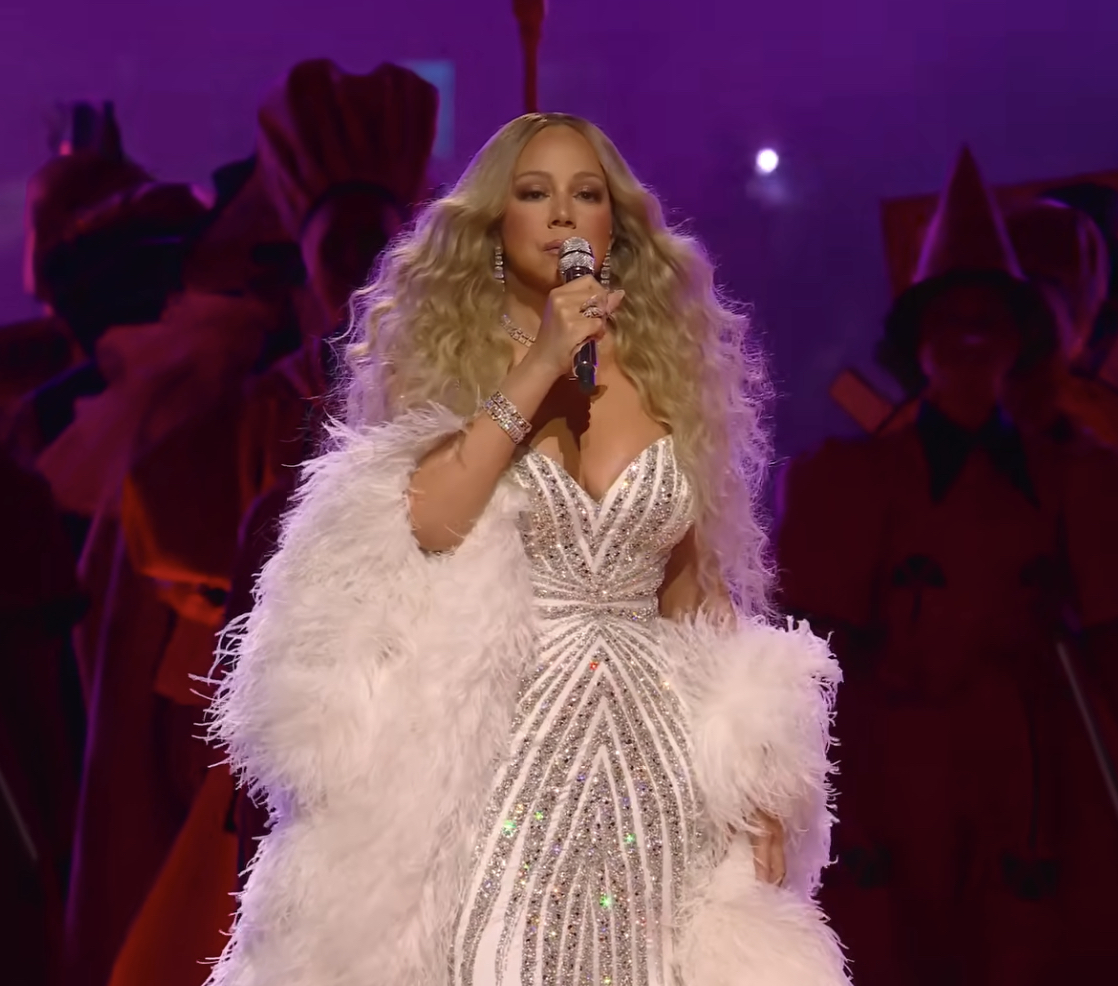
Then again, maybe Carey is the perfect celebrity to help further embody “the meaning” of the U.S. right now: willfully excessive (dripping in diamonds and feathers as she was for her appearance) at a time when it’s never been more obvious that most everyone else is starving in one way or another. And while her intention might have been to “honor” Italy by singing one of its classics, “Volare” (a.k.a. “Nel blu, dipinto di blu”), the result was quite the opposite. For, instead, it came across as if she was phoning that part of the performance in, right down to the fact that it was pretty damn obvious she was lip-syncing (and honestly, there’s many a drag queen out there who could have done a much more convincing job of it). Something that a constantly-peacocking-about-her-vocal-prowess diva like her ought to know isn’t a good look.
And, truly, if one is going to lip-sync in Italian, they could at least pre-record the track to have a better, less gross accent. This, in part, is why “La Bambola” by Madonna now sounds so much more listenable than Carey’s endeavor to sing an Italian classic “live.” For it’s apparent that Madonna at least tried her best to get the accent right (or as right as it can be coming from a Midwestern girl who can’t even nail a British accent, as she overtly attempted to for many years during the late 90s and early 00s).
But throughout Mariah’s bid to “sound Italian,” it’s clear that she must think that the extent of “being a part of” Italian culture is making linguini with clam sauce (though, from the sound of it in her memoir, The Meaning of Mariah Carey, it probably doesn’t taste very good). And while the Olympic organizers were likely wishing that Lady Gaga hadn’t already performed at the Paris Olympics’ opening ceremony (since Lady G has, sadly, become the requisite go-to for the American version of “being Italian”) so they could have asked her instead, they probably thought a pro like Mariah could, at the bare minimum, carry a tune.
Alas, as she stands there looking like she gulped down too many Valiums and kind of sways back and forth like she’s trying to hide that fact, Carey proved a long-standing stereotype about Americans: that money is the only thing that motivates them. And since none was slipped to Carey for this performance, it appeared as if she wanted to reflect that adage, “You get what you pay for.” That meant pronouncing Italian words like “felice” as “fay-lee-chay” and strategically holding the microphone over her mouth to mitigate being able to tell if her lip movements weren’t quite synced up to the lyrics.
Carey then transitioned into one of her own more recent songs, “Nothing Is Impossible” (a rather generic “empowerment anthem”). A declaration that didn’t feel grounded in reality since what is impossible, as history has shown, is an American in the public eye’s ability to speak a foreign language without butchering it. Her choice to sing this particular number (almost as disinterestedly as she sang “Volare”) ultimately amounted to wanting the existence of Here For It All to remain somewhat fresh in people’s minds.
Thus, it became rather obvious that, even more than trying to “represent America” at the Olympics, Carey wanted to represent herself. And in the process, she unwittingly made Madonna’s vocal delivery of Italian lyrics sound so much more listenable. Which is really saying something.


