


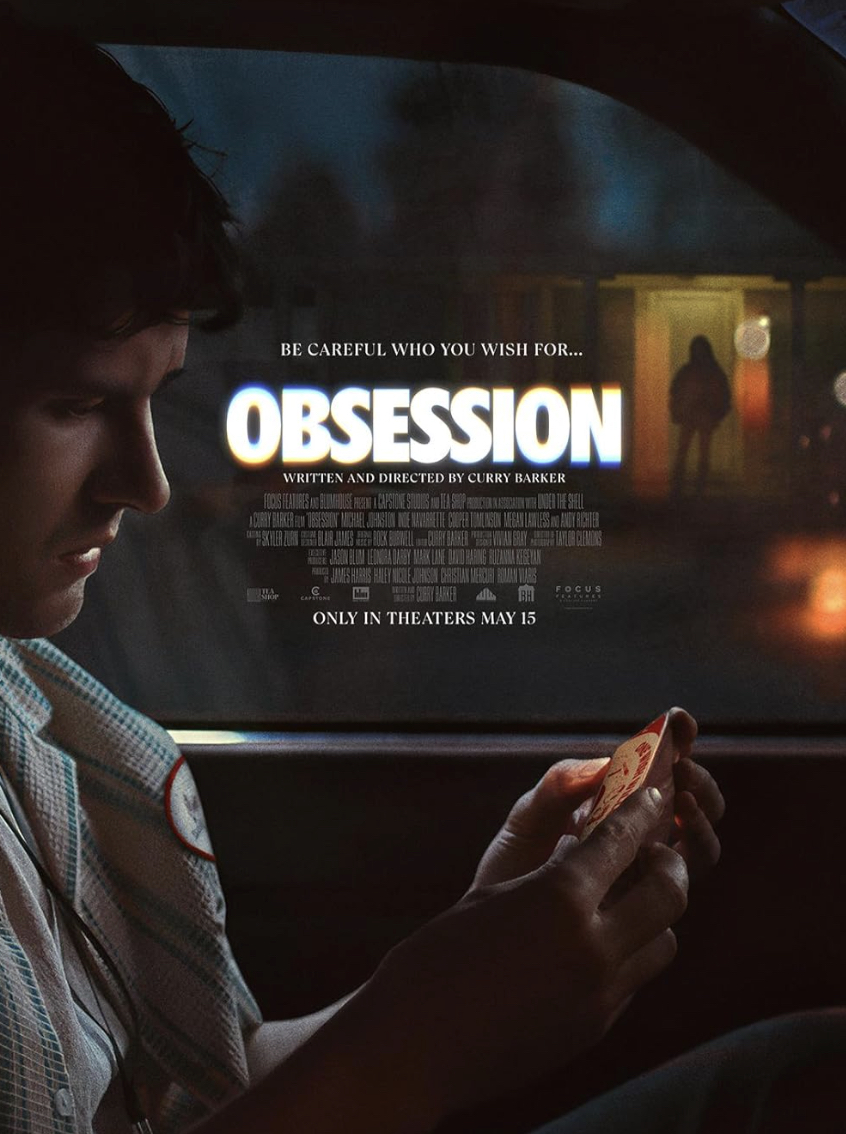
Because romantic love is no longer a “currency” in film (or in life) the way it used to be, it seems rarer and rarer to see a portrayal of a man or woman “consumed” or “crazed” by it (even though the upcoming movie Finding Emily does touch on some of that “old school” obsession). And so, in order to see it onscreen in a modern context, it makes sense to render it into a horror concept, as Curry Barker’s second feature, Obsession, does. Granted, in a manner that is decidedly Tales from the Crypt-esque. Even the title itself, so unabashedly generic, is akin to a Tales from the Crypt episode name. In fact, Obsession is similar to a very specific episode of said series: “Loved to Death.” Which served as the premiere of season three in June of 1991. A year before another movie about a magical entity that can make person fall in love with someone against their will came out: Love Potion No. 9.
However, the nature of Obsession’s “magical” plot device isn’t related solely to making someone fall in love with you, but that’s the way that Bear (Michael Johnston) chooses to use the magic, embodied by a “novelty item” called a One Wish Willow. This being Obsession’s answer to a monkey’s paw (from the famed short story of the same name by W. W. Jacobs). In fact, it wasn’t Tales from the Crypt that Barker cited as his source of inspiration for the story, but The Simpsons episode “Treehouse of Horror II,” which also aired in 1991 (though several months after Tales from the Crypt’s “Loved to Death”). And while whoever buys a One Wish Willow from the “mystic” shop can use it to wish for anything, not just for love, Bear makes the fatal error of breaking the stick-like entity as instructed and then telling it, “I wish Nikki Freeman loved me more than anyone else in the fucking world.”
Nikki (Inde Navarrette) is a girl that Bear has known since childhood and, now that they’re in their post-high school years, they both work at a music store (as in, one that sells instruments, not, like CDs and records). As do their fellow “aimless” friends, Ian (Cooper Tomlinson) and Sarah (Megan Lawless). Though Sarah has ambitions to attend an art school, and has been awaiting letters of acceptance from various institutions. Bear, Nikki and Ian, however, all seem content to work at the music store, which is owned by Sarah’s father, Carter (Andy Richter, the name with the most “star power” in the movie—an indication of its budget). This noncommittal job setup, too, is part of what lends the movie a kind of “90s feel” with the “slacker energy” of the characters (think: Empire Records or Reality Bites). Thereby even more firmly rooting it in Tales from the Crypt’s era.
Spending so much time with Nikki day in, day out is at least part of what prompts Bear to be “so in love” with her. As is her inherent unattainability. Making Bear a kind of Dawson Leery to her Jen Lindley, especially since the latter is also deemed slutty a.k.a. “freaky.” That being the word employed as a key part of her unwanted nickname of yore: “Freaky Nikki.” The “throwback” Ian advises Bear to use on her as a way to flirt rather than pouring his heart out and being mushily direct about his feelings toward her. As he is in the opening scene to Obsession, which gives the viewer more than a slight sense of where he’s coming from. And while, at first, it does genuinely come across as if he’s confessing all of these deeply personal, therefore embarrassing emotions, it turns out Ian has instructed him to just practice what he’s going to say on the waitress at the diner they presumably frequent. And while the waitress might be moved by it, Ian is repulsed, saying he had no idea it was going to be that bad and explaining to him that Nikki hates that type of shit.
At a loss for how to proceed, Bear decides to get her a “kooky” gift from the mystic shop after she tells him over the phone that she just lost her crystal necklace. That gift being the One Wish Willow, which he never does get around to giving her, dropping her off at her house after the gang’s regular meet-up for a bar trivia night and getting cold feet when it comes to telling her. Even though she’s intuitive enough to ask point-blank, “Do you like me?” Bear insists he only likes her as a friend, missing his best and only opportunity to say how he really feels. So instead, he himself turns to the One Wish Willow on a lark, only mildly sketched out when Nikki suddenly reappears and invites him to come inside.
After a lot of back and forth, she talks him into taking her to his house (which he conveniently inherited from his grandma). This achieved by claiming that she just found out her dad is dying of cancer and she doesn’t want to be alone. So much so that she even uses it as an excuse to insist that Bear sleeps in the bed with her, with one thing quickly leading to another so that she can kiss him. Something that Bear is delighted and aroused by until, somewhere inside of this husk before him, the real Nikki comes through to scream in protest. Bear is terrified, thinking that she doesn’t want this at all, but is then assured by the “Loving Nikki” that she just had a momentary panic attack and everything is fine.
This form of bizarre, unsettling behavior of course only escalates as Obsession progresses. In the same way that, in “Loved to Death,” Miranda Singer (Mariel Hemingway), an actress for sleazy movies that usually involve her disrobing, becomes increasingly crazed with love and obsession after Edward Foster (Andrew McCarthy), a neighbor of hers who lives in the same building, laces her drink with a love potion (again, something Love Potion No. 9 would make the crux of its plot in 1992). One that, as the One Wish Willow does for Nikki, transforms her into a hovering, insatiable “nightmare.” For the thing that most men deem terrifying is an “overly present” woman who seems to have no life beyond “tending to” her man (hence, why Peggy March’s “I Will Follow Him” is the sonic representation of every man’s worst nightmare).
That’s why the fantasy of “the woman of his dreams” reciprocating Bear’s emotions ends up going south so quickly. Not just because her emotions aren’t genuine, but because they turn her into someone “clingy” (the opposite of what Bear “fell in love” with). And because her feelings are entirely forced by the One Wish Willow, the dormant “real” Nikki inside of the obsessed one is able to scream in agony over the customer service number for the “product,” for she’s now but a trapped soul.
Not entirely wanting to acknowledge this, Bear calls the One Wish Willow number hoping he can “alter” his wish (and certainly, Obsession is set up in such a manner that there could be multiple installments of it that home in on a different person’s wish gone awry…this also adding to its Tales from the Crypt, “story of the week” vibe). Though he doesn’t seem to understand that no alteration will ever make a wish “improve,” for there’s always a caveat. That’s the thing about wishes. Ergo, the cliché, “Be careful what you wish for, you may receive it” (which appears, in fact, in Jacobs’ “The Monkey’s Paw”).
Obsession changes that adage with a tagline that reads, “Be careful who you wish for.” And who Bear wishes for is a girl that doesn’t ultimately exist. Because, in taking away her agency, he also takes away the essence of who she is (which, from what the viewer is let in on, is a willful, eye-rolling sort of person who would never go for meek, mild-mannered Bear, even if she “appreciates” him as a friend). The same goes for Miranda in “Loved to Death.” Though, in contrast to Bear, it seems as though Edward is mostly attracted to her based on appearance alone and not her, let’s say, “winning” personality. In other words, her crass one, considering she tells Edward outright that she wouldn’t go on a date with him unless he was actually rich and famous—as if that ever happens to the average screenwriter. Least of all an aspiring one. In Nikki’s case, at least she’s presented as some kind of “benevolent” soul, even if in hackneyed forms like a scene of her asking Sarah for some money as if it’s for herself and then going over to the homeless man she sees outside the bar to give it to him, promising after that she’ll pay Sarah back.
So sure, how could Bear not fall in love with someone like that? Though, in the early 90s, falling in love, for a man was fairly limited in its presentation onscreen, relying solely on a woman’s level of “hotness” as a reason why he would “go crazy” over a “broad.” Especially one that shows off a “sexpot” aesthetic like Miranda, who, upon unwittingly drinking the love potion administered to her by Edward (who got it from his creepy and mysterious landlord, Mr. Stronham [David Hemmings]), suffers the same unfortunate fate as Nikki: to completely lose her sense of identity as she funnels all of herself into “loving” the man who claimed to want so badly to be loved by her.
And yet, when it actually happens, he’s appalled. Suddenly changing his mind—even though, as Nikki is sure to remind him when she enlists his help to dispose of a certain person she’s turned into a corpse, this is exactly what he wanted. Or so he believed. But Bear’s sudden change of heart right when Nikki changes her own to suit his desires is in keeping with the message of “Loved to Death”: people (and men in particular) are never really that sure of what they want when it comes to love. Often having convinced themselves of what they wanted because of so much societal conditioning. That both Bear and Nikki (when she’s momentarily herself for that brief scene before he goes out to meet Sarah in the middle of the night) express dissatisfaction with one another is a testament to how no one can live up to the expectations projected onto them. Part of those expectations usually being that another human being can somehow be their “salvation.”
As both Bear and Edward quickly find out, trying to carry out that wish is far more trouble than it’s worth. Not only that, but entirely taxing on both an emotional and physical level. To that point, Miranda tells Edward toward the end of the Tales from the Crypt episode, “I’m gonna drain you dry.” She doesn’t just mean literally (for she’s been “making” him fuck her ever since she “turned”), but figuratively as well. The same goes for a possessed Nikki, a woman who keeps intermittently trying so desperately to be herself again that she’ll go as far as self-harm to do it. And here, too, Barker makes a statement about how so many women feel forced to lose themselves—their own true identity—in order to “make” a relationship work. Often entering into one because it’s still considered the thing you’re “supposed to” do.
As for the ending of each “tale,” it’s “Loved to Death” that has the more sardonically comedic one, with Edward trying and failing to kill Miranda with yet another “drink elixir” (courtesy, again, of Mr. Stronham) only to end up taking the wrong glass for himself and dying. But even then, he’s not given any peace, for Miranda kills herself by jumping out of the apartment window so that she can follow him into “heaven.” Which now becomes Edward’s version of hell as she keeps talking about being together “forever.”
In Obsession, Nikki is instead the one to pay for Bear’s sins, even though she’s “set free”—only to enter a fresh prison when she “comes to,” as it were, and sees what’s happened “while she was sleeping.” So it is that each iteration of this “forced love” narrative is a commentary on the “suffocating” nature of monogamy, particularly as viewed from the male perspective. Or at least the male perspective as funneled through pop culture…


[…] many (and most) characters’ actions. In Curry Barker’s second feature, called none other than Obsession, the title itself goes to show just how much that still holds true today in modern storytelling. […]
[…] in the relationship they thought they wanted, only to realize maybe it’s not (see also: Obsession as an allegory for […]