


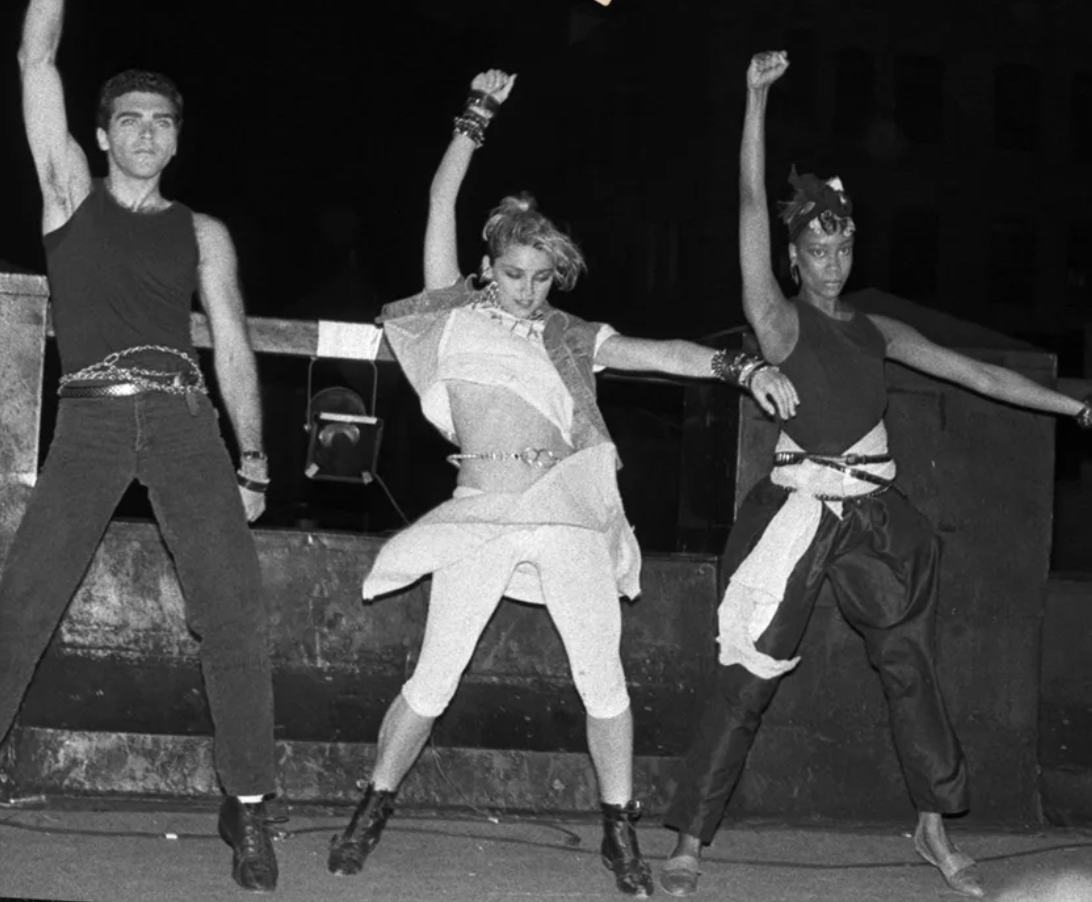
As Charli XCX (who accompanies Madonna on the Afterhours Mix of “Danceteria”) would tend to agree, there’s nothing like a party to bring together all walks of life. Therefore, those from all walks of “industries.” And, for Madonna, there was no industry more important to her during her Danceteria-frequenting heyday than the music one. More specifically, becoming a major player in it. Thus, despite generally turning her nose up at what “partying” connoted for most people (i.e., losing control through drug use), Madonna could quickly see the value of at least feigning a bit of a party girl persona for the sake of “playing the game” a.k.a. networking. In fact, doing so was absolutely integral to her securing a record deal thanks to “becoming friendly” with Mark Kamins—the DJ who had an in at the labels—and offering him cocaine in the bathroom of Danceteria. This after noticing that he, like so many people living in the 80s, had a fondness for “skiing the slopes.”
As she told Mel Ottenberg in Interview magazine, “…eventually I ended up in a bathroom with Mark Kamins, and I saw him snorting coke… I started putting two and two together and I was like, ‘Okay, he likes this, he likes that.’ … So anyway, I brought him some coke in the bathroom, took him in the stalls, me and Debi [Mazar].” Ottenberg then notes that surely Madonna must have done a bump too, if for no other reason than to seem at least slightly genuine with her “casual” merrymaking at the club. Madonna confirms, “Of course, but it hurt my throat. And I was like, ‘This isn’t a good idea for a singer. I want to have a job more than I want to have fun right now.’” To be sure, Madonna always wanted to have “a job” (a.k.a. “to rule the world”) more than she wanted to have fun. It’s part of the reason one of her first hit singles, “Holiday,” became something of a running joke for her (as she makes clear by poking fun at it during her performance of said song during The Girlie Show). For, with a determined, indefatigable work ethic like hers, the notion of “taking a break” or “partying” was always anathema.
And yet, considering Madonna arrived in New York during its literal and figurative last days of disco, avoiding “the party scene” would have not only been all but impossible for a creative person in search of both community and networking opportunities (back when 1) they felt more organic and 2) they weren’t “organized” in a liminal space), but also a huge faux pas in terms of missing out on “quintessential” New York before it became fully overtaken by corporations and yuppies (later rebranded as “hipsters”). Something Madonna didn’t have to endure during her non-famous days in the early part of that decade. Though the coinciding of the city’s fundamental “change” and transition with Madonna herself “going corporate” by becoming famous and leaving behind her “club rat” days does feel kismet. Almost as if they were in sync. Or at least that’s probably how someone with Madonna’s main character syndrome (especially in her more hubris-laden youth) would see it.
Just as she would assert to Ottenberg of her unstoppable ambition, “From the get-go, I was like, ‘I’m making it. I’m going to be somebody.’ Nothing could stop me. I was paying attention to shit. I also realized that if you’re partying, you’re not paying attention to shit, so I never got into that either. I’m sure I was the only sober person at Danceteria.” Save for when she “had to” engage in that “little bump” in the bathroom in order to endear Kamins to her (“outing” him and his “habit” decades later with a verse like, “Then I see Mark Kamins is the DJ/He’s a DJ/Hide the cocaine” on “Danceteria”). In other words, Madonna, like the good businessperson she’s always been, understood that even if she wasn’t “into” partying and what it entailed (“not paying attention to shit”), it was essential to her success. For nowhere else was she going to get the kind of networking chances that were available to her inside the walls of Danceteria.
Which brings Charli XCX up again. Since, as something of the party expert of her generation, it’s she who remarked of the cauldron of emotions and opportunities that can happen in such an environment, “So much stuff happens at parties. You meet people who you fall in love with. You’re with some of your best friends. You break up with someone. Partying is a place where I feel very free.” As did (and does) Madonna, even writing a song called “I Feel So Free” for Confessions II that addresses that topic—how the dance floor a.k.a. one big party makes her feel so free. And, ultimately, so rich and famous. For were it not for that “cozying up” to Kamins (“…we made out, we did a little blow and then he agreed to listen to my demo”), Madonna might not have gotten a record deal. Since it was only after becoming a “main squeeze” of Kamins that A&R music executive Michael Rosenblatt showed up at Danceteria.
Madonna, who was in the DJ booth with Kamins when this happened, convinced him to play “Everybody” during his set, mixing it in with what “could have been Kurtis Blow or the Sugarhill Gang, or Afrika Bambaataa,” as Madonna recalls. When the crowd kept not only dancing to the song, but actually vibing to it in front of Rosenblatt, it opened the gateway for him to recommend Madonna to his boss, Seymour Stein, the president of Sire Records. And the rest, of course, is history. A history somewhat preserved by none other than Madonna herself, who pushed for Danceteria as a filming location for Desperately Seeking Susan, her true first movie (since few count A Certain Sacrifice).
As for those who remember Madonna when she was just another “aspirant” and “scene queen,” it was Michael Musto (known for his malignments of the pop star) who said, “She was so unpleasant I called her priMadonna. But it was clear that she was talented and driven and had such tunnel vision about making it. Danceteria was a really good venue for her to step up that ladder.” In short, a good venue for her to network under the guise of “partying.”


+ There are no comments
Add yours