


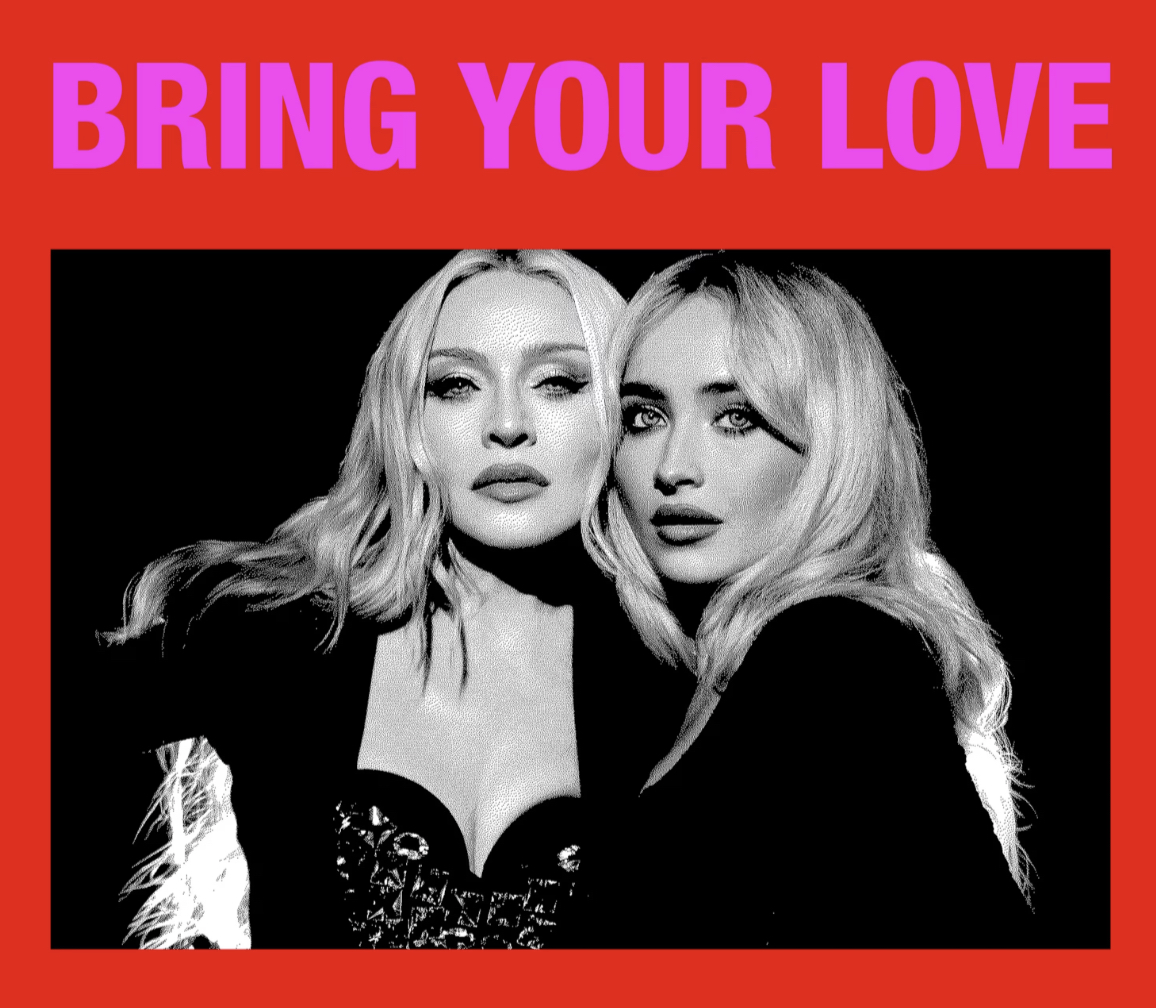
The last time Madonna did a duet with a blonde pop star as known for her simultaneous industry clout and sexually charged performances and lyrics, it was 2003. The blonde pop star in question was, of course, Britney Spears and the song was “Me Against the Music.” And while the single belonged to Spears’, she gave Madonna plenty of vocal time. What’s more, for those who thought (and still think) the exchange of lines—specifically, “It’s me against the music (It’s just me),” to which Madonna antithetically adds, “And me”—between them at the beginning is a bit “off,” perhaps that’s because Spears asked Madonna at the last minute to jump on the recording, presenting the song to her during rehearsals for the 2003 VMAs in late August. The single would then come out on October 14th (a.k.a. Lourdes Leon’s [who served as a “flower girl” before Britney emerged to sing her rendition of “Like A Virgin” atop the wedding cake at said VMAs] seventh birthday).
“Bring Your Love” has definitely been brewing for far longer. At its most germinal since February of 2025, when Carpenter met Madonna’s longtime manager, Guy Oseary, at the SNL 50 party. Oseary reflected on that encounter after Madonna and Carpenter performed a live debut of “Bring Your Love” at Coachella, noting, “I first met Sabrina at the SNL 50 party, where we bumped into each other walking thr[ough] the party. She told me how much she loved Madonna. Minutes later, she was asked to join the house band at that party to sing an impromptu song: the song she chose: ‘Like A Virgin.’ She has always shown love for the Queen, repeatedly…and last night [at Coachella] the mutual love was shown and shared with the world.”
Despite each song’s different origin stories, in many ways, “Bring Your Love” feels like the 2026 “update” to “Me Against the Music,” primarily due to the many sultry exchanges of vocals between Madonna and the blonde pop star du moment (not to say that Spears’ moment is ever over). Only this time, it’s Madonna’s song, not the “hotter” pop star’s. Of course, the mistake that many people have made throughout the course of pop music history is to assume that any one of the “hotter” pop stars of the era will ever manage to outlast Madonna’s staying power and influence.
Though, for the time being, it seems as if Carpenter is committed to having that kind of longevity (in a way that Spears could never quite convey due to the way she and her music were viewed as both “disposable” and “ephemeral”—of course, one only needs to look around at her influence over newer pop stars like Addison Rae [who was serving major Onyx Hotel vibes at Coachella] to see that her legacy has endured). And maybe, with a bit of help from Madonna’s demand at the outset of “Bring Your Love”—“Ask yourself this/What are you doing it for?/Is it for you? Is it for them?”—Carpenter will do her best to sidestep trying to pander to “numbers.” Which can become a fatal trap to fall into not only once you’ve hit the big time, but also in a climate where virality is prized over genuine, let’s say, art-making.
And, in this regard, the entire motif of the song speaks to the David Bowie quote, “Never play to the gallery” (something that Madonna has often tried to live by…you know, when she’s not doing things like filming ads for Brazilian banks). Which is somewhat ironic considering that it is the type of song that very much plays to the gallery. Certainly far more than “I Feel So Free,” which some were surprised to learn was merely a “preview”-type offering rather than the lead single from Confessions II (kind of like what happened with “Give Me All Your Luvin’” for 2012’s MDNA). But no, instead, Madonna has opted for the song she knows will get her to the top of the charts because it features one of pop’s most influential artists of the day (a tactic she’s been known for using, especially with a song like The Weeknd’s “Popular”).
Some might call that “pandering” in a way that could be what Bowie also billed as “dangerous,” further adding to his “never play to the gallery” warning, “Always remember that the reason that you initially started working was that there was something inside yourself that you’ve felt that if you could manifest it some way, you would understand more about yourself and how you coexist with the rest of society. I think it’s terribly dangerous for an artist to fulfill other people’s expectations. I think they generally produce their worst work when they do that.”
As some have argued Madonna did when she collaborated with Timbaland, Justin Timberlake and Pharrell about five years too late on 2008’s Hard Candy. In fact, one of the last times that Madonna truly mined from more “unknown” talent (as she was always known for doing in the 80s and 90s) was when she started working with Stuart Price (starting in 2001, when he served as the musical director of the Drowned World Tour), who eventually co-produced most of 2005’s Confessions on a Dance Floor. And perhaps because this was the last time Madonna can remember her music having a major imprint on the zeitgeist, she’s opted to return to it with a “sequel album” at a time when most people are feeling fairly joyless. Enter the house-infused backbeat of “Bring Your Love” (courtesy of a sample from Inner City’s “Good Life,” a track Madonna has often played in the background of her posts on social media)—meant to rescue people from the dreariness and hopelessness of it all (and, speaking of rescuing, the song also bears a certain odd similarity, both musically and vocally, to one of M’s lesser appreciated songs, “Rescue Me”).
This done while warning them, “Don’t comment on my ideas/I don’t want your judgment or your expectations.” Alas, it’s a little late to hope for that at this point, seeing as how Madonna has been subjected to judgment and expectations from the moment she became a household name after rolling around in a wedding dress in 1984. And yet, it’s become quite de rigueur of late for famous people to call any form of critique on their work, de facto themselves, an “attack” from “haters.” This in keeping with the ways in which criticism as an art form unto itself is becoming systematically stamped out by being rebranded as nothing more than a “fancier” version of being an “online troll.”
In any case, Carpenter then chimes in to back up Madonna’s sentiment with, “Don’t wind me up like a toy/Your vision of me is a killer of joy.” In other words, the public and the critics might think they know who people like Madonna and Sabrina are, but they have no idea (to borrow from the intro to MTV’s Diary). For the image projected onstage, in interviews and in music is but a “persona,” they say. (Well, everyone except for Lana Del Rey.) And Madonna’s has, of course, always been the persona of the “chameleon”—while sustaining her sexual “shtick” with each new “reinvention” (as her mere human evolution has often been tritely called). And yes, perhaps because Madonna has been around for so long, it’s only right for her to cheekily announce, “I know where the bodies are buried/Don’t try to shut me up” before Carpenter insists, “Don’t try to distract me with numbers/I did it all for love.” Here, again, there is an allusion to both women being in the music game because of what Bowie homed in on when he said that “the reason that you initially started working was that there was something inside yourself that you’ve felt that if you could manifest it some way, you would understand more about yourself and how you coexist with the rest of society.”
For both Madonna and Carpenter, that something inside of themselves is not just their “raw sexual energy” or reminding men they’re kind of shit, but also the desire to bring joy to the masses through a beat and tempo that gets asses on the dance floor. And “Bring Your Love” is very much that. In addition to a battle cry and a challenge to anyone that would try to bring their hate to Madonna or Sabrina. In fact, there’s a lot of Liz Lemon (Tina Fey) in this… Specifically, when she’s riddled with insults by her TGS staff (in a season five episode of 30 Rock called “College”) only to soak it up and tell them, “High fiving a million angels.” Because if it’s only hate and contempt they’re bringing, she’s going to insist that they bring their love instead—even if that means interpreting their hate as love is what she has to do (though that borders perilously on the Orange President’s territory). The same has gone for Madonna over the years, who once posted a famed aphorism to her Instagram that goes, “If you don’t like me and still watch everything I do. Bitch, you’re a fan”—thus, “alchemizing” the notion of hate into love.
Besides, Madonna views any vitriol aimed in her direction as but the insecurities and fears of others being projected onto her. You know, the type of “small minds” that branded her as some kind of nympho devil woman during the early 90s, when the Blond Ambition Tour, the “Justify My Love” video, Truth or Dare, the Sex book, Erotica, Body of Evidence and The Girlie Show all combined to make her “too much” for the average person. Especially the average puritanical American person. Hence, Madonna’s additional lyrical “request,” “Don’t shove your fears down my throat/Before I can speak, I can’t even breathe.”
Fortunately, despite her constant choking (no head-giving/Evian bottle reference intended), Madonna has managed to scream loudly over the naysayers across the decades, still challenging them—daring them—to try to bring her down with their hate. When obviously, that seems impossible. Which is perhaps why, for the first time in a long while (maybe since 2005), it’s suddenly chic again to show (/bring) love for Madonna. Who has a little help from her 2020s version of Britney Spears in securing that love.


