


In the days when Sex and the City fever was at its apex, arguably from 2000 to 2003, there was a common question thrown about. Or rather, four common questions: Are you a Carrie? Are you a Samantha? Are you a Miranda? Are you a Charlotte? Of course, in the early 2000s, women were expected to choose just one character to identify with, as the men running the show in media didn’t see them as anything other than one-dimensional (that’s right, not even two-dimensional). And that, accordingly, women had to fulfill one trope in order to easily tick a box that would make them more “conveniently” categorizable to men. Worse still, to other women, who would go on to internalize the misogyny intrinsic to this form of oversimplification for years to come. And yet, even in 2026, it seems that the masses want to paint a certain woman—Carolyn Bessette—as, again, just one of the main characters from Sex and the City.
By now, the theory has been well-trodden thanks to the release of the latest series in the Ryan Murphy Productions oeuvre, Love Story. Or, more specifically, Love Story: John F. Kennedy Jr. and Carolyn Bessette (because of course JFK Jr. gets the top billing). That theory is simple: Bessette was the real inspiration behind the character of Carrie Bradshaw. Even though Candace Bushnell has stated numerous times that the character Bradshaw was eventually formed into for TV from a series of columns that Bushnell wrote for The New York Observer was always, ultimately, Bushnell. Even so, the writer of the source material has also often stated that the people, or “characters” (if one prefers), mentioned in her column over the years were usually based on those who ran in a certain circle of NYC. From the “it girls” to the finance guys to the fashion models to the SoHo loft-based artists (in the last days of being able to be based out of a loft in SoHo before all the space was turned into retail). Bessette would have qualified as an “it girl” by that time when Bushnell was painting New York in her “modern Dorothy Parker” light, writing such phrases as,
“Truman Capote understood our nineties dilemma of Love vs. The Deal [and here, please try not to think of a certain Orange Creature because of that word, deal]—all too well. In Breakfast at Tiffany’s, Holly Golightly and Paul Varjak were faced with restrictions—he was a kept man, she was a kept woman—but in the end they surmounted them and chose love over money. That doesn’t happen much in Manhattan these days. We are all kept men and women—by our jobs, our apartments and then some of us by the pecking order at Mortimers and the Royalton, by Hamptons beachfront, by front-row Garden tickets—and we like it that way. Self-protection and closing the deal are paramount. Cupid has flown the co-op.”
If anyone could understand an assessment like that it was Bessette, who lived her life prior to JFK Jr. in service of her PR job at Calvin Klein. And here, the Samantha Jones of her “personality” (since, in New York, your job still pretty much defines almost all of “who you are”) shines through. Along with, as Love Story portrays it, her bawdy sense of humor about being someone who gets to be around male models in their underwear as part of her job description. To be sure, Love Story can’t help but portray Bessette as a slightly promiscuous “party girl” with a taste for snow (something Charli XCX would surely support). An overblown (no coke allusion intended) reputation that almost completely destroyed her relationship with JFK Jr. after an anonymous letter from a “friend” had him believing not only that she was a druggie-slut-partier, but that she was also “obsessed” with him before ever meeting him, and their introduction had been entirely calculated on her part. Even though the real-life story goes that he came into Calvin Klein for a fitting and the latter had Bessette deal with him as the brand’s in-house “VIP Whisperer” (as the show puts it). A nickname that could just as easily be bestowed upon Samantha (though not when it came to Lucy Liu).
As for Bessette’s stubborn, combative and highly elusive/standoffish nature, of course it smacks of Miranda Hobbes—particularly when it came to her behavior vis-à-vis being pursued by Steve Brady. Not only that, but, of the four women that comprise the leads of SATC, Miranda is arguably the most career-obsessed of them all. Bessette’s ambition, however, was matched only by her natural/understandable love of what New York nightlife could offer in the 90s. Something that, of course, aligns her more with Carrie Bradshaw, who, particularly in that first and second season of the show, appears to be perennially out at night. Which just goes to prove what Bushnell told Nylon in 2024, “Your apartment is just a place to sleep and get dressed and shower and maybe have sex. And then you go out into the night.”
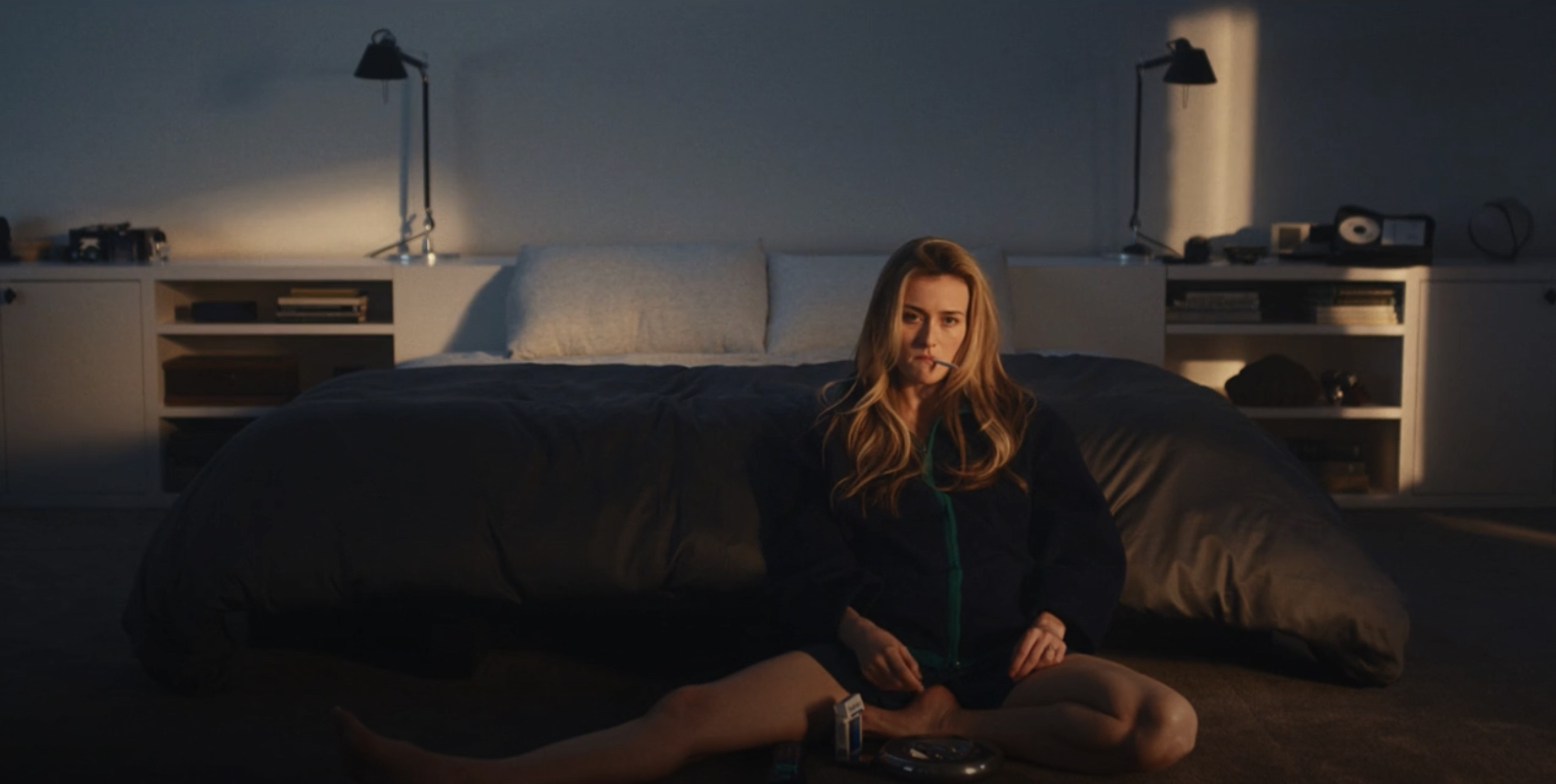
That’s certainly what Carolyn is doing in the first few episodes of Love Story, starting from the pilot, where she’s shown waking up grudgingly (as Primal Scream’s “Loaded” soundtracks the scene) after her alarm goes off at 7:21 a.m. With her decidedly disheveled and hungover look giving not only “heroin chic,” but also Carrie’s “Single and Fabulous?” cover for New York magazine, Carolyn proceeds to ready herself in what also looks like a place that’s not totally dissimilar to Carrie’s signature “single girl” apartment. Carolyn then steps out into the early morning hours and immediately lights up a cigarette. So yes, she embodies some very key traits of Carrie’s from the start.
And yet, it’s also safe to say that both “CBs” (that’s right, they even share the same initials) are representative of a certain kind of woman orbiting a certain echelon in 90s-era Manhattan. Including Carolyn’s co-worker, Grace (Viveca Chow), who meets up with her at the newsstand near their work building that same morning and proceeds to regale her with her own exploits at Tunnel from the previous night. And yes, Carrie herself will name-check said club as the place where one of her own drunken exploits resulted in her deciding to get an abortion after her one-night stand circa 1988. A detail she’s reluctant to mention to her stodgy steady of the moment, Aidan Shaw. And, in truth, Bessette probably wouldn’t have been eager to tell “John John” if she had an abortion at any point either.
In any case, the one character still being left out from all of this is Charlotte York. Who Bessette, of course, also has plenty of traces of in that she chose to get married, settle down and abandon her career (“choosing her choice,” as Charlotte would say). This, plus the fact that Bessette landed the “catch” of the century, just as Charlotte believed she had with Trey MacDougal. And so, while the easy comparison to make is between Bessette and Bradshaw, the truth is, that’s a very reductive late 90s/early 00s approach to “classifying” her. If one must, at least take into account that her personality is multifaceted enough to incorporate all four women. Though maybe it’s really Bushnell that Bessette mirrors the most (even sharing the same “sword” with her in the form of Michael Bergin—though Bushnell’s “relationship” with him was more of a dalliance), or so the former would like to believe. For there was seemingly a jealousy thing happening on Bushnell’s part.
If there wasn’t, why would she write a column called “Spoiled in the City” (reduced to the headline on the magazine cover that instead called it “Diary of a Bitch”), which kicked off in a November 1998 issue of Manhattan File? A column described as being about a woman with the initials CBK (Carolyn Bessette Kennedy, anyone?) who “married the world’s most eligible bachelor, and inherited way more than a nasty habit for popping pills.” Worse still, at the end of the story (designed to be serialized), the man, DW, that “CBK” is talking to assures her that’s he’s going to help turn her into “America’s very own Princess Di.”
Considering that Bessette already was frequently compared to Diana, constantly stalked as she was by the UK press, and that she had also just died in a car crash after being pursued by paparazzi in 1997 (the year after Carolyn married John), this feels like a line that’s pointedly in poor taste. However, a line that isn’t, and that comes from Bushnell’s Sex and the City book is this: “Relationships in New York are about detachment, so how do you get attached when you decide you want to?” The Samantha-sounding answer? “Honey, you leave town.”
Alas, this particular rule flew out the window when it came to Bessette eventually letting Kennedy’s charm and persistence win her over, all in spite of her best efforts to keep living the carefree, “single girl in New York” life that Sarah Jessica Parker (who, for added uncanny interconnectedness, also dated JFK Jr.) would immortalize as the 90s came to a close. And with that decade’s “death,” so to speak, came the death of an ultimate NYC former it/party girl. With Bradshaw, one supposes, carrying the “passed baton” for just a little bit longer in the early 00s.


