


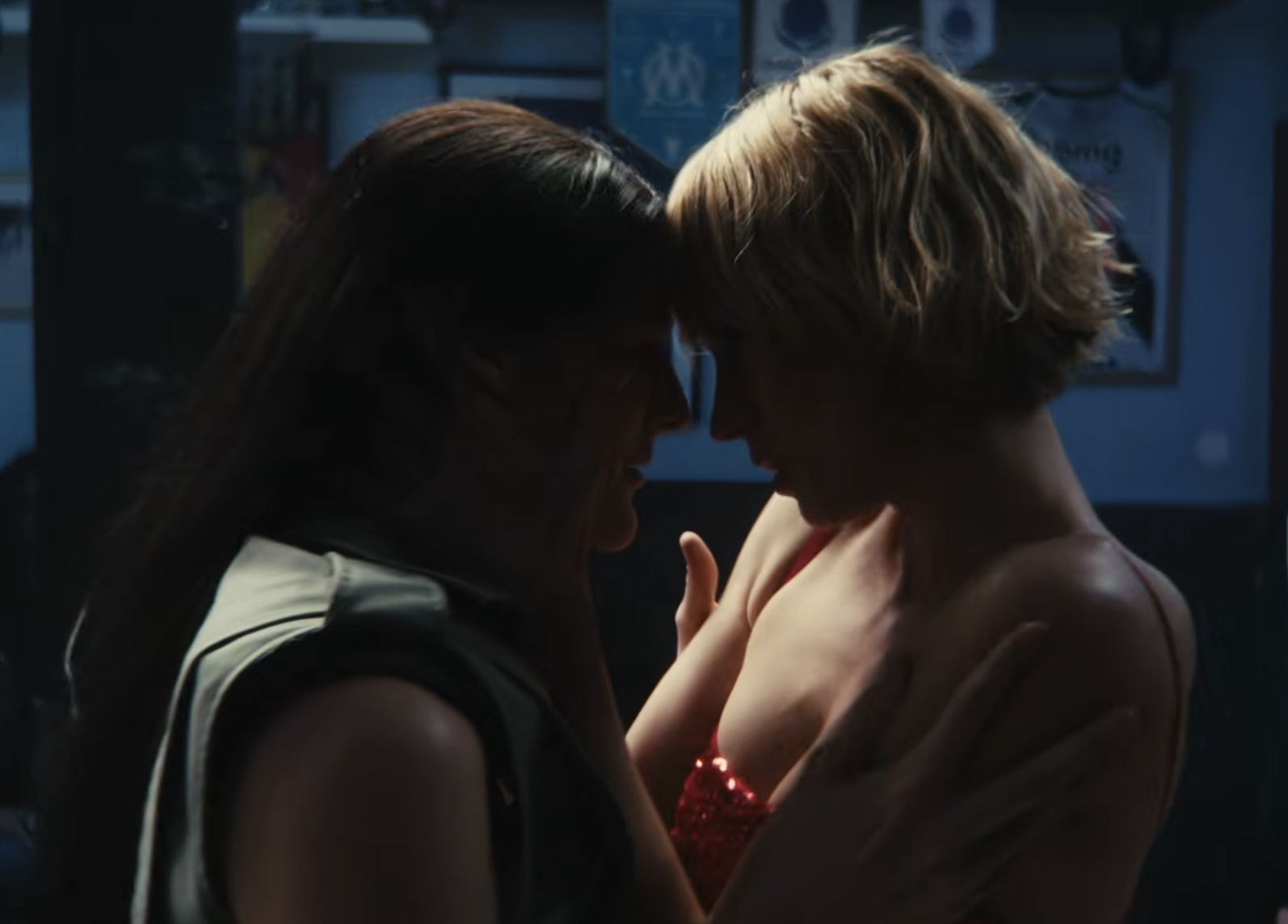
As Angèle reemerges from a slight period of dormancy (with her last musical offering being a trop court ditty called “A Little More” that was featured in a Chanel ad), her choice to return with a Justice collaboration makes “What You Want” all the more momentous. Not to mention jealousy-inducing for many a pop singer (mainly Charli XCX) who has loved Justice from the beginning (which, for most, really means from 2007’s “D.A.N.C.E.”).
In the years since Angèle became an internationally recognized pop star, with a 2020 feature on Dua Lipa’s “Fever” helping to fortify that status, her stardom also came with some major downsides. One of them being outed against her will by a French tabloid called Public in 2019. And, although the ways in which they were outed without their consent are very different, Billie Eilish, too, suffered a similar fate in 2023, when she felt outed on the red carpet at the Variety Hitmakers Awards.
Both artists, after being subjected to this extremely retro form of shaming a famous person for their sexuality, took back the narrative through music. For Eilish, that was releasing “Lunch” as her first single from Hit Me Hard and Soft. For Angèle, as “What You Want” proves, it’s creating a video that firmly asserts her sexuality, which she further went on to describe as pansexual in 2023 (already, her pansexuality has turned out to be much less hetero than Miley Cyrus’). And it’s that form of fluid attraction that remains constant in the video for “What You Want.”
Directed, choreographed and creative directed by the Marseille-based collective known as (LA)HORDE (a.k.a. Marine Brutti, Jonathan Debrouwer and Arthur Harel), the first scene opens on Angèle’s lips approaching the lips of another, seemingly a man. But before their lips can actually make contact, another hand reaches around to touch Angèle’s, pulling her back to reveal a whole slew of people trying to put their hands not just on her face, but in her mouth. This all occurring inside of a laundromat. Because, well, it still remains something of a “sexual fantasy” milieu. Particularly as they’re so much more widely available/used in French towns and cities.
Eventually, Angèle gets them to put her down, almost as if by some kind of magical force inside of her. Indeed, there’s a certain Jennifer Check quality to her ability to make everyone around her fall to the ground after they were just being so magnetically pulled to her. So it is that Angèle, wearing a red Justice logo tee (with the duo’s signature cross filled with piano keys in this case), a bomber jacket, struts out into the street only to find herself caught in front of a screeching car (one not [yet] shown onscreen) that ostensibly crashes and loses a mound of apples from the back of it. This particular fruit always bearing significance for its symbolism pertaining to a woman who dared to bite from the Tree of the Knowledge of Good and Evil. The first major misogynistic narrative to paint a woman (Eve) as the temptress responsible for the fall of man. But Angèle seemingly has designs on making everyone around her fall as she keeps traipsing through the streets and flashing the camera a conspiratorial expression (that’s right, she dares to break the fourth wall).
All of this happens in about thirty-three seconds before Angèle actually bursts into singing the first verse, “What you want/I’m only/What you want/Oh, baby/What you want/C’est pour la vie/Dare to take me/Oh, oui.” And while Angèle might briefly lead the unseasoned listener to believe that she’s going to speak in English the entire time, she quickly pivots to French (or Belgian French, if you want to make the distinction), seductively adding, “Encore une bêtise/C’est tout ton maquillage sur ma bouche/Tu me dis que ça t’excite/On arrange ça dans la douche/De temps en temps/J’aime essayer/D’changer les rôles/À mes pieds” (“Another silly mistake/It’s all your makeup on my mouth/You tell me it turns you on/We fix it in the shower/From time to time/I like to try/To switch roles/At my feet”).
By this time, Angèle has entered a restaurant (serving ramen, incidentally) and has taken over the space with her raw sexual energy there as well, alternating back to the “in English” chorus before a musical breakdown finds her voice harmonizing, all siren-like (as in the mermaid, not the police/ambulance device that makes a loud, unpleasant and sustained noise), with Justice’s pulsing and throbbing backbeat.
As Angèle departs from the restaurant to wreak havoc on her next location, she leaves in her wake a couple kissing in the corner, as if her presence itself inspired it…almost like some kind of urban Aphrodite. In the next scene, the viewer at last gets to see the car that screeched to a halt earlier and dropped all those apples. It’s a truck, in fact, with its driver filling the crates upon crates back up with the dropped goods. One of which Angèle is tossing up in the air repeatedly before moseying on to her next location. That turns out to be a karaoke bar (well, of sorts), where, obviously, a costume change is in order. Thus, Angèle swaps her red Justice tee for a red sequin dress, dancing with different men and women in the place as more than slightly scandalized onlookers watch (pointedly, it’s only the “elders” of the crowd that seem jarred by the sight of Angèle’s raw sexuality).
It’s during this sequence that Angèle gets “down and dirty” on the choreo with dancer Nora Monsecour, letting her be the one to benefit from the verse, “Encore des sottises/C’est pas vraiment que j’avais dit/J’aime quand tu parles dans la vie/Mais tais-toi quand je te touche” (“More nonsense/That’s not really what I said/I like it when you talk in real life/But be quiet when I touch you”).
Back out on the streets of Marseille, Angèle dances through scenes of lustful chaos—everyone kissing and/or frolicking with someone as fires burn, soap suds overflow and the apple truck remains, let’s say, “unremedied.” In the final wanton scene, Angèle and Monsecour stand at the center of the huddled masses kissing passionately (though before this, Angèle was also staring down a guy, to remind people that, yes, she’s pansexual).
In many ways, the video bears a thematic similarity to the abovementioned “Fever,” wherein Angèle is still causing a commotion throughout a cityscape, only she has a partner in crime in the form of Dua Lipa. But the most, er, seminal difference of all with the “What You Want” video is that it’s entirely about Angèle taking ownership of her own sexuality, rather than allowing the media to falsely do it for her. Or, as (LA)HORDE said of the concept, “[Elle] revendique et se réapproprie la maîtrise de son image, de son corps et de son désir” (“[She] claims and regains control of her image, her body and her desire”). And in so doing, empowers others (even those not in the public eye) to do the same.


