


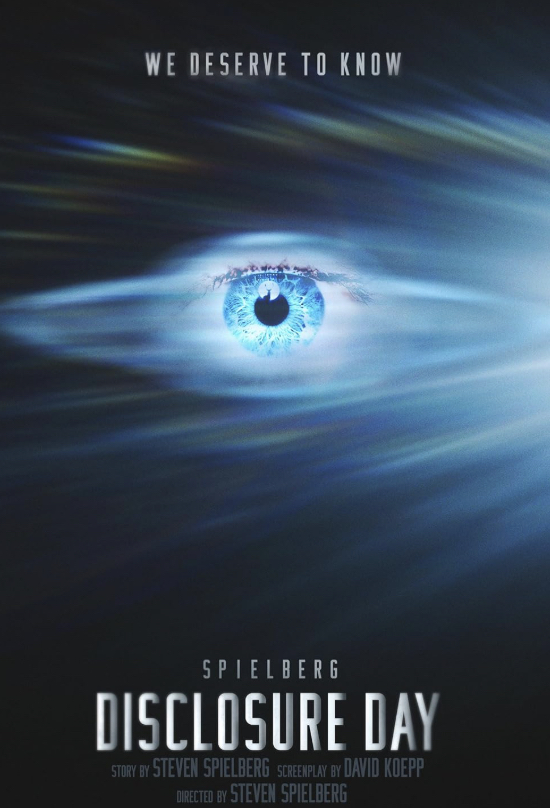
Although, when it comes to his quartet of “alien films”—now rounded out by Disclosure Day—Steven Spielberg might be forever associated with E.T., some people (read: philistines and youths—often one and the same) tend to forget that his first “right proper” sci-fi movie was 1977’s Close Encounters of the Third Kind. And he didn’t take long to re-explore the topic of extraterrestrial life, with E.T. being released just five years later. But then, it was as if Spielberg lost interest in that subject entirely, pivoting toward other subjects usually related to history (e.g., 1941, The Color Purple, Empire of the Sun, Schindler’s List, Amistad, Saving Private Ryan, Catch Me If You Can, Munich, War Horse, Lincoln, Bridge of Spies, The Post and even The Fabelmans).
In the mid-2000s, however, Spielberg did decide, twenty-three years after E.T. (unless one wants to count his executive producing on 1997’s Men in Black), to go back to the “alien genre” with War of the Worlds, his take on H. G. Wells’ 1898 novel of the same name. And then promptly took another two-decade break from delving back into the genre. Maybe because, in many ways, it’s a little too real for him. And, another twenty-one years on from War of the Worlds, he’s once again helping audiences to understand just how real it is. Since, when the U.S. government released the first tranche of documents, photographs and video files related to its PURSUE (Presidential Unsealing and Reporting System for UAP Encounters) agenda, people were rather blasé about it. Indeed, it seemed like yet another one of the Orange Creature’s deflection techniques when it came to getting attention off the Epstein files, or the fact that he had turned the U.S. (and, interconnectedly, a lot of the rest of the world) into complete shit. And when that didn’t seem to work, he could just keep escalating tensions with Iran, doing whatever might be necessary to bring the world to the brink of WWIII.
And, incidentally, that’s where it’s headed in Spielberg’s movie, with constant mention of “tensions” between other countries and the according raising of DEFCON levels. What’s more, it’s no coincidence that the first scene of the movie takes place at a pro wrestling match, where crowds are yelling and cheering for more carnage. Among the fray is the extremely out-of-place Daniel Kellner (Josh O’Connor, continuously coming up in the world between working with directors like Luca Guadagnino, Kelly Reichardt, Rian Johnson and, now, Spielberg). Indeed, it’s obvious he doesn’t seem to be there as a wrestling enthusiast, instead told by an “official type” sitting behind him to let go of his backpack the next time the crowd stands up. That “official” is Boyd Diaz (Elliot Villar), one of the most pit bull-like agents for Wardex—the private contractor that’s been working for the U.S. government when it comes to all things extraterrestrial.
As for Daniel, although he starts to obey the command, he’s reluctant to let it go as he asks, “Where’s Jane?” A gun in his side from Serena (Hettienne Park), a senior agent at Wardex, gets Daniel to stop asking questions and follow them into the secluded loading dock area. It’s there that he comes face to face with the CEO of the company, Noah Scanlon (Colin Firth, occupying the kind of role that’s rare for him: villainous). And yet, rather than being more afraid, Daniel asks again, “Where’s Jane?” Based on his concern level, it doesn’t take much guessing to realize that Jane Blankenship (Eve Hewson, occasionally looking like Alexandra Daddario or Gaby Hoffman) is his girlfriend. And that he cares about her enough to risk losing the very evidence that he put his own life at risk for to steal.
Luckily for his conscience, Jane, as it turns out, is fine. Promptly handed over to Daniel once the Wardex goons account for all the missing loot, so to speak. Only what they didn’t account for was that Daniel would have a good enough sleight of hand to remove what will only keep being referred to as “the device” from its casing and use it as leverage to get the hell out of there, stealing one of the cars that the suits drove into the loading dock. From there, Disclosure Day becomes as much of an “on the run” movie as it is an “alien” one. Mind you, that word is never actually used, and very much by design. For, as screenwriter David Koepp (a frequent Spielberg collaborator) told CinemaBlend, “‘Aliens’ also has a second meaning in terms of immigration. And we didn’t want anyone to be able to dismiss anything or be distracted. So we use ‘extraterrestrial’, we use ‘biological life forms,’ ‘non-human biologics.’ There’s a number of other terms that we use instead.”
Chalk it up to just another manner in which Disclosure Day is highly sensitive to the moment we’re living in. Indeed, “for a movie” (and a late-career Spielberg one at that), it’s surprisingly au courant…seeing as how other mediums (read: the internet and its social media tentacles) have taken up “the lead space” when it comes to reflecting society at its most “up-to-the-moment” state. And yes, it is, in this era of information-action ratio overload, more challenging for films to stay “relevant” by the time they’re released. But, for a start, Spielberg began writing the treatment for this story in 2023 and, what’s more, has always seemed to know that the topic of “lifeforms on other planets” is evergreen (no “little green men” pun intended). Even so, he probably couldn’t have known how resonant that topic would be this particular year, with the Orange One’s administration claiming they want to have their own slew of “disclosure days” vis-à-vis Unidentified Anomalous Phenomena (UAP) files. And no, “UAP” doesn’t roll off the tongue quite like the tried-and-true UFO. But it does better put the topic of extraterrestrials and their various “sweet rides” under one umbrella.
And, talking of rides, after escaping, Daniel and Jane are off to “a place he’s never been before in his life,” per his very specific request to Jane, who opts to take him to the convent where she was a novitiate—a.k.a. she was “in training” to become a nun. Because apparently, there’s a lot about the other that these two don’t know. For Jane certainly wasn’t aware of the type of people Daniel was working for, nor that he served time for cybercrime, after which Wardex recruited him “right out of the parking lot” of the prison. The first clue that he should have been suspicious of these people from the beginning.
After about fifteen minutes of all this exposition to what’s happening, Spielberg finally cuts to the real star of the show, Emily Blunt—playing a meteorologist named Margaret Fairchild. Working out of Kansas City, it’s immediately clear based on the dialogue between Margaret and her boyfriend, Jackson (Wyatt Russell), that she has a certain dissatisfaction with every new place she moves to, blaming it on not being able to move up the ranks and become a more serious broadcast journalist at whatever TV station of the moment she’s reciting the weather on. But when a red cardinal flies through her window as they have this discussion, everything within her shifts. And yes, it’s in the sort of way that’s very reminiscent of what happens to humans in Vince Gilligan’s (who, fittingly, did write his fair share of episodes for The X-Files) acclaimed TV show, Pluribus (the idea for said show starting to percolate around the time Breaking Bad ended and Better Call Saul began). This extends to, in essence, becoming empathic—but “on steroids.” In, short, being able to feel exactly what it’s like to inhabit any person’s specific head. A tool that will become her superpower, of sorts, as the movie progresses, since she can jar just about any authority figure by transforming into someone close to them and imparting some sort of wisdom or advice as that person.
To boot, Margaret also exhibits symptoms of what’s called “The Joining” in Pluribus when she can suddenly speak every language, flexing with a bit of Russian and Korean when she first gains this newfound “gift.” One that she doesn’t understand at all, but knows, somehow, that it’s part of a larger, important purpose. One that Hugo Wakefield (Colman Domingo), Wardex’s former “Director of Biological Assets”-turned-lead defector of the organization, eventually helps her come to understand. Even as he, too, is being “dived in on” by Scanlon. That term applying to the aforementioned “device’s” ability to make someone telepathic in the way that Margaret now is naturally. And while Scanlon is searching the premises for some indication of where Hugo’s location is as he “dives in,” the two engage in the philosophical argument behind what each of them is doing/fighting for. For Hugo, “siding” with the extraterrestrials and wanting to free them from captivity—in addition to telling the whole world about their existence—is for one simple reason: “They regard empathy as an evolutionary advantage. As the foremost evolutionary advantage. In fact, the core of animate existence. Our rejection of this understanding is leading to our extinction.”
Here, too, the “core tenet” of the extraterrestrials in Pluribus is at play, with the humans “infected” now rendered as “one.” And because they can each feel what everyone else feels, it has turned them into a peaceful, nonviolent population. In other words, the exact opposite of how non-extraterrestrially influenced humans usually act. In this regard as well, Gilligan posits among the few offerings in the pop culture lexicon that propose extraterrestrials are fundamentally nonviolent (though Carol Sturka [Rhea Seehorn] would beg to differ). Something that Spielberg himself believes (in spite of making War of the Worlds). These “supreme beings” are presented as such in Disclosure Day, even if still stuck in their “little green men” form. The longstanding cliché rendering of how aliens are “supposed to” look—based mostly on the famed Kelly–Hopkinsville encounter of 1955 (which, incidentally, served as the inspiration behind the treatment for an unrealized project Spielberg would write called Night Skies, with Tobe Hooper and John Sayles attached as director and writer, respectively). Besides that, the onslaught of 1950s sci-fi movies served to cement the image of “little green men” as the norm for how aliens would look (that is, until H. R. Giger’s xenomorph-inspiring image came along to change how the “average” extraterrestrial would look in Alien). If one were ever to truly have a close encounter of the third kind.
As far as known government involvement goes, most people, including Spielberg and Koepp, trace it back to that “crash of ‘47 in Roswell. Thus, Daniel’s math-related dialogue when, after showing Jane an “interrogation video” (a.k.a. torture video) of one of the aliens, he tells her, “There’s more. Seventy-nine years more. I have all of it.” The number of years mentioned refers to 1947. And, speaking of all that time, Spielberg was sure to remark of Disclosure Day, “The movie, for me, is a summation of my life in science fiction. It started when I was seventeen years old and made an 8mm little sound movie called Firelight… It was about UFOs when I was seventeen, so the subject is something that has been with me for most of my, uh, you know, young adult life.” And now, his not so young adult life. To that point, when you’ve cultivated a canon as robust as Spielberg’s, self-referencing tends to become inevitable. Hence, referring to the line, “We are not alone” in Close Encounters of the Third Kind by changing it to: “You are not alone” in Disclosure Day. This coming from the newscaster narrating the footage as she sees it for the first time with everyone else.
Which brings one to some of the more problematic, way-too-difficult-to-suspend-disbelief issues with the movie (especially as the third act comes along). First and foremost, that, in 2026, broadcast TV would be 1) the go-to medium to announce any kind of information that one would want to be disseminated quickly, 2) that others working at an affiliate network would be so quick to just go along with airing footage merely because they were told it’s important, 3) the notion that everyone is as zombie-like with their tech devices as Spielberg presents them to be as they watch the broadcast with rapt attention, 4) that Scanlon would just give up on trying to stop Margaret once he was right in front of her, 5) that Diaz, who showed himself to be the most violent of all the Wardex people, also wouldn’t try to cause harm to Margaret before she makes her announcement on-air. To name a few things. But it’s all part and parcel of the “everything must come together” order of a Spielberg movie.
And though Disclosure Day (a title that sounds like a combination of 1994’s Disclosure and 1996’s Independence Day) isn’t his best movie (or even his best alien movie), it’s obvious he cares deeply for this subject matter. Not least of which is because it just so happens to represent another way in which there is a class divide between humans. Or, as Spielberg commented in an interview with Ben Mankiewicz, “When the Great Unknown [that’s how he refers to this subject in general] is actually known by some, but not known by all of us, it’s that inequity that got me to write the story.” Now if only he could have written one that didn’t have such a significant aspect of Pluribus in it.


