


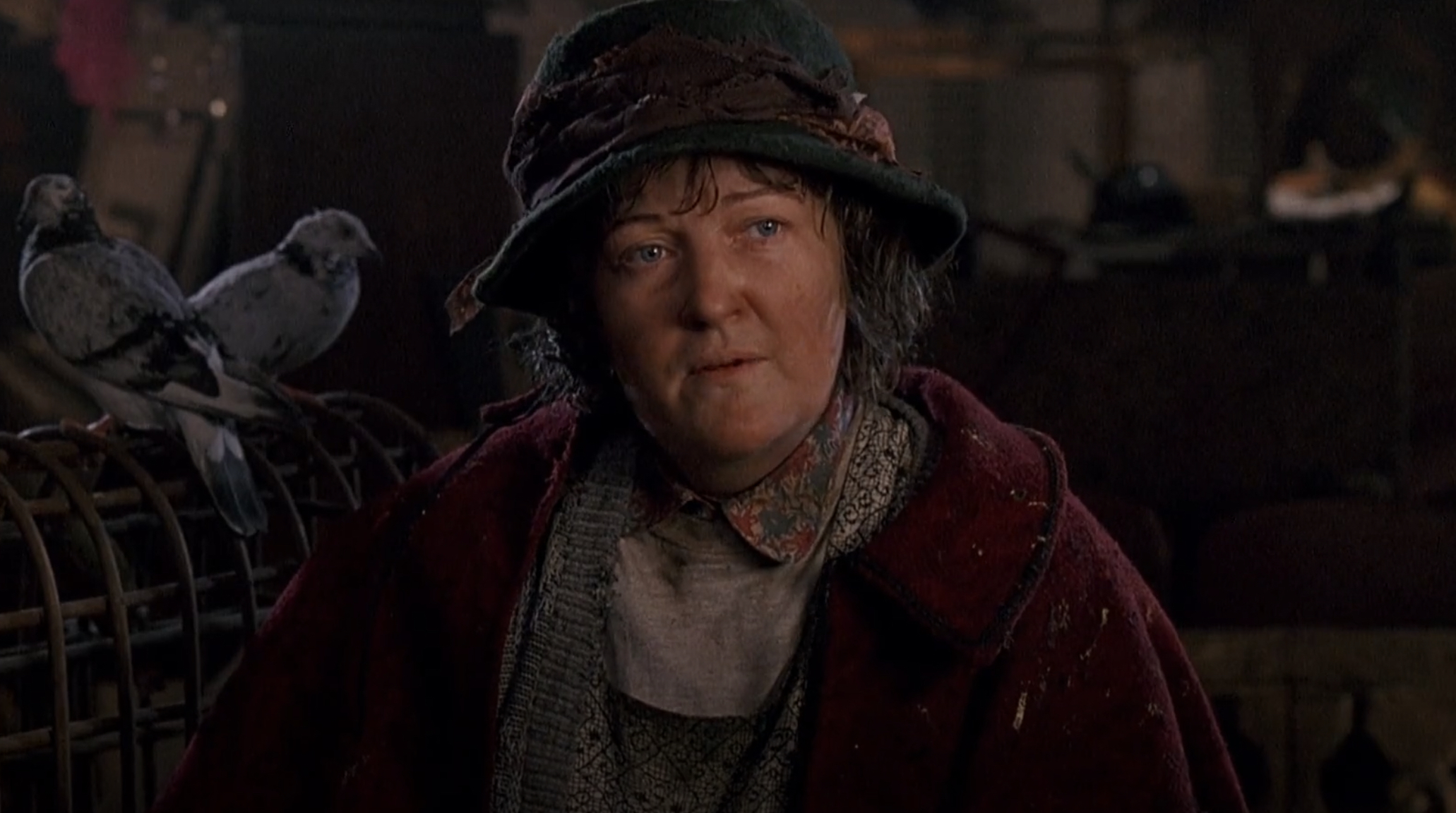
Despite Brenda Fricker’s long list of film, television and theater credits, for the most part (and especially to those in the U.S.), she will forever be remembered as the “Pigeon Lady” in Home Alone 2: Lost in New York. Much like how the recently deceased Bonnie Tyler will only ever be remembered as the “‘Total Eclipse of the Heart’ singer.” By the same token, announcements of Fricker’s death had her similarly, er, pigeonholed her, and included such headlines as, “Brenda Fricker, Home Alone 2’s Pigeon Lady, Dead at 81,” “Brenda Fricker, Oscar-winning actress who played Pigeon Lady on Home Alone 2, dies” and “One of the most beloved characters from Home Alone 2 will never be forgotten. Brenda Fricker, who played the iconic Pigeon Lady, has died at 81.”
And while some might find it strange that this theoretical “minor” role is also her most iconic one, the impression it left on viewers (even to this day) should not be underestimated or undervalued. Moreover, it was in keeping with her “I don’t give a (pigeon) shit” nature that the first Hollywood movie role she would accept after winning an Oscar in 1990 for her supporting part as Bridget Fagan Brown in 1989’s My Left Foot was an even smaller supporting role in a Chris Columbus/John Hughes movie.
But that was a testament to her “unassuming,” “unpretentious” nature. In other words, she embodied the “Irish spirit” (though, to be fair, many an Irish man is not unassuming or unpretentious). And, as if to play up that nature, she rendered the character of the Pigeon Lady—who is never given an actual real name during the entirety of the movie—with the kind of humanity that wasn’t typically given to homeless people on film. Least of all in the early 90s. What’s more, Fricker seemed to imbue some of the emotions that came from her own backstory into this character. And it was a backstory that came fully to light with the release of her 2025 memoir, She Died Young: A Life in Fragments. To be sure, the fact that she released it only a year before her death seemed to indicate that Fricker was aware that, at her age and with the health issues she had, it might be her last chance to tell the truth about her tragic life. Then again, in her interview with The Guardian about the tome, Rory Carroll clarifies that “the motivation for the memoir was not ego but money—to end a tangled saga of disputed debt—and it took four years of hard graft.”
Whatever her “motives” for writing it, titling the book She Died Young was perhaps Fricker’s way of immediately telling the reader that, because of the traumas she endured during her youth, she did, in some sense, “die young.” That innocent part of her that could trust people forever eradicated by the time she was eight, when she was sexually abused by a thirty-year-old man (billed as “Seamus S” in the book) that had been grooming her long enough to make her trust him before he started asking her to pull up her skirt so that he could masturbate to what he saw in front of him. And her parents took her to this man’s house every week for these “elocution lessons” he had so “generously” offered. Already at that point, she had also been subjected to her mother’s physical abuse as well. Later on, doctors would suggest that a tumor they found in her mother’s brain might have been the cause of her mercurial behavior in this regard.
The pain of her existence only continued to escalate, for by the age of ten, she was cutting herself and, by the age of fourteen, she was in a severe bike accident that flung her face-forward into a car windshield. Her injuries left her in the hospital for two years while the driver at fault suffered no consequences for causing the accident due to, per Fricker’s account, his connections to people in high places. With her time in the hospital hindering her educational progress, Fricker still tried to get out and socialize after the incident and, at seventeen, that “harmless” attempt at going to a party led to the first time she was raped. And no, sadly, it wouldn’t be the last, with Fricker also detailing a rape by fellow actor James Donnelly, who died in 1992. The year that she would become forever immortalized as the Pigeon Lady. The woman with a traumatic backstory who can’t seem to find the will to open her heart to anyone again.
Besides, as she tells Kevin McCallister (Macaulay Culkin), “I’m like the birds I care for: people pass me in the street, they see me but they try to ignore me.” Kevin, still too young and naïve to understand what true pain means (not to mention the fact that his sheltered existence—minus his 1990 run-in with the Wet Bandits—has mostly prohibited him from empathizing with Brenda’s fears about trust), brushes off her insistence on not trusting people anymore as “a dumb thing to do.” Pigeon Lady then explains, “I wasn’t always like this, you know. I had a job, I had a home, I had a family.” Kevin asks, “Did you have any kids?” Ruefully, Pigeon Lady replies, “No. Oh, I wanted them. But the man I loved fell out of love with me… And whenever the chance to be loved came along again, I ran away from it. I stopped trusting people.” These lines of dialogue ring eerily true, for Fricker did end up divorced from director Barry Davis, but not before having several miscarriages and even undergoing hysterectomy (a.k.a. removal of her uterus) without being asked or informed by the doctors beforehand.
Fricker’s emotionally fraught life was usually something she did her best to push aside, to bury deep within herself to avoid the pain (yet it often seemed to bubble up in her acting performances). And so, when talking about writing her memoir to The Guardian, she noted, “It was kind of ironic because I was talking about things I had paid a fortune to psychiatrists to make me forget. So it was very painful bringing them back. I thought they were a bit morbid. I think I’m a bit morbid. I’m Irish.”
In truth, it was her Irishness that made her not only stand apart from the rest of the Hollywood ilk with her “no fucks given” personality (which only intensified in her later years), but also allowed her to suffuse her roles with the tragicomic. The Pigeon Lady was no exception to that rule. And there are likely few other actresses that could have made that role so important. Or, to phrase it as her agent, Phil Belfield, did, “We will never see her like again, and the world is lesser for the lack of her.” But in the Home Alone universe, Fricker will live on forever.


