


Prior to Madonna’s “full-on” Confessions II rollout, William Orbit took to social media in March of 2026 to declare, “Right. Let’s put this Madonna ROL 2.0 thing to rest here and now folks. Can get exhausting[.] Is NOT going to happen. Look, why don’t I just lay it out, cos I get asked constantly[.] I have an album ready that imho [in my humble opinion] is indeed the successor to ROL. Everything about how it was made and how it sounds yells that from the first few bars. And I reached out. And there has been heard. Nil response. A week later. I speak with many close to her, including fam, but have not had a single syllable back in over two decades. There I said it. I sort of only hint we’re pals so’s not to ignite a firestorm of speculation… No idea whatsoever what’s in her head.” He was sure to add, however, that there were “zero zero absolute zero hard feelings. Are you kidding, I will always love that woman. For real. She made my career.”
The same can be said for Stuart Price’s own producing career, which truly took off after collaborating with Madonna on 2005’s Confessions on a Dance Floor. The album she chose to make a sequel to in lieu of Ray of Light, another one of her most “iconic” and successful (though somehow not successful enough to make it to number one on the Billboard 200, locked out by none other than Titanic: Music from the Motion Picture) albums. Yet Madonna chose instead to keep her “revisiting the past” to the twenty-first century. Being as notorious as she is for generally not liking to revisit the past, perhaps keeping it in the current century was as far as she could take her willingness to get “nostalgic.” An unfortunate result for Orbit, who did seem only too keen to take advantage of Madonna’s “sequel album” trend. Even if one doubts she would repeat herself again, and that Confessions II will be the extent of her sequel-making efforts (at least in music—but movie-wise, one wouldn’t put it past Madonna to make a sequel to Desperately Seeking Susan at this point)
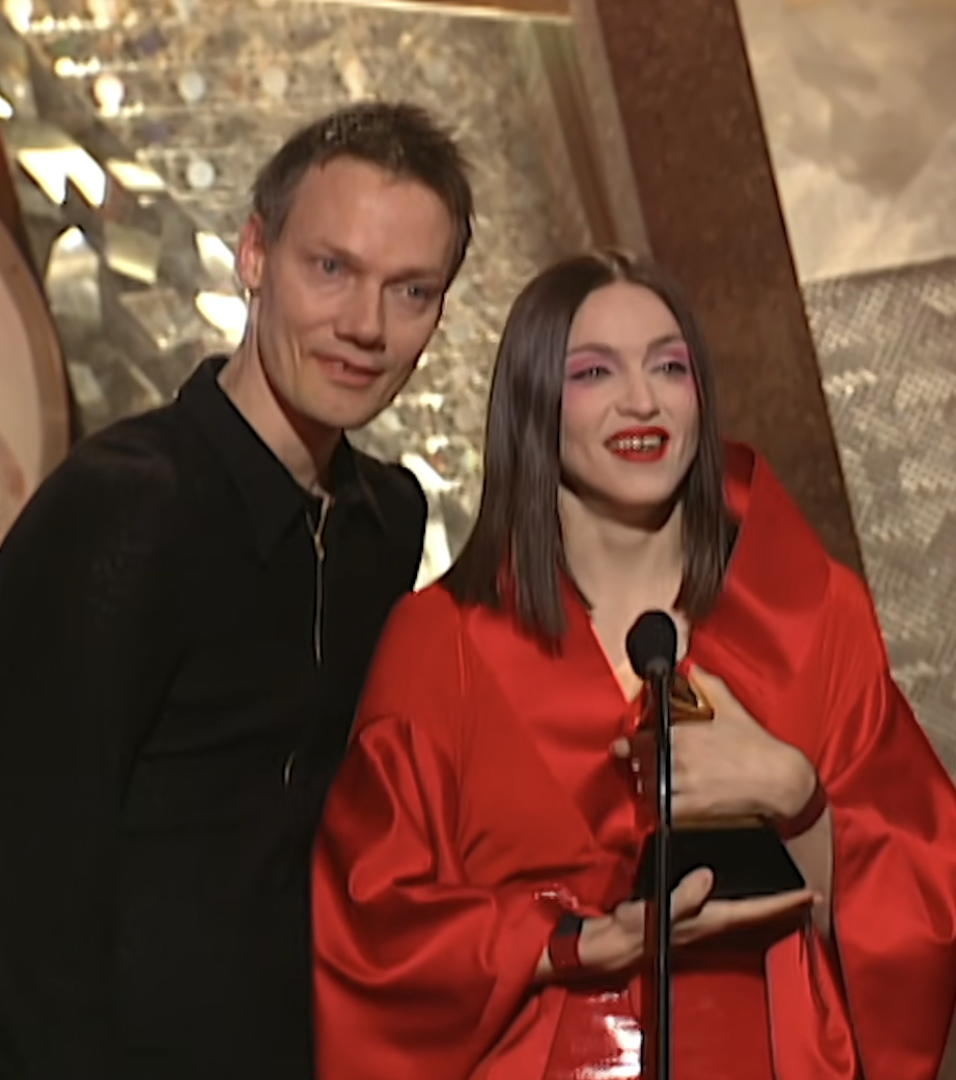
As for Ray of Light‘s creation, in an episode of MTV’s Ultrasound that aired in 1998, Kurt Loder was invited to Larrabee Studios in North Hollywood to go behind the scenes of what went into making the album. At one point, Loder asks, “What has William brought to this project, Madonna?” Without missing a beat, she answers, “A certain brand of sort of madman-type genius. Crunch. Bubbles.” That latter word would become part of her nickname for him: Billy Bubbles. And one that she would resuscitate for her tribute post to him on August 8th, the day after his death was officially announced (though he had actually passed away two weeks earlier on July 23rd). Posting a video of her 1999 Grammys acceptance speech interspersed with some key clips from the Ray of Light era, Madonna wrote,
“Goodbye William Orbit. I had an epiphany when I met you and started working with you. I realized that music did not have to fit into categories or genres. So we created our own. You pressed a magic button inside of me and I fell into a galaxy of unrealized dreams. Your music gave me a magic carpet to fly on and I visited many places. Sad and Joyful. I sang in ways I’d never sung before. I used words without caring if they made sense or not. In many ways you were my Ray of Light—as was my daughter Lola around this time—I was starting a new chapter, I was choosing another road to walk down—and you were right by my side with your crooked teeth and your genius way of hearing music. The studio was often church-like and I would sit in silence, waiting for your ideas to explode out of your keyboard or your guitar and then I would run with them. I miss those days. Only you could inspire me to write a song like Drowned World or Swim. You were so otherworldly. So singular. The years passed and I moved on to make music with other people, but I have never forgotten you or the magical time we spent together. Goodbye Billy Bubbles. I was so lucky to have known you and fallen down the rabbit hole with you.”
Interestingly, it seems that Madonna fell down another rabbit hole regarding her relationship with Orbit: giving in to the classic cliché of only paying someone any mind/appreciating them once they’re gone. Since, based on Orbit’s own account, he hadn’t seen her since 2012, and was met with radio silence when it came to the idea of working together again, even if it wasn’t on a Ray of Light sequel. And yet, it appeared that Price was the producer she was willing to work with again. And even Mirwais Ahmadzaï, to whom Madonna turned to work with on what could have just as easily been called American Life II (if that had been her gimmick and American Life had been as successful as Confessions on a Dance Floor): 2019’s Madame X. So perhaps watching Madonna repeatedly work with other of her previous producers more than once only added to the sting Orbit must have been feeling about this “ROL 2.0″ slight. Not to mention being particularly fragile after falling down his own rabbit hole of drug addiction around 2017.
As he admitted to The Guardian in a 2021 interview, “I did LSD, mushrooms, MDMA, coke, some hormones that everybody was experimenting with. Codeine. I wasn’t aware of what I was doing and I ended up having a psychotic episode.” That psychotic episode got him sectioned (or, as Americans put it, “Involuntarily committed” a.k.a. 5150’d) for twenty-eight days. The irony of it all being that, back in 1997/1998, when Madonna was working with him, she was sure to mention to Kurt Loder that the music they were making was “drug music without drugs” (this after he had commented, “[The album is] almost psychedelic, dare I say”). When Loder asks, “Is that possible?,” Madonna assures, “None of us are on anything. It’s possible if you have really free people. Because ultimately that’s what drugs do, they free your mind and give you the feeling like you have no inhibitions, you can go anywhere.”
For Orbit, the opposite seemed to happen, as he went down an unexpected path of drug-related destruction that would have made more sense earlier on in his life. Particularly when he was nineteen and, as he recalled to Huck magazine in 2022, “I tried to be a busker in Paris. I wasn’t the greatest busker and I would sleep with my guitar around me so that nobody could nick it, and then the gendarmes would come along at first light and wake us all up. I remember being so hungry. God, I’d walk past cafés around Saint-Germain-des-Prés and take food off of tables when people weren’t looking. I was that hungry, just walking around central Paris, starving, not really being a very good busker and nicking food off people’s plates.”
The parallels between Orbit’s Parisian waif story and Madonna’s New York waif story are perhaps what also made them feel a kinship with one another when they first met in 1997. Not to mention Madonna’s openness to working with a so-called ingenue. At least in terms of producing a “hit” record. For, as Madonna’s manager, Guy Oseary, pointed out in his own tribute post to Orbit, “It’s not common for an artist of Madonna’s stature to take a chance on a producer who didn’t already have a long list of major hits, or in William’s case, not even one. But that’s one of the many incredible things that has always made Madonna the visionary that she is. She looks for brilliance, not resumes.” And it was brilliance she found and shouted about from the mountaintops, saying in her 1999 Grammys acceptance speech for Best Pop Album, “Without [William’s] vision and his brilliance, this album would not be.”
Even if those kind words were somewhat mitigated when she then urged Orbit to say something into the mic after her own thank yous, and a shy Orbit admitted, “I have actually harbored a lingering desire to have one of these things, but I’ve not let on to anybody, but the mantelpiece is ready. I got a mantelpiece for it.” (On a poetic and related side note, in March of this year, Orbit would post about the three Grammys he won for his work on Ray of Light being broken to pieces in transit from Venice to London by DHL.) Madonna, in the early stages of adopting Britishness as her culture (and accent), then took the opportunity to dropkick him with the quip, “He does speak English, you’d never know it, but… Bye!”
Such ribbing was perhaps all part of the dynamic they had cultivated together in the studio (not to mention, again, the kind of “repartee” the British are known for). A dynamic that clearly made Madonna want to stay longer in it, for, at the time, Ray of Light was the record that she spent the most months working on (specifically, four and a half). Which is why she told Loder of the process, “It’s been really fun, I’ve never had so much fun really working…never felt so free to experiment.” (And yes, maybe in retrospect, this was the true genesis of her coming up with a song like “I Feel So Free.”)
Yet, for whatever reason, Orbit would not compel Madonna to work with him again in quite the same way after Ray of Light. Oh sure, there were still collaborations to be had on singles that included “Beautiful Stranger” and “American Pie,” as well as a few tracks on Music (the album that saw Mirwais becoming Madonna’s new producer golden boy) and MDNA, but it would never have the same “all-consumingness” of Orbit’s stamp as Ray of Light did. Who knows, maybe Orbit did something that ultimately turned Madonna off. Maybe he became too “needy” in his interactions. And, if that was the case, it harkens back to something else she said during that MTV Ultrasound special: “There’s similarities in the Kabbalah [to], say, Buddhism. The whole idea of cause and effect. And for every action, there’s a reaction. And, um, that you absolutely are the master of your destiny and that you have to take responsibility for the chaos in your life. You can’t go around saying, ‘Oh this happened to me and this happened to me and I’m a victim and this happened to me.’ It’s like you pull in what you put out, basically.”
To that point, Orbit’s “pulling in” of drug use later in the 2010s certainly would have been off-putting to someone like Madonna, who has often made her disdain for drugs known. Well, maybe not disdain so much as she sees no use for them, and can’t understand the why anyone would surrender their talents and abilities for the cheap thrill of an ephemeral high.
And, talking of ephemeral highs, it’s interesting to note that Madonna was also in her prime “I never look back” mode on this edition of Ultrasound, further telling Loder, “Songs are like tattoos. They represent a time in your life and if you’ve really moved on it’s hard to go back there and sing it with feeling.” One could try to argue that’s part of why she would never “deign” to make a Ray of Light II. But then, along came Confessions II, so it doesn’t quite hold as much water in terms of being a viable excuse. In fact, it comes across as if Stuart Price is her true producer “darling” (and yes, he’s definitely in the top three she’s worked with).
Price himself posted about Orbit’s death even before Madonna, writing, “In 2001, I went to William’s studio and we worked together. He was kind to me, inquisitive, encouraging, deferential, suggestive. I always felt he was limited to be labeled wizard, boffin, even genius, because what he also was, is sensitive, passionate, auteuristic and infinitely inspiring.” Apparently, even to Price, whose own imprint on Madonna’s work would be affected by Orbit. This in contrast to a more “OG” producer of Madonna’s, Stephen Bray. Who once said of people (like, eventually, Orbit) that were miffed by Madonna moving on from them, “If people feel exploited by Madonna—that’s resentment of someone who’s got drive. It seems like you’re leaving people behind or you’re stepping on them, and the fact is you’re moving and they’re not.”
And so, whether the reason behind Madonna ignoring Orbit during the last fourteen years was “moving on” or not, there’s no doubt that the news of the death of one of her most important collaborators must be sobering on many levels. Not just because he was one of her most formidable producers and she opted to sidestep him for a large bulk of the twenty-first century so far, but also because he was only two years older than her, and now he’s gone. Couldn’t even make it to his seventieth birthday, which would have been December 15th of this year. Meanwhile, Madonna herself is turning sixty-eight on August 16th. A day that will likely be filled with even more reflection than usual due to this unexpected loss. Though maybe a fair tribute to his legacy would be for Madonna to sift through that “ready album”—the one designed to be Ray of Light II—he said he made, write some lyrics, add her vocals and release it (because if Veronica Electronica can get a release, then why not this?). Especially since everyone from FKA Twigs to Addison Rae (with Eusexua and Addison, respectively) has been releasing their versions of Ray of Light in the past year. Just another testament to how influential that record remains, ergo how important Orbit was to Madonna’s late 90s “reinvention.”


