


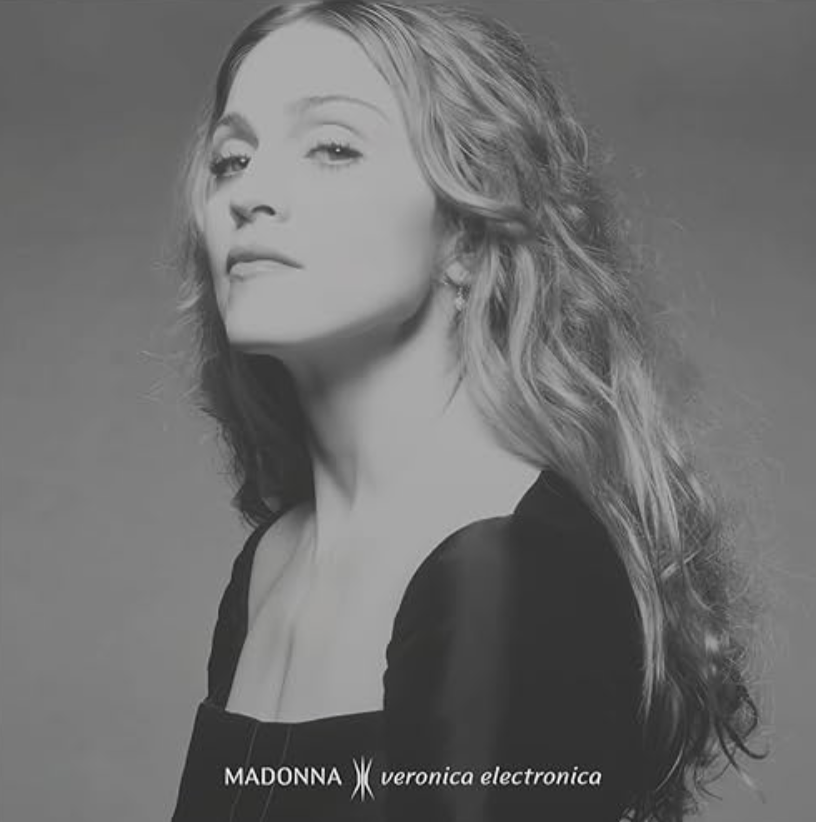
Because Madonna has never been a common artist of the mainstream, it comes as no surprise that, of all the things to revisit and release as an album, she opted for the long-rumored remix companion to 1998’s Ray of Light, Veronica Electronica. Which is right in line with Madonna also announcing her plans to reissue 1994’s Bedtime Stories, billing it at as “The Untold Chapter” a.k.a. “a vinyl EP featuring a never before heard story, early demos from the main manuscript and more.” Yes, Madonna is getting all Taylor Swift-y and presenting it as a “manuscript” because the album has the word “story” in it.
And while some might wonder why, of all the albums, Bedtime Stories, it’s apparent that, based on Veronica Electronica also coming out, Madonna wants to remind people of her often-underappreciated 90s oeuvre, with Ray of Light as the crowning jewel. In fact, it seems that after a couple of decades, listeners and musicians alike are finally understanding the full majesty and impact of the what Madonna did to and for music that fateful spring of 1998. Something that was, frankly, as impactful as the release of Windows 98 that summer. The operating system that further cemented the internet as “the future.” And, speaking of that word, it’s all over the sound of Ray of Light, de facto the remixes on Veronica Electronica.
As for that name, that “alter ego,” it was pulled from Madonna’s own full name: Madonna Louise Veronica Ciccone. Veronica being the confirmation name she chose in honor of Saint Veronica, the woman who gave Jesus her veil so that he could wipe the sweat and blood from his face as he carried the cross (many accounts also have it as Veronica herself wiping his forehead). After he had used the veil, the miraculously perfect image of his face was left behind on it, rendering the veil into a relic. Just as Madonna’s veil from her “Like A Virgin” performance in 1984 ought to be deemed one.
So yes, once again, Catholicism was at the center of Ray of Light, even if it was the first record she made after her Kabbalah transformation. This, paired with tapping William Orbit to produce, is what made Ray of Light fundamentally different from anything else she had ever worked on in the studio. Perhaps sensing how different it felt, Madonna commented at the time, “I created an alter ego, taking one of my middle names, and Veronica Electronica was born.”
The concept of this alter ego was so strong while the record was being made that Madonna even told Kurt Loder during an episode of Ultrasound (yet another fly show from MTV’s renaissance period), “We’re thinking of calling it Veronica Electronica.” Alas, that would have been too out of character for the real Madonna, who had always named her albums after one of the songs on it (usually a single). That is, until 2005’s Confessions on a Dance Floor. Of course, Veronica Electronica isn’t the only “esoteric” name of something Madonna came up with that didn’t pan out—just look at the erstwhile Whore of Babylon Tour that eventually became the Re-invention World Tour. All of which is to say that Madonna is often at war with her hyper-commercial side and her “weird art kid” side. With the release of this eight-track EP, the latter won out this time around. For there isn’t exactly a “wide audience,” apart from the die-hard fans, for something like this. And, truth be told, even the die-hard fans might be more than secretly miffed that Madonna has chosen to release yet another remix album so soon after Finally Enough Love, an album of Madonna’s fifty number one dance chart hits, remixed. By the same token, it should come as no surprise to fans that Madonna, as the woman who literally invented the remix album (hear: You Can Dance), keeps going back to it to remind audiences of her enduring worth as the dancing queen.
This, too, is ultimately the purpose that Veronica Electronica serves, in addition to calling attention to how valuable both Rick Nowels and Patrick Leonard were to the co-songwriting cachet of the remixed tracks highlighted on the record: “Skin” (Leonard), “Nothing Really Matters” (Leonard), “Sky Fits Heaven” (Leonard), “Frozen” (Nowels) and “The Power of Goodbye” (Nowels). As for “Drowned World/Substitute for Love (BT & Sasha’s Bucklodge Ashram New Edit),” which kicks of Veronica Electronica as it does Ray of Light, that especially personal song was co-written by Madonna, Orbit and architect David Collins (with credits also given to Rod McKuen and Anita Kerr due to sampling from their 1969 song, “Why I Follow Tigers”). Indeed, Madonna was obviously in a very hippie-dippy late 60s/early 70s mood for the record, with “Ray of Light” also sampling heavily from Curtiss Maldoon’s 1971 track, “Sepheryn.”
With the past already so palpably haunting Ray of Light, bringing Veronica Electronica to the fore now further proves that the past is always present, always haunting, permeating. To be sure, there is an undeniable hauntology to this musical offering, proving once again that society hasn’t moved forward, but is constantly looking back. Repurposing, reincorporating…reusing. In the years since Madonna brought electronica into the mainstream (that’s right, many months before Cher came onto the scene with “Believe”), that sound has been wielded countless times in music, reminding listeners—both those who did and didn’t live through the decade—that the 90s are never too far away. Ergo, the by now constant mention of how both Addison Rae and FKA Twigs basically remade Ray of Light for their own records that came out this year (Addison and Eusexua, respectively).
Even Madonna is remaking her own albums now, talking up her next record as being a “Confessions II” sort of thing. As in Confessions on a Dance Floor, Part II. Hence, working again with Stuart Price on what will be her first album in five years (the longest she’s ever gone without releasing a studio album). Though it might be six, at the rate things are going. This, too, is likely why Madonna saw fit to throw fans a bone with another remix record to keep whetting their appetite, as though said appetite isn’t insatiable enough as it is.
And likely to become even more so since this is only eight tracks’ worth of music, one of which is basically something fans already heard on Finally Enough Love (the Sasha Ultra Violet Remix Edit of “Ray of Light,” now the Sasha Twilo Mix Edit on Veronica Electronica—either way, both versions sound decidedly The Prodigy-esque). As for the standout remixes, “Skin (The Collaboration Remix Edit)” and “The Power of Goodbye (Fabien’s Good God Mix Edit)” are the frontrunners, while the lone “previously unreleased” (read: most fans heard the leak long ago) demo, “Gone Gone Gone,” only makes one think of the other noticeably missing demos from that recording period. Namely, “Revenge,” “Like A Flower” and “Flirtation Dance”—the latter being what would turn into the “Skin” heard on the final version of the album. Even the addition of “Has to Be” (which appears on the Japanese version of the album as a bonus track) would have been welcome.
Alas, Madonna has kept the selection sparse, perhaps not wanting the errant potential novices to get overwhelmed by the highly-layered music that runs at a length that’s unfathomable to the “TikTok generation.” But, despite all their naïveté on matters of taste, even they know the present is lacking.
Thus, because the present is nothing like the future that the late 90s promised (particularly through its music), Veronica Electronica is a comforting sound. One that you’ll just have to pretend you’re listening to on the communal headphones at Virgin Megastore.


[…] Windows (into) ‘98: Veronica Electronica […]
[…] apparent that electronica-oriented grooves inspired by Madonna’s Ray of Light (see also: Veronica Electronica) are all the rage right now—and getting plenty of mainstream attention. So why not “Everything […]