


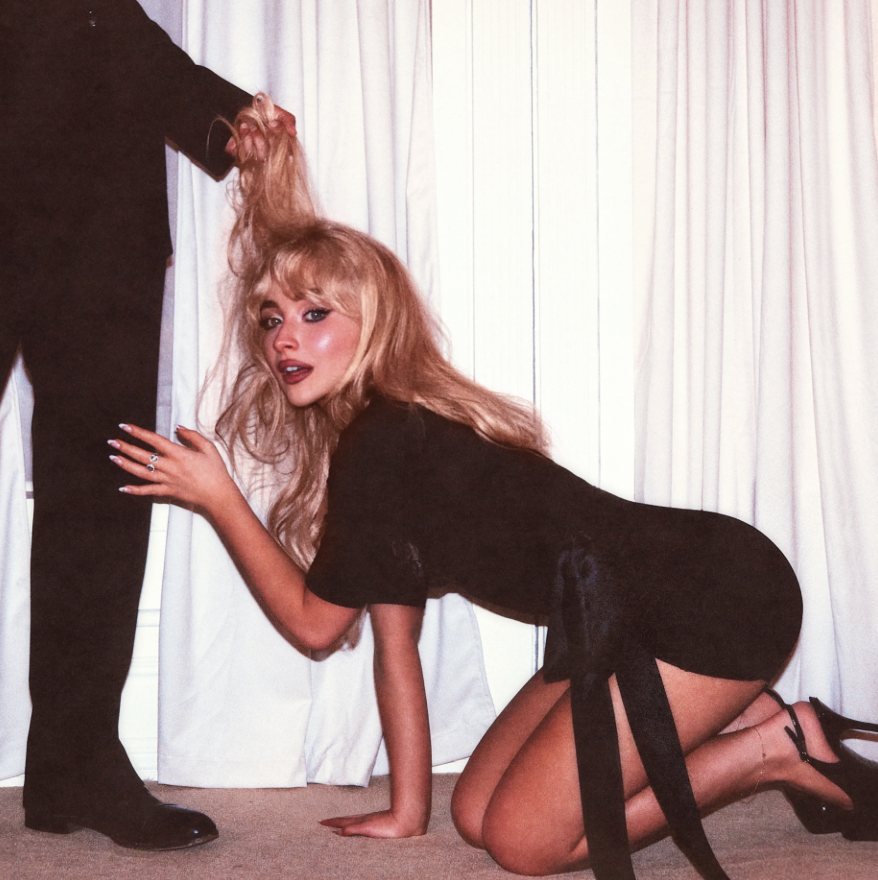
As is the norm with female pop stars, Sabrina Carpenter was able to go along with unchecked praise and reverence there for a while (read: about a year) before she finally did something that was deemed to have gone “too far.” That “something” is her recently revealed cover artwork for Man’s Best Friend, her seventh album in the span of ten years. Set for a release on August 29th (almost exactly a year after Short n’ Sweet was released on August 23, 2024), Carpenter has already managed to cause controversy months before. So who knows what kind of reaction some of the songs and their eventual accompanying visuals might invoke. For the moment, the only song and video anyone has to go on is “Manchild” (yes, a nod to Lana Del Rey), another eye-rolling, Dolly Parton-esque bop about the disappointments that men cause.
To be sure, it’s no secret that Carpenter has never been one for trying to pass the Bechdel test. Like her erstwhile touring mentor, Taylor Swift, speaking on the shortcomings of men in song form has instead been a point of pride, rather than something to be “ashamed” of. Nor is she ashamed of the album cover that has caused an uproar among feminists and fans alike, garnering such headlines as, “Sabrina Carpenter Album Controversy: Women’s Organization Slams ‘Regressive’ Cover,” “Sabrina Carpenter Innocent?,” “Sabrina Carpenter Fans Are Fuming Over Her ‘Degrading’ New Album Artwork,” “For the Girls? Sabrina Carpenter’s New Album Art Inspires Some Strong Reactions” and “Did Sabrina Carpenter Go Too Far With Her New Album Cover? The Feminists Are Furious.” And yes, there’s been a brewing backlash against Carpenter for a while now. Not just because she dresses as a projection of the ultimate straight male fantasy in her lingerie and other assorted “tradwife” looks, but because all the raciest, most sexual parts of the Short n’ Sweet Tour (e.g., “Taste,” “Bed Chem” and “Juno”) have been publicized ad nauseam since it kicked off back in September of ‘24.
Of this fixation on her sexual expression, Carpenter pointed out to Angie Martoccio in her July-August ‘25 Rolling Stone cover story, “It’s always so funny to me when people complain. They’re like, ‘All she does is sing about this.’ But those are the songs that you’ve made popular. Clearly you love sex. You’re obsessed with it. It’s in my show. There’s so many more moments than the ‘Juno’ positions, but those are the ones you post every night and comment on. I can’t control that. If you come to the show, you’ll [also] hear the ballads, you’ll hear the more introspective numbers.”
But, like Madonna before her, all that people seem to want to fixate on is her “ho-ishness.” How she acts—or at least dresses—like a “slut,” and that her influence on young women is ultimately negative because of this. It’s a familiar story. One that can be found during practically any moment of Madonna’s career (and perhaps that’s part of why Carpenter takes such joy in paying homage to M). For example, at the end of 1990, when “Justify My Love” was released as a single. But, more than the auditory aspect of the song, it was the video that sent puritanical America into a frenzy. This furor further heightened by MTV banning it from their airwaves, followed by Madonna then choosing to sell it as a VHS single, which raked her in plenty of extra dough.
In order to address some of the controversy, Madonna even appeared on Nightline to talk to Forrest Sawyer about “pushing the limits of sexuality,” as he called it. But, for Madonna, and now, ostensibly, Sabrina Carpenter, what feminism is really all about is the idea that a woman is free to do whatever she likes, so long as she’s the one making the decision about it. Regardless of whether that fits into the preconceived mold of how a feminist woman “should” act (see: Babygirl, another pop culture moment that subverts expectations of how a high-powered, independent woman “ought to” be with her sexuality).
Even so, like many others, Sawyer had to imbue his interpretation of Madonna’s work with literalism, telling her, “…one woman’s art is another woman’s pornography. I’m thinking of the ‘Express Yourself’ video. I mean, there are images of you chained, there are images of you crawling under a table, there are a lot of people who are upset by that.” Madonna immediately reminded, “Okay, I’ve chained myself though… There wasn’t a man that put that chain on me, I did it myself. I was chained to my desires, I crawled under my own table. You know, there wasn’t a man standing there making me do it. I do everything by my own volition. I’m in charge, okay? Degradation is when somebody else is making you do something against your wishes.”
This is something that clearly needs to be brought up again vis-à-vis the outcry over Carpenter’s new cover, which features her in a submissive position—on her knees on the floor—in front of a man standing over her holding her hair like a leash as she lightly paws at his leg. Those who spoke in favor of the image have wielded the “satire” approach as the primary defense, with one especially quoted tweet being, “I am a little concerned about people’s inability to immediately clock that the cover is obviously a commentary on the way women are treated, especially with the context of ‘Manchild’ and the album being called Man’s Best Friend.” But whether or not Carpenter is offering up another winking troll of men and the way they treat women is beside the point in terms of Carpenter choosing to pose and style herself in this way. The larger point is that people increasingly take issue with women who act or look too femme in a stereotypical way. Even if it’s their prerogative to do so (cue Britney’s “My Prerogative”).
Maybe this is, in part, a reaction to the circumstances that led to the election of a misogynistic prickhead (for a second round) as the president of the U.S., but, at the same time, it’s been going on for decades. Anytime a woman doesn’t disown the conventions of her femininity (a version of femininity that is deemed to have been fortified and propagandized by the patriarchy), men and women alike get up in arms. They insist she should be less “pretty,” “hot,” “fuckable,” etc. if she wants to be taken “seriously” as a “true” advocate for women. They say she shouldn’t promote a sex-positive way of life because, well, just don’t—otherwise you’ll create an entirely new generation of “ho bags.”
Alas, as Madonna said in that Nightline interview, “Sexuality is something that Americans would really rather just sweep up under the rug.” Carpenter is currently stoking this old issue with puritanism in the U.S. thanks to, among other things, her hyper-sexed up persona, her comfortableness with talking about being horny, the cover of Man’s Best Friend and, now, the David LaChapelle-shot photo for her Rolling Stone cover, which features her (again) on her knees in front of a hookah in nothing more than white thigh-high stockings as she stares up into the sunlight like she’s being touched by God. Meanwhile, a lot of people are secretly touching themselves to this image. All while decrying Carpenter as having gone “too far this time.”
Once more, it conjures up that Madonna backlash of the early 90s, with Sawyer telling her, “You’ve taken some heat from some women who feel that maybe you’re not expressing the values that they want feminism to express, all the way from way back when you wore the belt buckle that said ‘Boy Toy’ to the ‘Material Girl’ video which they feel reflects old values of women, even if it was satirical, to ‘Express Yourself.’ Do you have an answer [for] them?” Madonna, ever the intelligent defender of her actions, responded, “I may be dressing like the typical bimbo, whatever, but I’m in charge, you know. I’m in charge of my fantasies, I put myself in these situations with men, you know. And everybody knows, in terms of my image in the public, people don’t think of me as a person who’s not in charge of my career or my life, okay? And isn’t that what feminism is all about?… And aren’t I in charge of my life, doing the things I wanna do, making my own decisions?”
The same can be said for Carpenter, who has never been more in control of the direction her career is going. Which is exactly why she decided to provoke reactions with this album cover, and why she said in her Rolling Stone interview, “If you ever listen to my old albums…which, don’t, what I was really trying to do is what I’m doing right now, and what I think I accomplished with Short n’ Sweet.” And yet, she knows she’s up to the challenge of presenting an album that’s even better, one that expands on the universe established with Short n’ Sweet, as the visuals for the Vania Heymann (hey men!) and Gal Muggia-directed video confirm. A video of which she remarked, “I really never felt like more of a main character in a coming-of-age movie than when I listened to the song, and that’s how I wanted the video to feel.”
As for how she wanted the album cover to feel, well, that remains to be officially declared. Though perhaps she’ll be obliged to “come forward” and talk about it if the backlash keeps going strong—granted, unlike Madonna’s scandalous 90s days, “controversies” such as these tend to get swept away quickly by the next week’s, day’s or even hour’s “cultural flashpoints.”
Carpenter’s latest mentor, Dolly Parton, also lived most of her career in an era when headlines and criticisms didn’t simply “go away” because the public had no attention span and the news cycle needed to feed itself with something else every twenty-four hours. Instead, she was subjected to a lot of comments about her appearance. And how it “ought to be”–in other words, not so “trashy.” But it was Parton herself who famously said, “I make jokes about it, but it’s the truth that I kind of patterned my look after the town tramp. I didn’t know what she was, just this woman who was blond and piled her hair up, wore high heels and tight skirts, and, boy, she was the prettiest thing I’d ever seen. Momma used to say, ‘Aw, she’s just trash’ and I thought, ‘That’s what I want to be when I grow up. Trash.’” So, too, does Carpenter, if that’s how one must see it because of her “aesthetic.”
Of meeting and interacting with Parton while working on her revamp of “Please Please Please,” Carpenter noted, “It felt like I was looking in a weird mirror into the future.” Parton felt a similar way, echoing, “Our voices are very similar. I can’t tell sometimes which part’s her and which part’s me. And we look like relatives. She looks like she could be my little sister. We’re little women, doing big things.” And the “big things” Carpenter wants to keep doing is, evidently, challenging people’s conservative worldview with her unabashed sensuality. Thus, like Madonna before her, being lambasted for her “anti-feminism.”
But perhaps Carpenter can find solace in the words M offered during her 2016 Billboard Woman of the Year speech: “Camille Paglia, the famous feminist writer, said I set women back by objectifying myself sexually. So I thought, ‘Oh, if you’re a feminist, you don’t have sexuality, you deny it.’ So I said, ‘Fuck it. I’m a different kind of feminist. I’m a bad feminist.’”


[…] On the Backlash to Sabrina Carpenter’s Man’s Best Friend Album Cover […]
[…] On the Backlash to Sabrina Carpenter’s Man’s Best Friend Album Cover […]
[…] On the Backlash to Sabrina Carpenter’s Man’s Best Friend Album Cover […]
[…] The video for “Hammer” wasn’t without its own set of challenges as well. Directed by Renell Medrano, Lorde and co. “pulled an all-nighter” in Hampstead Heath to secure the gamut of scenes required to convey the “coming of age” feeling of the song. And it really is a track that establishes the mind and body shift Lorde has undergone in the time since 2021’s Solar Power came out—an album she effectively brushed off in her Zane Lowe interview about Virgin (likely validating many fans’ opinions). It was also in said interview that Lorde confirmed “Hammer” was always going to be track one of the record. And for good reason. Because, from the moment the listener is introduced to the guttural sound (which is the word Lorde uses to describe it, in addition to saying that her sister told her it sounds like it’s coming from her womb—though others might say it has the same sound as the warped voice at the end of Justin Timberlake’s “Cry Me A River,” or even a similar connection to the sound during the opening of Addison Rae’s “Headphones On”), it establishes and defines the rough, anatomical nature of the album. Particularly in a moment during the first verse when she sings, “Don’t know if it’s love or if it’s ovulation.” And, talking of that very feminine phenomenon, Lorde told Lowe, “It was really important to me with this album to document, um, a femininity that is the way I’m a woman in the world. There’s edges to that. There’s no apologies” (something Sabrina Carpenter knows all about). […]