


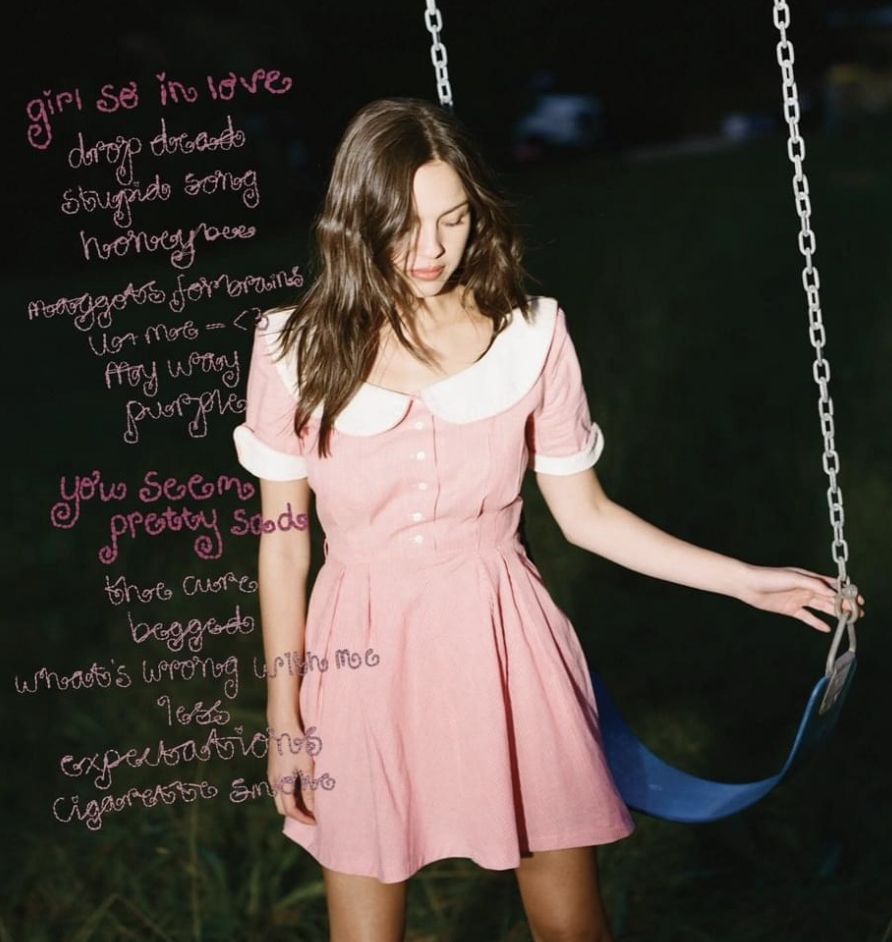
For a while now, Olivia Rodrigo has made no secret of her love for The Cure. And more specifically, her love for Robert Smith. The first noticeable tinges of that were on her last album, Guts, via the song “Pretty Isn’t Pretty,” which bears The Cure’s sonic signature of hopeful sadness (or sad hopefulness). That was in 2023. Then, in 2025, Rodrigo upped her game on idol worship and showing reverence for the band’s influence by having Robert Smith join her onstage at Glastonbury for a duetted performance of “Friday I’m in Love” and “Just Like Heaven.” It’s the latter song that the first track on (and single from) You Seem Pretty Sad for a Girl So in Love, “drop dead,” seems to borrow its tonal inspiration from (going so far as to directly name-check it with the lines, “You know all the words to ‘Just Like Heaven’/And I know why he wrote them/Now that you’re standing right here”). All jubilance and “honeymoon period” feels. Needless to say, Rodrigo is setting her listeners up for heartbreak with a start like that—so optimistic and willfully naïve as it is.
However, the cracks in that blind happiness start to appear on the following track, “stupid song.” Though it might just as well be called “another sad love song” (alas, that title was already taken by Toni Braxton). For it’s here that Rodrigo starts getting to the heart of her album title, some part of her already knowing early on that, when one’s heart is so full like this, sadness and pain are destined to follow (because it’s just, like, the laws of the universe). Tapping into what allowing oneself to have that level of vulnerability entails, Rodrigo offers such metaphors as, “I’m a car speeding down the boulevard without a brake” and “I’m a heart made of wax, and I’m melting in the sun.” There’s also a touch of Gracie Abrams to her tone and lyrics when she sings, “You’re a spark in the dark, and my clothes all caught aflame/You should feel how I feel when somebody says your name.” All while singing to a hyper-controlled piano backbeat that softly complements Rodrigo’s earnest, belting-it-out vocals. But around the one-minute-twelve-second mark, the music is finally brought more noticeably to the forefront with a transition that’s reminiscent of the buildup in “drivers license.”
Rodrigo also cuts to the core of what it means to fall in love with the simple, dichotomous line, “I feel right, I feel wrong, I feel totally insane.” The slow jams then keep coming with “honeybee,” which features a musical opening that harkens back to Lily Allen’s intro to “Littlest Things” (which wouldn’t be out of the question considering how close Allen and Rodrigo have become since the former joined the latter onstage at Glastonbury 2022 for a rendition of “Fuck You”). Acknowledging the sweetness (and yes, near goddamn saccharineness) of a love that’s just beginning, “honeybee” is pretty much an essential title on an album like this, with Rodrigo admitting of these early stages of her romance, “It’s too hard to describe this/In a way that feels honest.”
Nonetheless, she’ll continue to try for the rest of the record, in this instance remarking of her love, “I hope I never see/What your face looks like going” and “Here’s to hoping.” Indeed. But it’s a hope so overtly tinged with bittersweetness, with waiting for the other shoe to drop. So maybe that’s why, at the two-minute-twelve-second mark, Rodrigo’s now longtime producer, Dan Nigro, felt it essential to include an undeniably lovely string arrangement that digs the knife in terms of ensuring the listener knows just how much they’re doomed for as much of a fall as Rodrigo the further along in this love journey they go. To be sure, part of the album’s brilliance is its ability to make the listener feel as if they’re on the same roller coaster ride as Rodrigo (something that Lily Allen’s West End Girl also recently achieved).
Part of creating this effect is framing happiness and the feeling of being in love through a lens of both gloominess and joyfulness (for it is both of those things). “maggots for brains,” believe it or not, falls into the latter framing category and commences Rodrigo’s noticeable sonic homage to The Cure. Use of a drum machine (and a certain kind of guitar) aside, Rodrigo’s self-presentation as a girl who turns wayward in the absence of her love is nothing if not The Cure-esque. And, to describe that feeling, Rodrigo notes, “I’m a sad shell of a woman and I’ve got maggots for brains/But that’s just the thing that happens when my/When my baby goes away.”
Incidentally, this is also the song that Rodrigo mentioned early on (without giving away its title) when stating that one of the tracks was inspired by the Sex and the City episode, “Ex and the City.” Specifically, when Miranda tells Steve (who she’s been broken up with for some time at that point), “Whenever something funny happens, I always want to tell you about it.” As for Rodrigo’s version of that line, it’s: “Everything that’s funny I wish I could tell to him.” So it is that “maggots for brains” acts as a kind of foreshadowing to the breakup to come. Though, within context of the song, there’s a dual element to her “baby” being “away.” Is he on a vacation or did they break up already? At times, it seems as if it’s the latter. Like when Rodrigo sings, “And sometimes at a low point, I even wish for a tragedy/‘Cause I know he’d come over and take real good care of me.” Or maybe they’re not broken up, it’s just that the relationship is still too new for her to come across as being this needy (for not everyone is willing to admit, like Ariana Grande, “I can be needy, way too damn needy”).
Closing the song with a round of repeating, “What can I do/But think of you?,” Rodrigo emphasizes her “Robert Smith-ness” before transitioning into another song, “u + me = <3,” with overt sonic similarities to The Cure. The mathematical equation is nothing new in Rodrigo’s oeuvre—that is, if one is to count (no pun intended) Sour’s “1 step forward, 3 steps back.” But here, she lays it on thick with the chorus, “Carve our names into the car seat leather [slightly less lasting than doing it on a tree]/You plus me equals a heart forever.” Despite this plucky sentiment, there are more signs of Rodrigo’s optimism about love waning as she refers to her past romantic history with such lyrics as, “All of my girlfriends roll their eyes/And tell me to take it slow this time” and “All my ex-boyfriends have heard these lines before/But I like you better by a million times.” For now anyway. But, for the time being, Rodrigo is still staunchly Team Love, declaring at another point, “They say modern love’s a cruel endeavor/And to that I say, ‘Fuck it, whatever.’”
However, on the next song, “My Way” (not to be confused with Frank Sinatra’s more iconic single of the same name), there’s a one-eighty mood shift that leads one to briefly assume that it’s a track surely made to be on the “You Seem Pretty Sad” side of the vinyl. Because, yes, the record is divided into two “moods,” as it were: “Girl So In Love” and “You Seem Pretty Sad.” “My Way,” at track six, doesn’t quite fall into either category neatly. For it’s more in line with the angsty rage of her previous two albums. But Rodrigo wouldn’t be Rodrigo without offering up at least one song about jealousy at some point on the record. And this one exudes that emotion in spades (perhaps even more and on a different level than “Obsessed”) as she rails against some girl—whether an ex or just someone who’s crushing a little too hard—that won’t stop buzzing around her boo like a honeybee (lest anyone forget the title of track three).
Berating this “competitor,” Rodrigo lets her monogamous, heteronormative freak flag fly when she announces, “You’re in my way now/Don’t go, go where you don’t belong/Think I can’t make out/Ah-ah, how hard you hang on.” It’s during another set of lyrics that Rodrigo makes it clearer that this must be an ex of her boyfriend’s as she notes, “Or maybe you’re just tryna get me riled up now/You’re posting another pic in clothes that I know are his.” This, too, tying Rodrigo back to Sabrina Carpenter (with the Joshua Bassett “debacle” leading one to believe that “Obsessed” and “Taste” are companion pieces), who famously goads on “Taste,” “You’re wonderin’ why half his clothes went missin’/My body’s where they’re at.”
There’s also a connection to Slayyyter’s recent track from WOR$T GIRL IN AMERICA, “OLD FLING$,” wherein she, too, tells a “sniffing around” ex of her boyfriend’s, “You’re looking for him, but he’s something that you’ll never find/Wait, your name/Did come up a few times, but he said you’re not comparing to me.” Having commenced the song with the verse, “I see you creepin’, yeah, I see you from the sideline,” Slayyyter establishes a similar sentiment of annoyance with this “buzzing around like a fly” ex. And, apparently, vexing girls are prone to writing poetry (especially if they live in “the big city”), because Slayyyter mentions, “That shitty poetry only made you the pick-me type,” while Rodrigo adds, “You send him another poem and think that he’ll let me go.”
Her anger reaching a fever pitch, Rodrigo finally has to get as blunt as possible with the reminder, “Last time that I checked, I won/Let me be direct, just stop/You’re being fucking weird/Maybe I’m a petty bitch/But you made me resort to this.” “This” being to not even bother masking that she’s the jealous type and has absolutely no interest in “sharing” a man. Indeed, the song feels, in its way, like a Lily Allen-on-West End Girl sentiment as well—call it Rodrigo’s version of “Madeline.”
After expressing so much venom, Rodrigo appears to have exorcised it enough to go back to some sugary sweetness on “purple,” the final song on the “Girl So In Love” side of the record. As such, it pulls out all the stops on teetering between oozing with love and feeling suffocated. For, yes, it’s a fine line. And one that starts to bleed the longer one stays in a relationship. Particularly when “wanting to be together all the time” turns into outright codependence. Something Rodrigo captures with her use of color wheel knowledge, wielding the romantic but also insidious metaphor, “And so it goes that you/Kissed my neck/Made our paths intersect/Till the two lines formed a circle/And I melt with you [surely, a nod to Modern English’s 1982 hit]/Your red and my blue/Now I see the world in/Purple.”
By now, most are aware that “London boy” (to use a Taylor Swift phrase) Louis Partridge is the inspiration behind many of these songs, for Rodrigo’s roughly two-year relationship with him appears to have been her most serious (and most “adult”) yet. However, unlike previous blokes she’s dated (e.g., Joshua Bassett, Adam Faze and Zack Bia), Partridge isn’t an ex who has invoked her ire (hear: “vampire”—supposedly not about Taylor Swift). As much. For it’s obvious she still looks back upon some of their time together “fondly,” as revealed through gushing “purple” lyrics such as, “It’s crazy/How I used to visit your town like a tourist/Now I got/A local grocery store and a favorite florist” (this having a certain “Taylor Swift talking about Joe Alwyn” quality to it—along with Swift’s “invisible string” also having a thematic correlation here).
Yet, for all her “so in love” happiness, more cracks in the veneer start to show again when she says, “It’s a small world/When it only can revolve around us two/It’s crazy/I had big dreams till I tied myself to you/Now I’m all consumed.” A love bubble that, as Carrie Bradshaw can attest to (during her season one and two stints with Big), is always destined to burst. So it is that Rodrigo starts to lay the groundwork for side two of the album at the end of the song, asking, “Are we so in love? Are we too attached?” This in addition to describing, “Melt with you till it all turns black/When you smooth it out, but it feels too flat” and “Melt with you till I just feel sad.”
And oh, how that sadness majorly sinks in on the first track to kick off the “You Seem Pretty Sad” side, “The Cure.” The second single from the album, and one that, despite the title, sounds less like The Cure and more like a mash-up of 90s-era Smashing Pumpkins (i.e., “Disarm”) with Foo Fighters (i.e., “Everlong”). Amid this sonic landscape, Rodrigo likens the love she had to being a failed cure. Or rather, a “pseudo-cure.” Only working for a while until the effects—the pheromones—started to wear off. Hence, her lament, “It don’t matter how your love feels anymore/It’ll never be the cure.” The cure for her own self-hatred, self-doubt and any other insecurity in between. Because it’s true that being in love can initially make those unpleasant emotions go away. But sooner or later, when the high of a new amour subsides, one is still stuck with themselves, and their personal feelings not directed outward at another. Though that might provide a good distraction for a bit, sooner or later, the “healing powers” of love dissipate. Prompting Rodrigo to woefully demand, “Why can’t it ever be enough?/Why can’t you come stitch me up?” Answering her own question with, “It’s not enough/All because my head is full of poison/And my heart is full of doubt.”
The sorrow continues on “begged,” which amounts to Rodrigo’s version of Taylor Swift’s “tolerate it” and Lily Allen’s “Beg For Me.” On the latter track, Allen implores of her nonchalant, icy love, “Why won’t you beg, beg, beg for me?” On Rodrigo’s song, she admits to being the “beggar,” ruing, “I’ll take what you’re giving/Ohh/But nothing’s quite enough/When I know that to get it I begged.” During her debut performance of the track (both live and in general) on Saturday Night Live, Rodrigo was joined onstage by none other than Weyes Blood, who provides backup vocals on the album version as well (though, for whatever reason, isn’t credited as a “full-on” feature). And for the live rendition, Rodrigo opted for a set design that felt decidedly ripped off from Lana Del Rey’s long-standing live performance of “Video Games” (complete with a swing and some surrounding florals). Considering Del Rey was also an influence on the record (and definitely its lengthy title), this sort of “unwitting” homage makes sense.
As for Rodrigo’s heartfelt live delivery of “begged,” it remains intact on the album version. Including such gut-punching lines as, “I have this thought/When I lay in bed at night/That I feel trapped inside my life.” And yet, despite the dissatisfaction she feels with the particular person and the (wrong) way they (don’t) show love and affection, Rodrigo can’t help but stay with them (a phenomenon poignantly addressed on Madison Beer’s “bad enough”). The reason being, “I still cling/Cling to hope like snow on the mountains.” Hope that, maybe one day, this person’s behavior will mirror what she’s looking for in a romantic “partner.” Though, the way she’s describing things, it hardly sounds like a partnership at all, so much as a one-sided “love me right” fest.
While Weyes Blood might not have merited a feature credit to Rodrigo, Robert Smith certainly does on the next song, “what’s wrong with me.” A track that’s aligned with “The Cure” (how appropriate) in the sense that Rodrigo is keen to make medical/doctor analogies in self-diagnosing these strange symptoms caused by love. Symptoms that are prompted by “this feeling I’ve got in my head,” but one that she “can’t describe.” The experience of being at sixes and sevens (an idiom probably ruined now because of “six, seven”), as it were, when it comes to the matter of falling in love is something Rodrigo broaches on “honeybee” as well, mentioning a similar difficulty with describing her feelings when she sings, “It’s too hard to describe this/In a way that feels honest.” Even so, she does the best she can on “what’s wrong with me,” starting with, “I’m out of body in my bed” (one of the best lines of the track). Then going on to “medicalize” some of her symptoms by noting, “It’s like somebody put a weight on my chest” and “My head is spinning and my stomach is sick.”
With such severe physical maladies (manifested from her emotional ones), Rodrigo continues, “Went to the doctor and she [way to underscore through pronouns that women work in medicine too] said I was fine/But every movie that I see makes me cry.” As for Smith’s vocals, they subtly complement Rodrigo’s throughout, but it’s at the one-minute-thirty-nine-second mark that he’s allowed his full moment to shine with a verse that finds him bemoaning, “I keep looking for distractions/Hope the feeling passes, but I’ve got to say/It’s getting harder every day/And I can’t seem to get around it/Head just keeps on pounding with the simple thought/What if this isn’t what I want?” That latter question being all too common among people who at last do find themselves in the relationship they thought they wanted, only to realize maybe it’s not (see also: Obsession as an allegory for that).
Smith and Rodrigo then harmonize during the verses, “Went to the doctor and she said I was fine/Tried meditation [that’s right, meditation not medication] with a bottle of wine.” Speaking from a lovesick perspective that can apply to both the initial and end phases of a relationship, the title of the song leads one to believe “what’s wrong with me” is a question when, in fact, it’s a description—in the sense that, as Rodrigo and Smith put it, “I think you’re what’s wrong with me.”
That characterization reaching an even more heart-wrenching crescendo on “less,” a piano ballad that riffs on the adage, “If you love someone, set them free.” Except Rodrigo doesn’t really want to be set free by the very person who seems to be making her so unhappy. Even though she can’t exactly pinpoint why—she just knows, “I feel it again/Edge of the bed/Body and head protesting/My stomach’s in knots.” So there it is: more bodily ailments wielded as a means to “physically characterize” her emotions. And, try as she might to recreate the magic with her beloved (e.g., “We tried to recreate/Our favorite date/But we didn’t laugh much this time/Our trip to Big Sur/Only confirmed/This isn’t what it should feel like”), it just isn’t working anymore. Thus, it’s her boyfriend (*cough cough* Partridge) who has the strength to let her go. Painful though it may be. Yet the only thing more painful (for both) is to stay together.
Regardless, Rodrigo still sings, “You say you can’t stand to watch me/Cry a minute more/So you do the noble thing/And open up the door/If loving me means letting go/And wishing me the best/Well then, I guess/I wish, I wish, I wish/You loved me less.” For that would mean that he wouldn’t let her go, and maybe they could just keep trying—over and over again—until something changed. Of course, they say the definition of insanity is doing the same thing over and over and expecting different results…
And, talking of “expectations,” the penultimate track on You Seem Pretty Sad for a Girl So in Love, its giving Rodrigo’s “80s take” on “get him back!” With a similarly wry, playful tone as she takes stock of what she’s been through during her twenties thus far (in matters of romance, that is) and decides, “I’m not kissing any boy that is passive/Their indecision is painfully unattractive.”
More than any other song, “expectations” is the one that most acknowledges Rodrigo’s awareness of how much she’s grown/how far she’s come in the short three years since she’s been in her twenties. Learning perhaps far sooner than other twenty-somethings that discernment is so important when it comes to letting men (a.k.a. boys) in—physically and emotionally. So it is that Rodrigo pronounces, “Now I am secure/I am so evolved/Now I ask for more and more,” adding, “I won’t settle for a guy with a fake job/They seem so desperate for loving, but, baby, I’m not/Gave my heart with zero stipulations/Now I take careful consideration.”
And after seeing some of the dudes she’s dated before, that’s a major consolation. Rodrigo then continues touting her newfound confidence and self-assurance with the verse, “These days I’ve got expectations/So I hit the new year/Like a single girl at a Vegas bar/Rockin’ my mini dress/With a vodka cran [the drink that serves as an ultimate giveaway of someone being in their twenties] and an open heart.” This tempting the universe with a question like, “So what could possibly go wrong?” (The answer being: she could fall in love again.)
Rodrigo’s boundless certainty about knowing what she wants (or, more accurately, knowing what she doesn’t want) persists with, “Yeah, I got hope [something she’s said before in different ways on this album—namely, on “honeybee” and “begged”]/Yeah, I got drive/I will not lose my faith/Don’t think my future husband’s at this bar in Silverlake [some shade at the “fake job” types that orbit around that area, to be sure].”
To the point of the 80s-ness of the song, there arrives a vocal breakdown where it sounds like she got Devo to join in (fittingly, the musical intro to the track is very Devo-esque). This occurring at the two-minute-fifty-four-second mark when a warped masculine voice chimes, “She’s got big expectations/She’s got real big expectations.”
Granted, those expectations seem decidedly dashed on the album’s grand finale, “cigarette smoke,” arguably the most emotional track—which is really saying something. Commencing with a softly strummed acoustic guitar, Rodrigo wastes no time in providing listeners with one of her now signature metaphors in the form of, “The cigarette smoke/Is a smell that I know/It clings to my clothes/And seeps into my bones.” Wielding the often unshakeable odor—and a foul one at that—of cig smoke as a parallel to being unable to shake the “odor,” if you will, of her past relationship, Rodrigo is at her most candid when she says things like, “I regret you/And how long I stayed/I resent you/For not being brave.” Obviously, these are sentiments aimed at Partridge. Even though, in “less,” she sounded kinder toward him, insisting that she actually wished he wouldn’t have been brave by letting her go. But such is the arbitrary pendulum swing of emotions when it comes to being in love (a feeling that can so frequently border on hate, as it is said).
And, talking of “swinging,” there’s a reason that Rodrigo opted for an album cover that shows her cresting on the high of being on a swing—caught in mid-air just before the inevitable “fall” back down to Earth (not pictured, of course…but the observer knows it’s coming). When she does get there, she has such unwanted revelations as, “Give me back my time/And I will give you back your heart.” These lyrics also channeling some Swiftian vibes when she screams at John Mayer on “Would’ve, Could’ve, Should’ve,” “Give me back my girlhood, it was mine first.” The notion of “give me back my time” additionally veers into “inconvenience fee” territory, a concept that more women should take advantage of (à la Mariah Carey). That way, all this talk of regret might be slightly mitigated. For even Swift says practically the same phrase on “Would’ve, Could’ve, Should’ve”: “I regret you all the time.”
Rodrigo, too, mentions regret yet again with the verse, “I regret you/And what I let slide/I resent you/For taking her side.” Perhaps referring to whoever her competitor was during “my way.” But no matter who it is that Partridge chose to side with, the point, for Rodrigo, is that he didn’t stand up for her when it mattered most. A scenario that she further speaks on with the lines, “Some nights can be/So fucking lonely/But it’s better than begging [a callback to ‘begged’]/For you to stand up for me.”
Leading her to beg (something she’s evidently gotten used to), “Tell me something honest/So the memories turn dark.” Because if they don’t, it will be as Swift says (also on “Would’ve, Could’ve, Should’ve”): “Memories feel like weapons.” Apart from Swift’s “Would’ve, Could’ve, Should’ve,” there’s a hint of Sabrina Carpenter’s “Please Please Please.” That is, with regard to the shade thrown at the respective actors each singer is (/was) dating. With Carpenter insisting to Barry Keoghan, “I heard that you’re an actor/So act like a stand-up guy.”
Rodrigo, instead, prefers, “I thought that we played the perfect couple/Until you didn’t want the part.” However, as You Seem Pretty Sad for a Girl So in Love makes known throughout, it seems that Rodrigo didn’t fully want the part either. And that’s the thing about relationships in one’s twenties: certainty is rarely at play. Of course, the same could be said of couples at any age. Rodrigo just so happens to crystallize the “twenty-somethingness” of it all on this record. And with great The Cure effect.


[…] With You Seem Pretty Sad for a Girl So in Love, Olivia Rodrigo Hones Her The Cure Sound […]
[…] honor of releasing her third album, You Seem Pretty Sad for a Girl So in Love, Olivia Rodrigo also unveiled the video for the record’s third single, “stupid song,” on the […]
[…] Buccellati and Jason Vance Harris, ends up coming across a bit like what Olivia Rodrigo is doing on You Seem Pretty Sad for a Girl So in Love. Which is to say, she’s emulating her own more “rock”-oriented heroes like The Cure […]