


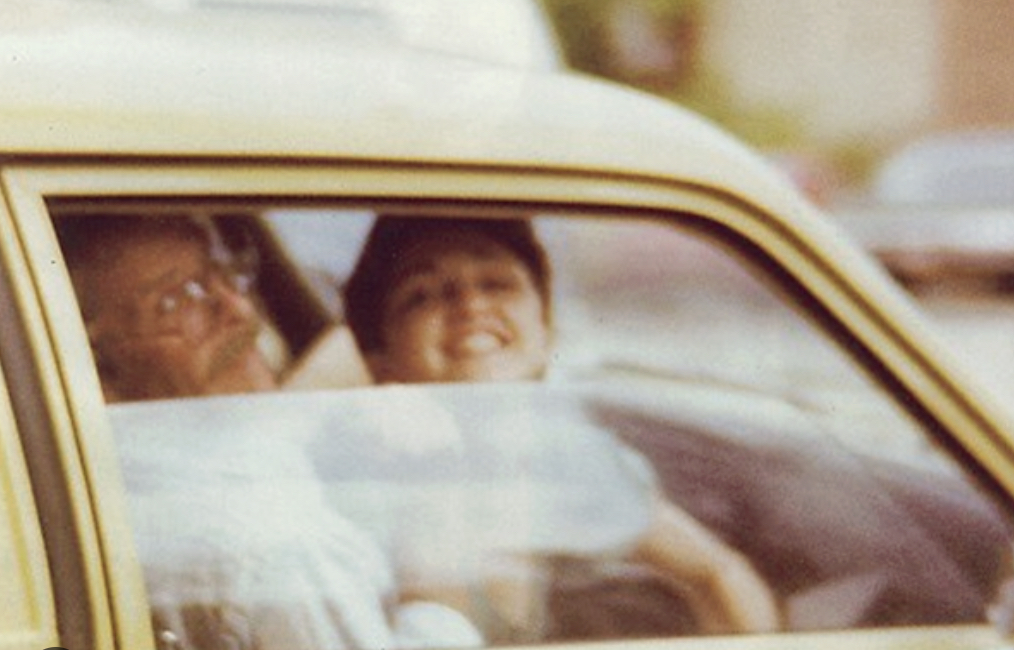
No matter how many varying accounts there have been of Madonna’s pre-fame years in Michigan, the one thing everyone can seem to agree on—even Madonna—is that Christopher Flynn was instrumental to shaping her and influencing her direction in life. Which of course negates the often-touted notion of Madonna being, let’s say, the “captain of her own destiny.” Because, in truth, were it not for Flynn, it’s debatable whether Madonna would have left Michigan. For it was he who homed in on her talent, molded her, advised her and, perhaps most importantly of all, took her to her first gay nightclub. A place called Menjo’s in Detroit, which still stands to this day. And the experience was so influential that Madonna continues to talk about it all these years later, most recently in her interview special with Graham Norton called Madonna & Graham.
In fact, almost every album cycle has an interview where she brings up Flynn exposing her to the gay nightclub scene and how much it would inform the rest of her life and career. And it makes sense for her to bring it up so often. Because when you are at that age, someone who pays serious attention to you like that and invests in your future is absolutely formative. In the VH1 Driven episode on Madonna that aired in 2001, Madonna’s former high school guidance counselor, Nancy Mitchell, remarked, “Christopher Flynn was Madonna’s primary influence during her high school years… This is a man who truly loved and cared and promoted her success.”
The feeling was mutual from Madonna, who idolized Flynn. Elizabeth Bergman, a dance professor at the University of Michigan, echoes that sentiment in the same Driven episode, stating that, when she went to Flynn’s dance studio to interview him for a position at the university, Madonna was one of the students in the class and it was obvious “she adored” him. Of course, what never seems to come up in any of these retellings about their mentor-mentee relationship is what Madonna’s strict and conventional father, Silvio “Tony” Ciccone, would have thought of a man like Flynn. Because, to him, perhaps the only thing worse than an older straight man cozying up to his eldest daughter, was the notion of a “homosexual” (the word that conservatives say to make it sound more like a “medical condition”) somehow “corrupting” her in other ways. And yet, at the same time, it’s probable that Mr. Ciccone was too busy both working and dealing with his other seven children to notice—though, by that time, he had married the family’s erstwhile housekeeper, Joan Gustafson, and had pawned off a lot of the responsibilities of caretaking and discipline to her.
Whatever his feelings might have been about Madonna’s dynamic with Flynn, it was apparent she was looking to the latter for a combination of maternal and paternal guidance she wasn’t getting at home. To be sure, it hardly seems like a coincidence that Madonna found comfort in a gay man who could channel both masculine and feminine energy (as she herself would later be known for doing)—lacking as she was in the kind of useful direction she was getting from her father or stepmother during her high school years. Especially since both would have only advised Madonna to stay in Michigan and build a life similar to the one they had. Which, at that time, would have been totally anathema to Madonna (though, later on, not necessarily—even if Madonna has formed her own family and manner of “settling down” in a more unconventional way).
Flynn, in contrast, encouraged Madonna to explore where her talent might take her. Hence, her decision to follow him to the University of Michigan in Ann Arbor, with Mitchell also commenting on that decision, “I think Madonna chose University of Michigan and the School of Dance because Christopher Flynn was there and he gave her great encouragement to follow along and, basically, sent the message to her, ‘Stay with me, I’ll help mentor you, I will teach you.’” Instead, after about two years of her U of M stint, he told her to go to New York City. Encouraged her to believe that she had the kind of talent and drive to make it there rather than continuing down the more traditional path (her least favorite kind) or pursuing a degree in order to prove she was talented and driven. As Flynn recalled, “It was becoming apparent that she was moving into a different direction and academic dance is academic dance, that’s all I can say about it. It can be thrilling and exciting in its own ways, but it has its limitations. And it was also necessary for her to explore lots of other things.” As she soon did upon stepping out into Times Square, as the legend goes, after telling the cab driver to drop her in the “middle of everything.”
So it was that Madonna was right to pronounce of her mentor during a 1990 documentary for the BBC, “When I met Christopher Flynn, my whole life changed. It wasn’t just because dancing—studying dance with him gave me a focus, which is really important and took me sort of out of what I considered to be a very humdrum existence, but he taught me about art and classical music and took me to museums and he also took me out to my first gay discotheque and I just saw a different side of life I had never seen before.” One that he compelled her to keep exploring with the final push of advocating for her move to New York. An advisement that might be the most valuable aspect of what he did for her in the sense that she might not have had the courage to do it without his support. And, as any Madonna fan knows, her arrival in New York was the thing that made her into what she would become.
Before that “plot point” in her life, however, there was Flynn making her into what she would become. In other words, he was responsible for one of her first integral transformations that would lead her toward an unstoppable destiny. And it all started with something as simple as telling her she had value when no one else ever really had. As Madonna recalled on that BBC documentary, he was “the first person that told me I was beautiful and that told me I was special and that made me look at myself in a different way.” A way that allowed her, ultimately, to unlock her full potential.
In this way, it is so important to acknowledge that, no matter how “self-directed” and -assured a person can seem, even Madonna, there is usually someone behind the scenes early on in life that helps inform this acute sense of self. This “knowing who I am and what I want” aura. And typically, that person is in a teacher role—once again reminding how undervalued teachers are, both in terms of their paycheck and the positive influence they can wield.
As Madonna embarks on her sixty-eighth year, proceeding to go into yet another transformation as she gets closer to a new decade in her life and in life itself (with 2030 just around the corner), it remains relevant to go back to the true source of where her real initial transformation began. Madonna herself certainly has no problem doing so, declaring, upon Flynn’s death in 1990 (yet another dear friend she would lose to AIDS), “Christopher Flynn was my mentor, is my higher power and will remain my eternal inspiration.”
She’s held to that promise time and time again over the years, even modeling Richard E. Grant’s character in her directorial debut, Filth and Wisdom, after him. And then, in 2024, for The Celebration Tour, it was his image (among many others) projected large next to her as she sang “Live to Tell,” her unofficial AIDS tribute song. And yes, she had already long ago written an AIDS-mourning song dedicated partly to him (and the other half to Martin Burgoyne) called “In This Life,” during which she sings of Flynn, “He was like a father to me/Nothin’ in the world that he wouldn’t do/Taught me to respect myself.” And, in turn, Madonna has taught so many others to do the same. Which is, in a sense, why any celebration (birthday-related or otherwise) of Madonna is a celebration of Flynn.


