


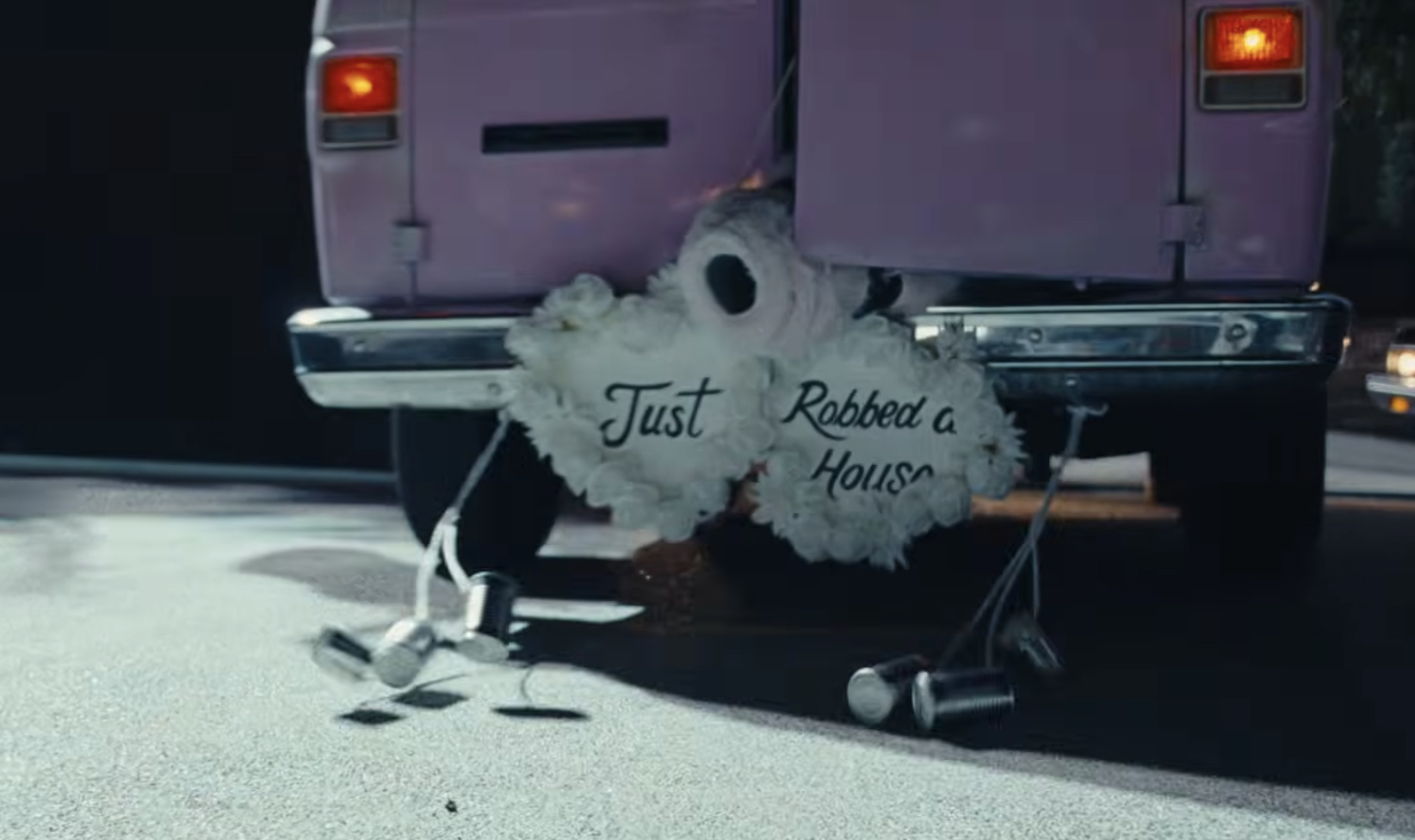
Sabrina Carpenter’s latest music video, “House Tour,” is indicative of a larger trend in mainstream pop culture. One that seeks to lambast the rich by promoting “socialist” ideals. Or at least, a “Hollywood-ized” version of them, which is less socialist and more outright “eat the rich,” as it were (after all, the rich themselves are certainly eating people, as the Epstein files have made clear). This much has also been emphasized by a movie like Ready or Not: Here I Come (in addition to its first installment, Ready or Not). In which rich people are the villains hunting a “poor” girl like Grace MacCaullay (Samara Weaving) for sport, with the “obvious” aim being to kill her in order to fulfill a Faustian pact. Because, yes, that’s the extent to which the rich are abhorred at this point, making them easy fodder to play antagonists who never actually worked for anything in their life, but instead rose to power through nefarious, supernatural means.
With such contempt reaching the ears (and eyes) of the rich themselves, it’s only natural for them to jump on the bandwagon of wealth-hating by also “attacking” their own class, even if only “undercuttingly” (a.k.a. very overtly) through media. After all, “if you can’t beat ‘em, join ‘em.” Except the fact that, of course, the rich will never join the poor (which amounts to just about everyone outside the one percent at this juncture). Not really. They might join them in mocking themselves, but that’s where it ends. And, in this way, it feeds into what Mark Fisher said about anti-capitalism actually reinforcing capitalism—or what he called “capitalist realism.” Which is defined as “the widespread sense that not only is capitalism the only viable political and economic system, but also that it is now impossible even to imagine a coherent alternative to it.”
Except that the new so-called alternative, for many corporations and “artists” (who are paid by those by corporations), is railing against it while continuing to sell a “lifestyle” through it. Even in ways as “subtle” as what Carpenter (who has a net worth in the millions of dollars) and her sidekicks, Margaret Qualley and Madelyn Cline, do in “House Tour.” Which is play “hot robbers” billing themselves as the “Pretty Girl Clean-Up Crew” as they pull up to a rich person’s house (or perhaps “mansion” is the better word) and go about pilfering whatever they want from it.
It’s an idea that not only lacks originality because it’s all the rage to promote “socialist” values at this moment in time (which, to Hollywood, just means presenting people who are stealing from the rich in order to get their rightful slice of the proverbial pie [see also: I Love Boosters), but also because Carpenter is pulling from the Bling Ring. An “outfit” (no pun intended) that became better known through Sofia Coppola’s stylized 2013 film that details how a group of L.A.-area teens ended up stealing roughly three million dollars’ worth of personal property and cash.
At the time when this happened, the full weight of the 2008 financial crisis hadn’t fully been felt in terms of the public expressing their outrage over being fucked over so blatantly by banks and big government. Arguably, the reaction to it didn’t reach a complete crystallization until 2011, with the Occupy Wall Street movement. The Bling Ring heists took place between 2008 and 2009, right as the fallout of the financial crisis was happening as a result of years of subprime mortgages being pushed by banks to people who couldn’t really afford them (or the predatory high interest rates that came along with them).
Yet it wasn’t “broke asses” breaking into celebrities’ homes (especially Paris Hilton’s) and stealing their shit, but rather, a well-off group of youths like Rachel Lee and Nick Prugo, the primary members of the Bling Ring. Their rash of thefts being as much about wanting expensive handbags and clothes as it was wanting to feel proximity to fame, thereby perhaps somehow getting closer to it themselves. For Carpenter and co., it appears less about that (even though whoever they’re stealing from must be famous enough to have a Grammy on their mantel—this also being a “tongue-in-cheek” nod to Carpenter’s own recent Grammy wins), and more about simply taking whatever she wants from someone with good taste (that last word also being the title of another Carpenter single from Short n’ Sweet). A phrase that, for whatever reason, is still associated with what it means to have money.
And yet, as the Beverly Hillbillies reminded, there’s no denying that money can’t buy taste. Carpenter and her sidekicks, however, clearly seem to think they have enough taste not only to pick and choose what they want from the house, but also to not bother paying for such expensive things in the first place. Especially since, as the video indicates, the rich ought to be footing the bill for such luxuries anyway. It’s not like they can’t afford to, right?
Besides that, if they’re “stupid”/“cavalier” enough to leave their house so vulnerable, then the “logic” goes that they should be taken advantage of. Case in point, in The Bling Ring, Marc Hall (Israel Broussard), the fictionalized Nick Prugo, is hanging out with Rebecca Ahn (Katie Chang), the fictionalized Rachel Lee, when he mentions that Hilton is hosting a party in Las Vegas that night. Rebecca’s wheels start turning immediately as she decides they should find and break into her house, offering, “I bet she’d leave her keys under her mat.” And she does, complete with an Eiffel tower keychain attached so as to reiterate her first name.
As the duo enters the property like it’s no big deal (and to them, it really isn’t), they eventually make their way into her giant closet, at which point, Marc makes the obvious assessment, “She has so much stuff.” “It’s amazing,” Rebecca says in return. As if to have a lot of shit is the end all, be all of existence. And it is, in this society so indoctrinated with capitalist “values” even as it tries to rail against it through the media, the very entity that is still promoting it best. For to talk about it in a supposedly “deprecating” way serves, ultimately, to do what Fisher mentioned about anti-capitalism serving capitalist realism. Which is to say, “What we have here is a vision of control and communication much as Jean Baudrillard understood it, in which subjugation no longer takes the form of a subordination to an extrinsic spectacle, but rather invites us to interact and participate… But this kind of irony feeds rather than challenges capitalist realism.”
Because the key example Fisher uses to encapsulate this is Wall-E, he continues, “A film like Wall-E exemplifies what Robert Pfaller has called ‘interpassivity’: the film performs our anti-capitalism for us, allowing us to continue to consume with impunity.” The same goes for Carpenter’s “House Tour” video. Not to mention the lyrics that, paired with this visual, now have some decidedly “communist” undertones rather than sexual ones (e.g., “Baby, what’s mine is now yours” and “My house could be your house too”).
This is why, fundamentally, Carpenter isn’t trying to say you should “take down” the rich at all by stealing from them, but instead merely underscoring the Bling Ring “philosophy” that you need to acquire material by whatever means necessary—a capitalist tenet at its core.


