


As the opening titles to The Invite commence, there are flashes (or “snatches,” if one prefers) of Joe (Seth Rogen) and Angela (Olivia Wilde) in their “younger years” a.k.a. the early days of their relationship. Joe plays the piano as Angela laughs along with him. In the midst of these “impressions” of a scene, there is a quote. And, considering that Wilde adopted her stage last name from none other than Oscar Wilde, it’s only right that she should use one of his quotes for the title card that kicks off the film: “One should always be in love. That is the reason one should never marry.”
The viewer is then brought into the drabness of the present-day, where Joe sits with a stoic yet pained expression in an empty auditorium. When he focuses in on what’s actually happening in front of him, he remembers that the students he’s theoretically “teaching” music to have concluded their performance and are awaiting his feedback. All he can muster is something to the effect of “great work” before he decides to dip out, telling them to rehearse it a couple of more times “just for practice.” He then grabs his cumbersome folding bike (given to him by none other than Angela) and heads out. The intro credits then toggle between showing what Angela is doing and what Joe is doing at the same exact moment. And while she’s happily making preparations for a dinner party Joe still has no awareness of, he’s slogging through his commute, which includes not only riding the BART, but also laboriously riding up one of San Francisco’s illustrious hills to get back home. Indeed, the intro to The Invite is the only time the viewer will see any of the four characters outside of Joe and Angela’s apartment.
And perhaps the only real reason to establish that San Francisco is the backdrop at all is because surely that’s where most of the sexually liberated people in the U.S. live (not, contrary to popular belief, NYC). In a similar fashion, “New Carthage” (for which Northampton, MA is the stand-in) is only fleetingly shown in Mike Nichols’ adaptation of Who’s Afraid of Virginia Woolf?, with George (Richard Burton) and Martha’s (Elizabeth Taylor) living room as the primary setting for the tension of their marriage boiling to the surface in front of a younger, more naïve couple named Nick (George Segal) and Honey (Sandy Dennis). Granted, this is just one of many small details about The Invite that mimics Ernest Lehman’s rendering of the Edward Albee play.
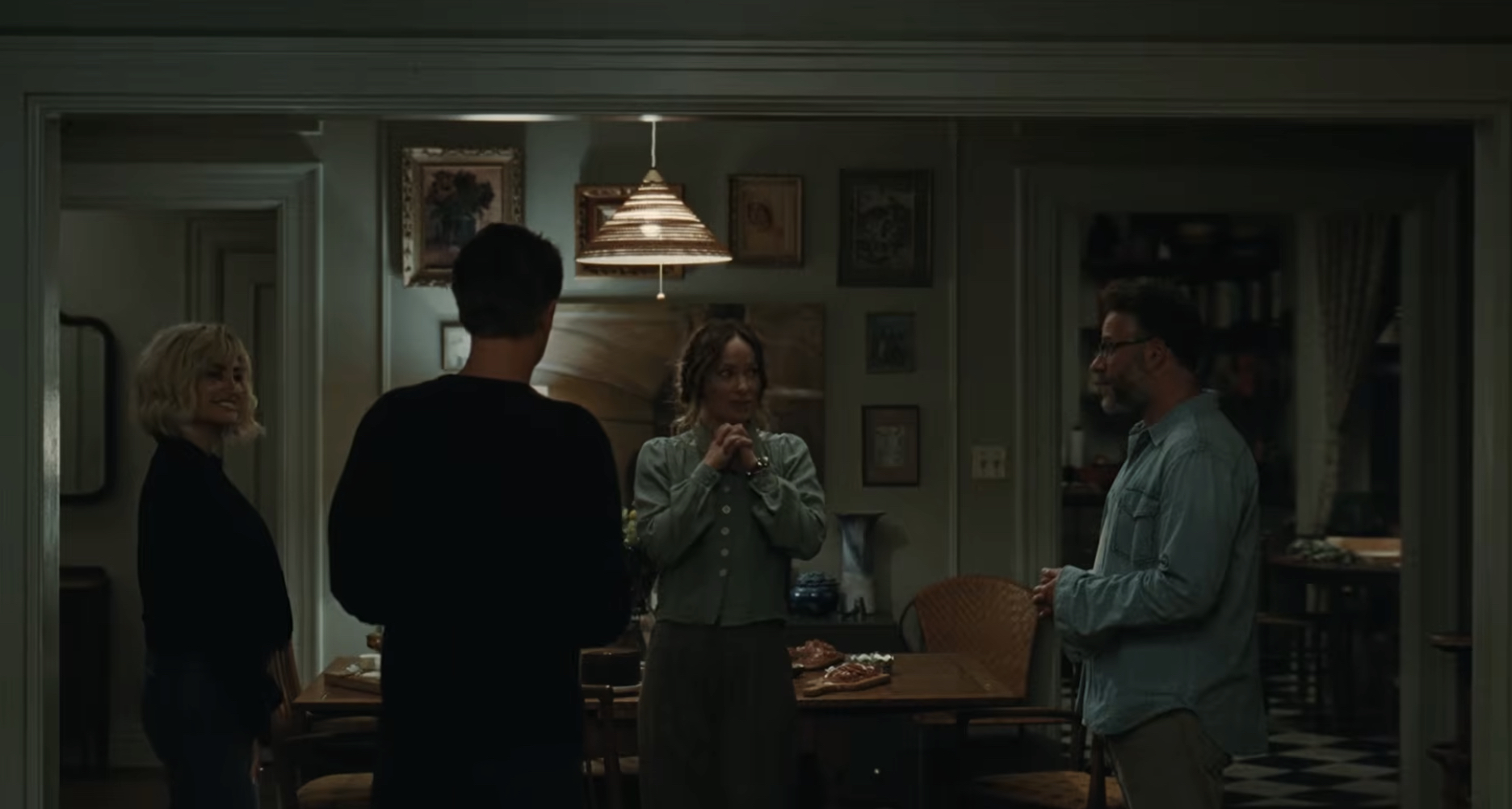
Something Wilde has no issue copping to. For, whether it’s in interviews with The New York Times or Letterboxd, Wilde has been open and upfront about the influence of Who’s Afraid of Virginia Woolf? on her latest directorial offering. And yes, like the latter, the source material for The Invite is adapted from a play. Specifically, Cesc Gay’s Los vecinos de arriba (and, on a side note, Gay has gotten plenty of mileage out of this play, as he already adapted into a Spanish movie called Sentimental in 2020). But rather than enlisting Gay to write the now American version of the screenplay, fellow actors Rashida Jones and Will McCormack were tapped to do it, collaborating with Wilde, Rogen, Penelope Cruz and Edward Norton to fine-tune the dialogue during a two-week rehearsal period of “workshopping the script together with our screenwriters,” as Wilde told CBS Mornings. The result is the “contentious environment” that Joe refers to as soon as Pina (Cruz) and Hawk (Norton) step into their apartment. Already having been made to wait an impolite amount of time as Joe and Angela bicker about the fact that 1) Angela didn’t tell him she was planning on having them over tonight and 2) he doesn’t want any company right now.
Nonetheless, Angela is adamant that the dinner goes forth as (she) intended (in part because Maggie, their daughter, is at a sleepover with a friend named Sadie). And it’s the same kind of conceit as Who’s Afraid of Virginia Woolf? Complete with Martha not telling George that she’s having guests over until right before they’re due to show up. Though, in yet another sign of how much grittier Who’s Afraid of Virginia Woolf? actually is, the couple that Martha has asked to come over is “popping in” at two-thirty a.m. For this is after another party they’ve all just come from, one thrown as a kind of “university mixer” for the professors and their spouses, it’s assumed. And, Nick, being new to the faculty, is eager to make his presence known, bringing Honey along with him (and no, that’s probably not her real name, so much as the only thing she ever gets called). As part of the biology department, it’s obvious he won’t have much in common with George, a “bog” of the history department. Not that George is looking to have anything in common with anyone, least of all these strangers who have clearly only come to suck up to Martha, whose father is the president of the university.
Joe is much the same way in that he’s uninterested in putting on any airs for Pina and Hawk, especially since he didn’t invite them over. What’s more, Joe, like George, is a teacher at a university. And is someone that Martha would inevitably call a “flop.” Someone who’s a “zero,” not even there, weak-willed, etc. But the difference between Martha and Angela is that the latter, as the viewer finds out over the course of The Invite, is rather “fine” with their life together, if only Joe wouldn’t be such a sourpuss about where he’s ended up. And that includes being in an apartment that prompts Hawk to bluntly ask, “Do you guys have money?” Indeed, it’s the bluntness of both Pina and Hawk that draws Joe and Angela out, forces them to address and verbalize some suppressed and uncomfortable truths about their relationship. Whereas, in Who’s Afraid of Virginia Woolf?, it’s George and Martha’s bluntness from the start that forces Nick and Honey to address some of their own “elephants in the room.”
As for other similarities between the films and their setups, there’s the verbal sparring and high-simmering resentment between George and Martha, overheard from the get-go by the young, naïve couple waiting behind the door to be let in. Only Pina and Hawk aren’t exactly young or naïve. In fact, they’re perhaps a little too worldly for Joe and Angela’s taste. Which is why they have no trouble immediately addressing the “contentious environment,” as Joe puts it, head-on. To be sure, any sense of “decorum” or “boundaries” unravels as the film progresses (as is the case with Who’s Afraid of Virginia Woolf?). To emphasize that, Wilde noted of one of her directing/set design techniques, “There was so much about doorways, frames, architecture creating boundaries between these characters that we would slowly dissolve. It was supposed to elicit hopefully within the audience the sense of being a little bit out of sorts.”
And something else that very much helps achieve that is Devonté Hynes’ cello-laden score, which stabs through each tense moment to add a layer of comedic levity in a way that Alex North’s musical contribution to Who’s Afraid of Virginia Woolf? doesn’t bother with. In fact, his offerings to the score (particularly for the intro and outro to the film) almost border on saccharine. Unexpectedly so. Perhaps because Who’s Afraid of Virginia Woolf? is well-aware that it’s more of a horror-drama than a comedy.
While The Invite tries more overtly at “handholding” the viewer, part of eliciting that “out of sorts” feeling Wilde was aiming for is also likely helped by the film being shot in the same order that’s presented in the script, allowing the tension and friction to keep building naturally among the actors. Until finally exploding by the time that Pina and Hawk reveal that the reason Joe and Angela can hear their sex at such a loud volume is because it isn’t just the two of them up there going at it. Oh no, they prefer to engage in group sex—and that’s why the sounds they’ve been hearing have been so tantamount to “fucking like monsters,” as Joe phrases it. Then again, his anger is, in part, informed by jealousy as his own sex life has been in a drought for the past year.
In this regard, it hits a little too close to home when Pina tells him early on in the movie, “People forget that they deserve more. And they start living on crumbs.” Crumbs of occasional affection, that is. Except, in both George and Martha and Joe and Angela’s relationship, there are no crumbs at all. Not even hints of crumbs. Just nonstop dissatisfaction and verbal abuse (and sometimes even physical abuse, in George and Martha’s situation). And yet, in the conclusions of both films, there is a sense that each couple would rather remain together than risk the “wilds” of attempting happiness. Though The Invite is overtly more maudlin about Joe and Angela’s relationship, positing that there’s still love between the two, it just needs to be better nurtured.
Indeed, there is a full-circleness to The Invite involving a piano scene (just as the viewer was shown another at the beginning of the film) and the fact that Joe was in a one-hit wonder band in the 2000s called The Onslaught—his one hit being written about Angela and his love for her. A denouement that suggests perhaps they can get back to that place again. For George and Martha, however, the chances of that happening are far less likely and their reasons for staying together are far more related to that old adage, “Better the devil you know.” And so, while both films feel, in their way, like cautionary tales about monogamy—and entering into a marriage to “lock down” (hence the term “wedlock”) that monogamy—it is Who’s Afraid of Virginia Woolf? that will still leave viewers feeling far more unsettled and unplacated about the nature of not-so-holy matrimony.


[…] Genna Rivieccio Source link […]