


Madonna has been in a very “looking back” kind of mood in the months that have led up to the release of Confessions II. After all, Confessions II itself is a kind of looking back in that it’s all about a “return” to 2005 by honoring Confessions on a Dance Floor. Whether she’s visually referring to the (00s) past with her Confessions “I”-inspired looks or casually mentioning that the real reason she got Mark Kamins to listen to her demo was by furnishing him with some cocaine, the Queen of Pop has been tapping into an erstwhile underused gift of hers: appealing to nostalgia. A talent that has gone mostly unnoticed because, for much of her career, Madonna’s entire “thesis statement” has been that she abhors “looking back” (the logical antithesis of “reinvention”). Because if you’re looking back, then you’re probably not moving forward. That no longer seems to matter and/or apply to her now, as she sees fit to keep nonchalantly adding in new details to the lore about her early days in New York City. And, in this case, to the lore surrounding the very day she arrived.
As the long-standing legend goes, Madonna touched down in New York in 1978 with thirty-five dollars in her pocket, some of which must have been used on the cab ride to Times Square, where the driver dropped her after she supposedly asked him to take her to the “center of everything” (or “center of it all,” depending on who you ask). A tale she would recount at the Times Square premiere of Who’s That Girl in 1987, telling the crowd, “I asked the taxi cab driver to drop me off in the middle of everything. So he dropped me off in Times Square. Anyway, I was completely awestruck.” Just as the crowd watching her in 2026 was when she offered a “pop-up” performance in Times Square, continuing to make the now “no actual NYC resident would be caught dead there” milieu an increasing part of her New York-related geographical history.
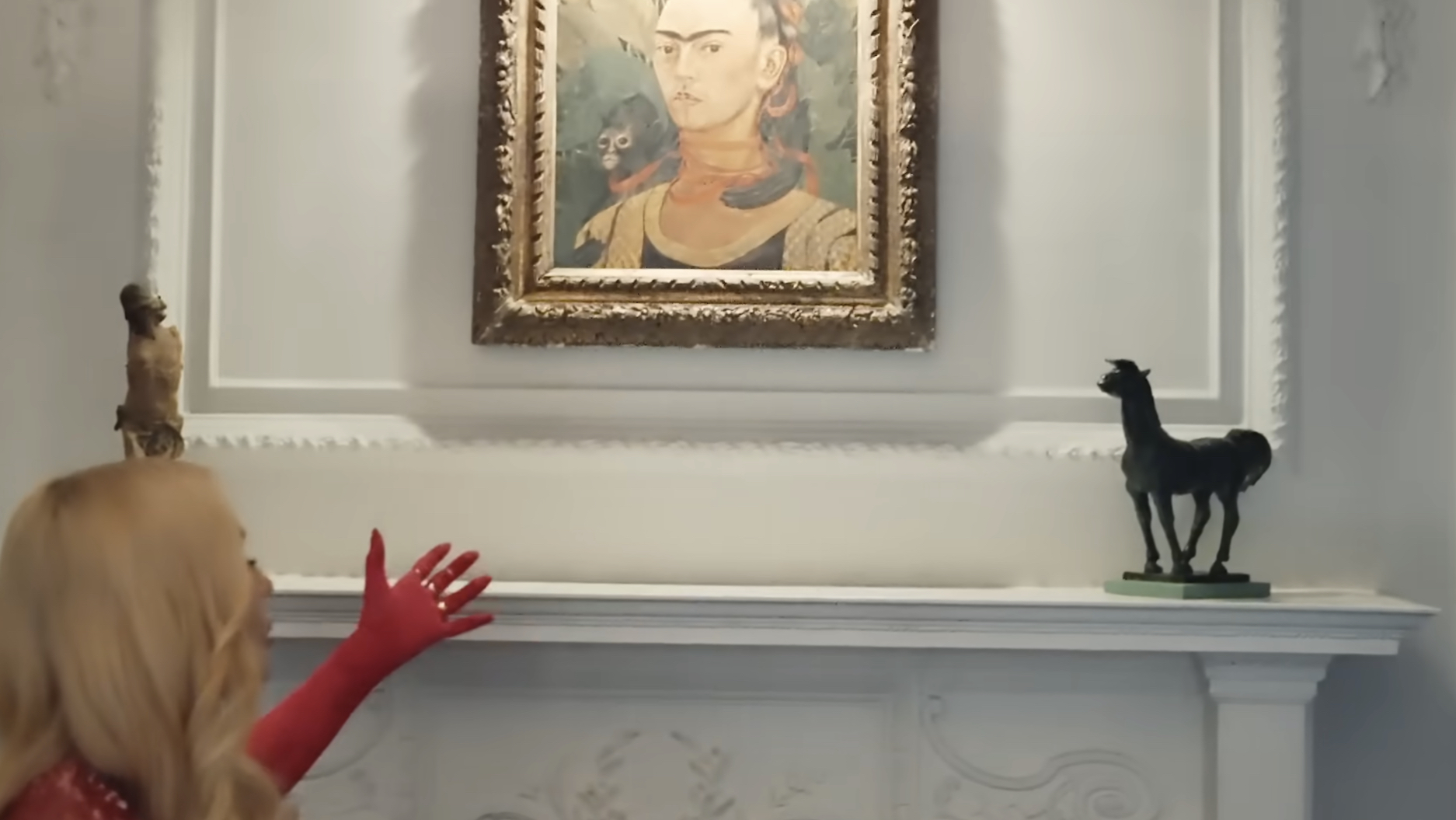
And presently, thanks to a segment for Vogue Italia’s “Objects of Affection,” there’s a new element of lore to her arrival story. One that she never saw fit to bring up before, for whatever reason. Perhaps deciding to slowly mete out the details after having spent the last few years in a “reflective-on-the-past” mode thanks to working on the script for her biopic (the one that was eventually scrapped because, as she tells it, Universal wouldn’t shell out an adequate budget for her “huge life”). One of those details being that (again, as she tells it) within the “first five minutes” of being in NYC, she saw a postcard of Kahlo’s Self-Portrait with Monkey, 1940, taking it not only as a good omen, but as a sign that Frida ought to be her talisman, of sorts, her “guardian angel” (that is, when she didn’t refer to her own mother as such).
Before Madonna mentions that point of interest, she’s also sure to show off her Frida knowledge with the “fun fact,” “She often painted herself with monkeys on her shoulders. She did have a lot of monkeys, but the reason that she had them is because she trained them to let her know when her husband had been sleeping with another woman. If he came home from his studio and he was having a good time with one of his female models, which he did often, the monkeys would go mad and then she would know and she would punish him accordingly.” This seems to be a detail that only Madonna was made privy to as, for the most part, the interpretation about the monkeys is that they somehow represented the children she could never have.
Nonetheless, Madonna shares this detail to not only establish the authority she has over the subject of Kahlo, but also to build up to the lore she’s working toward unleashing. And it begins with her describing a connection to the painting that goes way back, with Madonna recalling,
“Then there’s the history of the painting and how I came to have it. In high school, there was only one museum you could go to. It was called the Detroit Institute of Arts. The first time I came there, there were these huge Diego Rivera paintings all over the wall, murals. But what I was really drawn to were these small photographs kind of hidden away. With this beautiful Mexican woman, and I just was really taken by her self-possession and unique beauty, and it really moved me. And she became a kind of eternal muse for me. A few years later I moved to New York from Detroit, Michigan and I started walking around and there was a street fair, and I saw this postcard and it was this painting. This is my first five minutes in New York, and the first person I see is Frida. From that day on, I kept her with me, wherever I went. I got a thumbtack or a nail, nailed it to the wall and she was like my guardian angel.”
Again, when she wasn’t billing Madonna Sr. as that. What’s more, one wonders how she plausibly managed to stumble upon a street fair within her “first five minutes” in the city. But hey, it’s all part of the ongoing mythmaking Madonna has been cultivating ever since she became famous. After all, a story like her rise to fame doesn’t get much better on the “inspiring” front (not to mention on the “capitalism really works!” front). A story that assures she was armed with nothing but “cast-iron balls” (a Norman Mailer quote about her) and sheer force of will when she descended upon NYC at one of its grittiest, most dangerous moments in modern history (complete with the now illustrious brochure, “Fear City” a.k.a. “Welcome to Fear City: A Survival Guide for Visitors to the City of New York”). And that, using only those two qualities, she was ultimately able to get ahead in “the game” and succeed.
Her brother, Christopher Ciccone (the same brother she wrote a song about on Confessions II now that he’s dead), had something different to say about the “reality” behind that myth, writing in his 2008 memoir, Life with My Sister Madonna, “She is a middle-class girl who propagates the story that she landed in Times Square with just a pair of ballet shoes and thirty-five dollars to her name. But that’s pure mythology and the further she progresses, the more mythological her life story becomes… Far from being this lost and friendless little waif who didn’t even have a crust of dry bread to eat, when Madonna went to New York she had money in her pocket, plenty of contacts and a support system all in place.”
To the point about “the further she progresses, the more mythological her life story becomes,” one supposes that the “kismet nature” of “happening upon” a postcard version of this Frida Kahlo painting is but part and parcel of the kind of mythology Madonna keeps building. A mythology that would allow her to make such grand pronouncements regarding the supposed full-circle conclusion to the story of the painting and how she came to possess it—was, in fact, “destined” to possess it. This much made clear by her statement, “I vowed to myself one day I would own that painting. Cut to eleven years later [see, she’s even speaking in a screenplay format about her life now—and also somewhat emulating her character, Liz, on Will & Grace with her “cut to me” catchphrase], that painting came on auction and she was mine.” That would have been 1989, if her math is correct. But since there seems to be no public record of when the painting actually went to auction, one will have to assume Madonna’s accuracy on dates.
Because, if one were to go by the year she made her first million—1985—it seems she would have bought the painting a bit sooner than 1989 (the year she divorced Sean Penn), telling Howard Stern in 2015, “That was always my goal. When I was married to Sean, I said, ‘When I make my first million, I’m going to buy art.’ She then added, “I bought a self-portrait of [Frida’s]. At the time it was rather inexpensive because people didn’t know who she was.” In other words, Madonna asserted that she liked Frida before it was “cool.”
And now that Frida is so “cool” and sought after, it seems like the perfect time for Madonna to remind that she was the original trailblazer on “loving” her. Therefore, the rightful “owner” of her image…literally. For Madonna can’t help but lean into her capitalist tendencies by reminding people that, as she once put it regarding her music catalogue, “Ownership is everything.” Including, evidently, ownership over her mythology. One that has grown increasingly packed with new details of late. Details that are well-timed for not only an album promotion, but also for a woman who has been in the weeds of creating a filmic version of her life. Perhaps, at this point, herself unable to separate the lore from objective reality. Whatever “objective reality” can even be when a person has become as legendary as Madonna. Or Frida, for that matter.


[…] to Madame X, that album’s title itself was a nod to M’s “deep past,” for, as she told it (even if perhaps only adding to her lore), Martha Graham was the one who called her that. For, as Madonna explained in 2019, “…she gave […]