


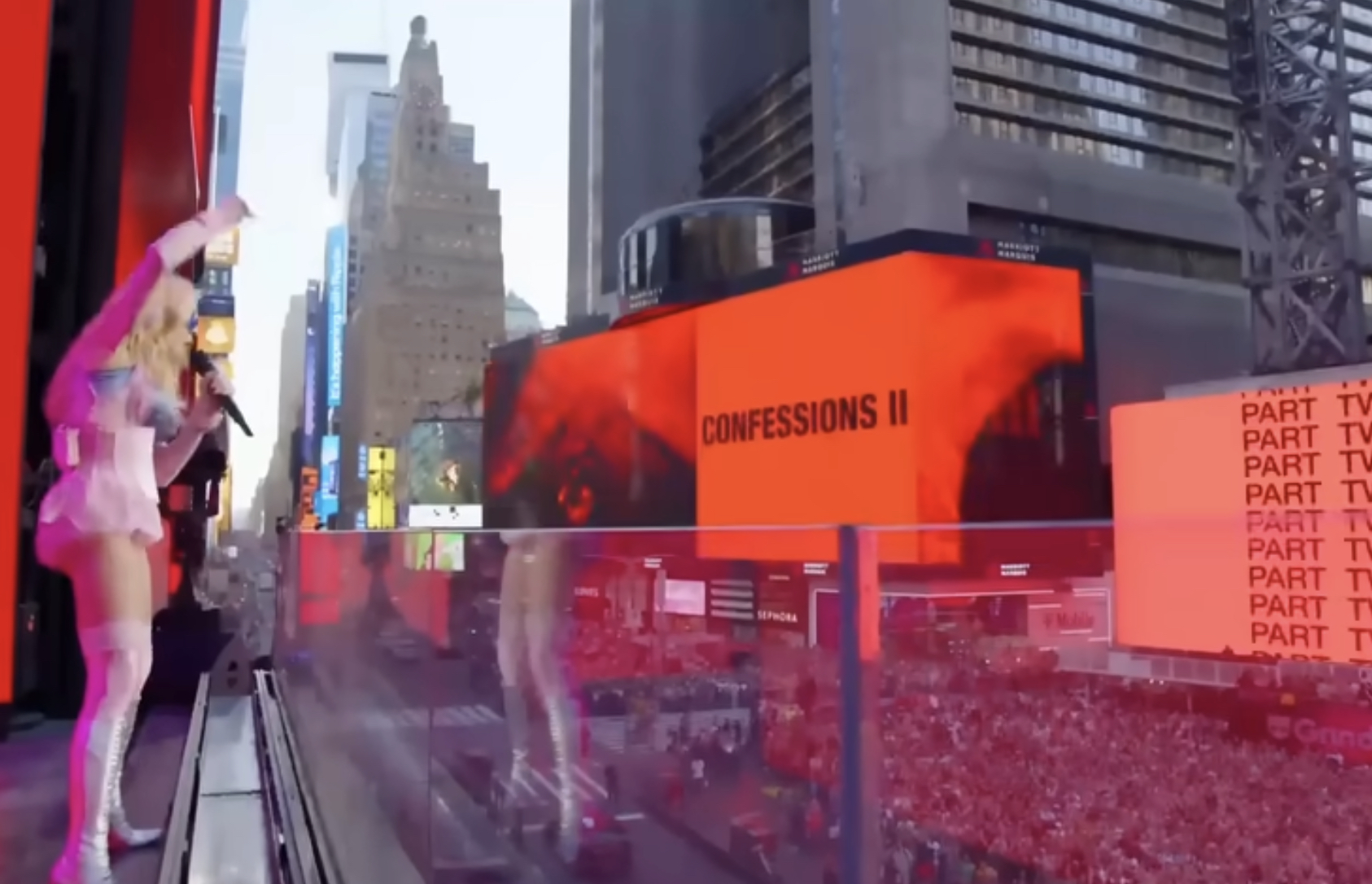
Since the Grindr-Madonna partnership can’t stop, won’t stop, her Grindr-backed free concert in Times Square on June 4th felt like a natural progression from Grindr Presents Confessions with…Madonna. Aside from the fact that the Queen of Pop usually tends to do something “grand” during Pride Month if she has a project to promote (as was also the case when she performed on Governors Island [a.k.a. Pride Island when it’s Pride Month] two weeks after the release of 2019’s Madame X), taking over Times Square is nothing if not the kind of “chef’s kiss” self-promotion she became known for in the 80s and 90s. And with the filmed performance starting out with various shots of the gay men-filled crowd (after all, it is a Grindr “event”), the camera soon homes in on a stationary party bus with the Grindr logo on the side and a giant disco ball looming over it. For Madonna’s Confessions II era hasn’t seen fit to come up with a new symbol, instead continuing on with the same one Confessions on a Dance Floor touted.
To that “glittering 1970s” point, Madonna’s “Future Lovers” was already plenty “I Feel Love” by Donna Summer-coded. But with “I Feel So Free” (itself a title that borrows from “I Feel Love”), Madonna took advantage of a second chance to even more fully emulate Summer, one of a few “disco goddesses” of the day. And, considering the song was released the first time Madonna ever visited New York (not to be confused with the year she moved there, 1978) in 1977, there is, indeed, a kismet quality to her singing her own take on the track in Times Square, opting to open with it for her introduction to the album. This after the sound of “The Sun Can’t Compare” by Larry Heard & Mr. White plays in the background to warm up the crowd.
The camera then goes to a shot of the barrage of screens themselves showing a Madonna-esque mouth opening to reveal, that’s right, a disco ball inside of it, spinning a bit before then switching to the image of Madonna’s “Grindr exclusive” cover for Confessions II. The music soon starts to shift, leading up to what is now a signature opening phrase for any of Madonna’s live performances: “Thanks for coming.” And with those three words that kick off “I Feel So Free,” Madonna establishes her arrival as the “doors” to the stage that hovers above Pelé Soccer open up to reveal her in an imitative pose of what she offers on the album cover for Confessions II. Complete with being “draped” in a sheer pink veil (one positioned to make Madonna’s shape look triangular, this, as many have pointed out, being a nod to the pink triangle that became a symbol of resistance amongst the LGBT community (before it was LGBTQIA+) starting in the 1970s and gaining especial prominence in the 80s thanks to ACT UP using it as the emblem of its SILENCE=DEATH campaign. One that Madonna was all too aware of as she watched many of her own gay friends die as AIDS ravaged entire communities throughout major metropolises like New York, San Francisco and Los Angeles.
Seeing all of this unfold from the proverbial frontlines, Madonna seemed to make it her mission to advocate for gay men when no one else in a mainstream position would (least of all a twat like then president of the U.S., Ronald Reagan). And, as she would remind during her 2016 Billboard Woman of the Year speech, “It wasn’t safe to be gay, it wasn’t cool to be associated with the gay community.”
As if to give a subtle nod to the gay men of the time who were forced, for all intents and purposes, to be pushed even further into the fringe, Madonna sing-speaks (though mostly speaks), “Sometimes I like to just hide in the shadows/Create a new persona.” And while Madonna, musically speaking, might have been “hiding” in the shadows for the past seven years since her last album came out, it would appear she didn’t actually bother with creating a new persona at all. For this is the same one she offered up in 2005, packaged under the banner of a “sequel album.” To that point, her trusty producer (and occasional musical director of her tours), Stuart Price, is right there behind her, acting as DJ while turning the various knobs (no sexual innuendo intended) on his Pioneer turntable. Sporting a baby blue jacket, his presence on the stage is just as significant as Madonna’s, for it’s inarguably Price who was able to draw out this kind of an album yet again from Madonna. And, as William Orbit will freely declare to the world, it’s not as if M would make a “sequel” to just any album. Which rather suggests Price is still special to her. A collaborator she not only trusts, but holds dear. Hence the image of the two of them touching their index fingers together during “I Feel So Free” like she’s God to his Adam.
Intercut scenes of overtly paid-to-be-there dancers in the crowd are meant to add to a kind of “orgiastic” vibe, despite Times Square being a long way off from its days of sexual debauchery, having now come to represent the pinnacle of corporateness. A statement that, fittingly enough, can also be applied to Madonna herself. Segueing into “Bring Your Love,” Madonna offers up some awkward maneuvering at first before finding her footing (literally and figuratively) again. At which convenient time, two other dancers join her as backup onstage to deflect attention from her own moves. And, surprisingly, Madonna actually allowed two younger women to join her rather than succumbing to her usual preference for men (especially gay ones). Allowing herself a few spins on the life-size turntable positioned at the center of the stage, Madonna proceeds to take her metallic silver jacket off and reveal the full extent of her Dolce and Gabbana lingerie.
And as she tosses the jacket aside, the camera angle allows the viewer to see a digital Coca-Cola billboard looming large behind her, almost as if to underscore just how much Madonna’s “corporate gay” energy is in full effect (though it never could be nearly as much as Lady Gaga’s with “Runway”). In truth, it doesn’t get much more “corporate gay” these days than partnering with Grindr (besides, it’s not as if Scruff has the same level of clout or cultural relevance in the mainstream marketplace). Though, in the early days of Madonna’s gay advocacy, the word “corporate” was not only far from her mind, but it would have been anathema to the community itself, so accustomed was it to being considered, to use a Madonna reference, on the “borderline” of society. And, of course, one would be overlooking Madonna’s contribution to “mainstreaming” the community if they didn’t see just how much she herself is responsible for LGBTQIA+ folk being able to be so joyous and open out in the streets of Times Square. A milieu that doesn’t get any more mainstream. Though it, too, at one point was considered “fringe,” a place only for the dregs of society. So go figure. It’s a poetic and complementary kind of evolution.
As it is for Madonna to swap out the boombox she used to writhe on during “Hung Up” in favor of a single silver speaker placed between her legs to offer the effect of her creating the letter “M.” And yes, it’s also a reference to one of her many album cover versions, with Madonna now giving Taylor Swift a run for her money on the number of visual variations of a record there can be. After all, as Madonna once declared long before she became famous, “Money is my love” (this said in a short film billed as “a portrait of New York artists” called In Artificial Light). To be sure, one might say it still gives her a “Love Sensation”—this being the song she leads into after “Bring Your Love.” Granted, the two songs have such a sonic similarity that it’s almost hard to tell there’s a distinction. Even so, Madonna gets a bit more “playful” onstage during this song, tinkering with Price’s turntable (not a euphemism) and standing on top of that area as she seeks to empower the crowd with love—the message she’s done her best to impart for a large bulk of career (though not so much during the “Material Girl” days).
After wrapping up “Love Sensation,” Madonna then starts to throw it back to 2005 in order to remind those audiences who weren’t sentient at the time that Confessions II was begat of Confessions on a Dance Floor. Thus, “Get Together” is the song Madonna opts to sing next as she lets herself be spun around on the giant imitation of a turntable. In fact, “Get Together” seems to be a song from COADF that holds a special place in Madonna’s heart, considering she also quoted it to the crowd at Coachella Weekend 2 when she joined Sabrina Carpenter onstage, telling them, “And I just wanna say four lines from my Confessions I record, okay? It goes like this: Can we get together?/I really, I really wanna be with you/Come on check it out with me/I hope you, I hope you feel the same way too.” The crowd in Times Square appeared to feel far more “the same way too” than the one at Coachella, with Madonna perhaps always going back to NYC whenever she wants to feel truly “embraced” (as many a gay man before her did).
Especially since it’s the place where she carved out the identity she’s been dredging up for a while now. The one that reminds she was an ally to gay men long before it became “chic” to position oneself as such. So it is that as Madonna sings the final lines of “Get Together,” “If it’s bitter at the start, then it’s sweeter in the end,” the screens throughout Times Square display various scenes of protests throughout gay rights history, with the camera cutting to an emotional-looking Madonna (this itself being part of her performance) before a quickly-flashed-to image of Keith Haring also appears onscreen. For it’s no secret that Madonna counted him among her “besties” of all the New York gays she knew in the 80s. That era when she truly “came of age,” “found herself” and generally became a lifelong cult member of the city. Hence, writing a track like “I Love New York,” which, although originally intended for a musical that didn’t pan out, Madonna still saw fit to include on COADF. And, since she once again found herself in Times Square for this performance, Madonna also figured it was only right to belt out a song that further emphasizes how the relationship she has with NYC is arguably her most long-term monogamous one.
As for the “full-circleness” of Madonna once again playing to a crowd in Times Square, it all goes back to the lore surrounding her initial arrival in New York, with Madonna also previously acknowledging that lore in, where else, Times Square on August 6, 1987 (ten days before her twenty-ninth birthday) for the premiere of Who’s That Girl. On a stage in front of the hordes, she remarked of the location, “I asked the taxi cab driver to drop me off in the middle of everything. So he dropped me off in Times Square. Anyway, I was completely awestruck.” On June 4, 2026, Madonna was perhaps still awestruck. Not just by the amount of people that turned up to see her, but by how much the landscape of New York in general and Times Square in particular has changed since the first time she was ferried into the latter in 1977. Then again, Madonna’s penchant for “adapting” a.k.a. reinvention runs parallel to New York’s. This, too, in the sense that neither are ever really that different at their fundamental core despite exterior appearances.
With that in mind, Madonna delivers a similar riff on her 2005-era performances of “Hung Up” to round out the show. And as the song concludes to the sound of an uproariously cheering crowd, Madonna calls out, “Thank you New York City, I love you!” Clearly, she’s continued to feel that way ever since moving there in the late 70s. Though what’s left unsaid about that fact is that she’s long been rich enough to flee it whenever she chooses. Spending large blocks of time living in other cities, including, perhaps most famously, Miami, London and Lisbon. And yet, like the self-described masochist she is, Madonna will always return to New York for more pain that, to a Catholic such as herself, only feels like pleasure.


[…] to add to some historic professional moments this year (not least of which was her “spontaneous” live show in Times Square), Madonna has now graced the cover of Interview magazine for the eleventh time. And for this […]
[…] Square. Anyway, I was completely awestruck.” Just as the crowd watching her in 2026 was when she offered a “pop-up” performance in Times Square, continuing to make the now “no actual NYC resident would be caught dead there” milieu an […]