


Following the unveiling of the M. C. Escher-inspired album artwork for her third record, Instinct, Angèle wasted no time in releasing a third single (following “What You Want” featuring Justice and “Dis-le”) called “Une Seule Vie.” As the title might suggest, it’s about the ways that people tend to squander the one life (theoretically, unless you’re the type to torture yourself with notions of reincarnation) they have as a result of, for the most part, fear.
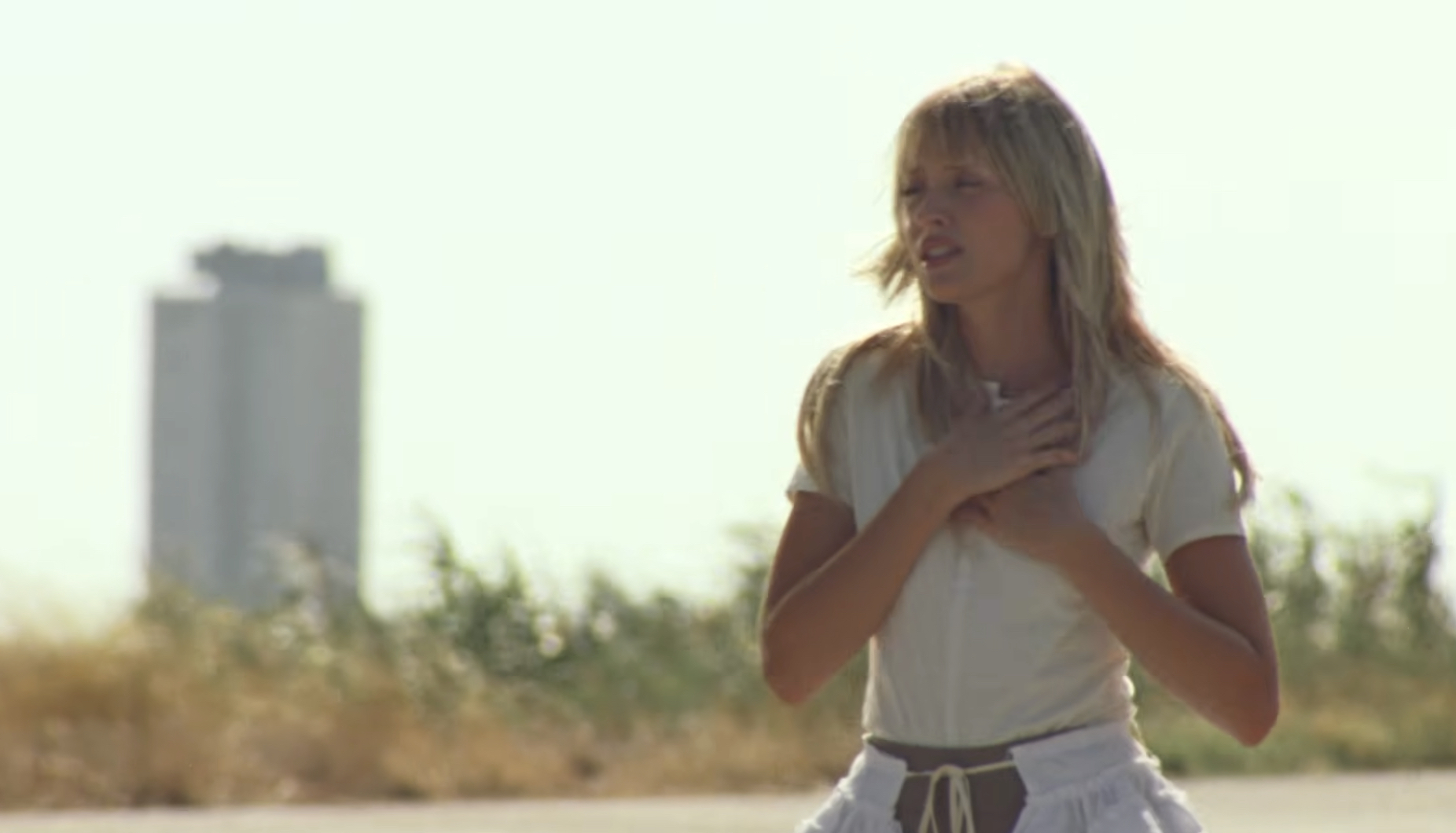
In the video, directed by Thomas Mailaender (known more for his art than music videos…indeed, this is his first), that brings the song to life, there is an element that also suggests this “one life” is equally as related to having “one planet” to live on. And the shittier that planet gets, the less enjoyable one’s sole life can become, as many sufferers of recent disasters (including the flash floods at the Nepal-Tibet border) can confirm. As for Angèle, she’s not standing amid a disaster, per se, so much as a would-be post-apocalyptic setting (which is, perhaps, just another word for an industrial one). And, as if to play up that Mad Max sort of angle (or “Angèle,” if you prefer), she mounts a motorcycle in the first scene and puts her helmet on like she’s about to go into battle.
The lyrics, however, are more about being in a battle with oneself than anyone else. And that much is made clear from the very first verse, “Qu’est-ce que les doutes ont fait de notre vie?/ Elle vit en vitesse de croisière, sans revenir en arrière/Sans fête, sans tise, sans danse, sans risques/Seulement l’amour pourra combler le vide” (or, en anglais, “What have doubts done to our lives?/And why are we where we are today?/She’s living on autopilot, never looking back/No partying, no drinking, no dancing, no risks/Only love can fill the void”).
And yet, it seems there’s so little of love to be had in this increasingly apathetic, humanoid world. Which is perhaps why Angèle makes ample reference to the eclipse that happened on August 12th, marking the first total solar eclipse to cross over mainland Europe since 1999. Because it was on that day that everyone seemed to share the same enthusiasm for taking in the sight of it, of having a “community experience”—while wearing their solar viewing glasses. An accessory Angèle herself sports as she watches the moon cover the sun while singing the chorus, “J’voudrais qu’on respire/On n’a peut-être qu’une seule vie/Tu le verras toujours dans mes yeux/J’ai besoin de brûler mes envies/Et j’sais pas c’que s’rait le mieux/On n’a peut-être qu’une seule vie/Ça suffit pas de le dire” (or, en anglais, “I just want us to breathe/We might only have one life/You’ll always see it in my eyes I need to burn through my desires/And I don’t know what would be best/We might only have one life/Just saying it isn’t enough”). In short, Angèle feels that a person should live life as if they truly realize they only have one, instead of just saying it.
Hence, Mailaender cutting to a scene of her whimsically dancing about in this desert-like milieu as she continues singing, “Ah, le temps passe et on voit/Nos vies entre nos doigts/On sait même pas pourquoi/Ah, tout est perdu déjà/On devient ce qu’on veut pas/On sait même pas pourquoi” (or, en anglais, “Ah, time passes and we watch/Our lives slip through our fingers/We don’t even know why/Ah, everything is already lost/We’re becoming what we never wanted to be/We don’t even know why”). It’s within this desert context that what comes to mind is Charli XCX’s 2019 video for “White Mercedes,” directed by Colin Solal Cardo. The same person responsible for videos like Yseult’s “Suicide,” Christine and the Queens’ La Vita Nuova and the Charli and Christine duet that is “Gone.” In fact, based on collaborating with these musicians, it’s somewhat surprising that Solal Cardo’s artistic path has yet to cross with Angèle’s (but perhaps one day it will).
In any case, it’s more than just the industrial (a.k.a. post-apocalyptic a.k.a. Ukrainian [where the video was shot]) backdrop that makes one draw a parallel between “White Mercedes” and “Une Seule Vie” (wherein, funnily enough, the picturesque Martigues is used as the industrial tableau). There’s also the fact that the opening shot in Charli’s video is of her inside a car in a similar motif/mise-en-scène to what Angèle is doing with the motorcycle in her opening scene. And, like Charli’s white car (which, to some people’s shock, isn’t a Mercedes), Angèle’s motorcycle will appear throughout the “narrative.” One that also takes on a surreal tone thanks to visuals pulled right out of M. C. Escher’s 1935 lithograph, Hand with Reflecting Sphere. The striking self-portrait that inspired Angèle’s own take on it with the help of British photographer Grant James-Thomas.
So it is that a giant reflective sphere appears about as frequently as the motorcycle—whether Angèle is chasing the former through the streets or being filmed with that warped “from within the sphere” perspective shown in the original lithograph. At another moment, the motorcycle is shown suspended from midair while “Angèle” (or a stunt double) stands atop the saddle in an image that also echoes what Charli does in her video. But where the visuals differ is in the fact that, for a start, Charli has a much less, let’s say, “pro-environmental” take. And also, where Charli is all on her own (echoing an individualist stance that’s in keeping with how she often treats the environment in her videos), there are many other people shown in Angèle’s mostly desolate, dusty landscape. Some of these people even feel obliged to hold up flags that feature a picture of her as a child on them (for, as any Angèle fan knows, she’s fond of showcasing childhood pictures of herself—at least on the cover for her 2018 debut, Brol). What’s more, there are no burning cars in Angèle’s post-apocalyptic vision.
Ultimately, however, the overall aesthetic and “vehicle-centric” nature of each video makes them feel like at least “half-sisters.” Besides that, both songs talk about pills. For Charli, that means mentioning, “I take all of these blue and yellow pills.” For Angèle, that means referencing The Matrix with, “J’sais pas ce que je veux/Prendre la pilule rouge ou la bleue? (or, en anglais, “I don’t know what I want/Take the red pill or the blue?” To boot, each track also conveys a tormented desire to be as wild and free as one can (even if, for Charli that means feeling a bit guilty because she’s “always been running too fast”). That is, if they truly want to live their best life. Though that might, at times, mean making others feel like they’re living their worst, emotional rejection-wise. But, to quote another British person besides Charli, “Everybody’s got to live their life/And God knows I’ve got to live mine.” Because there’s only “une seule vie” to live (“God” willing). Granted, Angèle sings toward the end of it, “On a peut-être qu’une seule vie”— “We might only have one life.” And a lot of people are certainly acting like that might be true.


