


In a series called Mondo Bullshittio, let’s talk about some of the most glaring hypocrisies and faux pas in pop culture…and all that it affects (and reflects).
From the moment Lily Allen announced seemingly out of nowhere that she would be releasing a new album called West End Girl in October of 2025, fans who had started to think she might never make new music again went into a frenzy. Then, once the album was actually out, it didn’t take long for everyone else to go into a frenzy as well. Because the album was pure tea, with Allen being more no holds barred than she had ever gone, which, of course, is really saying something.
But since it had been seven years since her last album, No Shame (which explores, in slightly less microscopic detail, the end of her first marriage), not only did Allen have plenty of pent-up creativity to unleash, she also endured two major life events: 1) getting married (ready to take on round two of this institution) to David Harbour and 2) reckoning with the apparent “slow burn” breakdown of that marriage. And while “women scorned” had been known for writing “breakup albums” before (e.g., Beyoncé with Lemonade and Taylor Swift with, well, just about everything), no one had ever quite dared to be this nitty-gritty, this vulnerable when it came to divulging such details…with the caveat of being “autofiction,” of course. After all, Allen wouldn’t want Harbour trying to sue for her defamation or some such. Because, yes, everyone knew that West End Girl was about him. Even Beyoncé didn’t write (or rather, get many people to write) the entirety of Lemonade about Jay-Z, nor Swift the entirety of Red about Jake Gyllenhaal.
Allen, in contrast, stayed thematically committed to the cause of dissecting her relationship and what she could retroactively see as all the signs that it was doomed. Starting with Harbour’s barely veiled resentment over Allen getting the lead in a West End play, 2:22 A Ghost Story, shortly after they were married. Hence, the title of the album, for it was Allen’s stint on the West End that quickly brought to light just how much Harbour wasn’t the man she thought she had married. This described in the title track that rightly kicks off the album, as Allen sing-speaks, “I put the key in the door/And then the phone started ringing/So I answered the call/And they were like, ‘Hey, you got the lead in a play/You’ve got to be back in London for rehearsals in May’/And later that evening, you said how was my day/I said, ‘I got some good news/I got the lead in a play’/That’s when your demeanor started to change/You said I’d have to audition/I said, ‘You’re deranged.’”
But as West End Girl unfolds with all the riveting juiciness of a kitchen sink drama, it becomes obvious that Harbour’s resentment about the play (immortalized during a brief red carpet interview at the 2022 Olivier Awards) was only the beginning of his derangement. For, as it turns out, he also wants to spring it on Allen that, by the way, he’s actually nonmonogamous. A way of life that she reluctantly agrees to in order to make him happy for the sake of their marriage. And yet, instead of appreciating what a gift that is from her, Harbour violates the only terms of her conceding to it (as revealed in “Madeline”): “We had an arrangement/Be discreet and don’t be blatant/There had to be payment/It had to be with strangers.” So begins her complete emotional unraveling for most of the middle part of the album before she takes on a more resigned yet humorous tone for “Act Three” tracks like “Dallas Major,” “Let You W/In” and “Fruityloop.”
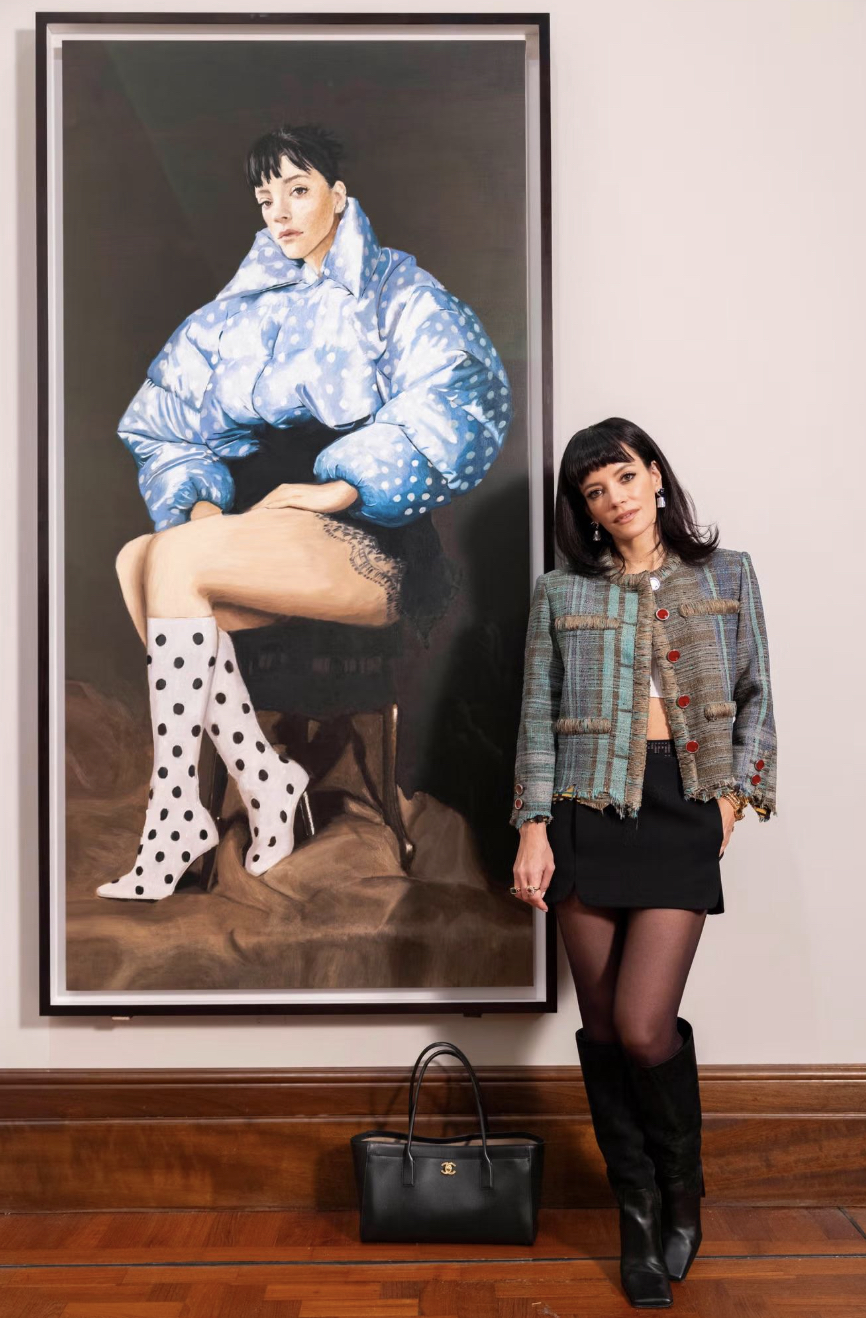
Such album innovation, such careful craftsmanship, one might assume, would make West End Girl a shoo-in for several categories at the Grammy Awards. Alas, it would seem that all the Recording Academy had “room” to give Allen was a nomination for Best Album Cover. Which, ultimately, is a nomination for Nieves González, who painted Allen’s portrait in the style she’s become known for: elegant, “old school” (read: the seventeenth century) -looking women wearing “ultra-modern” clothing. Often, a puffer jacket. And, in Allen’s case, a light blue puffer jacket with allover white polka dots. So striking to enough “Establishment people” that the original painting was even hung in the National Portrait Gallery for a limited time (and near a David Hockney painting no less).
So yes, there’s no denying that the cover itself is worthy of such attention and recognition from the Recording Academy as well. It’s just that one would have thought that the actual contents of the album would take precedence. Instead, West End Girl was shut out of all categories, (Dallas) major and “minor.” Perhaps yet another sign that Allen is just “too British” for consideration in U.S. awards ceremonies. On the bright side, however, Allen can take comfort in the fact that she was the one who “co-signed” González (with plenty of help from Allen’s stylist and creative director, Leith Clark, who discovered and messaged González on Instagram to invoke her for the project). Thereby giving the artist an incredible career boost in the process (a.k.a. women uplifting other women). To the point where she, not Allen, is being nominated for West End Girl at the Grammys.
But no matter—Allen already got an award for West End Girl that’s far more significant. No, not the Ivor Novello for Outstanding Song Collection (with an additional nomination for Best Album), but rather, the ultimate revenge: having hordes of people validate your feelings about a romantic relationship gone wrong.


+ There are no comments
Add yours