


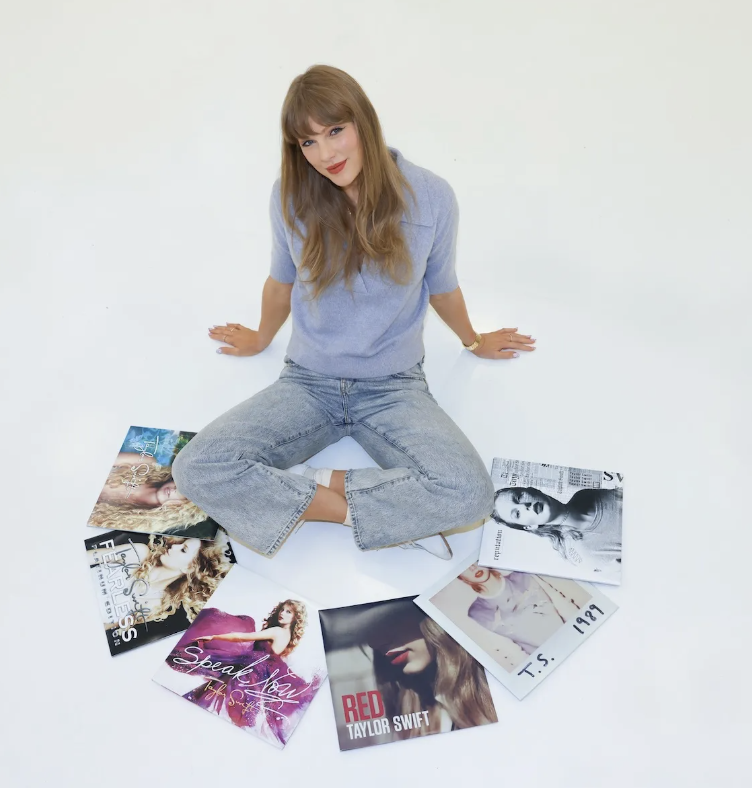
While everyone (read: the Swifties) has been quite overjoyed to hear that Taylor Swift was able to buy her music catalogue back for, well, the price of a song (that is, for a billionaire like Swift, who paid roughly 360 million dollars to reclaim her entire oeuvre), there’s still a nagging sense of the wool being pulled over everyone’s eyes for the past five years. And the entity she purchased her own work from? Shamrock Capital, described as “a Los Angeles-based investment firm with a rich history of investing in the media, entertainment and communications sectors.” More succinctly, it’s the investment firm that belongs to the Disney family. Who is rich(er) indeed, thanks to investing in the media of Swift, and recouping that investment at a slight profit. Though probably not the amount they had hoped for upon buying her masters from Scooter Braun, who acquired them when his company, Ithaca Holdings, effectively “absorbed” Big Machine Records, the label responsible for releasing Swift’s first six albums.
Back when this all began, with Braun painted as the immediate villain, it was an announcement that rocked the music industry in terms of scandal and drama, fortifying the permanent bad blood between Swift and Braun (who many fans think “Karma” was inspired by). Everyone seemed to have something to say about the unexpected turn of events. But it was, of all people, Kelly Clarkson that ended up having the most clout for Swift in terms of “how to proceed.” For it was Clarkson who famously tweeted in July of 2019, “Just a thought, U should go in & re-record all the songs that U don’t own the masters on exactly how U did them but put brand new art & some kind of incentive so fans will no longer buy the old versions. I’d buy all of the new versions just to prove a point.” And with that, the seed of the re-recording idea was born, with Swift being all too game to take on such a project if it meant 1) having some sense of ownership over her music and 2) sticking it to Braun for daring to defile her precious “kingdom” of songs.
So began a roughly five-year period of adding re-recording into her busy schedule, during which she also found time to record two new albums, Midnights and The Tortured Poets Department. And surprisingly, considering Swift’s methodical nature, the albums were not re-recorded in the same order that they came out, with Swift opting to re-release her sophomore album, Fearless, first, followed by Red (her fourth album), Speak Now (her third album) and 1989 (her fifth album). In 2025, with only two left to re-release (Taylor Swift and Reputation), and two years having passed since 1989’s re-release, it was rather convenient that Swift copped to her hesitancy about re-recording those two as part of her open letter to the public detailing her acquisition of the masters.
Swift noted that Reputation in particular (even though, for Taylor Swift, it might be all but impossible to effectively re-create the sound of her “little girl” vocals without some kind of technological enhancement) was an off-putting re-recording prospect to her. Hence, as part of her statement on the purchase of her masters, she included the sentiment, “What about Rep TV? Full transparency: I haven’t even re-recorded a quarter of it. The Reputation album was so specific to that time in my life, and I kept hitting a stopping point when I tried to remake it. All that defiance, that longing to be understood while feeling purposely misunderstood, that desperate hope, that shame-born snarl and mischief. To be perfectly honest, it’s the one album in those first 6 that I thought couldn’t be improved upon by redoing it. Not the music, or photos, or videos [really though, not that album cover?]. So I kept putting it off.”
As for declaring that Reputation alone was “specific to a time in her life,” what does it say about the other albums that are apparently “generic” (in corporate speak, this is sometimes called “evergreen”) enough to re-record with ease? Or does the truth of the matter ultimately boil down to: as Swift came to realize she would have the option to buy back her masters, re-recording the final album of the six suddenly felt hollow? Unnecessary? Because, yes, she does also state in her handwritten letter (another Swiftian conceit) that Taylor Swift was re-recorded and she “really loves how it sounds now.” However, not enough to release it anytime soon. Though she did cushion the blow of this (along with not re-recording Reputation) by adding, “There will be a time (if you’re into the idea) for the unreleased Vault tracks from [Reputation] to hatch… These 2 albums can still have their moments to re-emerge when the time is right, if that would be something you guys would be excited about. But if it happens, it won’t be from a place of sadness and longing for what I wish I could have. It will just be a celebration now.” Of course it will. For what’s not to celebrate when you’ve made millions of extra dollars off the same music? All while playing the victim turning their pain into profit.
But obviously, there’s no denying Swift’s debacle with her masters dredged up some important issues about the way musicians are treated by their labels. Often taken advantage of when they’re just starting out because executives know that a young singer doesn’t want to pass up their “one shot” at a record deal. Swift’s decision to “bite back” at the proverbial suit represented, in this instance, by Braun, certainly got the discussion about artists’ rights to their own intellectual property going in a way that it never had before. So sure, in that sense, all the fanfare, the hullabaloo—in short, the re-recording—was worth it.
But in another sense, it’s difficult to ignore the notion that accepting Swift as an “artist shouting intellectual rape” is at war with her overarching “shrewd capitalist” “persona” (not a persona at all). There were, theoretically, many other ways to go about reclaiming ownership of her music without emptying the pockets of her legions of fans. The legions she knows will always shell out when she has a new product. Even if it’s a product that’s old and “made new again.” Mainly with her “From the Vault” tracks, lending upwards of nine additional songs to certain albums (namely, Red). Some of those tracks marking her biggest hits, like “Is It Over Now?” from 1989 (Taylor’s Version), which became Swift’s eleventh number one upon its release at the end of 2023.
Thus, while Swift’s re-recording endeavor might have all been one giant troll of Scooter Braun thinking he could somehow strong-arm her into anything (least of all signing an NDA “stating I would never say another word about Scooter Braun unless it was positive” in order to even bid on her masters), it turns out the listeners/fans were the most trolled out of everyone. And, clearly, happy to be, lying to themselves the whole time when they said that the newer versions sounded even better. Though the truth was (and is) that they deliberately sounded the same. Even if sometimes to worse effect, particularly for the songs when Swift’s teenage angst wasn’t translating into her thirty-something voice.
Still, Swifties were as committed to the project as Taylor appeared to be, buying up the “new” albums and sending them to number one again. But, upon being informed of Swift’s long-awaited purchase of her own music, a different reality set in. As Tyler Foggatt of The New Yorker put it in terms of fans’ collective sigh of relief over no longer having to pretend, “The re-recordings era was officially over. Swifties, meanwhile, have celebrated by reintroducing the Scooter’s Versions, which are now also Taylor’s Versions, back into their lives. And, more quietly, they’ve started to admit that maybe the re-recordings were never that great to begin with.”
In fact, Foggatt puts forth the notion that the entire endeavor was too rushed. Too rushed, in fact, to really be seen as an “earnest” attempt at doing this for “artistic integrity” rather than, well, a convenient cash grab. Foggatt questions, “Was the new 1989 so much better than the first one? Not really—it was re-recorded to sound almost exactly the same, with songs like ‘Blank Space’ essentially beat-for-beat facsimiles of the originals. And yet, whereas the first 1989 won three Grammys, 1989 (Taylor’s Version) was eligible for another slew of awards, making one wonder how Swift was not running afoul of some kind of double-jeopardy rule.”
And here, one gets into the other well-known “myth” about Swift: she likes to be the best. To have the most awards, the most number ones—in essence, to be the most celebrated. Annoyance over this competitive streak masquerading as “striving for excellence” cropped up quite noticeably last year, when Swift was accused of calculatedly (yes, that word again) blocking other artists from the number one spot on the album charts by releasing new versions of The Tortured Poets Department the same week. Never was that more glaring than when she did it to Billie Eilish the week that Hit Me Hard and Soft came out. Because with the re-recording project, it seemed as though once Swift popped on “album variant creation,” she could no longer be stopped. It was, ostensibly, tantamount to breathing for her.
Her greater commitment toward filling her bag than filling her “artist’s soul” was further called out in the abovementioned New Yorker article (titled “Taylor Swift’s Master Plan”), with Foggatt reminding, “In June 2021, Swift announced that the next re-recording would be Red (T.V.). But, that September, she surprised everyone by dropping ‘Wildest Dreams (T.V.),’ a track [from] 1989. Why the switch? As it turns out, the original ‘Wildest Dreams’ had started going viral on TikTok, raising its streaming numbers. Swift seemed to be following the money. All of this—combined with the staggered rollout schedule, synchronized merch drops, and albums’ vinyl variations—contributed to the feeling that the re-recordings had gone from a feminist crusade to a capitalist cash grab. Swift was recycling I.P. to make old songs go No. 1 again, just as Disney releases soulless live-action remakes of animated classics.” A fitting comparison considering that Shamrock is a Disney venture.
Still, Foggatt, as a self-proclaimed fan, wasn’t all cynicism about the endeavor, adding, “As it turns out, Swift’s project may have been a different kind of cash grab than anticipated. In the letter announcing that she had bought back her masters, Swift told fans that it was the success of the re-recordings and of the Eras Tour that made the purchase possible. Swift reportedly paid roughly three hundred and sixty million dollars for her music, which is less, in adjusted dollars, than what Braun is thought to have sold them for in 2020. With the help of fans, she devalued her old music—shorted her own stock—then bought it at a discount.” And how could one expect anything less of the daughter of a financial advisor?
Was it Swift’s master plan all along? Who knows? Then again, having built a reputation around being a mastermind (even having a song titled as such on Midnights), it wouldn’t be out of question for Swift to have come up with this highly strategic play as her end game (ah, so many possible puns with Swift’s song titles).
Because all of it, in the end, was equivalent to a storm in a teacup. Of course Swift was always going to be able to buy back her masters. As if anyone would truly think of fucking her over the next time an opportunity became available for her to buy them. In the years since she countersued radio DJ David Mueller for sexual assault and battery, everyone—especially men—knows that she’s not one to be trifled with. Something that the Orange Creature currently occupying the White House ought to remember when he runs his mouth about her.
In any event, Swift has effectively refuted the lyrics in “White Horse” that insist, “I’m not a princess, this ain’t a fairy tale.” Clearly, however, it is…as Swift rides off into the sunset not with Travis Kelce, but her six formerly lost children: Taylor Swift, Fearless, Speak Now, Red, 1989 and Reputation. And, as Madonna once said of her music catalogue, “Ownership is everything.” Especially when you’re a shrewd capitalist.


