


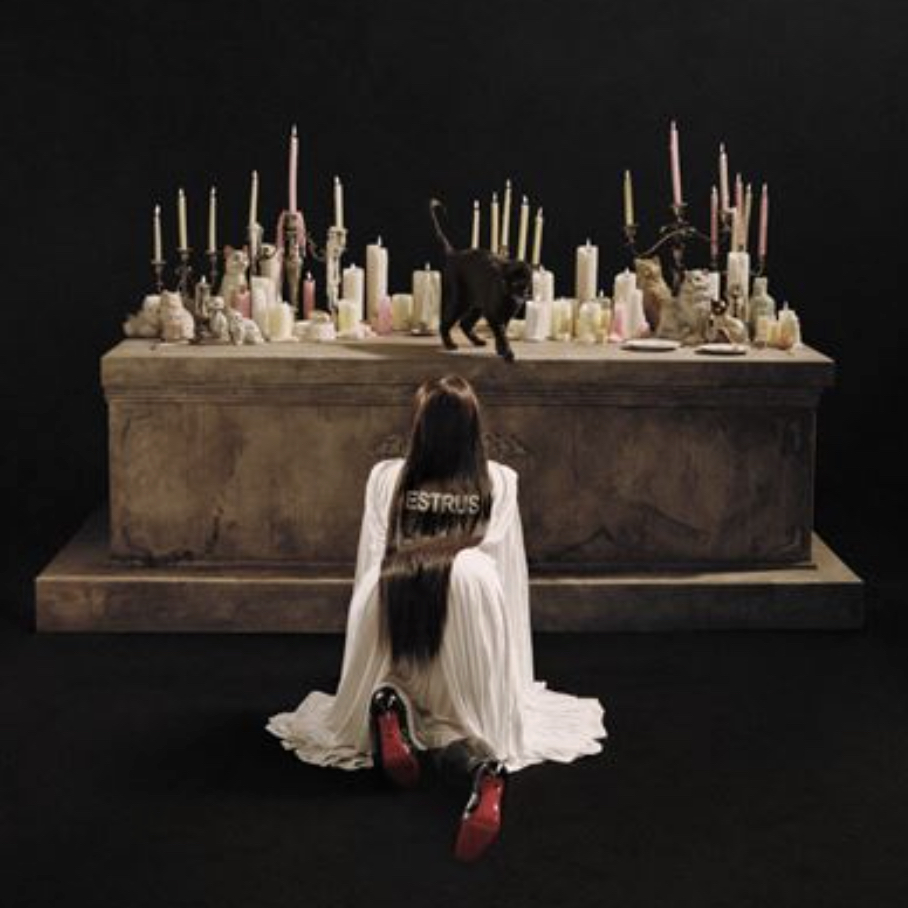
In many regards, Tove Lo’s sixth album, Estrus, feels like a continuation of the overarching themes she explored in 2022’s Dirt Femme. Now, four years later (the longest she’s ever taken in terms of years in between albums), it appears those themes—the push and pull between wanting to just be a messy bitch vs. wanting to be the responsible type who can (and wishes to) have children—are plaguing her more than ever.
So it is that Estrus kicks off with its thesis statement, of sorts, “a lot of feelings, no solutions” (incidentally, what she had originally planned to name the album). As if that title alone isn’t an indication of where her head’s at, Tove wastes no time in further elaborating with the lyrics, “I got a lot of feelings/But no solutions/I got a lot of anger/But no retributions.” And that’s it, that’s the entirety of the lyrics. Though, to be fair, it’s only a fifty-second song (albeit one that still finds plenty of time to sound a lot like something out of LCD Soundsystem’s oeuvre—foreshadowing for what’s to come on “Idiot”). Though what she might have specified at one point during the repetition of these words is that she has a lot of conflicted feelings. Namely, about becoming a mother with her husband of six years (though the pair have been together since 2017), Charlie Twaddle. And these are the conflicted feelings that have lingered since she previously summed them up on Dirt Femme’s “Suburbia”: “Now here I am with you/I never wanted babies/I know they’re kinda cute/I never wanted marriage” and “Just let me talk it through/So if we had a baby/You’d love them more than me?/What if I’m way too lazy/For the mom Olympic team?”
These kinds of questions continue to haunt and taunt Tove. And, in a certain sense, she already set the benchmark with “Suburbia” for Charli XCX to write a song like “I think about it all the time”—only to later publicly announce on SmartLess that, na, “I actually don’t really wanna have kids,” much to Jason Bateman’s ostensible dismay. However, such questions don’t haunt and taunt Tove too much just yet on “I’m your girl right?,” a song that sets another tone—the tone—on the album: ferality.
Indeed, the language of this song, which acted as the album’s lead single, is positively dripping with horniness as Tove Lo makes such cannibalistic statements as, “I like your teeth, could watch you eat for days/A fancy steak, I’ll pay.” She then builds on the senses she’s addressing by adding smell and, in a way, “touch” into the fray, singing, “Is that perfume, or is it you I taste?/Bite the skin thin.” Even the sense of hearing is then acknowledged in the line, “Tell me what I wanna hear now, don’t let me down.” So yes, there is as much “neediness” present in the track as there is “horniness.” Such as it is with a woman’s “sexual receptivity” (a.k.a. being in heat) turning quickly into needing reassurance after the act—chalk it up to that goddamn oxytocin.
This roller coaster of emotions is no doubt why Tove Lo chose it as the first single, explaining of the album and its title, “It’s primal, contradicting emotional chaos. It’s my mind and my body wanting different things, wanting everything.” In the “wanting everything” regard, it certainly dredges up one of Sylvia Plath’s most quoted passages from The Bell Jar,
“I saw my life branching out before me like the green fig tree in the story. From the tip of every branch, like a fat purple fig, a wonderful future beckoned and winked. One fig was a husband and a happy home and children, and another fig was a famous poet and another fig was a brilliant professor… I saw myself sitting in the crotch of this fig tree, starving to death, just because I couldn’t make up my mind which of the figs I would choose. I wanted each and every one of them, but choosing one meant losing all the rest, and, as I sat there, unable to decide, the figs began to wrinkle and go black, and, one by one, they plopped to the ground at my feet.”
That’s kind of Tove Lo’s vibe with Estrus. Though, by the end of the album, she does seem much closer than ever before to reaching a decision. To finally surrendering. But more on that later… Because long before that comes track three, “if i could i would,” which finds Tove Lo addressing herself. Or rather, part of herself. Though that might not be immediately apparent as Tove opens the song with, “I’m standing at the sink/Stare into my sleepless eyes/Wonder what you’d think if you saw me tonight/I can’t really decide if I wanna look fragile or hot/Whatever’s gonna get your attention.” That attention being of her hyper-critical side that wants to be “absolutely perfect” (hence, giving Tove Lo an eating disorder, and one that she speaks on with vulnerable candor during Dirt Femme’s “Grapefruit”).
During her interview with Zane Lowe, he asks, “Was there one [song] immediately after the fact [of writing it] where you were like, ‘Okay, I pushed myself there. Like, I got something that made me uncomfortable and I really let it go?’” She eventually answers (after saying “every song”) with “if i could i would.” And this is how it comes up that, as she explains, “I’m singing to my mean perfectionist inside. Like, it’s something I’ve also been told a lot in therapy, that I have these two sides that…one is this kind of, uh, harsh, cold perfectionist who wants everything to be perfect, there can be no mistakes, like, whatever I do is not good enough. And the other one is this messy, disruptive, um, love-to-lose-control, um, following-your-impulse kind of person. And, um… I’m trying to balance those.” So it is that the song is in the spirit of some other recent “critical internal voice” tracks. Specifically, JADE’s “Glitch” from That’s Showbiz Baby! and Ellie Goulding’s “Black Prada Dress” from I Know Too Much.
Yet, for Tove Lo, no matter how much she knows the “messy” side of herself is the kinder one, she still can’t help but admit to the cold perfectionist side, “I’m so desperate to be your kind/Where’s your empathy?/If I could, I would/Think I wouldn’t be over you/If I could, I would.” In another moment of honesty, Tove sings, “I keep being destructive and lie in therapy [though not to the point where said therapist couldn’t pinpoint these two sides]/I can’t really decide if I wanna get better or not.” The latter line highlights yet another instance of Tove’s constant push and pull throughout this album and in life. Which is why, during its making, Tove realized, “It felt like I was going through some sort of metamorphosis but I didn’t know what it was. I felt like my mind and body wanted different things—I’m a grown woman and I’ve been told over and over how I am supposed to be a certain way at this point, which I’m not. All these conflicting emotions and constant back and forth emotionally fueled the whole album.”
That goes even for a song like “des fleurs” featuring Stromae, which is about both the romance of yearning and the horniness of lust. To boot, Tove and Stromae did go back and forth on creating the song for a while, with Tove finally asking Stromae if she could use what they had worked on for her new album, prompting him to write a completed/final verse for it. Perhaps because it’s the “oldest” song on the record with regard to when it was initially started, that’s why it stands out sonically more than the rest. Well, that and the hypnotic piano arrangement.
However, one of the second “oldest” songs on the album is “DNH” (a.k.a. “Drunk n’ Horny”) which was among the first compositions to come out of Tove while she holed up in a small fishing village in the south of Sweden to push herself to get the job done on this record. As such, “DNH” has undeniable “shot out of a cannon” energy, as if Tove realized how many years her album-making creative outlet has been pent up and she just had to do something about it. Indeed, “DNH” is very much an accurate depiction, as she mentioned on The Zach Sang Show, of what she and her friends were doing in the time after the Dirt Femme Tour ended and she just wanted to get out there and “live life” again.
As did her group of messy friends, apparently. But Tove is, of course, also using herself as an inspiration when she talks about the kind of woman who is “drunk and horny in the crowd/You need attention, let your tears come down.” And yet, as female musicians such as Lily Allen and Lana Del Rey have learned, being “messy” doesn’t often get so “applauded” the older a woman gets. Which is why Tove has been defiant in asserting that no matter what age she is, she will forever be a messy bitch, no matter what judgments get thrown her way. Thus, her declaration, “As a grown woman now, I feel like there’s less acceptance for me being messy and, you know, kind of mak[ing] mistakes and still needing self-exploration… Uh, I needed to kind of like—‘No, I’m still this girl, I’m still this person.’”
But even though she knows this about herself, she can’t always accept it, likely influenced by the perfectionist side of herself that insists, like the rest of society (especially the pristine Swedish one she came from), that she ought to “get her shit together.” This sense of guilt about that shines through on the next “abbreviation song,” “F.A.M.T.,” which is a unique song in the sense that it’s the only one on the album co-written and co-produced with Luka Kloser and Elvira Anderfjärd—lately better known as the producing duo behind Addison Rae’s Addison. And it was Kloser who gushed of getting the opportunity to work with Tove, “Y’all don’t understand Tove Lo is why I started making music!!!” And clearly, Kloser has been a student of “Habits (Stay High),” with the motifs of that single being all over this. That is, in addition to another iconic track by a different artist. Namely, Peaches.
To be sure, as something of her own lyrical version of “Fuck the Pain Away,” Tove instead sings during the chorus, “I, I should be working on myself right now/Don’t wanna know, don’t wanna figure it out/I’d rather fuck away my tears somehow/I-I-I, I would feel better with your hand in my mouth.” So yeah, like Peaches, Tove is more interested in fucking her problems/pain away as well. But, of course, she also incorporates her own style of vulnerability (again, the one she became known for with “Habits [Stay High]”) by singing to the person that might put their hand in her mouth, “Please don’t tell my friends/You found me lonely in the club/I just need some kisses/To forget about my stuff/Please be my distraction/I’m not asking you for love/I just need a moment/To pretend that things are good.”
As if to offset the insecurities she “vomited” onto everyone with “F.A.M.T,” Tove’s confidence level then gets another upswing on “I’m the cake” (and yes, there is a dash of Rihanna’s “Birthday Cake” to the way she repeats “cake” on it). A song that seems to serve as a reminder to her husband, should he ever get a wandering eye, “How am I not enough for you?/When I’m the fucking cake, cake, cake, cake, cake, cake/You should be eating me, me, me, me, me, me/It’s your birthday every day, day, day, day, day, day. In another instance of “don’t you know who I am?” energy, Tove boasts, “Babe, I’m a pop star, did you just forget?/Open my legs and I’ll show you Sweden/She’s all symmetrical and soft and pink.”
That confidence she radiates on “I’m the cake” shows up in a different form on “the bad one,” perhaps the first song of its kind to not only admit to being the heartbreaker, but also not feeling bad about it either (then again, Marina and the Diamonds’ “How to Be a Heartbreaker” kind of does that too). The dreamy sonic intro gives way to the “cold water in your face” lyrics, “We didn’t date for very long, and it was long ago/So I’m really confused by your text/I didn’t fall for you as hard as you did for me/But it sounds like I’ve been haunting your bed.” Tove Lo digs the knife in further as the song progresses, goading/shrugging, “We didn’t really date at all, we never made it official/It’s not like I went off birth control/I know you think that I’m the worst, I’m a bitch, I’m a jerk/The most problematic woman on Earth…/I was the bad one who got what I wanted/Do you feel better having someone to blame?” The answer to that question, for most people who feel they’ve been “jilted” is, “Fuck yes.” And Tove is happy to oblige in playing the “villain.” However, like most villains, she doesn’t lose any sleep at night over the “alleged” hurt she’s caused. Perhaps one of the primary superpowers of a Scorpio.
Yet even a Scorpio’s superpower of “coldness” isn’t immune to the “emotionalities” of the artist’s plight. Which is the belief that one must suffer and shirk all other “conventional” things to be an artist. On “die for my art with a lonely heart,” Tove suddenly seems to feel racked with guilt for the fact that, rather than suffering for her art of late, “My happiness taking control/How I used to be ruthless, now I let go/I never know what’s better/Will I hate looking back/If I don’t die for my art with a lonely heart?” Peppered in throughout is the allusion to “time running out,” which once more brings up the notion of Tove (or at least her body) being hyper-aware that she has to decide on this whole “baby thing” sooner rather than later.
What’s more, the chorus has a kind of “What You Waiting For?” by Gwen Stefani quality to it (though in that case, Stefani was referring exclusively to getting her solo career started), with Tove singing, “They all say you shouldn’t waste it/Oh, so precious, never enough/At the end, they say you’ll taste it/Time is running out on us/Don’t leave me alone/Not good on my own.” It’s the latter set of lines that seem to allude to Tove being almost scared in a way that if she doesn’t deliver (no pun intended) on having a baby, her husband will leave her. Yet the other side of her fear stems from the idea that, if she does go through with “birthing,” she might not be able to birth art itself anymore. At least not in the way that artists are often told they should. Which is to say, by devoting their entire life to it. Of course, no one really does that anymore, and most people of the present are convinced that art is the shit they put on social media, so Tove is doing better than most on the Real Artist front.
Another topic that came up about art and inspiration while Tove discussed the album with Zane Lowe is the notion that an artist has to drop everything the moment “the muse” decides to “commune with” them. Something that many normies can’t comprehend, thinking that an artist can just “jot down the idea” and come back to it later. Not understanding that when it’s happening, it needs to happen right fucking now. This philosophy of seizing inspiration when it comes also echoes what Charli XCX said about the music and concept for Music, Fashion, Film arriving so soon after Brat. And that while she had planned on taking a break, “the muse” had alternate plans instead. Punctuating what Tove said to Lowe (try not to think of the phrase “Tove Lowe”), “There is a reality of, um, when inspiration strikes… you have to run with it. When an opportunity comes your way you have to go with it because it’s so rare and it’s so, like, it doesn’t happen to anyone, you know?”
But it happens to Tove Lo for the entirety of Estrus, with her questioning insecurities persisting via a different topic on the following track, “are we on a break”—in other words, Ross and Rachel’s theme song. Tove is more like Ross in this scenario though, not entirely clear on the “guidelines,” per se, of what it means to be on a break. And, on the one hand, she tries to play it cool by assuring, “Are we on a break?/I guess I wouldn’t mind/A few good months to fuck around.” But that “it’s fine” aura soon transitions to her admitting, “But I just can’t deny/That if I’m with some other guy/Or if I’m with a girl [because Tove is forever sure to bring queer visibility into her work]/You’re still the one on my mind.” Her eagerness to know/general neediness reaches a crescendo with the chorus, “Where you going? What you doing?/Are you focusing on yourself?/Are you home? Are you out with friends?/All new people in your pictures/Was it easy to forget me?/‘Cause I can’t forget you.”
It’s that line of questioning that leads in perfectly to bringing back the self-deprecating side of herself that she speaks to on “if i could i would.” A side that returns with a vengeance on “Idiot,” which samples from LCD Soundsystem’s 2010 banger, “Dance Yrself Clean.” Speaking to a seeming on-again, off-again lover, Tove belts out, “I wanna be something/But I feel so stupid around you.” And after that, she chants, “Idiot, idiot, idiot, idiot” like a mantra (and in such a manner so that it almost makes you feel as if that mantra is genuinely inside your head).
In a way, the rhythmic LCD sample Tove has chosen for this does suggest she’s trying to “dance herself clean” of this person that she not only can’t seem to shake from her life, but who is also so clearly taking advantage of her fraught emotional state in order to keep securing their place in her life despite how shitty they make her feel. Not like the lizard who “stars” in the penultimate track, “Roomie.” Arguably the most creative offering on the record. This thanks to Charlie Twaddle, who has prompted Tove to prove the seriousness of their relationship not with their marriage but by actually immortalizing him in a song. And one that gets its title from the idea of a lizard that lives in their backyard acting as Charlie’s roomie while Tove was away recording the album.
During her interview for The Zach Sang Show, Tove said Charlie was probably high as he made the following observations about the lizard: “I see this little dude every day/He lives in under the lavender/He’s always just hangin’ out on the step/And then darting into the lavender whenever I come out//My roomie.” In between some of those lines, Tove Lo interjects with an, “Mmm,” a “He’s hangin’ out” and an “Oh.” While Charlie’s “musings” might never have made it onto Estrus, it just so happened that her longtime producer, Ludvig Söderberg, was looping the bassline “accidentally” at that exact moment and it “fit perfectly in the cadence… so we just threw it in there.”
And it was Charlie’s evident “stonedness” that then shaped the entire direction of the song, with Tove commenting to Sang, “I feel like something I feel when I’m stoned at least is, like, I wanna be more in touch with nature. I feel like this, like, need to go outside, like, I want to be calm and peaceful… That sort of sparked that idea of, like… connection in nature, basically.” And, Tove being Tove, that connectedness turns sexual pretty early on after she talk-sings, “I think nature might set you free/Running naked on forest hills/Run away from L.A. cheap thrills/I think you’re the one for me.” And that’s when she goes in for the sexual kill with, “I’m going down on Mother Nature/I feel the rain when I taste her.”
Well, it’s certainly a new “nature-fucking” classification apart from “dendrophiliac.” And maybe Tove herself requires a new word to more precisely characterize the internal war between a woman’s mind and body when it comes to “finally” deciding whether to have a baby or not. Whatever the word is for it, Tove makes the feelings behind it clear on her grand finale for Estrus, “source of life” (yes, it has a sort of L’Origine du monde [by Gustave Courbet] sound to it—and the meaning is the same: pussy creates existence). Another song that has some decidedly “I think about it all the time” sentiments to it. Including, “What if I ruined my chances by partying late instead?”
The “chances” Tove is referring to are, of course, her pregnancy ones. Knowing full well that if she really wants to have a child, she should probably start taking better care of her body. And yet, as she puts it, “Body connection is strong, but I feel like my mind objects.” A line that has a similar conflictedness as Lily Allen on “Relapse” singing, “I tried to be your modern wife/But the child in me protests.” And though Tove’s mind is doing plenty of protesting against her body, it’s also a mind that can’t help but feel strongly about having a child specifically with Charlie. As she summed it up to Zane Lowe, “I do feel like having kids is almost the final boss of adventures, in a way… And I kind of, like, am, ‘If there’s anyone I should do this with, it’s with Charlie…’ I really feel that very strongly… And so it’s almost more about it being with him than my body being like, ‘Have a baby!’”
Thus, “source of life” is an extremely romantic song, directed at the only person in the world, it would seem, that could change her lifelong lack of desire to do the whole marriage and kids thing. So it is that she sings to him, “Want something new/Something with you” and “The source of life/The source of mine and yours/Between my thighs.”
In terms of “bookends” to a record, “source of life” offers some sort of “resolution” to the hesitancy of “a lot of feelings, no solutions.” A track that sets the stage for something she also told Zach Sang: “My body and mind are having a fight.” When Sang then asked, “Who do you think’s gonna win?” Tove replied, “I mean, I tend to listen to my body a lot so I don’t know. Maybe my body, we’ll see.” An answer that essentially feels like her officially declaring that she’ll succumb to motherhood sooner rather than never.
In any case, as a September release, Estrus is also apropos for the start of the “witching season.” Indeed, during many of the accompanying visuals, Tove Lo incorporates the kind of imagery one would automatically associate with conjuring (particularly during the visuals for “a lot of feelings, no solutions,” “if i could i would,” “des fleurs” and “F.A.M.T.”). And what she’s conjured up here is nothing short of one of her best albums yet. One that highlights the L.A. Story adage, “Let your mind go and your body will follow.”


+ There are no comments
Add yours