


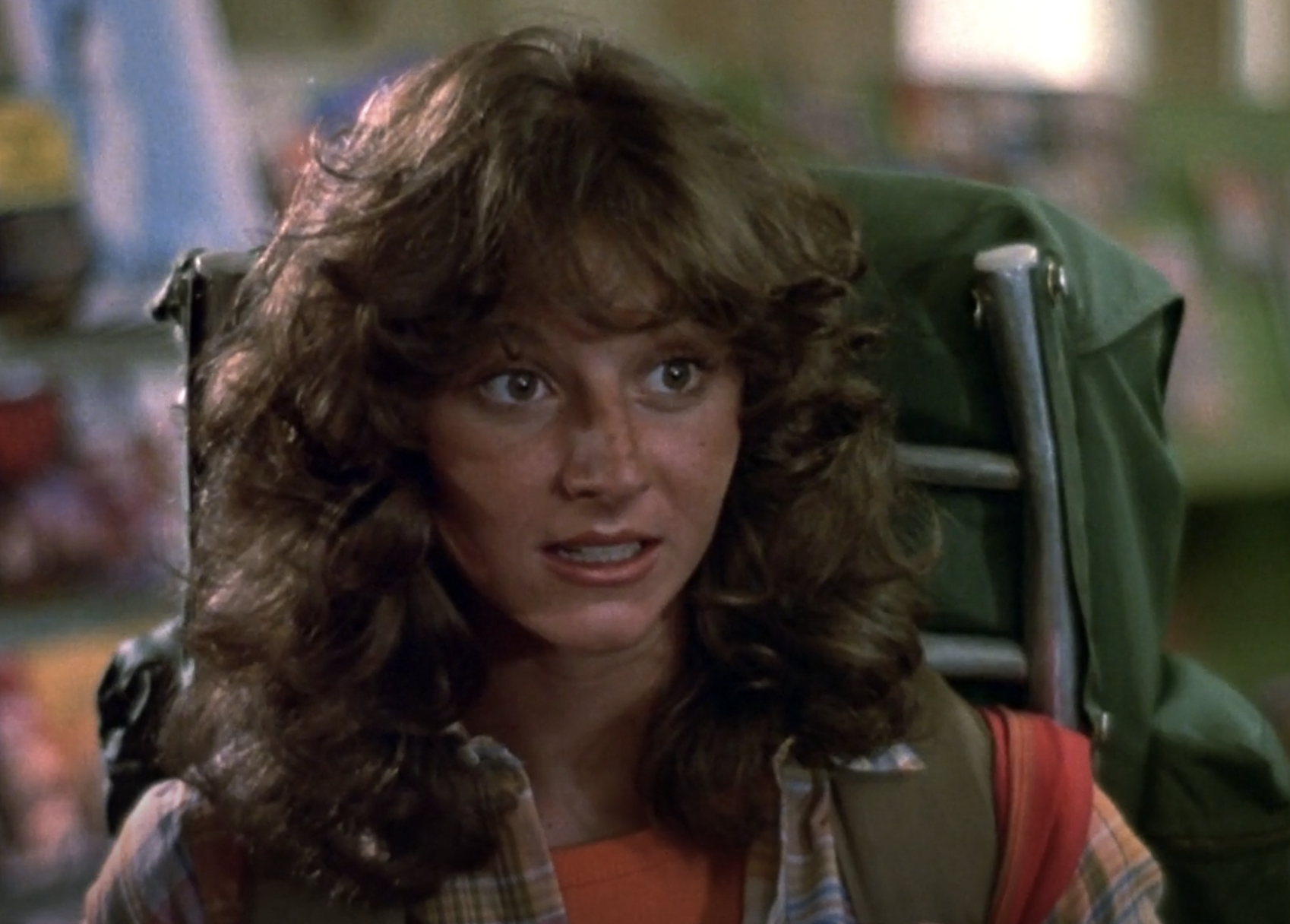
Because the first Friday the 13th (released in 1980) has been getting a bit more attention of late thanks to the prequel series Crystal Lake, it’s worth looking back not only on the character of Mrs. Vorhees (Betsy Palmer), but also Annie (Robbi Morgan, who didn’t have a very robust filmography after appearing in this role), the would-be cook on her way to Camp Crystal Lake after the opening scene of requisite carnage. As she pluckily traipses through the town, the only soul she encounters is a stray dog, delightedly petting him and asking, “How far is it to Camp Crystal Lake?” The dog lets out a tortured whimper, almost as if he’s the first one to warn her—well before “Crazy Ralph” (Walt Gorney)—that going to the camp is a bad fucking idea. But rather than picking up what the dog is putting down, she replies playfully, “That far, huh? Okie-dokie. See ya later.”
Annie then heaves her massive hiking backpack (with a sleeping bag attached) over her shoulder again and keeps wandering around in the hope of finding someone, anyone who will lead her in the right direction. Even though the dog definitely tried to with that pained exclamation. Eventually, she makes her way to Crystal Lake Diner (which seems more akin to a convenience store), where she asks the crowd at large in there, “Excuse me, how far is Camp Crystal Lake from here?” Everyone whips around to stare at her as though there should also be a record scratch sound effect at play. She stares right back at them, wondering what she said that was so wrong. Finally, the waitress (since that word was still “okay” to say in 1980), Trudy (Dorothy Kobs), turns to a man named Enos (Rex Everhart) sitting at the counter and says, “What is it, Enos? About twenty miles?” Enos agrees that sounds right and then also agrees when Trudy suggests he ought to give Annie a ride about halfway since it’s along his truck route.
With that, they head off, walking toward his rig as Enos makes an inappropriate comment about her being “good looking.” As she laughs awkwardly (or is it “good-naturedly”?), the “conversation” is interrupted by Crazy Ralph jumping in front of her to demand, “Going to Camp Blood, ain’t ya?” Enos tries to tell Ralph to back off and leave her alone (even though he ought to take some of his own advice), but Ralph continues, “You’ll never come back again.” This is enough to put a horrified look on Annie’s face while Enos tells him point-blank, “Shut up, Ralph.” But Ralph will not shut up. For it seems he has made it his mission in life to forewarn anyone foolish enough to go to Camp Crystal Lake, least of all attempt working there. So no, he refuses to be silenced, further calling out to Annie as they walk away, “It’s got a death curse!”
But Enos shrugs off the warning by joking, “He’s a real prophet of doom, ain’t he?” And, even though Annie gets in the truck, ignoring Ralph’s alert, she still can’t help but look out the window of her passenger seat to see Ralph getting on his bike and rolling down the hill, as if he’s now washed his hands of trying to help her. After all, you can’t help people that don’t want it. That would prefer, instead, to learn the hard way. Which, clearly, Annie does. Determined as she is to work, it’s not as if she could genuinely “hear” the message anyway. Besides, she has Enos continuing to chalk him up as nothing more than a loon by telling her once they’re barreling down the road, “He’s causing problems enough for your boss with all that talk. Goddamn nuisance.” Which is what every capitalist calls someone who dares to fuck with the potential for money-making. Risks or dangers involved in that money-making be damned.
Even so, something in Enos’ eyes as he looks over at just how naïve and trusting Annie is makes him ask her, “He tell you anything?” Clueless as to who he might be referring to, Annie inquires, “Who?” Enos elaborates, “Your boss, Steve Christy.” She shrugs, “I’ll be cooking for fifty kids and ten staff.” But no, Enos explains, that’s not what he means. Did Steve tell her about what happened? Initially unbothered, she says, “No.” But then probes, “There’s something you’re not telling me.” Enos then goes all Ralph himself on the matter and urges, “Quit. Quit now.” Annie balks, “Quit? Why would I wanna quit?” Enos finally declares, “Camp Crystal Lake is jinxed… Quit.” “I can’t,” she asserts flatly, with no further explanation. Though she does seem plenty chatty with the next car she thumbs a ride from (after Enos drops her in front of the cemetery, yet another harbinger of doom). A car driven by, as everyone ought to know by now, Pamela Vorhees. Though, of course, the entire “gimmick” of the movie is that the viewer never knows who it is until the end, with all of the killing done from Pamela’s POV so that one can never see the killer “from the outside looking in,” as it were.
And, of course, Annie has no idea she’s riding with a murderer as she dreamily tells Mrs. Vorhees, “Guess I always wanted to work with children… When you’ve had a dream as long as I have [mind you, she’s still a teenager, so she couldn’t have had the dream for that long], you’ll do anything.” Even, whether you know it or not, catch a ride from a killer. Something Annie only starts to catch on to after Mrs. Vorhees “misses” the turn for the camp and keeps speeding past. Annie gets sketched out pretty quickly after begging her to stop and being met with no sign of Mrs. Vorhees adhering to that request. So she just jumps right out of the car, evidently still determined to make it to that godforsaken camp—that godforsaken job—one way or another.
But, of course, Mrs. Vorhees has other ideas in mind, stalking her into the woods as Annie tries to limp away from her pursuer as best as she can. Alas, there’s no hope for Annie, who ends up with her throat slit for all the trouble she went through just to have a job. Her “dream” job at that. Since it involved working with kids. Unfortunately, most dream jobs do genuinely entail risking life and limb. Even at the baseline level of daring to leave one’s abode every morning and get into some deathtrap, be it a car or public transportation, just to make a few fistfuls of cash. In this regard, Friday the 13th is a bigger allegory than it knows for the ways in which trying so hard to get to work/to work in general is often more trouble than it’s worth. That is, if one values their life more than money. Which, antithetically, is what the system of capitalism requires in order for you to keep living. Though you just might not if you keep trying to work. A real catch-22.


+ There are no comments
Add yours