


As far as debuts go, screenwriter Travis Braun theoretically had everything “on his side” when it came to One Night Only, what with being the “darling” of The Black List two years in a row (an unprecedented feat in the survey that ranks unproduced screenplays based on votes from development and agency executives). And then getting Will Gluck, fresh off the high of the success of Anyone But You (which he wrote and directed), to direct the project. One that has a very simple premise the viewer must simply get on board with from minute one of the movie: a government mandate prohibits unmarried people from having sex save for one night a year. The “don’t ask a lot of questions why” factor isn’t necessarily what could, er, rub viewers the wrong way about the narrative (more on what will later). In fact, it’s entirely believable that the U.S. would reach such a point based on its current regime, paired with its cud-chewing population.
What’s more, it could be argued that the U.S. was essentially just like this before the whole “sexual liberation” movement of the 1960s, with the government all but flogging a woman who dared to have a child out of wedlock (that scary word). This being the telltale sign of her “immorality.” Either that, or contracting an STD. Yet somehow, men were never blamed for spreading such disease, instead warned against “loose” women, particularly during World War II, with PSAs touting such slut-shaming copy as, “Don’t take chances with pickups! Loose women may also be loaded with diseases.”
So one supposes that, in Braun’s “alternate” version of America (a.k.a. a pre-sexual revolution-inspired one), the only real difference between it and the epoch before the mid-twentieth century is that unmarried people’s “immoral”—and now, illegal—sex acts can actually be monitored with a biometric tracker implanted into their wrist. Again, don’t ask a lot of questions behind the “mechanics,” suffice it to say that this is the type of thing that surely Elon Musk would support manufacturing. Other “kinks” Braun doesn’t quite work out is why only heterosexual people seem to be subjected to this “mandate,” which has been in effect for three years at the start of the movie. Presumably because, well, the regime in charge is of the belief that the “free love” and “sexual revolution” heyday is what led to the breakdown of the nuclear family. In other words, the thing that ensures capitalism will always endure. Passed down from generation to generation. More than that, reinforcing the notion that one’s blood family is the only “tribe” to be concerned with, and not anyone else. So it is that the traditions of monogamy and nuclear family fundamentally support a “fuck everyone else” philosophy, an us v. them mentality. Of the sort that applies to a phrase like, “Provide for your family.”
When the 60s and 70s saw people getting too “free” with their sexual expression (though, in the patriarchy’s eyes, it only mattered that women were getting too free) and focusing less on the “real” purpose of sex—creating a family—it seemed well-timed for the conservative agenda that AIDS arrived at the dawn of the 80s, just as Ronald Reagan was ushered in to crack down on all that “liberal debauchery” that had gone unchecked. One Night Only seems to take a page from this pendulum swing. As illustrated by an on-TV interview with a politician one can assume is either a high-up senator or the president of the U.S. When he’s asked the question, “Why do you have an exception for this one night?,” the man answers, “I guess that’s what sets us apart from…other places. Here, politics require compromise. But on this night, we have made the use of protection mandatory.” Here, again, even the most forgiving of viewers on the matter of suspension of disbelief would be unable to avoid the question, And how the fuck would it be “governable” as to whether someone uses a condom or not?
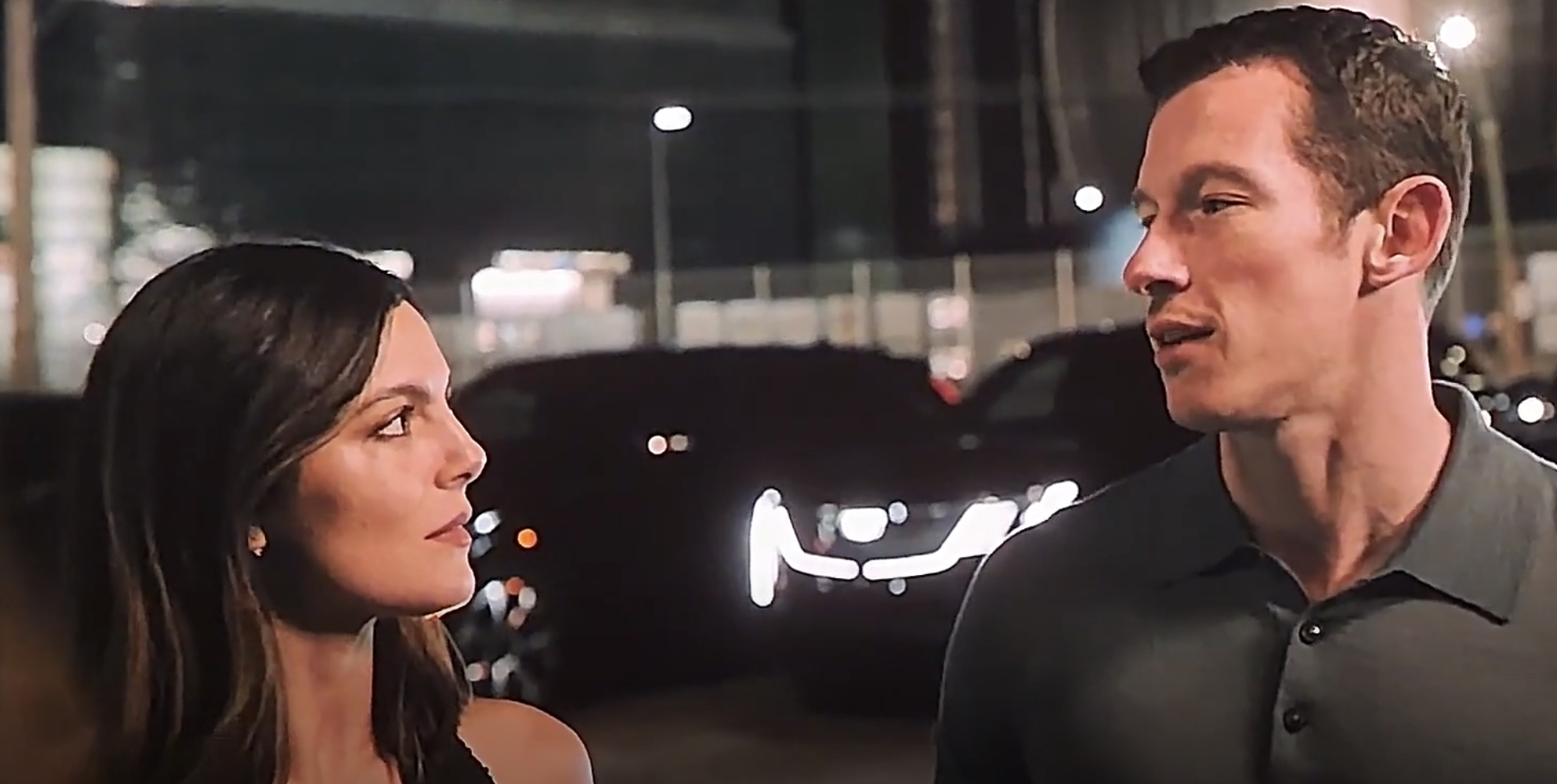
In any case, so it is that “singles” treat this day almost like their own version of New Year’s Eve, complete with a countdown to the moment the mandate is lifted. The only two single people in all of New York City who don’t seem too jazzed about the “hallowed” (but profane) day are Allie (Monica Barbaro) and Owen (Callum Turner). The former is an aspiring singer who can only get work in said profession by doing cover versions of pop songs that appear in ads for, say, psoriasis—which is the commercial she’s working on (to the tune of Sara Bareilles’ “Brave”) at the beginning of the movie. As for Owen, he owns his own pizzeria called, banally, Claremont Pizza. He also has a girlfriend named Malika (Maya Hawke), who he plans to propose to on this “special day.” Only she had to go and ruin that plan by telling him she wants to use their sex night to sleep with someone else (photographically portrayed by Glen Powell, a nod to Gluck’s Anyone But You clout, along with Sydney Sweeney appearing as an option on a dating app that Owen swipes through). She suggests that he do the same—that, like her, he should take the opportunity to “explore.”
Crushed by her callousness, Owen goes uptown to seek comfort from his mother, Linda (Molly Ringwald, in something of an unexpected role choice). Indeed, he’s hoping he can stay there for the night since Malika expressly requests that he does not come back to their apartment while she’s using it for her “exploration” purposes. But even Mama’s got plans to take advantage of the night, telling him to “get out there” and, more importantly, that she’s having sex with Rick (LeVar Burton), who’s already inside the house and has overheard everything.
Allie’s roommate, Arya (Quintessa Swindell), tells her the same thing—to get out there (along with the one-line “explanation” about why gays don’t need to participate in this night: “Tonight is for the straights. We’ve been dancing around your laws since before the Bible”). Whereas Arya herself will be babysitting a pervy twelve-year-old and getting five thousand dollars for it. Just one of many examples of the “surge pricing” this night can yield (especially for condoms, as one plot point makes clear). This in and of itself a commentary on capitalism. Along with the new “business opportunities” that have arisen in the wake of this form of oppression. Take, for example, a legal brochure that Allie picks up while waiting at a police precinct. An image of an ambulance-chasing lawyer on the front is paired with the copy, “Broke the mandate? Don’t break the bank. Expert legal defense for mandate offenses.”
Then there’s the biometric tracker itself, mansplained to Allie at a bar by an “angel” investor named Woodrow (Nicholas Braun—best known for his role as Greg on Succession; and, speaking of, it feels like this movie is trying to be something that Will Tracy would write). As he tells her, “It tracks dopamine, oxytocin and testosterone levels. So if it spikes when it’s close to another one with elevated levels, bam, it flashes red and the authorities are alerted via 5G.” He then adds, “So we’re developing a pill that masks dopamine.” When Allie points out that such a development could cure Parkinson’s, he looks at her as if she’s said the most offensive thing ever and exclaims, “There’s no money in that shit.”
Nor is there much money, lately, in sexual freedom. Particularly since, in real life, those who can have sex whenever they want opt not to, with the ongoing perception of Gen Z being that they don’t fuck much (and certainly not as much as previous generations). To the point where Gregg Araki felt obliged to troll them with I Want Your Sex, a love letter to sexual freedom and expression. Which isn’t quite what One Night Only feels like. Instead, it comes across more as a harbinger of what could be.
To be sure, just as it is in the movie, it’s obvious that one of the larger intents of conservatives in promoting marriage over “casual sex” isn’t just the old chestnut about reducing the rate of STDs and other sex-related health risks (familiarly trumpeted during the AIDS scare). It’s also to ensure that capitalism stays fortified through the “conventional” family unit. Moreover, in the movie, another larger purpose of the mandate is to strong-arm unmarried couples into getting married more quickly than they otherwise would if they could just “bang freely.”
And so, overall, One Night Only feels less like a “dystopian rom-com” and more, somehow, like “surrender Dorothy” propaganda (complete with featuring a line of dialogue that has one character “looking on the bright side” with, “Just maybe the fascists were right about this one”). Of the sort that insists one ought to “make the most” of their loss of freedom. Particularly when it comes to bodily autonomy. In this regard, one can’t help but see the correlation between this message and the fact that two straight white men are responsible for putting it out into the cinematic universe.


