


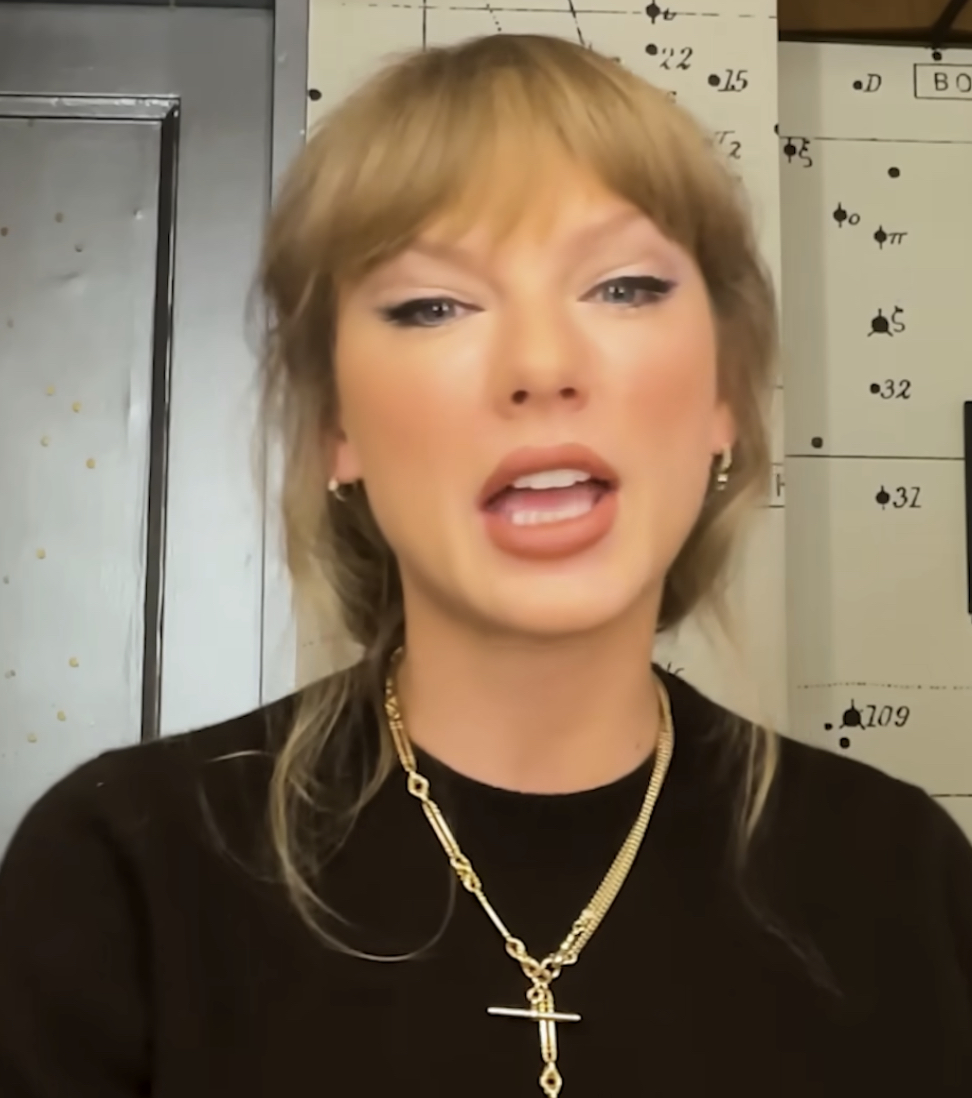
At first, there was a schadenfreude-y reaction to a Vanity Fair article by May Jeong titled, pointedly, “The Mastermind” (for “everyone” knows Taylor Swift has a song called “Mastermind”). A reaction not unlike that of the students at the end of Cruel Intentions who get to read all about the real Kathryn Merteuil (Sarah Michelle Gellar) in Sebastian Valmont’s (Ryan Phillippe) diary.
To be sure, everyone, more or less, has been a bit fed up with the whole “Taylor Swift can do no wrong” narrative. One that she herself has worked diligently to cultivate, reframing every “faux pas” as part of her own victimization (this most famously extending to her “Kimye debacle” of 2016 that so “crippled” her she couldn’t even be bothered to urge America not to vote for the Orange Creature)—which is where a line from the article about Swift being both “a combination of victim and victimizer” comes in. Though, what shines through most in this article, is the latter quality. Alas, after “The Mastermind” had more time to “circulate” on social media, a pendulum swing happened that suddenly favored Swift again, and instead accused Jeong of, let’s say, “nit-picking” about details as innocuous as Swift owning three pairs of Uggs during their fashionability heyday of the 2000s. But within the context Jeong is speaking of—that Swift was a bit of a rich bitch in the spirit of Regina George (another staple of 00s culture)—it’s relevant.
Which is why she writes, “Arielle Peppers was a year behind The Star [Swift’s actual name is not once mentioned in the article] and sat on the other side of [Chanice] Skinner in [Sharon] Luyben’s class for multiple quarters. She remembers The Star coming to class in Ugg boots. Peppers had transferred from the nearby city of Reading after her neighbor was stabbed in the neck. She asked her mother for a pair of the same boots. ‘Do you know how much they cost?’ her mother said. A pair of Uggs amounted to half her single mother’s paycheck working variously at a bakery, at a dairy mill and as a caretaker. Peppers recalls The Star owning multiples of Uggs: ‘She had the brown one, the black one, the blue one.’”
The point, obviously, is to create a sense of contrast. That, when it comes to Swift, it has always been fundamentally impossible for her to be a victim in terms of hailing from the background that she does. And yes, around 2003, the average cost of a pair of “classic tall” Uggs would have about a hundred and sixty dollars. Which means that single mother’s paycheck was about three hundred and twenty dollars (hopefully every two weeks). So yeah, it’s little wonder that someone like Arielle Peppers would come forward to offer a quote in this article that feels “the need” to delve so far back into Swift’s past—because that’s what’s necessary if one wants to unearth a time before she couldn’t control the narrative through her “mastermind” media manipulation. A prime example of which occurred in 2013, when Swift brough up in, of all publications, Vanity Fair, the quote (which she misattributed to Katie Couric), “There’s a special place in hell for women who don’t help other women” (at the time, it was a dig at a light-hearted joke that Tina Fey and Amy Poehler had made at the Golden Globes that year, with Swift in attendance). Which means, to her, Jeong probably deserves one of those special places.
In reality, though, Jeong is just doing what few others with a mainstream media platform have had the guts (no Olivia Rodrigo reference intended) to do: engage in an outright takedown/calling into question of Swift’s image. But no, now Jeong is saddled with “think pieces” of her own, like the one in The Spectator that begins, “There’s an old saying that if ‘you come for the king, you better not miss.’” In other words, they feel Jeong has missed, even though she took a big swing. Because for many, and certainly Swift’s fans, it’s not enough for The Star to have had three pairs of Uggs and been bought a career by her father. They need dirt that’s far more damning than that. Indeed, short of murder, this is the kind of fanbase that could forgive Swift of any trespass (probably even murder since, with her resources, there would likely be “no body, no crime”). Not totally dissimilar to the most die-hard “members” of MAGA.
Incidentally, this is hardly the first attempted “takedown” of a female pop star. But what makes it different is that Swift has always managed to cling to her “beneficent” image. Not like Britney Spears (who was “on the way out,” just as Swift was really starting to rise in 2008), the pop princess that scarcely got to be “America’s sweetheart” for very long before her breakup with Justin Timberlake in 2002 turned her into “America’s trollop.” The girl that everyone loved to lambast, especially the media. Swift never had to contend with anything that Britney Spears did—not being mercilessly stalked, ridiculed or pilloried. And yet, when Spears was the recipient of a much less flattering cover story for Rolling Stone written by Vanessa Grigoriadis in 2008, titled “The Tragedy of Britney Spears,” it was met with the kind of schadenfreude that stuck (with such articles and the type of thinking they displayed not “reassessed” until more recent years). Chalk it up to the “seriousness” of print journalism over “the online kind.” Nonetheless, “The Mastermind” is an article serious enough to have warranted the Committee to Protect Journalists to reach out to Jeong, for there’s no denying the Swifties are coming for her. Just as they did for Paste magazine writer Niko Stratis when she wrote a review of Midnights. The fan reaction to the review was evidently scary enough for the next Paste review of a Swift album, The Tortured Poets Department, to be published anonymously.
And, talking of that album, it seems that TTPD was the first pinpointable moment of Swift’s so-called downfall, with critics and fans alike finding it more of a challenge to get behind such schlock as, “You smoked then ate seven bars of chocolate/We declared Charlie Puth should be a bigger artist/I scratch your head, you fall asleep/Like a tattooed golden retriever.” As for who that title track was so obviously about, Jeong even finds a way to bring Matty Healy into the article by commenting, “‘To become a billionaire,’ The Star’s ex Matt Healy once told the Doomscroll podcast, ‘you don’t really care that much about culture.’” Not least of which is because Swift has been given plenty of reason to believe that she is the culture. And, as such, has single-handedly helped to make it as bland, basic and apolitical as it is (gone are the days of pop stars meeting any form of Madonna-level controversy and thought provocation).
Jeong continues, “[Healy] wasn’t speaking specifically about The Star but the deadening effects of modern wealth. Beyond need lies want. Beyond want, greed.” And Swift has shown herself to be plenty capable of that. Indeed, before Jeong could add this piece of the puzzle in, it was revealed in late November that residents of Bratenahl, where Swift and her freshly-minted husband, Travis Kelce, just bought an “estate” overlooking Lake Erie, strongly objected to the couple’s landscaping plans, which include building ten-foot shrubs and a six-foot fence to ensure their privacy. The pushback against the duo’s intentions stemmed from complaints about tree removal, obstructing views of the lake, disrupting wildlife habitats and even potentially wreaking havoc on a one-hundred-plus-year-old sewer line. Regardless, the board approved the “requests” (read: demands) of Mr. and Mrs. Swift—because whatever Taylor wants, Taylor gets. Even when it came to presenting herself as an ostracized and “bullied” youth after becoming famous when it was always rather obvious she would have fallen into the “mean girl” category.
This much confirmed by another of Jeong’s one hundred sources interviewed in order to put together this article. Namely, Chanice Skinner, a classmate who “recalls The Star being ‘always part of the popular crowd,’ among preppy kids who wore Ralph Lauren shirts with the collars popped. ‘If you weren’t part of her friend group,’ Skinner says, ‘you didn’t exist to her.’ Years later she was watching a Target commercial in which The Star talked about being bullied. ‘I was like, You were part of that. What are you talking about? If anything, you were one of the bullies.’” But no one wants to “relate” to a bully or a mean girl (as evidenced by even Paris Hilton having to rebrand and do her best to bury some of those early TMZ and X17 paparazzi videos that found her doing things like laughing gleefully over Brandon Davis calling Lindsay Lohan a firecrotch). Which was undoubtedly part of why Swift pivoted toward playing the “victim” early on, with a glaring example of that being one of her early hits, “You Belong with Me,” during which she positions herself as the outsider “contending with” the type of popular, conventionally “hot” girl that she herself was in junior high and high school.
But no, in the Fearless era, she was cosplaying some kind of nerdy band geek, which is, in fact, an insult to actual nerdy band geeks. Just as it, apparently, is an insult to fellow classmates that Swift’s success was so “in the bag.” And so blatantly, too. Which is why, as Jeong writes, “In Skinner’s estimation, The Star’s success, like so many aspects of American life, was overdetermined. ‘That’s what happens when you have a family that is already well-off and able to back you, [to] fund your dream.’ Did it seem, though, that The Star carried exceptional promise? ‘We all had promise,’ says Skinner, who starred in plays with The Star and now sells industrial saws in West Reading. ‘It’s just that she had money.’”
And yet, at another point, Jeong brings up the notion that, “You only become famous if you really, really want to. Lana Del Rey [who has her own privileged backstory, despite protestations to the contrary] said as much to the BBC in 2024. And The Star really, really did. ‘She wants it,’ Del Rey said. ‘She’s told me so many times she wants it more than anyone.’” And whatever Rich Bitch wants, Rich Bitch gets. This most definitely bleeding into how Swift leveraged the shit that went down with Kanye West to her ultimate advantage. Indeed, one could argue that West was integral to cementing Swift as an “innocent victim.” The clean, lily-white soul who was just minding her own business when, he, the “big, bad Black man” stormed the stage to ruin her moment at the 2009 VMAs. To be sure, when it comes to Swift’s relationship with races beyond her own, things tend to get a bit cringe. For it’s only been in recent years that she bothered with notions of “inclusivity” that tend to come across as entirely disingenuous (see: the “Lover” video and the “All Too Well” video).
Thus, despite Swift likely wanting desperately to respond in some way to this “hit piece,” trying to “come for” Jeong creates a complicated problem for the “Aryan princess” in the sense that, once again, it would be a white woman playing victim against someone from a race that has been historically marginalized in the U.S. To be sure, “The Mastermind” is even more impactful because it’s not a white woman pointing out Swift’s flaws, or her inability to deal with competition or criticism—which is why she prefers to “quash” it altogether instead. Something that has been a longstanding “theory” by those who point out that every time a fellow female musician has new music coming out, Swift “conveniently” releases a different iteration of her day-old schlock to block that musician from taking the number one spot. It’s happened with everyone from Billie Eilish to Charli XCX to Olivia Rodrigo, with the latter two being brought up in the article as “The Brat” and “The Protégé” (though it should be “The Protégée”). Confirming the ongoing speculation that Swift wrote “Actually Romantic” in response to XCX’s “Sympathy is a knife” and that Rodrigo had a falling out with her that may or may not have been immortalized in her 2023 hit, “vampire” (with lyrics to Guts’ “the grudge” also being highlighted in the article), and that was pettily related to her sending a Sour PR kit to “the wife of her archnemesis,” Kim Kardashian, in 2021.
Jeong even brings up the older beef between Swift and Katy Perry, who gets labeled as “The California Girl.” A woman that Jeong describes as being “an adult pretending to be a child,” while Swift, instead, “might be a child pretending to be an adult.” Something that could be deemed a “savage” assessment were it not for the fact that one can very much imagine Swift having a Regina George-style tantrum as she storms into her room and finds a picture of her and Cady Heron to cut up so that she can put the her own image in the Burn Book and write something mean about herself in it. A “mastermind” stroke of brilliance that allows the principal to believe, however briefly, that she had nothing to do with the book, since there are only “three girls in the whole school who aren’t in it.” And now, Regina isn’t one of them.
The Swift-George parallels come up a few times in the article, with “The Exec” commenting, “It’s truly Regina George,” before Jeong continues, “There once lived a music critic who dared pan The Star. Around then, members of her friend group, one of whom she lived with, were getting courted by The Star. The Critic felt The Star was ‘ordering friends from a catalog.’ After her negative review ran, The Critic’s friends—professional musicians all, who previously credited The Critic for their early success—shunned her. Her roommate, seemingly of her own accord, asked her to move out of their shared duplex. The Star had won.”
In an earlier part of the article, Jeong also alludes to Mean Girls/Regina George with, “She wears a bandeau ‘nap top’ and midi skirt, and everyone else buys a bandeau nap top and midi skirt. She is our most gracious homecoming queen, our Miss Americana. In these divided times, everybody agrees: The Star is power.” But, thanks to this article, it’s become quite clear that Swift’s “power” is not necessarily something everyone can agree on anymore. That, as The Guardian put it in response to reading “The Mastermind,” “It may not have revealed anything new, but the fact that this Vanity Fair piece was even published seems to suggest the megastar is entering a new era: one where she is seen as less untouchable than before.”
Alas, anyone with Swift’s income tax bracket is untouchable. Which is where talk of Swift’s major networking event posing as a wedding at Madison Square Garden comes in. Painting a contrast between the people on the inside of that venue versus those on the outside, Jeong wrote, “It is not lost on them [read: the hoi polloi] that her $26 million giveaway, apart from being a tax write-off, is akin to a person making $81,228—the median household income in New York City—giving away $1,055. (In fall 2025, when this article was commissioned, The Star was worth $1.6 billion. By the time this issue goes to press, she will be worth over $2 billion, or the GDP of Eritrea.)” Yet, perhaps surprisingly to some, when you are a person for whom $26 million is “chump change,” public opinion still very much matters to you.
Case in point, the immediate bad reviews of The Life of a Showgirl were something Swift clearly paid attention to. For in the aftermath of its release, she gave an interview to Zane Lowe during which she insisted, “I welcome the chaos [a euphemism for “bad reviews”]. The rule of show business is, if it’s the first week of my album release and you are saying either my name or my album title, you’re helping.” This said while giving a big, diabolical smile. The kind that indicates Swift knows that, in her current powerful state, she can release a turd of an album and still have it be her best-selling one. At the same time, it overtly pains her to know that she doesn’t have critical acceptance, adding, “Art. I have a lot of respect for people’s subjective opinions on art. I’m not the art police. Everybody is allowed to feel exactly how they want.” But that doesn’t really seem to be true for Swift, who prefers to control the perception of her and her music as best as she can. Even in internet-fueled times as uncontrollable as these (see also: the “bot bombarding” related to The Life of a Showgirl “promoting Nazi ideas”). Unfortunately, because (and as her “showgirl-themed” album revealed) she’s grown increasingly out of touch with the public, it’s as Jeong says in her conclusion, “If you listened carefully then to the sounds of the city—not for any semantic meaning, but if you were to really pitch your ears to the utopic promise of music—you might have heard the determined whoosh of a weighted blade dropping, dropping, dropping, the ax of public opinion falling in downward demotic motion.”
It’s hardly a coincidence that Jeong’s image almost evokes that of a guillotine. But Swift’s “pretty” little head (now filled with Botox) is far from dropping into the basket just yet. Particularly with Jeong now bearing the brunt of the backlash wrought by this article. One that, for many a Swiftie, will cause a visceral reaction. For none of them want to be reminded of their “queen’s” inherent vapidity. But if Swift is vapid, isn’t it only because, as Jeong also points out, “Stars function, as cultural theorist Stuart Hall observed, as a mirror. ‘I want you to know/I’m a mirrorball,’ The Star sang in a 2020 hit [of the same name]. ‘I’ll show you every version of yourself tonight.’ The Star holds up a mirror to us, and what the mirror says is this: if churches were once our society’s primary source of community, identity and meaning, in these secular times we turn instead to celebrities” (see also: Swarm, the TV series that takes aim at the Beyhive). Even Swift herself tried to play the “mirror” card in defending her shittiest album yet, telling Lowe, “What our goal is as entertainers is to be a mirror.” But if Swift is reflecting society back to itself, it bears noting that she seems to have no real reflection of her own. Just as a vampire (shoutout to Rodrigo) has no reflection either. With her greatest talent being to harness criticism as fuel for a new era (2017’s Reputation being the most successful example of that).
Which is why, when “someone who previously collaborated with The Star—and asked that their profession not be mentioned because The Star had worked with so few with this specific job—[and] advised I turn down this assignment” was asked, “Did they think The Star would read the article though?” their answer was, “Oh yes.” Because when someone is as rich and comfortable/comatose as Swift, criticism is all they really have as “inspiration” anymore.
So if and when Jeong or Vanity Fair is referenced on the next album, no one should be surprised. In truth, for all the flak Jeong has been getting, using Swift’s own brand of pettiness and “coded messaging” to get at her is a stroke of brilliance on the journalist’s part. With the “randomly” capitalized letters peppered in throughout ultimately spelling “LOOK WHAT YOU MADE ME DO.” Which, according to the haters of the article, is force Jeong to take “legitimate” journalism down a peg. But then, maybe that’s only a mirror of what Swift herself has done with music.


+ There are no comments
Add yours