


As Madonna starts to get back into the mode of “feeding” her audience “properly,” she’s been breadcrumbing a few “new old” releases over the course of 2025. It started with Veronica Electronica, an EP that dredged up various remixes and demos/“previously unearthed” gems (to those who are but casual listeners of Madonna). This released after Madonna had already announced her intention earlier in 2025 to put out another EP, Bedtime Stories: The Untold Chapter, to honor the thirtieth anniversary of Bedtime Stories. Although that EP hasn’t come out as of yet, Madonna has thrown yet another offering her fans’ way: a digital release (that’s right, not even physical) of Confessions on a Dance Floor (Twenty Years Edition). Not “Twentieth Anniversary Edition,” which would perhaps indicate a bit more polish. But this rather “tossed together” version also doesn’t have much on it that seasoned and die-hard Madonna fans haven’t been privy to for years. Namely, “Fighting Spirit,” “Super Pop” and “History” (oh yeah, and some token remixes that have also already appeared elsewhere). Songs that, prior to this version, had to be found by more circuitous means.
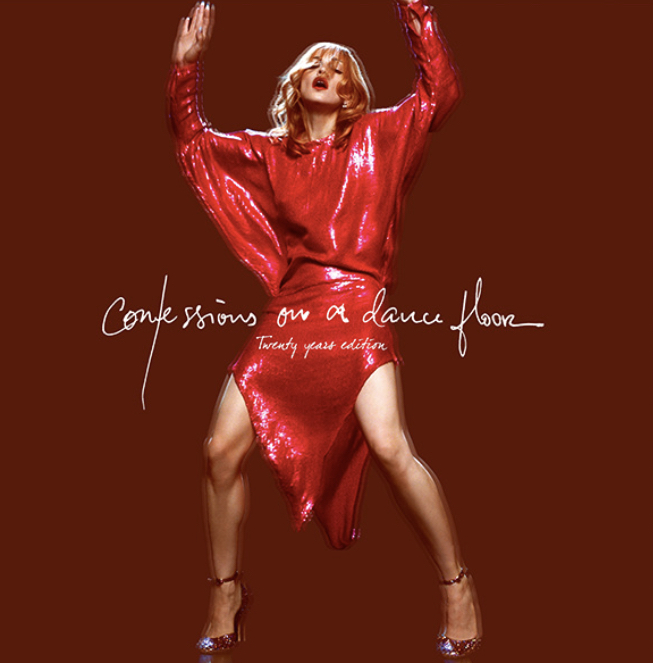
That said, Madonna at least saw fit to provide some alternate cover art for this “special” edition. Specifically, an image taken during a Steven Klein photoshoot for the album and its promotion that features her in a shiny red “disco dress,” frozen mid-dance pose with her arms raised up toward the sky (or the disco ball). An image that was then ostensibly cropped onto a plain brownish background with the original font for the album’s title slapped onto the center with the “Twenty Years Later” parenthetical beneath it. And so, with little to get truly excited about, despite this release clearly being Madonna’s way of “drumming up excitement” for Confessions on a Dance Floor “2” (or Confessions II), as she keeps billing it, perhaps the best thing to do is to step back in time to remember just how beaming-with-luster the album felt in its original form when it was first released.
The date: November 9, 2005 (hence, the reason this “Twenty Years Edition” was released on November 7th). By this point in the year, the devastation of Hurricane Katrina had already transpired and Kanye West had already casually chided/called out George W. Bush during a fundraiser on live TV, “George Bush doesn’t care about Black people.” This while standing next to an ever-disbelieving Mike Myers, who was trying his best not to “break” as West went on a tirade leading up to that now iconic one-liner. The same month that Katrina hit the Gulf Coast, Madonna fell off a horse while trying to engage in a celebratory ride for her forty-seventh birthday at her English country estate. A contrast that shows just how much the rich are often the ones to put themselves in harm’s way (see also: OceanGate’s Titan) because they have the time and the money to do so, while the less well-off are subject to the ravages of Mother Nature’s wrath (and increasingly at the hands of rich people’s activities). But from the ashes of that accident, Madonna quickly rose up in time to not only make one of her most well-known music videos (particularly because of the pink leotard), “Hung Up,” but also to promote the album and, not long after, embark on a world tour for most of 2006.
Part of Madonna’s promotion for the album centered around “getting back to her New York dance roots” (this included reviving “Everybody” with an updated take for her tour). So it was that, weeks ahead of the album’s release, she made a surprise appearance as a guest DJ with Stuart Price at the Misshapes Dance Party that was then held at Luke & Leroy in the West Village (soon after, not only did the Misshapes party have to move to a bigger location [Don Hill’s]—in no small part because of the spotlight Madonna put on it—but Luke & Leroy also closed down). Showing up on the night of October 22nd going into October 23rd, her appearance occurred just days after the trial of Saddam Hussein began in Iraq on October 19th. Indeed, two years earlier, Madonna seemed to have Hussein much more on her mind when she filmed a music video for “American Life” that featured lookalikes of him and George W. Bush, the latter using a grenade that Madonna tosses into the “fashion show” audience to light a cigar.
In the end, she didn’t release this version of the video, opting to back down (a rarity in her career), and pivoting toward an extremely bland version featuring her in military dress as an array of various countries’ flags flashed behind her to indicate something like “unity.” A message, indeed, that Madonna has consistently promoted in her work (even in something as lyrically simplistic as “Holiday”). But the reaction that American Life received—particularly in terms of sales—as an entire work seemed to discourage her from continuing down a more overtly political path with the record that was to follow: Confessions on a Dance Floor.
Besides, by 2005, most Americans had pretty much accepted the wars in Iraq and Afghanistan as a “necessary evil” in order to “do right” by their own country. Hence, the pervasive number of yellow ribbon stickers featuring the urging, “Support Our Troops.” For to do otherwise would be “anti-American.” At least during that particular era, when Bush and Cheney were still content to wield 9/11 for their political aims, though the steam behind it was starting to run out by the end of 2005, especially since it had been revealed by this point that the Bush administration decided to go through with “Operation Iraqi Freedom” despite having no intelligence to suggest that Iraq was actually harboring weapons of mass destruction. Which it wasn’t. But no matter to the Bush team. And no matter to much of anyone else in the U.S. either, as everyone seemed determined to “rebuild” and “repair” themselves (by any numbing means required) after the collective American trauma of 9/11. And, of course, nowhere else was that truer than in New York itself. Perhaps such bands as The Strokes and Interpol serving as the nucleus of the “new New York music scene” was a primary example of that. For while many speculated there would be a mass exodus from the city, it seemed, instead, that it only attracted more creative energy than ever at this moment in time (only for all of that to be shot to shit by the mid-2010s). This both in spite and because of that unseemly Williamsburg rezoning law that was approved in ‘05 as well. And full-stop in spite of Michael Bloomberg becoming the post-9/11 mayor (reigning over the city from 2002 to 2013).
Nonetheless, the energy was starting to mirror what Madonna would later describe as being “like [sticking] my finger in an electric socket.” This “electric” sensation included, believe it or not, the fact that TRL was still being broadcast live from Times Square, with thousands gathering outside One Astor Plaza to catch a glimpse of their favorite singer visiting Carson Daly at MTV Studios. And yes, despite not being deemed “demographic worthy” for this audience, Madonna still showed up a few times. One of the most memorable being her October 17, 2005 appearance on the show, staying for the entire filming and judging a “Move for Madonna” contest that granted the winner access to a screening of her then new documentary, I’m Going to Tell You a Secret, the following night. In other words, the PR machine was in full swing (see also: the Motorola ROKR commercial), and Madonna was obviously dead set on making this record more of a success than American Life. Which it was, outselling the latter record by millions in worldwide sales.
The success of the record, however, wasn’t just a result of Madonna’s tireless promotion, but of her still keen ability to tap into what the public was craving—whether they were aware of it or not—at a particular moment in time. And what everyone seemed to want was to get their ass back on the dance floor and pretty much black out all the “political bullshit,” a war that wasn’t actually based on anything concrete included.
Of course, most are aware by now of how that “avoidance of reality” blip turned out. For, roughly two years later, the effects of the 2008 financial crisis were about to let the guillotine fall on everyone’s good time. Though Bush was certain to assure the masses that capitalism was still “the best system ever devised.” Never mind that few others were experiencing anything like that version of “reality” in the aftermath of total economic collapse. And maybe that’s part of why Madonna’s next album, Hard Candy, landed with such a thud. Released in April of 2008, when the wound of the financial crisis was still fresh as all get-out, not as many appeared to be on board to adhere to Madonna’s dance music-drenched commands to, “Get up out of your seat/Come on up to the dance floor.” At best, most people were trying to come on up to the dole lines, as it were.
In this regard, Confessions on a Dance Floor remains the last objectively “successful” Madonna record in the sense that she was tapping into what the collective consciousness wanted to hear. With this in mind, of the three additional non-remix songs on the re-released album, all of them bear a certain eerie prescience when framed in the current context. On “Fighting Spirit,” the first track after the usual ending of the album, “Like It Or Not,” Madonna bolsters morale with, “Don’t let it get you down/Keep the fighting spirit and turn your head around/Don’t let it take you in/Keep the fighting spirit and you’ll begin again.” As many people have been forced to in this economic climate—one that was cemented by the goings-on and excusals of bank and big business corruption that took place during the 2008 financial crisis.
In “Super Pop,” Madonna sings, “If I was an animal, I’d be a dog/If I was a dog, I would be a man/If I was a man, I’d be the president/If I was the president, I’d be different.” Her assertion now feels like even more salt in the wound, considering that, twenty years on, there still has yet to be a female president who might actually get a chance to “be different,” who might actually counteract this dick-swinging patriarchy.
Then, finally, there’s “History,” with its salient lines, “How many tragedies will we see before we come together?/It’s easy to forget we have the power to make things better” and “We all need to change/Or just repeat history.” Ironically enough, Madonna has proven herself right by re-releasing this album and deciding to essentially replicate it—complete with Stuart Price producing again—for her next release. Perhaps aware, somewhere deep within, that this record was the last definitive time she connected with listeners outside of her usual fanbase. Not to mention the last time anyone felt obliged to sweat it out with no inhibitions on the dance floor. Because after 2005, the risk of being filmed or photographed in public skyrocketed, with the first iPhone being released in 2007. The year that, not so coincidentally, everything started going down the toilette (the economy, Britney’s freedom, etc.)—even if Barack Obama was to be elected as president (since history has proven him to be very much a part of the political machine).
So while this “Twenty Years Edition” re-release might have been intended to be celebratory, it feels more bittersweet than anything else. A reminder of one of the last times when anything had a sense of unencumbered “carefreeness” to it.


