


In 2022, FKA Twigs released a standalone single called “Killer.” It was about three years after her abusive relationship with Shia LaBeouf had ended. Though it wasn’t until the pandemic lockdowns that she came out with the harrowing details of their dynamic, citing the reason for doing so as her understanding that, because of the lockdowns, many women would be trapped inside with their abusers, telling Elle in 2021, “It made me realize I need to come forward and talk about my experience.”
An experience that came to a head on Valentine’s Day of 2019, when LaBeouf’s physical violence reached a previously uncharted crescendo. As she also told Elle, “What I went through with my abuser is, hands down, the worst thing [I’ve gone through] in the whole of my life. Recovering has been the hardest thing I’ve ever tried to do.” Part of that recovery, one might posit, was making a song like “Killer,” which addresses the dichotomy of being in love with one’s abuser while simultaneously knowing that the person is poison (“Dancin’ in the dark, I can feel it in my heart/You’re a killer, but I didn’t wanna call it/Somethin’ in the way you put your hands on my waist/Pulled me nearer, no I didn’t wanna call it”). In the accompanying video, directed by Yoann Lemoine, Twigs opts for a decidedly Herb Ritts style. An aesthetic choice that makes plenty of sense when considering that Ritts was always hiding something grittier and rawer beneath the surface of his “pretty pictures.”
In this regard, such a style was all too apropos for a song that addressed how easy it can be for a woman to be lured into a relationship when the man/abuser knows all the ways to make everything seem so pleasant—at the outset. Or, as Twigs phrased it to Elle, “If you put a frog in a boiling pot of water, that frog is going to jump out straightaway. Whereas if you put a frog in cool water and heat it up slowly, that frog is going to boil to death. That was my experience being with [LaBeouf]” (and something fellow Brit, Lily Allen, is also quite familiar with, as West End Girl reveals).
She also added, “People wouldn’t think that it would happen to a woman like me. The biggest misconception is, ‘Well, you’re smart. If it was that bad, why didn’t you leave?’ [But] it can happen to anyone.” And in enduring what happened to her, Twigs was forced to reconcile with some of her own issues. Like, “What attracted her to this person in the first place?” To boot, after dating LaBeouf, she went for another skeevy white guy in the form of Matty Healy (“passing him off” in time for Taylor Swift to make The Tortured Poets Department). In 2023, however, Twigs veered away from the actor and musician set and began dating director/photographer Jordan Hemingway. A partnership that soon blended romance and creativity, which would explain why the Euseuxa and Eusexua Afterglow era has offered some of Twigs’ lushest and most powerful videos. Her latest, “Hard,” is no exception to the rule, and somewhat picks up where “Killer” left off in terms of emulating Ritts’ style, in addition to showing what happens to “the girl” after she heals. Emulating Ritts, in this case, however, is more of an homage to his outright sensual photos (of which there are many—indeed, his career began with a sexy image of Richard Gere posing at a gas station). For it seems Twigs is finally in an emotional state to re-own what it means to express herself and her sexual fantasies without inhibitions. In short, to tell her romantic and/or sexual partner what she needs.
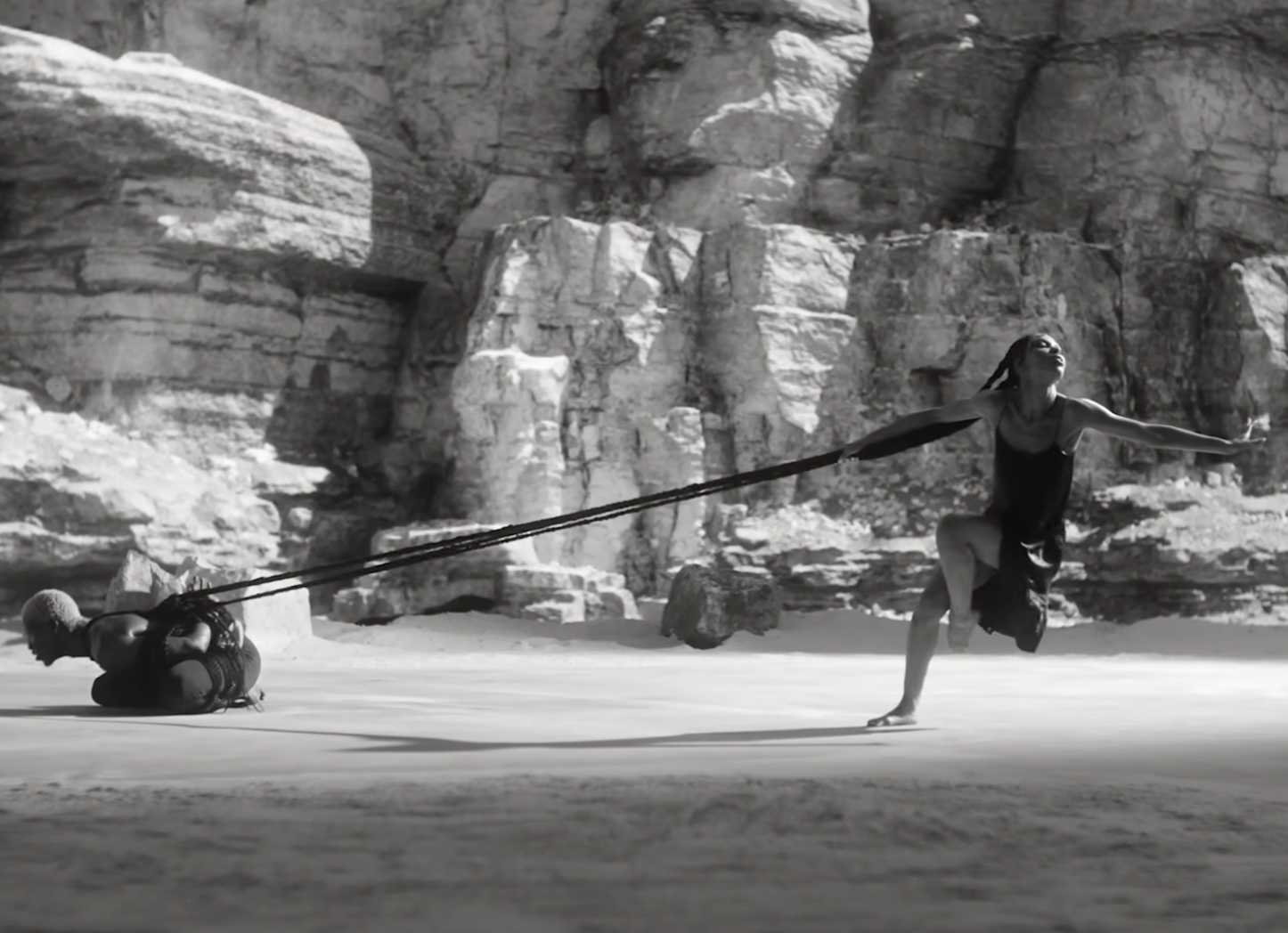
As the third single from Eusexua Afterglow (following “Cheap Hotel” and “Predictable Girl”), “Hard” is the most sexually liberated. Something that’s made clear from the very beginning with the Janet Jackson circa Janet sound and the lyrics, “Wet thighs, I’m ecstatic/Chemistry was automatic.” The opening scene of the video shows a man with a shaved head (to be clear, there’s still hair on his head, it’s just not hair that’s “cascading”), which is immediately contrasted by the braids that are tied around his back and hands, shibari-style. So it is that, from the outset, Twigs is making the kinky slant of the video quite clear. The braids, in fact, are briefly made to look as though they belong to Twigs (during the midpoint of the video, the viewer can see a full shot that confirms they do) as Hemingway cuts to her delivering such lines as, “Just tell me, would you do it hard?/Wham! Bam! I think we can/A victim of your touch/Baby, it’s you/Play my Double-Dutch/Do it right or do it without you.” While the latter lyric might be easily interpreted as Twigs saying, “Do it right or I can just masturbate and do it right by myself,” the larger meaning it applies to is one that pertains to performing within the established sexual boundaries and parameters that Twigs has established.
This is also why, when she asks the object of her sexual desire to “play [her] Double-Dutch,” it’s a reference to her wanting them to understand how to perform the delicate choreography she’s seeking in the boudoir. A choreography she also makes literal when she dances alone while wearing a slip dress (or “chemise,” if you prefer) in a very Ritts-esque outdoor setting. It’s only at about the one-minute-twelve-second mark that she allows others to join in with her, an event that warrants a costume and hairstyle change on her part (albeit a look that seems as though it would be more at home in a video for “Sushi,” the eighth track on Afterglow).
Tellingly, the dancers that do join her are all shirtless, muscular men (another Ritts staple). Then, out of nowhere, she’s back in the slip dress, as though there are two Twigs dancing with these men: an emotional representation and a physical one. Both versions, it would seem, just want to be “ridden”—and hard. Hence, a scene of Twigs on all fours with a saddle on her back. This shown around the time she says, “Would you do it if I didn’t ask you?/Would you give me your love totally?/Totally/I need your hard love in my life/Would you do it the way I need you?” So it is that Twigs makes her desires, wants and needs very apparent, leaving no room for her sexual partner to misread her. Something she undoubtedly learned was important after her harrowing ordeal with LaBeouf.
Thus, her ability to trust again when it comes to romantic/sexual relationships is not only momentous, but artfully conveyed as the final scenes of the video show her and her backup dancers wearing blindfolds. An addition that she commented on as follows: “The blindfold represents many things. Bodies that are never seen, bodies that deserve to be seen, bodies that trust, bodies that find freedom through relinquishing trust, finding power and courage through vulnerability and consensual submission. This is what it looks like to witness your vessel moving, absent of judgment.” Indeed, the world that Twigs has created through Eusexua (and particularly with its companion, Afterglow) is designed to get this message across. Wisdom that was hard-won after the tumultuous years she spent in a relationship that not only didn’t give her what she needed, but drained her entirely. With “Hard,” however, Twigs aims to remind that she’s very much a woman in control—even when she willingly relinquishes it (see also: Romy in Babygirl).


