


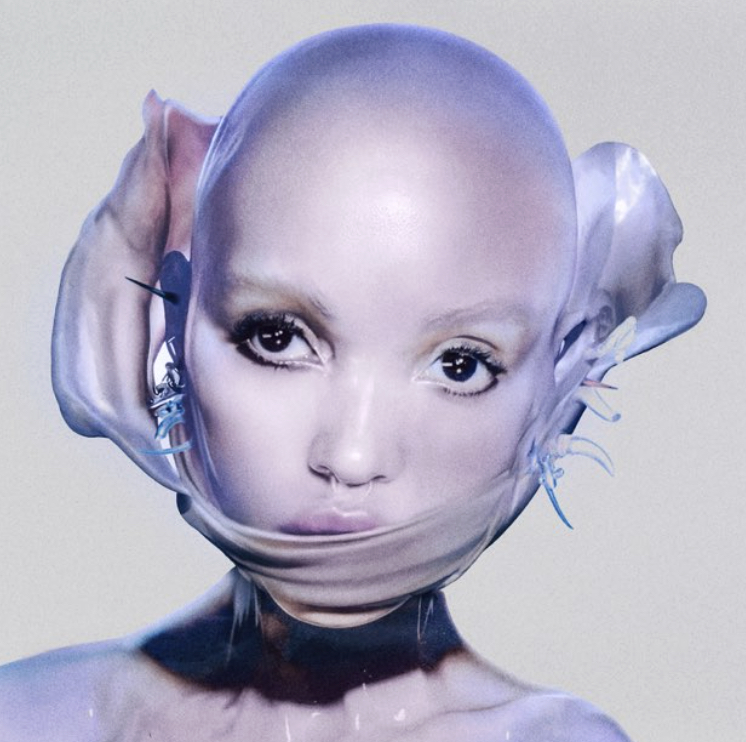
There are few musicians with the ability to release two albums in the span of a year (Taylor Swift having once shown such prowess in 2020 with the one-two punch release of folklore and evermore). This isn’t only because most artists struggle to “churn it out” like that, but also because there isn’t necessarily the “demand” for such a glut of music, with most record companies relishing the chance to draw out the marketing and merchandising potential of one album cycle at a time, milking it for as long as possible. Of course, they love when a musician is prolific in the “one album a year” sense (as Rihanna was once prone to adhering to), but the twice a year cycle has been all but unheard of since the early days of The Beatles.
Thus, for FKA Twigs to emerge as the “out of left field” artist to accomplish such a feat in 2025 is worth applauding. Of course, there are those who might snarkily say she could have just merged the eleven songs that appear on Eusexua Afterglow with the eleven on Eusexua, but it wouldn’t have worked as effectively. For the very concept of Afterglow symbolizing the portion of one’s night out when it gives way to the early hours of the morning is part of what sets these albums up as “companion pieces.” They’re not the same, but rather, in the same universe. Twigs makes that immediately clear with the opening track, “Love Crimes.” For while it might sound sweet and siren-y in the same way that “Eusexua” does for the majority of that song, “Love Crimes” quickly segues into what amounts to a “violent paroxysm” around the fourteen-second mark as Twigs, declares (over and over), “You don’t understand/I had to let you go.” The thunderous rhythm, co-produced by Twigs, Manni Dee, RougeHotel and Hezen, finds FKA speaking to the times we live in with her casual explanation for callousness being, “Hard times/Call for love crimes/You might be the one/But now I’m done.”
So it is that, with this simple verse, Twigs acknowledges how disposably most people treat others when it comes to would-be romantic affairs. Especially at the club, where every body is just that—a body. Ideally, to rub up against (“That body flexible/Intellectual”) and maybe kiss (“Kissing so sensual”), but beyond that, what purpose can they serve? There’s another moment in the song where it almost feels as though Twigs is deliberately referencing a time in club culture when it was very dangerous to have sex with a stranger due to the AIDS epidemic. That line being, “Your body’s a deathtrap/Precious like a teardrop.” This is, in part, what makes the song feel as though it does belong to another time. A time when one actually could feel free and uninhibited on the dance floor without fear of being photographed or filmed (though instead, there was a fear of death by sex with a stranger). By the end of “Love Crimes,” Twigs is speaking as though she’s a succubus who suddenly gained a heart and a conscience as she laments, “My heart keeps falling/Harder than before/The best ones are the hardest to let go.”
The tenor of the album shifts with “Slushy,” which has a more laid-back, chilled out sound as Twigs serenely describes (in her drugged/blissed out lilt), “The bluest sky/The deepest night/A slushy/The perfect home/A sweet goodbye/A lover’s eyes, ooh/A honeycomb/A bowl of rice/A shoulder/To rest upon/Accoutrements/Someone to phone.” The almost “glitchy” sound of it changes around the one-minute-ten-second mark, when Twigs begins to speak in her, let’s say, more “alert” voice, noting, “Things that make me smile/When my world falls down/Download them from my memory/Running ‘round the city with my girls feeling fine/Drop-top down, acting twenty-three/Wondering who I am/If I can/And who I wanna be.” And who she still wants to be, with the sound of this record, is Madonna on Ray of Light—for that sonic motif is all over “Slushy.” Even in terms of the imagery and “positive vibes” she’s trying to put out with a verse like, “I’m gonna make today heavenly/I’ll make believe till it’s right/I’ma create some harmony/And paint my world with my mind.”
The music of “Slushy” slows down in a warped way (think: that moment in Britney Spears’ “[You Drive Me] Crazy” after she screams, “Stop!”) as it leads seamlessly into “Wild and Alone” featuring PinkPantheress. And yes, talking of Madonna, two of her key collaborators are present on this song, with Rick Nowels serving as a co-writer (he also co-wrote three songs on Ray of Light) and Stuart Price as a co-producer (he also co-produced most of Confessions on a Dance Floor, and was “retapped” by Madonna to co-produce a “sequel album” to it that will be released in 2026). And yes, there is a distinct Ray of Light connection here in that it’s Twigs’ version, thematically speaking, of “Drowned World/Substitute for Love.” Describing the loneliness of fame, Twigs opens the track with vocals that sound as though they would be right at home on Caprisongs, setting the scene, “Wild and alone/‘Cause everybody’s reaching for you/Wild and alone/‘Cause nobody cares/Wild and alone/‘Cause everybody’s reaching/Wild and alone/‘Cause nobody dares.” PinkPantheress then joins in for the chorus that is complimentary in a way that suits both star and potential has-been as they sing, “You’re a star/You’re a waterfall/Shining your light on everybody/But if you gave it up, it all/I’d love you if you were nobody.” A likely story.
In another standout lyrical moment, the two sing, “I think being famous is funny/Told me, ‘I hate your life and I hate all your money.’” This line, for once, seeming to consider the perspective of the “civilians” who are forced into the spotlight as a result of getting close to someone famous. But Twigs and PinkPantheress assure, “One flame giving to another never lost no light/I’ll keep you warm/I’ll do you right, baby.” Addressing two sides of the “wild and alone” coin (on one side, the famous version; on the other, the anonymous), Twigs tells her would-be civilian suitor, “I would love for your gaze to meet with mine/But you’re wild and alone.” Just as she is, but in an entirely different, less “low-key” kind of way. So it is that this song feels like it should have been on the Notting Hill Soundtrack (or played at Lana Del Rey’s wedding to a “civvy”).
Unlike the following track, the suggestively titled “Hard” (stylized as “HARD”). Although it’s a “love jam,” the tempo doesn’t exactly slow down. However, for about the first seventeen seconds, Twigs briefly tricks her listener into believing this is going to be, musical tenor-wise, some Janet Jackson-esque number in the spirt of “That’s the Way Love Goes.” And just when they think it is, the music pulses forth, increasing its pace in time for Twigs to give the intro, “Wet thighs, I’m ecstatic/Chemistry was automatic/Don’t touch, there’s no rush/I gotta know something about you.” This desire for delayed gratification is already in contrast to the world presented in “Love Crimes.” But then, Twigs pivots back to a sweaty, horny dance floor mindset with a question like, “Just tell me, would you do it hard?/Wham! Bam!/I think we can/A victim of your touch/Baby, it’s you/Play my Double-Dutch/Do it right or do it without you.” So yes, even if the sound is no longer “Janet,” the R&B sex mixtape lyrics certainly are. The freneticism of the backing track matches the push-and-pull energy of Twigs’ “gagging for it”-meets-“please take it slow” energy. This contrast evident in a verse like, “Take me hard/Would you do it if I didn’t ask you?/Would you give me your love totally?”
Essentially fulfilling every man’s fantasy, at another point, Twigs is sure to add, “I’m the kinda girl that is so physically free.” With such a sentiment in mind, there is a tongue-in-cheekness to her placing “Cheap Hotel” right after this. Having served as the first single from Afterglow, it established the broader theme of the record, which as Twigs so succinctly put it, is as follows: “AFTERGLOW is a broken mirror at five a.m. AFTERGLOW is the chaos in perfection. AFTERGLOW is daring to begin again.” In other words, Afterglow is an album for people who want to keep partying long after the club has closed (We’ll go all night/I don’t wanna go home”), going so far as to pay for a cheap hotel in order to house the unofficial after-after-after-after-party. In this regard, Twigs might just have Charli XCX beat in terms of being crowned with the moniker of “365 party girl” (though perhaps Twigs would instead be content with the synonymous nickname of a “24/7 party girl”).
The dreamy, ambient sounds continue on “Touch a Girl,” which works as half-excoriation, half-love letter. It’s the former aspect that shines through when Twigs chides, “You’re so clever/But you still don’t know/How to touch a girl/Physically/Compatible/Emotionally/Detestable/Ask a question/And maybe you’ll know/How to really touch a girl.” And yet, elsewhere, she offers such compliments as, “Fix your gaze on my face/You’re the only one I ever wanna look at anyway” and “Did I tell you that you’re pretty when you smile? [a comment Lana Del Rey’s “Pretty When You Cry” incarnation wouldn’t care for]/Did I tell you that my mama kinda liked you?” In another lyrical nod to “Childlike Things” from Eusexua (in the sense that Twigs could still recall that she had that song in her mind since she was about twelve years old, remaining in touch with the child version of herself to finish it as an adult), she urges, “Be yourself/Be the one the child in you would like/Maybe then, maybe, you maybe just might/Really touch a girl.”
Whether that girl is an unpredictable or “Predictable Girl,” as the next song is titled. And this time, Twigs seems more content to chastise herself rather than someone else, for the lyrics read like an internal monologue of casual self-loathing with such verses as, “Predictable girl, you’ve done it again/You followed your heart then got lost in your head/Predictable girl, you took it too far/You made up a world, then got fucked in the ass/No, I’m not in love, no, I’m not in love.” The unspoken line to follow that being what 10cc once said: “It’s just a silly phase I’m going through.”
With “Predictable Girl” sounding grittier and grimier than the previous tracks, that same level of grit and grime continues on “Sushi,” which opens with a dance floor-ready beat as Twigs announces, “Baby, I’m here in your city [an announcement that recalls the meme of the little blonde girl with a ‘what the fuck’ expression on her face and the caption, ‘Okay, have fun’], I’m/Hitting you up for a good, good time/Just like a movie, a 90s vibe/Here for a week, let’s pretend you’re mine [which sounds not unlike the premise of Splash]/Don’t wanna make it all ‘bout sex/But I like to do that sometimes/Could be forever or just a night/Doin’ whatever, we’re adults, right?” Twigs’ “romancing” mood only intensifies as the song goes on, with her suggestion of potential activities getting so detailed that she recites during the chorus, “Sushi on Monday/Dancing on Tuesday/Karaoke Wednеsday/I wanna take you out/Paris on Thursday/Do you like pilates?/Work you out on Friday/I wanna take you out.” In short, she’s playing the masc role in a way that every cliché woman wishes a man would act.
At the three-minute-forty-six-second mark, the signature sample from Tronco Traxx’s (a.k.a. Robbie Tronco) 1996 club hit/drag queen anthem, “Walk 4 Me,” is wielded before the song takes another sonic turn that, at one point, allows Twigs the opportunity to mention that, of all things, “Gasolina” by Daddy Yankee is her karaoke song (on a related note to sampling, there are also elements of her own 2015 single, “Glass & Patron,” thrown into the mix, in part because she commands during that song [with a video that, for further tie-in cachet, features Ballroom posing in a woods setting], “Hold that pose for me”). She then offers some more drag suggestiveness when she says, “Sushi/Got me feelin’ fish tonight.”
At the four-minute-forty-eight-second mark (for this is one long-ass odyssey of a track) there’s a Big Freedia on “Break My Soul” sound when another voice chimes in, “I’m gonna, gonna, gonna take you out” in a manner that somehow comes across as being ominous rather than romantique. Which surely must be why Twigs then turns it into a call and response track by answering that assertion with, “You’re never gonna take me out.” Because if anyone is going to do the “taking out,” it’s Twigs—“butch bitch” that she is, and who will render every bloke of hers as a “Piece of Mine.”
This title has a dual meaning in the sense that, on the one hand, she’s referring to a man (or woman, knowing Twigs’ fluidity) as a piece…as in, of ass. On the other, she’s talking in a less sexual way about how this person is like a piece of her soul, a piece of herself. Of course, that doesn’t really come across in “objectifying” lyrics like, “Lay back/And recline/You’re the one I want, yeh/You’re a piece of mine.” Twigs also lays the innuendo on thick when she coos, “Follow the high/‘Cause it’s a long ride, baby” and “We got no choice but to be honest/On the ride of our lives.” Elsewhere, she’s far less subtle as she, er, gushes, “Taking it from the club to your living room now/Making out nice/You’re the right size/I didn’t wanna say/Till you got inside.” Yes, such salacious lyrics are definitely giving Janet Jackson a run for her money. What’s more, the theme of Afterglow is strongly present here in terms of Twigs talking about going to a “second space” once the club can no longer provide what they need (namely, a “place to be”—and this most likely because it’s closing).
The mid-tempo, slow burn sound of “Piece of Mine” segues into the ethereal, slightly saddened vibe of “Lost All My Friends,” a lamentation about, what else, losing sight of one’s friends inside the club (likely after each went after their own various drug- and dick-related pursuits). Commencing with an allusion, perhaps, to her “alien” appearance on the album cover, Twigs recounts, “When I was on Earth/I was spinning.” At the same time, it’s a clear reference to how she’s so far gone mentally (whether from a “natural” or drug-induced high). That much is further emphasized when she admits, “I don’t even remember who you are/You are/You are.” Indeed, this is largely the extent of the lyrics, with Twigs relying more on the atmospheric sound (at times channeling the Pure Moods compilation) of the track, co-produced by Bapari, Manni Dee, Jonny Leslie and Mechatok. Even if one would have expected Danny L Harle to be among the co-producers, for it has his sonic stamp all over it, he is instead one of the co-writers, along with Arielle Baptiste, Manni Dee and Twigs herself.
A seamless transition into “Stereo Boy”—the affecting finale of the alum—then picks up the pace of Afterglow yet again, with Twigs altering the pitch of her voice almost as if to sound like she’s performing on a very specific breed of 90s song. Someone who would be right at home on a Massive Attack record. But while the tempo is slightly more “upbeat” in relation to “Lost All My Friends,” it’s still an elegy for a relationship with a man that Twigs knows can never give her what she needs, likening him to a “stereo boy” because, “I heard the static in your heart,” later adding, “I changed the station, but my pain, it still remained/‘Cause you’re just a stereo boy/Stereo boy.” In a certain regard, it bears a connection to The Shangri-Las’ “Leader of the Pack” in that, like Mary Weiss ruing that she’s fallen for a bad boy (though her concern about it is mainly what her parents and friends think), she still can’t help but let it happen, surrendering to the pleasure—and the pain.
For Twigs, that feeling is made all the worse by the fact that she’s well aware there’s no real future between her and this bloke, acknowledging, “You want just what you said/A fast life and an empty head/I tried to catch a ride/Doors open, suicide/Look at me/I’ll let you drive mе off the edge.” Much as the listener of Afterglow will let Twigs drive them off the edge, as she let the creation of both “sister” albums do the same to her—in the best possible way. As she phrased it, “The DNA of the firstborn should relinquish some control to the second. You are sisters now and you will continue to grow together, I will raise you that way.” And while Afterglow was originally rumored to be “just” a deluxe (as the release of deluxe albums has grown ever more common), Twigs corrected that assumption in the month leading up to Afterglow’s release by saying, “I am full and abundant and ready to give birth. Her name is Afterglow, and my labor shall commence next month.” Funnily enough, likening the creation of art to childbirth among women who haven’t had children seems to be a common thing (and, incidentally, the opening scene in the abovementioned “Glass & Patron” video features Twigs with a pregnant belly). As fellow 365 party girl Charli XCX reminded by mentioning that analogy in her first Substack post, commenting of her experience with Brat,
“I find when there’s such an influx of joy and passion and vitality in creating an album (the songs, the visual language, the packaging, the live show, the performance of the whole thing) there is naturally a feeling of emptiness that follows once it’s out in the world. Perhaps the giving birth analogy applies but I’ve never done that so I wouldn’t really know. In my mind you get pregnant, you grow the baby, you carry the baby, you give birth to the baby, people want to meet the baby and then you have to spend your time keeping the baby alive and caring for it eternally. But what if birthing the baby in part makes you lose your uniquely intimate connection to it and therefore changes your purpose slightly? What if you don’t want your entire life to be about one damn baby? Obviously to most people a baby is not the same as an album, but to me it kind of is.”
The same goes for Twigs, with Afterglow being the latest child to bask in the, well, glow. Of the spotlight. Or maybe “disco ball light” is perhaps the better phrase in this instance. At the beginning of “Piece Of Mine,” a warped voice remarks, “What is this glitch?/But then you like it, so you do it again.” In a sense, that statement can be made of Eusexua and Afterglow, with Twigs opting to “do it again” right after Eusexua, creating a glitch in the matrix of pop culture by “daring” (as a non-Taylor Swift) to break the “tradition” of only releasing one album a year, at the most. And perhaps more musicians should take a page from this form of prolificness. When it is clearly done in service of the art rather than an obsession with putting out “more” for the sake of offering additional merchandise and album variants.


[…] FKA Twigs Would Like to Remind That She, Too, is a 365 Party Girl with Eusexua Afterglow […]
[…] FKA Twigs Would Like to Remind That She, Too, is a 365 Party Girl with Eusexua Afterglow […]
[…] FKA Twigs even went so far as to release an entire “companion” album to Eusexua, called Eusexua Afterglow, to bookend the year with more of her new music as well. The point being, JADE is very much […]
[…] with the tracklist of the first record she released in 2025, Eusexua. However, after “birthing” Eusexua Afterglow into the world, Twigs apparently got into some kind of additional “fuck it”/“why not?” mood […]