


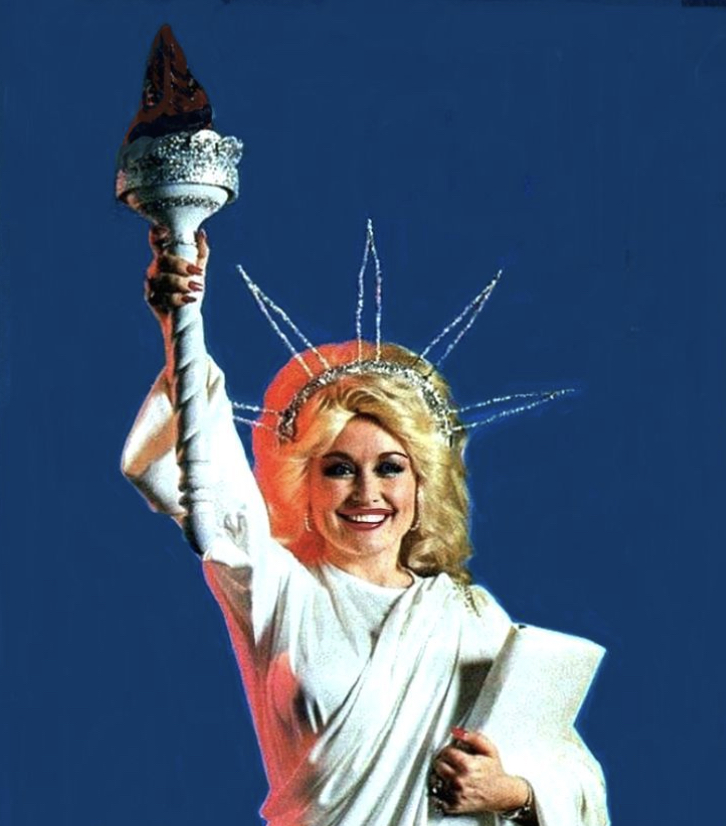
Perhaps because she’s been a fixture in pop culture for so long, it seems unfathomable that Dolly Parton could really be gone. This despite the signs of Parton’s health issues starting in September of 2025, when she was scheduled to make an appearance at Dollywood, but couldn’t attend due to a kidney stone infection. The signs of Parton being “felled” by her own ill health then continued when, shortly after, she also postponed her six-night Dolly: Live in Vegas show at the Colosseum at Caesars Palace. At the time, Parton admitted, “I have been dealing with some health challenges,” adding, “Don’t worry about me quittin’ the business because God hasn’t said anything about stopping yet. But, I believe He is telling me to slow down right now so I can be ready for more big adventures with all of you.”
And for about another year, she continued—endured. Not necessarily having “big adventures” with her public, but still being a beacon of light in a generally dark world. A world that even Parton must have had to acknowledge (if only privately) was darker. If not at the global level, then at least on a personal one. For when her husband, Carl Dean, died on March 3, 2025 (thereby narrowly missing the milestone of their sixtieth anniversary on May 30), it seemed obvious that even Parton wasn’t immune to becoming one of those cases of someone dying soon after their beloved does. She and Carl had that kind of love. Just as the world had that kind of love for Parton herself. Indeed, it was Courtney Love, of all people, that phrased it best in regard to what Parton meant to so many—and Americans in particular—when she said in a tribute post, “The greatest American. The one we could all agree on. Neither dumb nor blonde. And the reason I can read [a symbolic reference to Parton’s international book gifting program, Imagination Library]. Dolly you are our national saint and the best of all of us.”
And it’s true. There are few Americans that such a thing can be said of. But Parton very much represented a certain ideal of what it once meant to be American. Not just in the sense that someone can come from nothing and become what Parton did, but because she represented what it meant to raise others up when you yourself managed to. Even when she had absolutely no “need” to do something like that for younger artists such as, most recently, Sabrina Carpenter, with whom she appeared on a rendition of 2024’s “Please Please Please.”
Miley Cyrus, who never made any secret about Parton being her godmother (frequently getting her to collaborate in some form or another), summed up Parton’s enduring appeal in this regard in a 2025 Apple Music interview with Zane Lowe, telling him, “Anyone I’ve spoken to that stayed relevant for like fifty years in their career… [is] on it in a way that Dolly Parton is on it. Dolly sees Sabrina Carpenter and goes, ‘She’s blonde and wearing high heels. Get her over here. I want to be on the song.” In other words, Parton was never a snob about being a legend. She knew, much like Madonna (a fellow Carpenter collaborator) knows, that in order to keep her music moving from one generation to the next, it isn’t just about making new songs, but disseminating them through a more “current” artist. The same thing happened in 1992 when Whitney Houston covered “I Will Always Love You” and arguably made it the more famous version of the song.
Yet Parton saw an opportunity for a new audience to become acquainted with the work, especially since, before she was a singer, she was a songwriter, and it was always important that the words themselves were honored, making it less about “the originator” who sang them. And when Parton heard Houston’s version, she described herself as being “wrecked” over the delivery. Houston, in her own recounting, stated that when Parton called to congratulate her on the single’s success, she said, “‘Whitney, I just want to tell you something. I’m just so honored that you did my song. I just don’t know what to tell you, girl.’ I said, ‘Well, Dolly, you wrote a beautiful song.’ And she said, ‘Yeah, but it never did that well for me. It did well for you because you put all that stuff into it.”
Just as Parton put “all that stuff” into her passion for helping others, far beyond the pop star community. Because, again, this was an ideal of the American spirit, often not very accurate—especially as the country became the epicenter of “capitalism on steroids.” But while Parton certainly enjoyed the financial benefits of her success, she never forgot where she came from or what it meant to be someone who was vulnerable due to their circumstances of birth. That much was evidenced through the Dollywood Foundation, which she started in 1988. Indeed, she blazed a trail when it came to “pop” (/country) stars founding philanthropic organizations, which is now practically the norm (see also: Lady Gaga’s Born This Way Foundation and Olivia Rodrigo’s Fund 4 Good).
Under the umbrella of the Dollywood Foundation, many philanthropic initiatives took shape. Including the Imagination Library, the Dolly Parton Scholarship, the My People Fund and, as everyone well remembers, donating upwards of a million dollars to the cause of researching and developing a vaccine for Covid-19. To say Parton was a “do-gooder” would be an understatement. It was more than that. She genuinely cared about other people and saw the world as a collective—hence, her “we’re all in this together” approach to life. Not an individualistic one that many people tend to adopt once they become wealthy (and even if they never do). A sentiment and philosophy that, ironically enough, goes entirely against how American culture is set up to function. Which is part of why it’s strange, in many ways, that she’s the great unifier in American culture. The one thing, as Courtney Love stated, that everyone can agree on.
As if to accent that point, even the Orange One and the Democratic Socialists of America could agree that Parton was a national treasure, with the former posting, “There has never been anyone like her, and never will. In her honor, I am lowering the American flag throughout the United States for a one week period… Rest in peace, Dolly!” The latter instead posted, “Democratic Socialists of America extends our deepest condolences to the family, friends and fans of Dolly Parton, a hero of the working class and an inspiration to us all.” In the United States, particularly in this epoch, it truly doesn’t get more unifying than that.
In a bittersweet turn of events, one of the last things that Parton publicly said was, “You know me… I’ve dreamed myself into a corner and I still have so many things I want to achieve, so I’m gonna keep on working as long as I can to see everything come to life.” While she might not have gotten to keep working (“9 to 5” or otherwise) as long as she would have liked, there’s no denying that all the work she did put in while she could is going to leave a lasting legacy. Hopefully one that reminds at least some Americans what they as a collective are capable of when kindness and tolerance are the norms—not the total opposite.


