


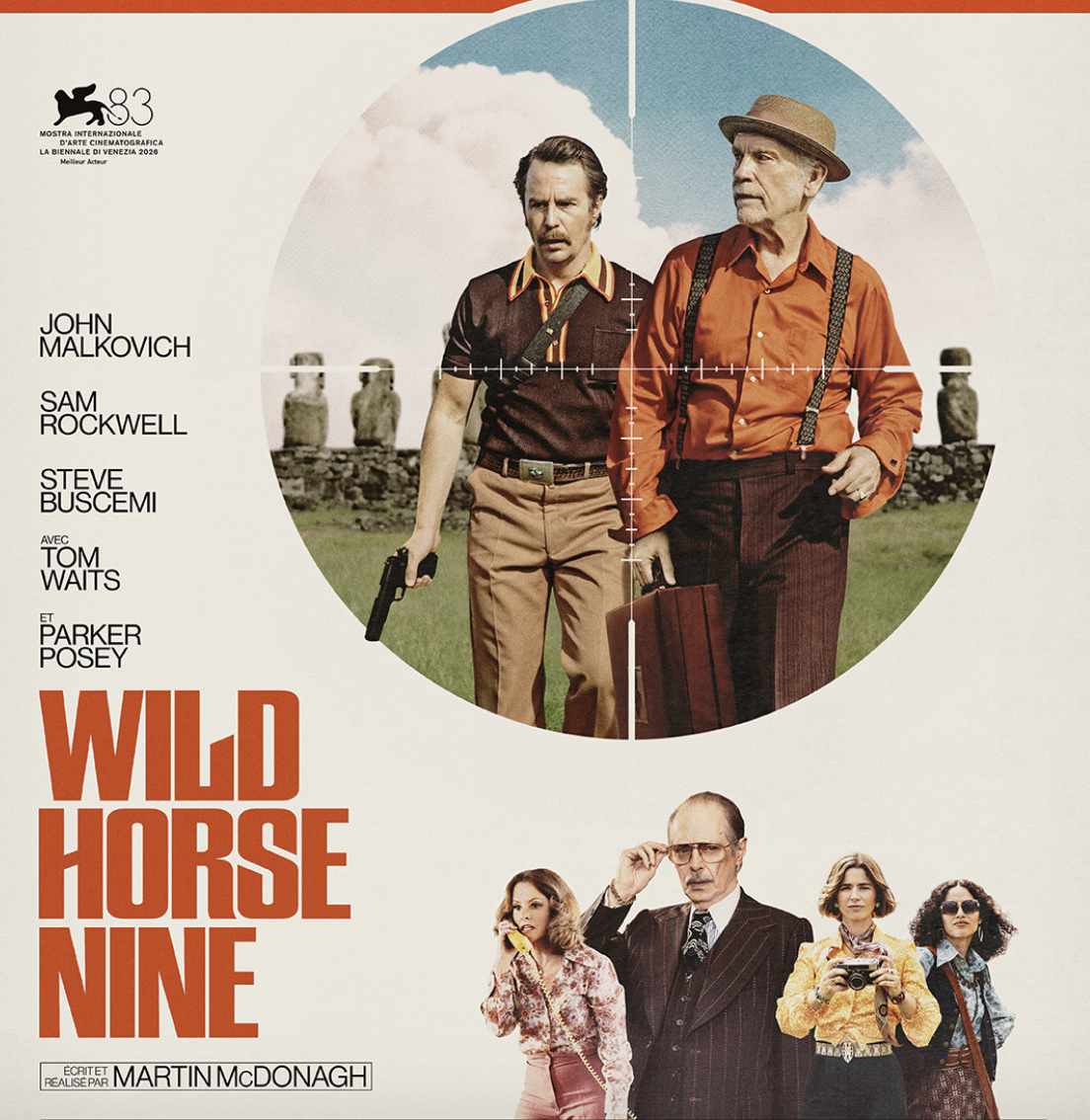
In what has become something of a tradition for Martin McDonagh, Wild Horse Nine follows the unlikely friendship of two men. This time, a veteran CIA agent named Chris Carlisle (John Malkovich) and his partner in “destabilizing democracy,” Lee Chesterfield (Sam Rockwell, McDonagh’s “muse,” of sorts). And it’s an unlikely friendship in the sense that these two men wouldn’t forge such a strong bond in any other circumstance. Nor would a man suffering from dementia be quite such a liability in any other circumstance as high stakes as working for the CIA—and as one of their most valuable “hit men,” no less.
In fact, Chris’ most notorious hit (at least to those in the know) is the assassination of John F. Kennedy in 1963. An event that altered the entire course of history, as Wild Horse Nine emphasizes by setting its tale ten years later, with Chris and Lee’s recently completed mission in Santiago, Chile, where they’ve laid the groundwork for the military overthrow of Salvador Allende, deemed as the first Marxist to ever be elected by a democracy. Needless to say, a Richard Nixon-run American government at that time would be quite keen to eliminate such a “threat” to their Republican capitalist existence. For the last thing the United States government and big business would want is for the world to see socialism working effectively and non-dictatorially. Which is what would have happened if Allende had lived. Instead, on September 11 (that apparently always ominous date), 1973, the military moved in on Allende and his elected government. Allende took his own life by shotgun in the Palacio de La Moneda amidst the attacking of tanks and military planes dropping bombs. All paving the way for General Augusto Pinochet’s junta government, which would last almost a full seventeen years before a transition back to a so-called democracy in 1990.
But before all of this goes down, Chris and Lee have a date with Easter Island (about a five-hour-forty-minute flight in today’s world, but perhaps a bit longer in 1973), preferring to watch “the fruit” of their nefarious labors sprout from afar—and also Chris is waiting for his cancer to take complete hold and kill him (that is, if Lee doesn’t honor a request he forgot he even made: to shoot him in the head). Besides, Easter Island is still Chilean territory. Granted, there’s more to it than that, with the real purpose of their trip being that Chris wants to go somewhere “ceremonial,” let’s say, to “expire.” And what could add more ceremony to one’s death than being surrounded by moai a.k.a. “big heads,” as Chris and Lee keep calling them. Much to the dismay of two students, Monica (Mariana di Girolamo) and Alicia (Ailín Salas), that are waiting at the airport to take the same flight to what Alicia reminds them is called Rapa Nui. An early sign of “wokeness” that triggers Chris (no gun pun intended) as he simperingly mocks her correction. Later, when he and Lee are dining at a restaurant on the island, it’s the latter who steps up the defense of being politically incorrect by telling a British couple who informs them that the statues are known as moai that he and Lee will call the heads whatever the fuck they want.
Apart from being an invective written for comedic value, it’s one that also speaks to just how imperialist/colonialist American thinking is (and no, not just at the CIA level). The bravado of a country that not only swoops in and meddles in the affairs of others, but can’t even leave well enough alone when it comes to theirs. Hence, the longstanding “conspiracy” theory that the CIA took out its own “big head” of state when they and other high-ranking organizations/officials started to dislike Kennedy’s policies—both foreign and domestic—a little too much. For they were the kind of policies that, in McDonagh’s (and many others’) imagination, wouldn’t have allowed the CIA to take out socialist governments all over the world at such a steady clip. Thus, as Chris’ brother, Jim (Tom Waits), reminds him when Chris calls him after ten years of not talking (which distinctly coincides with the time he shot Kennedy), the world went to shit after JFK died. Chris, in turn, reminds his brother that the world was already shit, it’s just that no one (Americans at least) seemed to yet notice. A sentiment that also feels resonant when applied to the election of the Orange Creature—twice—and many Americans being “shocked” about it. As if they didn’t already know that was the world they lived in.
It’s the kind of naïveté that Monica (far more than Alicia—which will turn out to be telling) keeps radiating every time she has the misfortune of running into Chris on the island. First at the restaurant, then in front of the Ahu Vai Ure platform at the Tahai Ceremonial Complex, then at the beach. It’s there that he happens to find her without Alicia, deciding, against Lee’s advisement, to approach her and try to apologize. For, in some sense, he sees Monica as the embodiment of hope—something he’s lost not only because he’s dying of cancer, but because he’s seen up close and personal how society truly functions. Hell, he is the inner workings of how it truly functions. And, for some reason, he homes in on Monica in a way that might seem, to her (and the viewer) as “bullying,” but really, is a form of wanting to “wake her up” the way he wishes he could wake up the entire population that keeps chewing their cud. So it is that he’ll end up making her cry with his bluntness, his unbridled honesty. And, talking of “unbridled,” Wild Horse Nine as a title might read as McDonagh’s most “arcane” yet (in addition to being his third movie with a number in the title), but it makes sense as the story unfolds and one sees that Chris is staying in Room 9 at the hotel and is a “wild horse” himself among the actual wild horses he sees and makes friends with on the island. Though it’s one in particular he takes a shine to (for those who have seen The Banshees of Inisherin, it’s no secret that McDonagh isn’t kind when it comes to the fate of a beloved animal in his scripts).
While shots of the roving horses provide a rare glimpse of the island (in fact, the last movie filmed there, Rapa-Nui, was in 1994), in McDonagh’s bid to “expand” the universe of the script beyond the island now and then, he includes some scene-stealing phone conversations that allow him to intercut between the island and Lee’s wife, Marge (Parker Posey), in Utah and Chris’ brother in Monument Valley. Scene-stealing moments from Steve Buscemi in the role of MJ, their CIA bureau chief, also contribute to the dynamism—the crackle—of the film. Buscemi even has a line that, in another writer and actor’s hands, might sound more like Lloyd Bridges as Steve McCroskey in Airplane! saying, “I picked the wrong week to quit sniffing glue.” In MJ’s case, he doesn’t bother ever quitting heroin, telling Lee that everything about life is sad and that’s why he has to take so much.
It’s the kind of declaration that could lead certain viewers to brand this as McDonagh’s most cynical film. But the truth is, it might just be his most unvarnished. Especially on the political front. To that point, McDonagh told Seth Meyers during their interview that he first learned about the Chilean coup d’état in his teens when he heard The Clash song, “Washington Bullets.” With lyrics like, “Remember Allende and the days before/Before they came/Please remember Victor Jara/In the Santiago stadium,” McDonagh became fascinated with this subject, clearly letting it percolate over the years until it converged with a visit to Easter Island fifteen years ago. Indeed, the script itself didn’t come together for him until incorporating this Chile/CIA plot element.
And, in contrast to a “pessimistic” (read: too much reality) film like Digger, McDonagh at least has the decency to instruct his viewers on how to avoid/mitigate the inevitable fallout of this commitment to capitalism: kill men in uniform (i.e., the fascists, who now wear tailored suits as well), live free and wild at all costs and, barring those two things, never die with a gun pointed at your back. Instead, at least face your back to the ocean while the gun is pointed at you from the front. Because, alas, they shoot wild horses, don’t they?


+ There are no comments
Add yours