


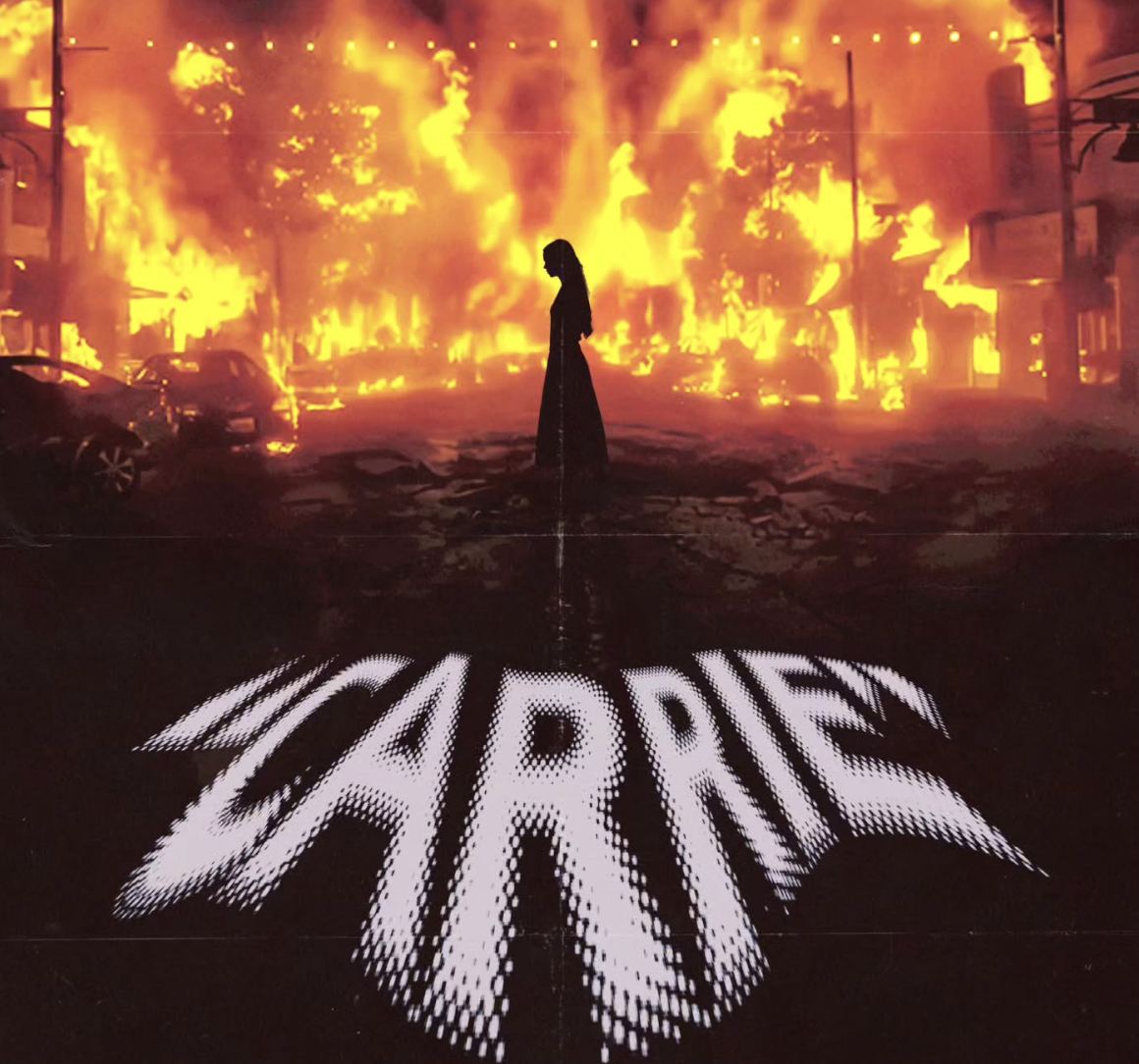
By now, viewers have been conditioned to understand that, whenever Mike Flanagan is behind an adaptation, remake or reboot, the final result is going to be epic (and yes, of course, horrifying). Considering how untouchable Brian De Palma’s 1976 film adaptation of Stephen King’s debut novel, Carrie, has remained, Flanagan had his work cut out for him when it came to not only holding a candle to the original, but also making the character and narrative feel both fresh and relevant to a post-internet/post-social media audience. Luckily for Flanagan, however, bullying and ostracism is evidently timeless—even for all the associations that Gen Z has with being “woke,” therefore “respectful” of others who might stand out more than usual for being “different.”
And what’s most different of all about Carietta “Carrie” White (Summer H. Howell) in her latest iteration is the fact that, like Kimmy Schmidt (Ellie Kemper), she’s essentially been living as a “bunker girl” her entire life. This thanks to her doomer/conspiracy theorist father, Ralph White (Tahmoh Penikett), who gets far more play in this iteration of the tale. In fact, Carrie’s fate of being ridiculed and mercilessly taunted is ultimately determined by Ralph’s unexpected death at a construction site within the first five minutes, when three pallets of piled-high cement blocks fall onto him while he’s fiddling around in a large ditch on the construction site with safety earmuffs that prevent him from hearing the ominous rumbling and shifting of gravel behind him. The immediate question after Ralph’s death is: “Did Mr. White ever mention anyone to you? A boyfriend, girlfriend? Someone’s gotta claim the body.”
Well, not willingly. For after his death, when the police go to Ralph’s house to investigate what clues they might find there about who could claim his body, Margaret (Samantha Sloyan) and Carrie hide away (at her mother’s behest, naturally) in the closet so that they can keep living off the grid as Ralph would have wanted them to. Unfortunately, all government officials have a nose for anyone trying to escape their clutches and, accordingly, end up “sniffing them out.” So it is that Margaret is forced to get a “real” job and Carrie to go to a “real” school. And, after that moment of the pair “being discovered,” Flanagan opts to, in some sense, pay homage to how Stephen King’s book is structured (incorporating newspaper clippings and excerpts from studies on “the White case,” mostly from a book called The Shadow Exploded) by featuring interviews with students that are ostensibly being conducted for a documentary about what happened at the Ewen High School prom.
From what the interviewer, Adelaide (Kate Siegel), gathers, everyone has a different take on Carrie—not unlike that scene in Mean Girls where everyone has something different to say about Regina George (Rachel McAdams). Though, in that case, it’s mostly negative. There are far more positive things said about Carrie in the opening sequence, with Sue Snell (Siena Agudong) commenting simply, “She was my friend.” Alas, Sue, despite her best efforts, didn’t help her “friend” feel slightly less ostracized before it was too late. Before her telekinetic powers were activated for outright “evil.” Though, of course, rightful Carrie defenders would argue that she was pushed to her limit, her breaking point, when it came to “taking the knocks” she had endured for the entirety of her schooling experience. Which, in Flanagan’s version, hasn’t even lasted a full year (whereas, in the book, Carrie has gone to school like everyone else starting from the normal age). A grueling social reckoning for Carrie made all the worse by the fact that she’s been trapped inside her own house for most of her life. Never exposed to the cruelty outside of it (though, to be sure, she suffered from another form of it inside the house as well).
The pureness of Carrie’s soul—her very essence—can only come from not being subjected to humanity. Indeed, her social worker, Nancy Piper (Crystal Balint), describes her as “stunningly uninformed” (after also mentioning the infamous Turpin case in Perris, California). Something that could only happen “in this day and age” if she was, for all intents and purposes, placed “on lockdown” by her parents. Which she was—with not even so much as a birth certificate to let the state know of her existence. As a “ghost” like that, her parents were able to raise her however they wanted. That is to say, without the intervention or “influence” of state-mandated institutions. Namely, The School. But, perhaps even more to the point, social media and the internet.
Indeed, one of the primary reasons that Flanagan sought to update Carrie (which was presented to him rather than him initially wanting to do it) was because of how much high school has changed since his generation was dealing with “analog” bullying. And how, as he points out in an interview called 20 Minutes with Mike Flanagan, his own son was about to enter high school, making him extremely concerned for the social media-related dangers and risks that go hand in hand with that. Not least of which is a new form of bullying that “70s-era” Carrie White would have never even fathomed. Least of all Christine “Chris” Hargensen (Alison Thornton) starting a fake account from Instagram (which, by the way, is very Gossip Girl reboot) with the handle CarrieRed_. The nickname that Carrie is given by none other than Sue after her infamous “plug it up” kerfuffle that kicks off both the book and De Palma film adaptation of it (the latter finding a way to be super porn-y during the lead-up to it). Chris, glomming onto what Sue said as a “one-off” “witticism,” turns the name and the account associated with it into a synonym for bullying and carnage.
Yet, by the same token, Flanagan wanted to be certain that Chris would get more nuanced character development and background with this adaptation so that she would be empathized with in her own way by the viewer. This “empathy,” of sorts, assisted in part by John Hargensen (Michael Trucco), Chris’ father, who is presented even more prominently as an underhanded and generally douchey “role model” for Chris than he was in any previous versions of Carrie. So yes, with a dad like that and a mother (played by Heather Graham) who opts to abandon both of them in favor of a more wholesome family, how could Chris not turn out to be such an asshole?
And in her modernized bully form (which Flanagan helped bring to life by letting actual high school students participate in the writers room), Chris can unleash that “superpower” in even more far-reaching ways because of social media. Which is why Flanagan commented of the fundamental difference between 1970s Carrie and 2020s Carrie, “…at their most vulnerable and critical kind of time of their life, all of their torments, all of their mistakes can be enshrined digitally forever in full view of the entire world.” A kind of pressure that no previous generation had ever known or been forced to contend with. Thus, Flanagan was compelled to “take apart” King and De Palma’s versions and use “all of its little pieces… to build something new.”
The result? A reimagined Carrie White that has risen from the ashes of the old one to give voice and resonance to those who suffer in entirely different (and perhaps even crueler) ways in the post-social media twenty-first century. Complete with Lana Del Rey (via “Did You Know That There’s a Tunnel Under Ocean Blvd”) to soundtrack some of that brutality. But if Carrie were to ask, like Lana, “When’s it gonna be my turn?” her answer would come in the form of the ultimate vengeance she still gets to take on her fellow classmates in 2026. For, no matter what decade, there is no Carrie without a violent prom. Though, soon enough, maybe even prom will be too “irrelevant” to include in yet another eventual reworking of the source material. Until then, a season two of Carrie will have to suffice.


+ There are no comments
Add yours