


Keeping the visuals and singles from Bass Persuades coming, Miley Cyrus has reveled in the announcement of her album topping the Billboard 200 charts by releasing the Mert Alas-directed “Different Religion” video featuring Model/Actriz. Following “Bass Persuades” and “Let’s Get Married” (both also directed by Alas), the “narrative” of “Different Religion” actually takes place in the daylight, in contrast to those aforementioned videos, and sees Miley barreling down a desert highway in a white Pontiac Firebird Trans Am (a.k.a. the sort of vehicle Kesha would be fond of). Which makes sense considering such car-centric lyrics as, “I’ve got my own god/He drives a fast car.” (And yes, that happens to be among the many Lana Del Rey-esque lines presented in this track.)
What’s more, being that the song has “religion” right there in the title, it also makes sense that there’s a rosary hanging and dangling from the rearview mirror (again, more Lana-type imagery). Proudly showcased while Miley maneuvers lustily in the driver’s seat as if there’s a built-in vibrator installed in the cushion. And that “horny” (and possibly symphorophiliac) aura is further intensified when, as she sings, “My god’s a hot boy,” model Charlie Knepper conveniently appears on the side of the road. And no, she has no qualms about picking up this hitchhiker, ostensibly kicking Maxx Morando to the curb after leaving him at the Chateau Marmont back in the “Let’s Get Married” video.
As if to the broach the cliché of why you should never pick up a stranger, when she promptly backs up the car to “rescue” him, Knepper even delivers her the kind of look that most would see as “serial killer-y.” But Miley, only taking in the “total package” of his beauty, clearly interprets that look as “smoldering” and wants to be saved by the “different religion” of his “sexiness” (hence the line, “My faith is his hard body, cracked leather”).
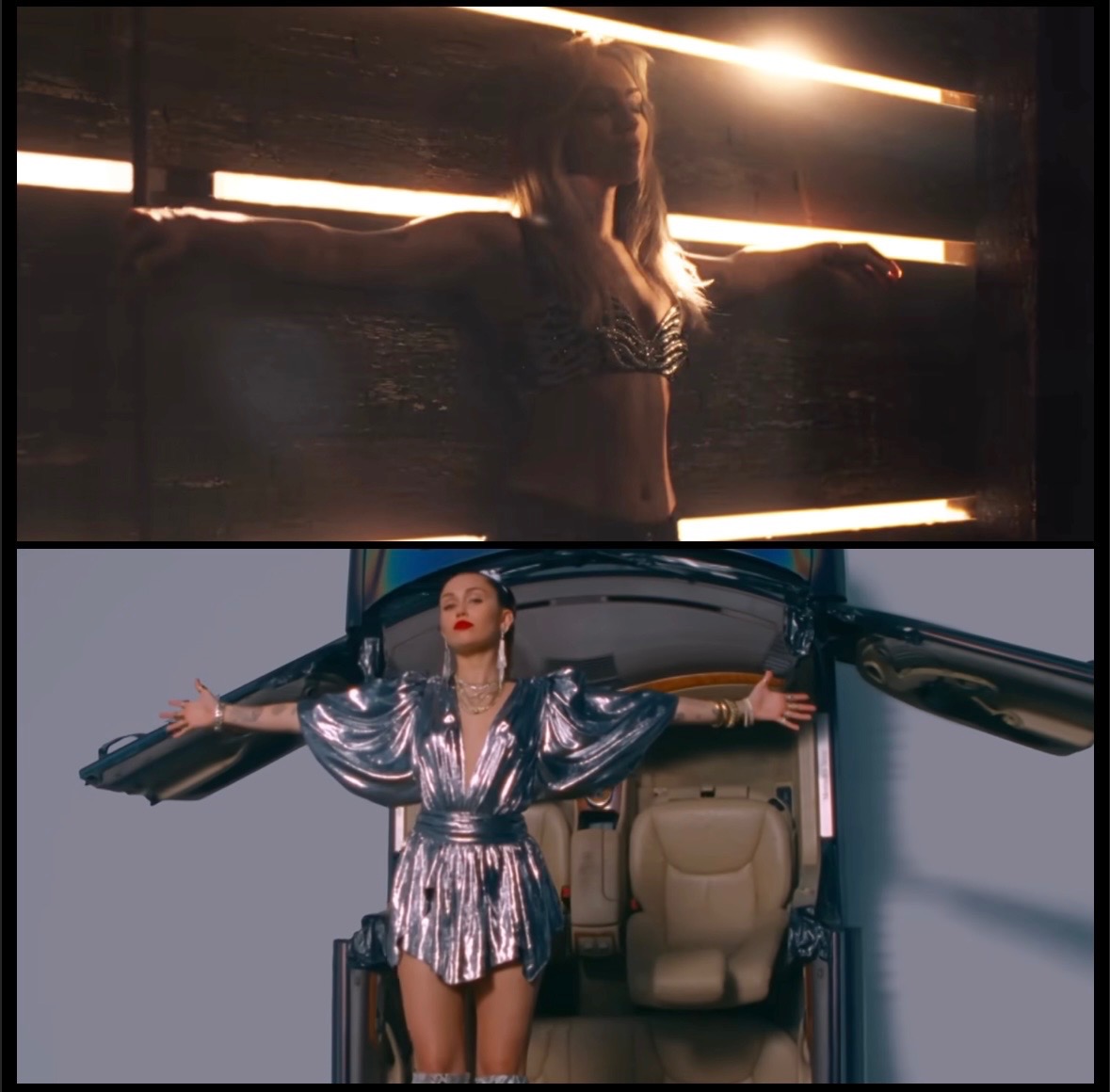
As she keeps gunning it down that open road with Knepper in the front seat, the two appear to find a crude “truck stop” of their own making along the way, with Miley’s back against a wall made of wood planks as she waits for Knepper to come closer while outstretching her arms, Jesus-style. In other words, martyr-style. And it’s this pose that serves as one of the noticeable correlations between the visuals for “Different Religion” and “Nothing Breaks Like a Heart.” The latter, released in 2018 and directed by We Are From LA, not only also features Miley involved in some high-speed driving (though, in that case, it’s to avoid the police, in a very O. J. Simpson kind of manner) for most of the video, but also positions her in a distinct martyr pose while standing in front of her getaway car. A moment that’s reserved for the final scene.
As for her Christ-like arm positioning in “Different Religion,” it comes at a time when Knepper decides to prove that maybe he really is a serial killer by throwing knives around her body’s “perimeter.” And, in contrast to that famous scene from the I Love Lucy episode titled “Lucy Tells the Truth,” this shtick of his is presented as “hot” rather than “hilarious.” Meanwhile, Alas keeps intercutting “impressionistic” scenes in either black and white or red (since, as one will remember, Miley initially presented this album as having a “red” theme—as if a color alone can be a theme…but since it seemed to work for Taylor in 2012, perhaps Miley thought she, too, would give it a go). One of those scenes being the first glimpse that Miley gave of her “new era”: her in a white pantsuit serving up a PJ Harvey-inspired (specifically, from the “This Is Love” video) guitar-playing session.
And when the knife-throwing session is seemingly over, Miley appears to be back on the road again without Knepper, stopping off again at what looks like an abandoned gas station with a few empty cars situated behind her as she stares “heavenward” to sing, “I’ve got a different religion/And he’s giving me Jesus.” As she makes this declaration, the clouds shift rapidly as if in they’re in some kind of “apocalypse mode.” After all, that’s when “the messiah” is supposed to show up, maybe even in Miley’s “different religion.” Indeed, the sky suddenly turns even darker and more sinister at the height of Cole Haden’s eerie complementing vocals. This “apocalypse” vibe is then emphasized anew by a scene of intense lightning and a hand squeezing the rosary tightly right afterward.
But Miley seems totally unfazed by the imminent “end,” shown hanging her head out the window of the driver’s seat as the Trans Am now magically drives itself (or maybe it’s just in cruise control, since this ain’t no self-driving model). Caught between day and night (Carly Rae Jepsen would approve) by the end, Miley runs toward some unknown force in the desert, which is now suddenly populated with quite a few other people and cars—almost as if they, too, showed up to this spot to witness some kind of “second coming.”
In the intercut scene of her playing guitar in her white pantsuit, Miley, hair whipping in the “wind” (machine), appears as if she’s playing her music for some god offscreen, one that she keeps looking into the distance at while she plays her heart out for him, almost like a summoning song. All while further underscoring the “end times but it’s fine” feeling with some of the closing lyrics that urge, “Losing our innocence/Give in to sin again/Take it to genesis/We’re gonna begin again.” And with one of the final shots being of the car continuing to speed down the open highway, it’s as if Miley is saying something similar to what she did in the video for “Nothing Breaks Like a Heart”: you can start over anytime and anywhere you like, so long as you have a car and can drive fast enough. Unfortunately, in “Nothing Breaks Like a Heart,” she doesn’t quite manage to outrun the long arm of the law, crashing (but still miraculously surviving) by the conclusion. Thus, enduring a more “personal” apocalypse.


+ There are no comments
Add yours