


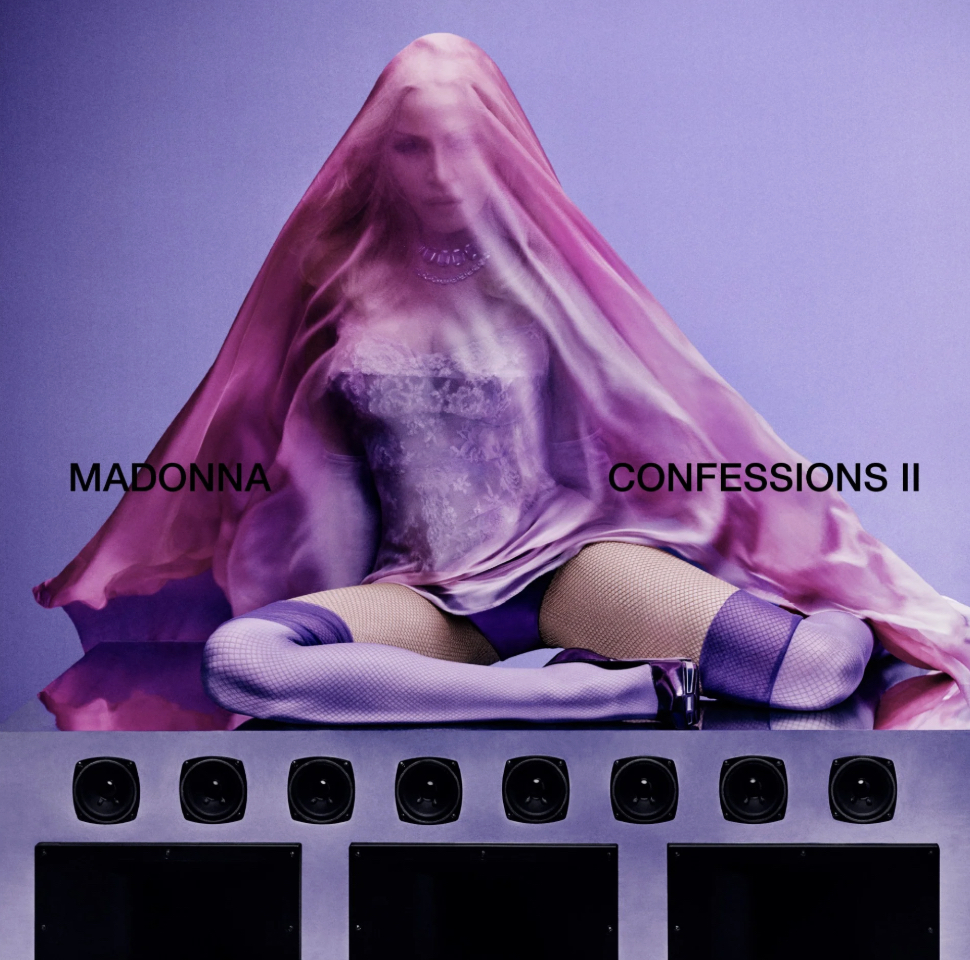
To say that people have been waiting with bated breath for Confessions II to come out would be an undoubted understatement. For, as every Madonna fan is well-aware, this is the longest the Queen of Pop has ever gone without releasing an album. That is to say, it’s been seven years since 2019’s Madame X was released (specifically, on June 14th—a certain Orange Creature’s birthday, of all days). Prior to that, Madonna never allowed more than four years to lapse between studio albums, with the gap between 1994’s Bedtime Stories and 1998’s Ray of Light being the first time this happened. Followed by the four-year gap between 2008’s Hard Candy and 2012’s MDNA, and then 2015’s Rebel Heart and Madame X.
So now, after all this time, the logical question is: was it worth the wait? The simple answer is: yes. For it’s no secret that, once Madonna sets her mind to do something, that something needs to be executed exactly as she envisions it. So when she said of Confessions II, “It’s got to be as good as or better than [Confessions I],” she meant it. And set out to do precisely that with Stuart Price at her side once again. A so-called friend she hadn’t really spoken to since the promo for Confessions on a Dance Floor was over (per her recounting to Interview).
Then, when she reached out to him again in 2023 to be the musical director for The Celebration Tour (a role he also took on for 2001’s Drowned World Tour, 2004’s Re-Invention Tour and 2006’s Confessions Tour), Madonna’s “collaborative spark” with him was reignited again. As she explained it to Interview, “I reached out to Stuart because I thought the world is in a very dark place and people need to dance. I hadn’t worked with Stuart for a long time. We’d just done The Celebration Tour together, but besides that, I didn’t really see or speak to him for probably fifteen years [that was around the time he did some remixes for Hard Candy]. I was living in New York and I reached out to him, thinking, ‘What if we tried to make Confessions on a Dance Floor: Part II, and reenter the world of inspirational dance music?’ So I came to London and went to his studio, and we were just playing around to see if there was magic between us.” Needless to say, the magic was (and is) very much still there, with Price being one of Madonna’s most beloved producers among the fanbase (much to William Orbit and Patrick Leonard’s dismay). And for good reason. For he seems capable of drawing out the “fun” in her even as she remains simultaneously reflective and (self-)serious.
And, considering there are some very dark subject matters to address on this album (with Madonna also adding, “I had a lot of stuff going on in my life personally. My brother was very, very, very ill, and my stepmother, with whom I’d had a very traumatic relationship throughout my entire childhood, had just died”), it was important to temper her tone and lyrics with some musical levity. Which is exactly what Price does best. That skill being something he’s been allowed to hone and perfect in the years since Confessions on a Dance Floor turned him into a sought-after producer for the likes of Kylie Minogue, Pet Shop Boys and Dua Lipa. Offering that skill to Madonna again on this “sequel,” Price (although not the only producer on the album) is arguably the most valuable “weapon” in the arsenal of tricks that make Confessions II what it is: a rallying cry for a return to the dance floor.
Because, indeed, in the now twenty-one years since Confessions on a Dance Floor was released, the dance floor has become somewhat, well, tepid. Not empty, per se, but definitely flaccid. And while recent Madonna “bestie,” Charli XCX, did what she could to revive it in 2024 with Brat, the job is clearly not finished (especially now that XCX has pivoted decidedly away from the dance floor with her forthcoming Music, Fashion, Film album). Which is why Madonna is here to “save the day”—or at least numb the pain—yet again. Starting with the beckoning intro track, “I Feel So Free.”
Very much a part of the “manifesto” of the record, which is that “we must dance, celebrate and pray with our bodies,” “I Feel So Free” is all about Madonna recapturing the feeling she first had when got onto a dance floor at a nightclub. More specifically, a gay nightclub. Even more specifically, Menjo’s in Detroit. The place where her “mentor,” Christopher Flynn, took her to cut loose and see “how the other half lives” (to repurpose a phrase about class). Ever since, Madonna has been chasing that high, that feeling. One that was amplified when she started frequenting the clubs of “80s heyday” NYC. Particularly Danceteria (the place that merited her writing a song about it for track five).
To be sure, the crowd at said club would definitely vibe with the hyper-sexual nature of “I Feel So Free”—with its oozing-with-sex orgasm sounds that are meant to serve as a callback to the likes of both “Everybody” and “Erotica.” Indeed, throughout the album, Erotica as a whole (no sexual innuendo intended) is the album that runs through this one, sonically and tonally—complete with the kind of, let’s say, “throaty” vocals not heard since songs like “Where Life Begins,” “Thief of Hearts” and “Secret Garden.”
Not to mention that Madonna is clearly harkening back to a time when people were still oozing sex/feeling sexual in general. Even if she arrived in New York at the, er, tail end of that party, as it were. With AIDS ramping up after the first headline, “Rare Cancer Seen in 41 Homosexuals,” about it appeared in The New York Times in 1981. The date of its publication was July 3rd. The same day as the release of Confessions II in 2026 forty-five years later. Something that feels like much too uncanny of a coincidence considering that Madonna also fashioned her silhouette into the shape of a pink triangle (thanks to the positioning and color of the veil she’s wearing) on the album cover. The symbol that gay activists “took back” in the 70s. For it was the same symbol that Nazis used to identify gay and trans women in concentration camps.
As the symbol became associated with a new, more empowered meaning in the late 70s and early 80s, ACT UP also adopted it for its Silence = Death campaign. So yes, Madonna is clearly flexing her longstanding queer allyship with not only the “semiotics” of this record, but even its release date (whether she intended it to align with that abovementioned headline or not). And, talking of the release date, it also feels pointed that she should drop the record so close to this particular Fourth of July, which marks America’s two hundred and fiftieth “birthday.” In other words, it’s been two hundred and fifty years since the Declaration of Independence was “adopted” by the Second Continental Congress (though it wasn’t signed until August of the same year). You know, the document that increasingly seems to have no actual weight or meaning in the country that created it. Least of all for the groups that have been historically marginalized in the U.S. So, again, Madonna’s quote, “I thought the world is in a very dark place and people need to dance,” comes to mind. Because, yes, dancing in the face of oppression and hopelessness is still an act of defiance. And one that Madonna seeks to enact as she urges, “Come on, meet me on the dance floor/Come here, baby, I can give you much more tonight/Oh, baby, let’s do it right.”
And she continues to “do it right” on the track that follows, “Good For the Soul.” Which starts out with the Albert Camus line, “Everything begins with consciousness.” The finishing part of that (which Madonna doesn’t say) being, “…and nothing is worth anything except through it.” Funnily enough, it’s a quote from The Myth of Sisyphus. A “work” (because it’s not quite a book) that one might not immediately associate with “plucky,” “feel-good” Madonna. And yet, Madonna herself would tell you that she’s “been through it”—over and over again. Experiencing heartache in so many different ways (though mostly through the death of those close to her), and all of it amounting to rolling the same boulder up the hill, only to watch it fall to the bottom at the end of the day. Case in point, having to see so many of her nearest and dearest gay friends die of AIDS by the end of the 80s and beginning of the early 90s (prompting her to write the track “In This Life” for Erotica—there it is again—and also bill AIDS as “the greatest tragedy of the twentieth century” during her live performance of it for The Girlie Show).
Nonetheless, she can still manage to see the beauty in existence—the poetry and full-circleness of it all. That much is made apparent in the trippy “Good For the Soul.” A song that, in Confessions II: The Film, stands out most especially because it’s the point in the visual when green lasers are shooting out of women’s pussies as Madonna runs through the forest they’re in (making for a “Jennifer Lopez in the ‘Waiting for Tonight’ video” kind of effect). Evidently doing her best impression of Snow White fluttering around in a state of confusion and chaos after the Huntsman tells her to “run” and “hide” once he confesses that the Queen commanded him to kill her.
Anyway, lyrics like, “Traveling through space and time/Interstellar helix unwind/Don’t forsake or the love will die/Don’t forget your love, alright/On the spiral light, we fly/We will be one, we will be divine/All the spirits, they all intertwine/Don’t forget that” could not only soundtrack Snow White’s woods journey, but also serve as callbacks to other of Madonna’s songs, including “Bedtime Story,” “Impressive Instant” and “Across the Sky” (an unreleased track from the Hard Candy era).
The trance-like beat then paves the way for Madonna to delve into the chorus, “That it’s good for the soul/To let down your hair/And breathe in the air/Good for the soul/‘Cause up to the sky, a thousand birds fly/The ones that you love will keep you above/So just dance in the rain, no need to explain.” The kabbalist motif of such lyrics reminding her fans that she recently participated in Kabbalah Master Classes via “The Mystical Studies of the Zohar.”
And it’s a mystical sort of tone that keeps going on “One Step Away” (and yes, there’s a Kabbalah-meets-Michael Jackson type of line on it that goes, “Come and get salvation, all God’s children can be saved”). A track that commences with another part of M’s “Confessions II manifesto”: “People think that dance music is superficial. But they’ve got it all wrong. The dance floor is not just a place. It’s a threshold. A ritualistic space where movement replaces language.” Madonna then dispenses with her speaking voice to sing, “One step away from your freedom/One step away from the dance of life/One step away from your heartbeat/One step away, yeah, you’re one step away.” And what she means is that you’re one step away from the club that will serve as your salvation, your “safe space” (especially when you’re part of the LGBTQIA+ community).
As it was hers during those early New York days when she felt like an outsider. In no small part because she was still bereft over the loss of her mother and pulling the rip cord completely from her family by leaving Michigan. She addresses as much with the verse, “Understand your violence and the trauma you’ve survived/Nobody’s free until they’re broken/Understand your silence and the drama deep inside/Nobody’s free, it’s just a token.” Though, of course, if anyone is free, it’s Madonna…thanks to her financial status. One that she sidesteps on her biggest Billboard Hot 100 hit since the 2010s, “Bring Your Love” featuring Sabrina Carpenter. And listeners did bring more love for it than they did for “I Feel So Free,” what with Carpenter being more “accessible” (read: younger) to mainstream audiences.
Despite her youth, however, she keeps up with Madonna, and the latter’s insistence, “Don’t try to distract me with numbers/I did it all for love.” Even if, it wasn’t exactly all for love at “Danceteria,” so much as a love of seeing and being seen. After all, the multi-floor nightclub at 30 West 21st Street was, at a certain point, the hub of fashion, art and culture in NYC for a good while there. Well, “a good while” by the standards of an average nightclub’s lifespan, for it lasted at this location from 1980 to 1986. Meaning that Madonna barely eked by in terms of getting it featured in her 1985 movie, Desperately Seeking Susan, where it remains forever immortalized.
And yet, that’s hardly the only way in which it’s a seminal part of her New York history, with M never forgetting the role that getting her demo tape played there for the first time (by the influential DJ du moment, Mark Kamins, who gets a big name-check here) had in securing the fame and fortune she was determined to get. As for the song on that demo, it was to be her first single, “Everybody,” during which she urges the crowd, “Dance and sing/Get up and do your thing,” telling them, “Let the music take control/Find a groove and let yourself go.” Madonna is saying the same thing on “Danceteria,” providing an obvious callback to “Everybody” via the chorus, “Everybody get up and dance/Ah-ah-ah-ah-ah-ah-ah/Everyone here is a work of art.”
As for Linda Perry calling out Madonna for “trying to compete with Charli XCX,” there’s a certain “Charli vibe” to Madonna suddenly getting very name-check happy on this particular track, starting with the second verse, during which she opts to call out Martin Burgoyne first, singing, “Meet this boy named Martin Burgoyne, he’s my best friend, he’s my boy toy.” A nod, of course, to the nickname that started out as Madonna’s graffiti tag (thanks to her brief dalliance with Futura 2000) before she began sporting it as a belt buckle. Elsewhere in the song, she also mentions Haoui Montaug (who died of AIDS as well, and who famously introduces Madonna at Danceteria for her first live performance of “Everybody”), Debi Mazar, Mark Kamins (who Madonna has seen fit to call out as a cokehead with her, um, line, “Hide the cocaine”), Fab 5 Freddy, Basquiat, Keith Haring, Kenny Scharf, Shafrazi (as in Tony, the gallery owner and art dealer), Maripol, “a guy named Fred,” Rock Steady Crew, Crazy Legs, Nile Rodgers, David Byrne, B-52s and Lounge Lizards. With so many “iconic” names (at least when it comes to the downtown NYC scene of the 80s), there’s a very “Vogue”-like quality to the song because of all this people-listing (also think: the intonation of Madonna chanting, “Greta Garbo and Monroe/Dietrich and DiMaggio”).
What’s more, it’s upon mentioning Rock Steady Crew and Crazy Legs that Madonna can’t stop herself from declaring, “Puerto Rican boys, they make me crazy.” Probably not the best thing to remind people of, what with that rumor about her trolling the L.E.S. for underage Puerto Rican boys in her limo. But clearly, Madonna can’t stop herself from a lot of things on this record, for the floodgates of memory were opened (thanks, in no small part, to working for so long on writing and shaping her biopic), and there’s so much she wants to evoke from the past.
This even includes the less distant one. For, in addition to making reference to Lou Reed’s “Walk on the Wild Side” (with her Reed-inspired use of, “Lower East Side/Take a walk on the wild side/Doo-doo-doo-doo-doo-doo-doo-doo-doo”), it also has sonic tinges of 2000’s “Music” to it at the end. One would also be remiss not to bring up the fact that Rebel Heart’s “Veni Vedi Vici” featuring Nas is something that definitely foretold Madonna delving even deeper into this part of her past. A part of it that she seems particularly yearning for ever since phones and the internet took over art and society in such an all-consuming way.
Indeed, back in 2015, when Madonna was doing promo for Rebel Heart, she gave an interview to Pitchfork during which she said,
“I think about Keith [Haring] coming over and saying, ‘I heard you are doing a show at the Paradise Garage, I want to paint a costume for you. What are you wearing? Can I just paint on it?’ And I’m like ‘Yes! For sure!’ Or then to have Basquiat and Warhol come to the show and then everyone goes out afterwards and just talks about art. Or to go to Basquiat’s gallery and see his work and talk about it. I can’t even explain what an amazing time that was for all of us. We were all excited about each other’s work and jealous of each other’s work and cheering each other on. It was the beginning of something truly amazing—and then suddenly everyone died. All these amazing people just wiped out almost all at once. Now I think about how artists come up and, well, there is no community, really. There’s social networking, but it’s not real connection between people. It just feels like pop culture is very separate from the art world now, whereas before they used to be one and the same.”
With Confessions II, Madonna is doing what she can to make them one and the same again. Even in terms of how she’s been rolling out the album with her “Club Confessions” nights in L.A., Paris and, finally, London, where the album release party was held (at Magazine London). Something of a riff on what she did for two nights in October of 2005, teasing Confessions on a Dance Floor ahead of its November 9th release at both The Roxy and the Misshapes party. For Madonna’s entire raison d’être when it comes to her obsession with dancing and dance music is the idea that it creates a sense of community, however ephemeral (sometimes only lasting the length of a song).
On “Read My Lips” featuring Feid, Madonna continues to keep the party vibe going, even as she addresses some lovelorn lament (as is her way). In fact, this song, too, bears some similarities to the type of fare on Rebel Heart. In addition to reminding one of “Spanish Lesson” from Hard Candy (for it’s Madonna’s way to pepper in some “Latin flavor” at least once every other album). Then, of course, there’s the parallel to Madame X’s lead single, “Medellín,” what with Feid seeming to step in for Maluma here on the “need a Colombian fuckboy del momento” front.
Long before his verse, though, Madonna offers a precursor to what she’ll be speaking on in “Bizarre” by opening with, “You’re giving leading actor, you wanna steal the show/Shut your mouth” (or, as she puts it on “Spanish Lesson,” “‘Cállate’ means ‘close your mouth’”). She then gets even blunter with the chorus, “Read my lips, tell it to my face/And you cut me with your lies/‘Cause you hurt me with your kiss and I realize/You’re just broken.” Though, to be fair, she did say earlier on “One Step Away,” “Nobody’s free until they’re broken.” In which case, this dude sounds quite free.
Elsewhere in the song, there’s an unwitting callback to the fruit mention on COADF’s “Like It Or Not” (“All of my fruit is yours to take”) with Madonna ruing, “I ate the poisoned fruit.” Fortunately, as she’s sure to remind anyone who would question her toughness, “But I will survive” (a Gloria Gaynor nod no doubt, what with Madonna also doing a cover of that classic while on The Celebration Tour).
Toggling back to Erotica vibes, there’s a brief flicker of a “Deeper and Deeper” intro (with just a hint of “Thief of Hearts”) on “Everything” (a very big name for the title of a song). This before Madonna belts out, “When I close my eyes/Everything [there’s where the title comes in] is crystallized/No one wants to go outside/It’s not okay, it blows my mind.” And so it is that Madonna has no issue with highlighting her boomer-centric generational divide from the likes of millennials, Gen Z and every generation thereafter. For it is baby boomers alone (Gen X was already “taken” by MTV and early forms of the internet) that remember a time of true and pure “connectivity.” Being forced to go out into the world if they wanted to find a social situation. As for the way things are now, Madonna declares, “It’s not okay/I don’t fuck with it.” But of course she does—whenever she promotes anything on social media. For everyone, no matter how “anti” or “opposed” they are when it comes to the internet’s chokehold over society, can’t seem to avoid it if they want to be “in the world and of the world.” Which, obviously, Madonna does. Even if “under duress” when it comes to engaging with “phone life.”
So it is that she insists of what people have to “say” now, “Your words have no meaning” (this echoes her sentiment on Erotica’s “Words” when she sings, “Words/I don’t wanna hear your words” and on Bedtime Stories’ “Bedtime Story” when she sings, “Words are useless/Especially sentences/They don’t stand for anything”). And as the track comes to a close, Madonna opts to speak the final words in what can only described as an “Erotica voice,” assuring, “Wherever there’s the greatest amount of darkness/That’s where you’ll find the greatest light/So come outside into the light.” That whole motif about darkness becoming light (and “it’s always darkest before the dawn”) coming into play a lot during her 2005 documentary I’m Going to Tell You a Secret (which came out around the same time as Confessions I).
Such optimism transitions nicely into “Love Sensation,” an effusive, “we can do anything” sort of number that additionally finds Madonna owning her boomer nature. For it is extremely “hippie-dippy” to say things like, “I’m your love sensation, good vibration” and “There’s nothing that we cannot do.” In fact, the latter sentence is most of what she sings throughout the song, which she found worthy as her third single from the record (or second, depending on if one counts “I Feel So Free” as a “real” single or a “promo” one).
Talk of “vibrations” also happens on “Love Without Words.” The song where Madonna wields the phrase “club of love” by inviting, “Come to the club, come into the club of love.” When asked by Mel Ottenberg what that phrase meant to her, Madonna replied, “A place where you don’t need words to express how you feel, where you just connect to the music and have an out-of-body experience or enter a fever dream.” Thus, “Love Without Words” builds on elements of the “manifesto” that were touched on in “One Step Away” (“movement replaces language”) and “Danceteria” (“it’s not what I say, it’s not what I do/It’s how my body language talks to you”). Whether one chooses to “call it trance [or] call it house,” the bottom line, for Madonna, is that expression through dance is “love without words.” A “Bizarre” phenomenon, to be sure.
And, talking of “Bizarre,” that’s the song (featuring Martin Garrix, who tinges it with a very “Sweet Dreams [Are Made of This]” kind of sound) that Madonna segues into next. First premiered at Garrix’s show in New York on June 13th, hearing the lyrics in full have prompted more than a few Madonna fans to speculate that the song is throwing some shade at Sean Penn. After all, there are such pointed and specific details as, “Movie star, deep blue eyes/In Hollywood, we’re a perfect prize/He drove way too fast/Shelby Cobra wasn’t meant to last.” That last detail about the car model being très scathing in that it was what Madonna got Sean as a wedding gift back in 1985.
While some may have thought Madonna exorcised all of her rage and sadness when it came to Penn on 1989’s Like A Prayer, turns out, “Just when you finally think you let go/It comes back to you.” So it is that she addresses some of the key issues that ruined them (or rather, some of Sean’s key issues that ruined them). Namely, “Roll out the carpet for us but you won’t share it/I guess you’re threatened by me, you won’t admit it.” Even so, Madonna can’t deny that “the fire was so intense” between them (what with both of them being Leos, to boot). And so, when the fire started to turn from intense passion to raging anger, it seemed time to call it quits, with Madonna pointing to herself as the “leaver” via the lyrics, “I know I left you behind and you resent me.” Even so, it appears she’s still suffering from that “rupture,” admitting, “Now you’re gone, I feel so empty.” Never mind that Penn is actually her most embarrassing ex.
Someone who ought to be taken to “School” for his comments and behavior. As for Madonna’s next song, “School,” it essentially reiterates something she said in the aforementioned I’m Going to Tell You a Secret: “The minute you stop wanting to know more, that’s when you stop growing and that’s when you die. And that’s when you’re nothing.” With that in mind, she commences “School” with erotically-tinged spoken vocals (because call her a sapiosexual) that announce, “There’s only one thing I like more than sharing what I know with people/And that’s learning/Please, someone/Teach me something I don’t already know” (it smacks of “It’s not fair to be selfish and stingy/Every girl should experience eating out”). To that point, no wonder she prefers younger men. For it seems like that ilk she’s addressing when she says things like, “‘Cause, baby, I’m not your mother/I’d rather be your lover, lover, lover.” To be sure, these lines are a combination of what she says on Bedtime Stories’ “I’d Rather Be Your Lover” and on “Justify My Love” with the lyrics, “I don’t wanna be your mother/I don’t wanna be your sister either/I just wanna be your lover.” So it is that Madonna’s favoring of her early to mid-90s sound is in full swing, even if it’s not specifically Erotica that she’s favoring all the time on the record.
And yes, a “heartfelt” and “poignant” track such as “Fragile” would have been likely to be found on Erotica or Bedtime Stories. Albums released during a time when M’s brother, Christopher Ciccone, was not only still alive, but very much involved in her life both personally and professionally. Around 1999/2000, when Guy Ritchie became a fixture in Madonna’s life, is when their rift started to form, cemented by the release of his “memoir” (a.k.a. tell-all), Life with my Sister Madonna, in 2008. When he was diagnosed with pancreatic cancer years later, the two started to truly mend their relationship again before his death on October 6, 2024. And to cope with that loss, Madonna wrote “Fragile,” “finding a way to turn disappointment or loss into some form of joy” (a phrase she used to describe to Bob the Drag Queen on the iHeartRadio and TikTok Live premiere of the album how she creates dance music in general).
Once again, her study of the Kabbalah’s teachings is very much at play with yet another spoken-word intro that illuminates, “People really think that there’s a beginning and ending to this thing called life [how very Prince of her to phrase it that way]. But energy never dies. This is just a portal we’re going through. Still, it’s hard to let go.” Though she tries her best to by painting Christopher (and their bond) as “fragile.” Probably the worst word to call a gay man of a certain generation. The implication being that he’s somehow “soft” or a “pansy.” A depiction further emphasized by the chorus, “I know you’re fragile/‘Cause you’ve been hurt, been let down/You couldn’t be yourself now/You had a nervous breakdown.” Probably not exactly how he would want to be remembered. And as for the allusion about not being able to “be himself,” it didn’t much help when Madonna pulled him out of the closet fully by publicly outing him in a 1991 interview with The Advocate.
While “well-intentioned,” one can’t help but imagine Christopher Ciccone’s horrified reaction to the lyrics of “Fragile.” Ones that write him off as, well, a bit weak and unhinged. Even if funneled politely and gently through vocals that channel what Madonna was doing for her unreleased cover of ABBA’s “Like an Angel Passing Through My Room.”
But oh well, as Madonna will tell you, whatever she might be accused of, “My Sins Are My Savior.” A French-speaking number (which samples from Army of Lovers’ 1991 song, “My Army of Lovers”) that, because of such French-speaking, features none other than Stromae (who also recently showed up on Tove Lo’s “Des Fleurs”). Though, despite all the teases, there’s still no Kylie Minogue be found as the album starts to reach its end.
In any case, Madonna opts for a “Paradise (Not For Me)”-style opening (to the tune of something like “Where Life Begins” meets LL Cool J’s “Doin’ It”) with, “Je n’étais pas perdue. J’étais juste cassée [on ‘Paradise,’ it’s, ‘Encore une fois, je suis cassée’]. Ils ont essayé de me faire tomber. Je m’en fous. Mes péchés sont mon sauveur.” The sweltering, sexy backing track punctuates a French-fetishizing bridge that finds Madonna casually mentioning, “I’ve been a belle de jour (can you blame me? can you blame me?)/I’ve read Marquis de Sade (do you know it? did you like it?)/I tried to find my way in unfamiliar faces/I looked for love in unexpected places.” Those parenthetical moments sounding like the tone of her saying “what you’ve done is a crime” on “Thief of Hearts.” As she talks about people who tried to break her, it also goes back to her assertion on “Bring Your Love,” “You’ll never break me.”
Nor could her “evil stepmother,” apparently. The subject that comes to light after a seamless piano transition (paired with a saxophone that, again, sounds ripped from “Where Life Begins”) from “My Sins Are My Savior” and into “Betrayal.” For, just as she came for Sean Penn on “Bizarre,” Madonna comes for her stepmother, Joan Gustafson (who died the same year as Christopher), on another “B” song. And adds to the drama of it all by sampling from Erik Satie’s Gnossienne No. 1. It’s, of course, no secret by now that Madonna had an extremely contentious rapport with Joan (who she once berated in an interview with Carrie Fisher for telling her she couldn’t wear tampons as a teenager). And why shouldn’t she? Joan started out as their housekeeper before swiftly transitioning into the wife of the Ciccone clan’s patriarch, Tony. This three years after the death of Madonna’s mother in 1963.
For Madonna, who not only preferred to be the female alpha, but also wanted to preserve her mother’s dominance in the household (even if that dominance could only be spectral), this was a major affront. One she has no problem addressing in no holds barred lyrics like, “This is the story of betrayal/You couldn’t see your fall from grace/So take the hammer, hit the nail [some savage coffin imagery there]/You’ll never take my mother’s place.” Things then get even more macabre when Madonna tells Joan, “And we’re dancing, yes, we’re dancing/We’re together forever/You betrayed me, you enslaved me/We’re together till the end.” But, for those who are worried that a song like this might finally do Tony Ciccone in, Madonna is sure to conclude of her feelings for Joan, “Used to hate you, I don’t hate you.” This while also ignoring that Frozen (the movie, not her 1998 song) already has the monopoly on the repetition of the phrase, “Let it go, let it go, let it go.”
Something that Lourdes a.k.a. Lola Leon is also trying to do on “The Test,” a song that she herself approached Madonna about making together in order to “heal” their own apparent rift. One caused, it would seem, by Lola’s resentment over being born a nepo baby/in the eye of a media storm she didn’t ask for. Madonna was, of course, game to engage with her daughter in this more abstract way.
From the outset, the ethereal song (co-produced by Arca) conjures Ray of Light imagery as Leon sings, “Shining on our skin” (track five on RoL being “Skin”) and Madonna interjects with the nickname she also made into a song for that album: “Little Star.” Which is exactly what Leon became from the second she was born, landing her first Vanity Fair photospread (for an article called “Madonna & Child”) before she was two years old. So whether she wanted it or not, fame was what she got as a result of her daughterly bond to Madonna. Something the latter addresses with the mea culpa, “I tried to put you on a pedestal/You didn’t ask for all the flashing lights.” She then seems to finally realize, “My butterfly [“Never forget how to dream, butterfly”]/Was always being watched” and acknowledges the difficulty of that kind of scrutiny when you’re just a kid trying to live your life.
Madonna then offers her own riff on the chorus with, “I know they tried to put us to the test [this itself going back to Madonna urging on ‘Express Yourself,’ ‘Put your love to the test/You know, you know you’ve got to’]/We’re not the same, but I’m treading on your footsteps/Sometimes I think you wish I’d go away/But my shadow stays and it’s okay to be yourself.” Just as she has been doing with her modeling and her own music career, quietly building up to a single like “T Shirt,” her first release as “Lola Leon” and not “Lolahol.” And so it is that all becomes a little more right with the world as mother and daughter repair their relationship through art (in a way that Madonna never could with her own mother, had she lived long enough for them to even develop a rift).
Which allows Madonna to get back to the business of reflecting on her early NYC days with the finale of the non-Icon Edition of the album, “L.E.S. Girl,” which turns out to be a love letter not to the Lower East Side, but some boy she loved way back when (what’s more, there are moments when it has a sonic resemblance to certain guitar string arrangements on slower The Velvet Underground songs). A boy she calls an “archetype” in her Interview article, telling Ottenberg, “[It’s about] this guy I was dating who was a musician and I was in love with. He was really an archetype.” And no, she will not say his name. Doesn’t seem like it could be Dan Gilroy though, for he didn’t exactly have a “Marlon Brando face” (and yes, Brando is also mentioned on a COADF bonus track, “Super Pop”)—though he did have blonde hair, even if not “bleach blonde dirty roots.”
As for the opening verse, it sounds like something off the Brat album or the oeuvre of Lana Del Rey: “On Avenue B, she paints her lips cherry red/Mirror cracked in her hand/Eyeliner smeared, running out the door/Still there from the night before.” Painting the picture of herself as she was—and how, in some sense, she will always see herself—Madonna reminds that, like “Danceteria,” “L.E.S. Girl” has some “Veni Vedi Vici” lyrical qualities (including Madonna talking about the last time she can ever remember struggling to pay rent). And, for the first time, it seems Madonna is looking back in a very real, unbridled way. One that truly acknowledges the passage of time (even going so far as to sing, “Time is a river we cannot unwind” on “Good For the Soul”). This heightened by her conclusion, “Everything fades away.” Though, based on the effort and thought put into this record, it’s clear she hopes not her legacy as a musician.
And then, as if to switch to lighter note and remind listeners of her signature bawdy sense of humor, there is “Hot Sauce” for those with the Icon Edition of the album. A song that not only samples “Hung Up” sampling “Gimme! Gimme! Gimme! (A Man After Midnight),” but also finds Madonna, once more, showing off her enthusiasm for all things Latino as she offers up such “saucy” lyrics as, “Your skin so hot, mucho caliente/Body is fuego, you move suavecito/Flames getting higher, the light is candente/Eyes undressing me, so indecente” and “Dame un ritmo, you play with fire/Más, más, más, you’re my desire, baby.” Call it her 2026 iteration of “Burning Up.” Just as one can call Confessions II her 2026 iteration of Erotica, and not, as the marketing insists, Confessions on a Dance Floor.
Either way, Confessions II isn’t just a “sequel album.” It is a reminder to everyone, whether fans, critics or fellow pop stars, that Madonna remains the blueprint and the benchmark. Continually breaking down barriers to prove that, to paraphrase a lyric from “Love Sensation,” “there’s nothing that she can’t do.” Except maybe separate her romanticized self-image from whatever is left of the Midwestern middle-class girl that “just wanted to get the hell out of Michigan.”


[…] In Many Ways, Madonna’s Confessions II is Erotica II […]
[…] In Many Ways, Madonna’s Confessions II is Erotica II […]
[…] the most vexing thing about the near unanimous praise for Madonna’s fifteenth studio album, Confessions II, is that what people (especially critics) seem to most enjoy about it is the fact that it marks […]
[…] the news of Madonna landing her tenth number one album on the Billboard 200 with Confessions II has been met with joy and triumph (except for those who will never concede to Madonna having any […]
[…] many have continued to point out in their reviews of Confessions II, it’s, like, “a big deal and stuff” that Madonna is willing to 1) reflect so candidly on her […]
[…] coming was that when Madonna said she was making a sequel to Confessions on a Dance Floor called Confessions II, she also meant she would be making sequels to some of the live performances associated with […]
[…] if acting is to Charli what dancing is to Madonna. For, as the latter says on the opening track to Confessions II, “I Feel So Free,” “Sometimes I like to just hide in the shadows/Create a new persona/A […]
[…] even Madonna, on the precipice of releasing her dance sequel album to Confessions on a Dance Floor, Confessions II, captioned a carousel of photos with, “If your dance floor feels dead maybe you’re playing the […]