


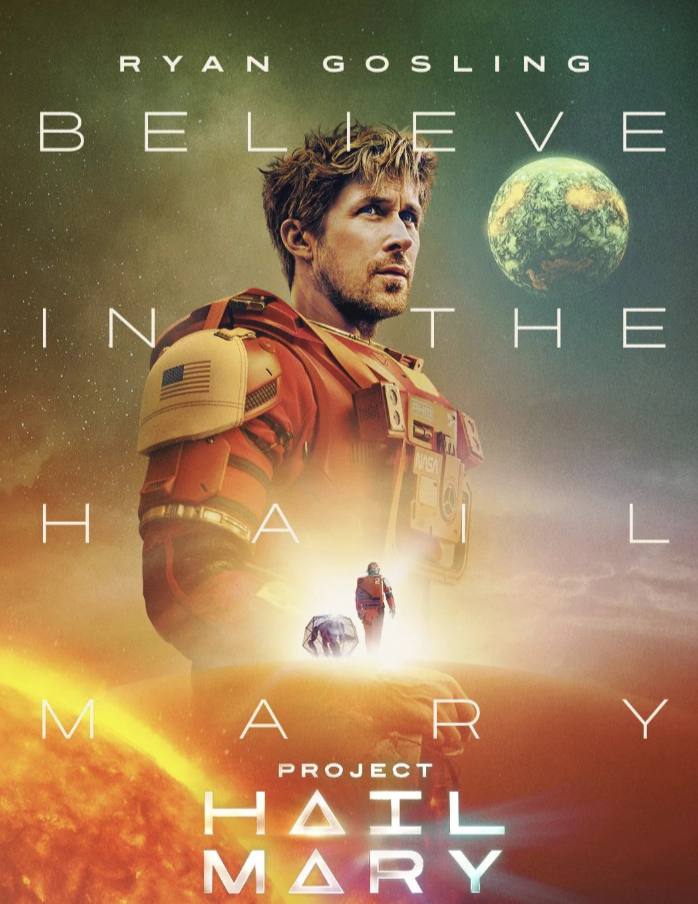
As many a space movie has revealed in the past, audiences love a story with an “ordinary man in an extraordinary situation” premise. Project Hail Mary is no exception to that general rule. Only Ryland Grace (Ryan Gosling) isn’t exactly “ordinary.” Though his modest profession as a junior high science teacher might make it seem that way, Ryland (or “Grace,” as he’s mostly referred to throughout the movie) is anything but full-on ordinary, what with being a highly intelligent molecular biologist—even if an extremely controversial one.
In fact, the reason he’s found himself teaching at a junior high level stems from being ostracized by his own community of colleagues after writing a thesis that suggests that not all lifeforms necessarily require water to survive. A theory, evidently, that has gotten him shunned, but that very much intrigues Eva Stratt (Sandra Hüller), the head of Project Hail Mary and, in the book (because of course it’s based on one—with Andy Weir being no stranger to his work getting adapted thanks to his 2011 novel, The Martian), the former administrator of the European Space Agency.
With her “film update,” no such mention is made of that; it merely seems as if she’s a high-ranking government official with a lot of authority and autonomy to do whatever it takes to save Earth. This includes plucking Ryland from his now relative obscurity (though he’s certainly not obscure to the students he teaches) and utilizing him for his expertise and intelligence in his field rather than judging him on his “quack” thesis like everyone else who has since written him off as a “nut.” But in him, Stratt can see the key to figuring out the scientific mystery currently threatening humanity: the Petrova line. A phenomenon (named after the fictitious scientist that discovered it) that refers to the infrared line leading from Venus to the sun. A line that’s directly related to the sun beginning to look noticeably dimmer.
Upon finding out that the cause for that dimming is the result of a newly-discovered microorganism that scientists brand “Astrophage,” the next step is determining how the Astrophage can be stopped before the sun “goes out” completely in the next thirty years. To do that, the scientists on Project Hail Mary have been looking to the only star that hasn’t dimmed as a result of the Astrophage: Tau Ceti.
As Ryland sits back, so to speak, and listens to all this information (meted out to him over several top-secret meetings with Stratt), he becomes increasingly fascinated by and, of course, attracted to working on the project. However, after getting him to study the samples of the Astrophage in the book, what happens next is that Stratt actually “cuts him loose” and sends him back to his job. And while at work again, what leads him to admit that he really wants to keep up his research for Project Hail Mary isn’t his own undeniable scientific curiosity and fervor, but a sentimental moment while teaching his students and realizing that their futures are fucked if someone doesn’t figure out a way to save the sun. In the movie, it’s just a matter of Ryland pretty much immediately admitting that he doesn’t want to be sent back to work when he can continue his experimentations on Astrophage.
And so, with the help of a security guard named Carl (Lionel Boyce), Ryland goes about the business of figuring out what makes Astrophage “tick.” Or, ultimately, reproduce. With this newfound knowledge, Ryland and the team also realize that Astrophage can be used as a fuel source for the spacecraft, even if a turbulent one.
As Ryland continues his work on a naval ship in the middle of the ocean, he finds himself connecting—as much as someone like himself can—with Stratt. Not necessarily in a romantic way (for the real romance, or bromance, comes later), but in one that suggests Ryland has at last found someone who believes in him and his capabilities. So it shouldn’t come as any surprise to him that Stratt breaks her “straight man” act for a few minutes at the team’s, let’s call it, “end of the world party,” to sing a karaoke rendition of Harry Styles’ “Sign of the Times” (which Gosling referenced during the episode of Saturday Night Live he hosted at the beginning of March). Her “offbeat” way of consoling him.
Alas, any such placations on her part go out the window when she’s left no choice but to make Ryland embark on the mission himself. This after an unfortunate explosion caused by the Astrophage in the same building where all the intended people for the ship end up perishing. Which means Ryland is the only mind on Earth capable of finishing what they started. In order to make him believe in himself, they induce a coma that’s laced with a drug that will give him temporary amnesia. Stratt’s thinking likely being that he’ll have more confidence in himself and his abilities if he doesn’t remember who he is. At least not right away.
So it is that the opening scene commences with a shaky, volatile awakening on Ryland’s part (an image that is somewhat reminiscent of the goings-on in Mickey 17). His hair long and unkempt (or rather, effortlessly tousled…as it always is for Ryan Gosling), Ryland pieces together that not only is he on this ship alone (with the only other two crew members found dead, perhaps by suicide), but he’s been on there for quite some time.
As he starts to gather his bearings, wearing what will be the first of many iconic t-shirts (eventually including one that reads, “I Had Potential”), things start to come back to him slowly in flashbacks. This being the narrative structure of the film (and the book), so that the viewer, like Ryland, can’t fully understand everything until the third act.
What they can understand, however, is the unique bond that forms when Ryland encounters another lifeform on a different spaceship. A being he comes to nickname “Rocky.” And like Stephen King’s It (another alien, but much scarier), Rocky is a “spider.” Or rather, that’s the shape his rocky form takes. When both of them realize they’re there for the same reason—to save the dying star that lights up their planets—they decide to team up, pooling their respective knowledge (each one’s very different in scope) to get to the bottom of why Tau Ceti can withstand the Astrophage so that they can implement the defense for their own suns.
As this part of the plot develops, Project Hail Mary quickly evolves into a “space buddy movie.” Which is part of why it’s been called, as Gosling himself said when hosting Saturday Night Live, “like E.T. meets Interstellar.” With the former similarity being the most important to why Project Hail Mary continuously tugs at the viewer’s heartstrings throughout. And also begs the question: if two entirely different lifeforms can get along, why can’t humans do that with their own fellow Earthlings?
Despite the many touch-and-go moments that will leave one on the edge of their seat, Project Hail Mary is, in the end, a “feel-good movie.” With its musical selections being a significant part of shaping it to come across that way. For example, The Beatles’ “Two of Us” plays during the scene when Ryland decides he must choose to save Rocky over returning to his own planet, and so he drops the “beetles” (or capsules) filled with his findings about Tau Ceti into the abyss of space to send to Earth and then turns the ship around to find his new best friend.
Indeed, what goes left unsaid for the entirety of the film is that of course an antisocial, romantically challenged white man would find it more appealing to spend time with a rock alien than bother returning to Earth. For, in truth, were it not someone as attractive and charismatic playing this part, it wouldn’t be difficult to read Ryland as an incel. But, again, such is the magic of Gosling in just about any role he inhabits. Even one where he’s fundamentally talking to himself for most of the narrative.


